Disclosure: topratedkitchenware.com is reader-supported. When you buy through links on our site, we may earn an affiliate commission from Amazon and other retailers, at no extra cost to you.
Where to buy
Shoppers comparing the best whole grain cookers usually want two things at once: an honest shortlist and a clear view of what each option actually is. The six products below are the verified options for this guide; each name links to its Amazon listing so you can check the latest price on Amazon before you decide.
- BLACK+DECKER Rice Cooker, 6-Cup Cooked — Best Simple Batch Starter; 6-cup cooked, rice cooker with steaming basket.
- AROMA Rice Cooker, 3-Cup Uncooked / 6-Cup Cooked, ARC-363NG — Best for Small Households; 3-cup uncooked / 6-cup cooked (1.5 Qt), rice cooker and multicooker.
- Zojirushi NS-ZCC10 Neuro Fuzzy Rice Cooker and Warmer — Best for Grain Texture; Not stated in listing title, neuro fuzzy rice cooker and warmer.
- Zojirushi NS-TSC10 Micom Rice Cooker and Warmer, 5.5 Cup — Best Computerized Control; 5.5-cup (1.0 L), micom rice cooker and warmer.
- Dash Mini Rice Cooker, 2-Cup — Best Personal Portions; 2-cup cooked (1-cup uncooked), mini rice cooker.
- BLACK+DECKER 16-Cup Rice Cooker, RC516 — Best for Family Batches; 16-cup cooked (8-cup uncooked), rice cooker with steaming basket.
Whole grains punish lazy cooking — tough bran layers need time, water and steady heat — so this guide sorts the six by how each machine manages long, thirsty grain cycles.
Read the full guide ↓
The best whole grain cookers earn the title on the hardest grains in the pantry: brown rice with its bran coat intact, steel-cut oats, farro, barley, quinoa and the mixed-grain blends that defeat a rushed stovetop pot. Whole grains need more water, more time and more temperature patience than white rice, and the difference between a cooker that merely survives them and one that excels is how it manages that long hydration — steady heat, an honest soak or pre-programmed cycle, and a keep-warm that does not dry the finished pot out. Six verified machines are compared here, from a personal mini to a 16-cup family batch cooker.
Read for your grain rotation. Brown-rice households live or die by the dedicated cycle and the texture intelligence behind it; oatmeal and quinoa eaters need gentler, smaller-scale control; batch cooks need raw capacity. Each pick below is mapped to the grains it handles best. Brown-rice specialists are compared in Best Small Brown Rice Cookers. Small-format rice picks live in Best Small Rice Cookers For Brown Rice.
Key Takeaways
- Whole grains need more water and more time than white rice — a cooker with a real brown-rice or grain cycle beats one with a single timer.
- Fuzzy and Micom control (both Zojirushi picks) manage long grain cycles by sensing, not just timing.
- Rinsing grains and respecting the soak improves texture more than any machine feature.
- Batch logic: cooked grains refrigerate and freeze well, so a large cooker (BLACK+DECKER 16-Cup) can serve a small household weekly.
- Keep warm is safe for hours, but whole grains dry at the edges over very long holds — portion and refrigerate the surplus.
In this guide
Quick Picks
| Pick | Badge | Capacity | Type |
|---|---|---|---|
| BLACK+DECKER Rice Cooker, 6-Cup Cooked | Best Simple Batch Starter | 6-cup cooked | Rice cooker with steaming basket |
| AROMA Rice Cooker, 3-Cup Uncooked / 6-Cup Cooked, ARC-363NG | Best for Small Households | 3-cup uncooked / 6-cup cooked (1.5 Qt) | Rice cooker and multicooker |
| Zojirushi NS-ZCC10 Neuro Fuzzy Rice Cooker and Warmer | Best for Grain Texture | Not stated in listing title | Neuro Fuzzy rice cooker and warmer |
| Zojirushi NS-TSC10 Micom Rice Cooker and Warmer, 5.5 Cup | Best Computerized Control | 5.5-cup (1.0 L) | Micom rice cooker and warmer |
| Dash Mini Rice Cooker, 2-Cup | Best Personal Portions | 2-cup cooked (1-cup uncooked) | Mini rice cooker |
| BLACK+DECKER 16-Cup Rice Cooker, RC516 | Best for Family Batches | 16-cup cooked (8-cup uncooked) | Rice cooker with steaming basket |
Badges divide the six by scale and intelligence: computerized Zojirushi control at one end, one-touch batch capacity at the other, minis for fresh daily portions.
How These Picks Were Chosen
This guide is research-led. Every pick comes from a verified product pool checked against Amazon’s catalog data on 2026-11-21: the brand, model and product type in each listing title were confirmed before a product could be recommended, and only picks whose confirmed type matches the core of this keyword carry purchase links. Where a pool product turned out to be a different kind of machine from the one this keyword names, it is reviewed honestly in full but presented prose-only, with no link and no image, and the reduction is recorded in the article’s sources file.
The comparison weighed the things that decide daily satisfaction with this class of cooker: capacity against household size, the functions you will actually run each week against menu padding, inner-pot material against cleaning habits, and the long-term ownership picture — parts, support and how the machine ages. No hands-on testing is claimed; this is a structured comparison of verified specifications and established category knowledge, written so you can see exactly why each pick earned its badge — and where each one will frustrate you.
The 6 Best whole grain cookers Picks, Reviewed in Detail
Each review names the grains the machine is genuinely suited to, the cycle logic behind that suitability, and the point where a different pick serves a whole-grain household better.

BLACK+DECKER Rice Cooker, 6-Cup Cooked
Badge: Best Simple Batch Starter
The BLACK+DECKER 6-Cup is the straightforward rice cooker in this pool: a removable non-stick bowl, a steaming basket in the box, and one job done simply. Six cooked cups is a side-dish quantity — rice for two to four people with vegetables steaming in the basket above it — and the low complexity is the point: no menus, no fuzzy logic, just a cooker that does the daily grain-and-vegetable routine without ceremony.
For whole grains, the 6-cup BLACK+DECKER is the simple starting point: small batches of brown rice or quinoa for a few people, cooked with the water discipline described in this guide’s how-to section. It has no grain-specific intelligence, so your ratios do the work — but for a household adding one whole-grain side a few nights a week, that trade is honest and sufficient.
A dedicated rice cooker succeeds by controlling the end of the cycle: as the water absorbs and the temperature at the pot’s base begins to rise, the cooker knows the rice is done and drops to keep warm. That simple thermostat logic — or the fuzzy logic refinements of it in the smarter machines here — is why a rice cooker turns out consistent grains while a stovetop pot demands attention. For mixed pots, remember the vegetables contribute moisture of their own, so a small reduction in cooking water keeps the grains distinct rather than soupy.
Strengths
- Steaming basket included for vegetables over rice
- Removable non-stick bowl is easy to wash
- Simple operation suits daily, unthinking use
Trade-offs
- 6-cup cooked capacity is small for families
- No timer or fuzzy logic refinements
- Non-stick bowl needs care to avoid scratching
| Specification | Detail |
|---|---|
| Capacity | 6-cup cooked |
| Type | Rice cooker with steaming basket |
| Key features (from listing) | Steaming basket included; removable non-stick bowl |
| Construction | Removable non-stick bowl |
Best for: Small households wanting simple rice-plus-vegetables cooking / Not suited for: Large families or texture perfectionists
Check on Amazon to check the latest price on Amazon and confirm the current configuration before you buy.

AROMA Rice Cooker, 3-Cup Uncooked / 6-Cup Cooked, ARC-363NG
Badge: Best for Small Households
The AROMA ARC-363NG is the small classic: 3 cups uncooked, 6 cups cooked, 1.5 quarts, with oatmeal and soup functions and automatic keep warm. For vegetable cooking it is the personal-size option — a pot of rice with vegetables folded through it, or a small soup, for one or two people — and its tiny footprint is why it survives in dorms, offices and small apartments where a 10-cup machine would be absurd.
The little AROMA’s whole-grain role is small and daily: a cup or two of brown rice, a morning pot of oatmeal — its listed oatmeal function is a genuine whole-grain credential — cooked fresh rather than reheated. Small volumes hydrate evenly and cook faster than big ones, which quietly suits the longest grains’ needs at personal scale.
A dedicated rice cooker succeeds by controlling the end of the cycle: as the water absorbs and the temperature at the pot’s base begins to rise, the cooker knows the rice is done and drops to keep warm. That simple thermostat logic — or the fuzzy logic refinements of it in the smarter machines here — is why a rice cooker turns out consistent grains while a stovetop pot demands attention. For mixed pots, remember the vegetables contribute moisture of their own, so a small reduction in cooking water keeps the grains distinct rather than soupy.
Strengths
- Compact 1.5 quart size fits anywhere
- Oatmeal and soup functions widen it beyond plain rice
- Auto keep warm keeps small meals ready
Trade-offs
- 6-cup cooked maximum rules out family batches
- Basic feature set — no delay timer or fuzzy logic
- Small pot means vegetables must be cut small to cook evenly
| Specification | Detail |
|---|---|
| Capacity | 3-cup uncooked / 6-cup cooked (1.5 Qt) |
| Type | Rice cooker and multicooker |
| Key features (from listing) | Oatmeal cooker and soup maker functions; auto keep warm; 1.5 quart; white |
| Construction | White finish body |
Best for: Singles and couples cooking small rice and vegetable meals / Not suited for: Families or batch cooks
Check on Amazon to check the latest price on Amazon and confirm the current configuration before you buy.
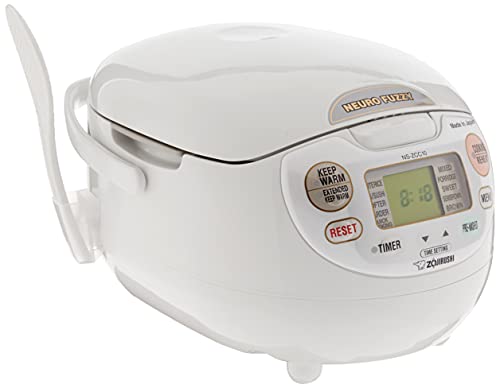
Zojirushi NS-ZCC10 Neuro Fuzzy Rice Cooker and Warmer
Badge: Best for Grain Texture
The Zojirushi NS-ZCC10 brings Neuro Fuzzy logic to the job: the cooker senses and adjusts through the cycle rather than following a fixed timer, which is the technology cooks credit for consistently distinct, fluffy grains — including the mixed rice-and-vegetable pots where moisture varies with what you added. Automatic keep warm and a delay timer complete a machine aimed at people who eat rice daily and notice texture.
The Zojirushi NS-ZCC10 is where whole grains get serious: Neuro Fuzzy logic exists for loads that do not behave like white rice, sensing through the long brown-rice cycle and adjusting, and the delay timer means the soak and cook can be scheduled so a slow grain is ready at breakfast or dinner without you managing the clock. Texture-first households start here.
A dedicated rice cooker succeeds by controlling the end of the cycle: as the water absorbs and the temperature at the pot’s base begins to rise, the cooker knows the rice is done and drops to keep warm. That simple thermostat logic — or the fuzzy logic refinements of it in the smarter machines here — is why a rice cooker turns out consistent grains while a stovetop pot demands attention. For mixed pots, remember the vegetables contribute moisture of their own, so a small reduction in cooking water keeps the grains distinct rather than soupy.
Strengths
- Neuro Fuzzy logic adapts to variable loads like rice with vegetables
- Delay timer supports meal planning
- Keep warm holds finished rice without drying it out
Trade-offs
- Premium-tier positioning in this pool
- Rice-focused — steaming capacity is secondary to grain quality
- Capacity is not stated in the listing title, so confirm the size before buying
| Specification | Detail |
|---|---|
| Capacity | Not stated in listing title |
| Type | Neuro Fuzzy rice cooker and warmer |
| Key features (from listing) | Neuro Fuzzy logic; automatic keep warm; delay timer |
| Construction | White finish body |
Best for: Daily rice eaters who mix vegetables through their grains / Not suited for: Shoppers who mainly want a big steaming capacity
Check on Amazon to check the latest price on Amazon and confirm the current configuration before you buy.

Zojirushi NS-TSC10 Micom Rice Cooker and Warmer, 5.5 Cup
Badge: Best Computerized Control
The Zojirushi NS-TSC10 is a 5.5-cup Micom cooker: computerized control, LCD interface and a delay timer in a 1.0 liter size that suits small-to-medium households. For whole grains its computerized cycles matter — brown rice, mixed grains and porridge-style grains need longer, managed hydration than white rice, and a Micom machine’s programmed cycles handle that timing instead of leaving you to guess with water ratios alone.
The NS-TSC10 brings Micom computerized control to a 5.5-cup size with an LCD interface that makes cycle selection explicit — choose the right program for brown rice or mixed grains and the machine runs the long, managed cycle those grains need. For small households that cook whole grains daily and want the settings visible and repeatable, this is the precision pick.
A dedicated rice cooker succeeds by controlling the end of the cycle: as the water absorbs and the temperature at the pot’s base begins to rise, the cooker knows the rice is done and drops to keep warm. That simple thermostat logic — or the fuzzy logic refinements of it in the smarter machines here — is why a rice cooker turns out consistent grains while a stovetop pot demands attention. For mixed pots, remember the vegetables contribute moisture of their own, so a small reduction in cooking water keeps the grains distinct rather than soupy.
Strengths
- Micom control manages longer whole-grain cycles properly
- 5.5-cup size fits small and medium households
- LCD controls and delay timer make settings explicit and repeatable
Trade-offs
- Premium-tier positioning for its size class
- Whole grain cycles take real time — plan ahead
- Rice-specialist machine; not a general multicooker
| Specification | Detail |
|---|---|
| Capacity | 5.5-cup (1.0 L) |
| Type | Micom rice cooker and warmer |
| Key features (from listing) | Micom computerized control; LCD controls; delay timer |
| Construction | Not stated in listing title |
Best for: Whole grain eaters in small households who cook grains daily / Not suited for: Anyone wanting one appliance for pressure cooking too
Check on Amazon to check the latest price on Amazon and confirm the current configuration before you buy.

Dash Mini Rice Cooker, 2-Cup
Badge: Best Personal Portions
The Dash Mini is the personal grain cooker: one cup uncooked to two cups cooked, a removable ceramic nonstick pot, keep warm, and an explicit brief to cook oatmeal, quinoa and grains. For whole grains it is the single-serving answer — a morning pot of oatmeal or a lunch portion of quinoa cooked fresh rather than reheated — in a footprint that fits a desk-side shelf or a dorm corner.
The Dash Mini’s whole-grain brief is written into its listing: it cooks oatmeal, quinoa and grains, in personal portions, with a ceramic pot that releases sticky grains cleanly. Steel-cut oats for one, a single portion of quinoa for a lunch bowl — fresh, small and exactly portioned, which is how many people actually sustain a whole-grain habit.
A dedicated rice cooker succeeds by controlling the end of the cycle: as the water absorbs and the temperature at the pot’s base begins to rise, the cooker knows the rice is done and drops to keep warm. That simple thermostat logic — or the fuzzy logic refinements of it in the smarter machines here — is why a rice cooker turns out consistent grains while a stovetop pot demands attention. For mixed pots, remember the vegetables contribute moisture of their own, so a small reduction in cooking water keeps the grains distinct rather than soupy.
Strengths
- Personal size cooks whole grains fresh, in one portion
- Ceramic nonstick pot removes for easy washing
- Keep warm holds a small portion until you are ready
Trade-offs
- Two cooked cups is the hard ceiling
- Mini format means no batch cooking or leftovers plan
- Ceramic pot needs gentle handling
| Specification | Detail |
|---|---|
| Capacity | 2-cup cooked (1-cup uncooked) |
| Type | Mini rice cooker |
| Key features (from listing) | Removable ceramic nonstick pot; keep warm function; cooks oatmeal, quinoa and grains; black |
| Construction | Removable ceramic nonstick pot |
Best for: Solo cooks making fresh single portions of grains and oatmeal / Not suited for: Families or meal preppers
Check on Amazon to check the latest price on Amazon and confirm the current configuration before you buy.

BLACK+DECKER 16-Cup Rice Cooker, RC516
Badge: Best for Family Batches
The BLACK+DECKER RC516 is the family-size sibling of the 6-cup model: 8 cups uncooked to 16 cups cooked, one-touch operation, a removable non-stick bowl and a steaming basket. For whole grains that capacity is the story — a big batch of brown rice or a grain blend cooked once on Sunday becomes the base for a week of bowls, salads and sides, and one-touch simplicity means anyone in the house can run it.
The RC516 is the batch engine: 16 cooked cups of brown rice or a grain blend, cooked once, portioned for the week. Whole grains are the ideal batch food — they reheat well, freeze well and form the base of bowls, salads and soups — so for families and meal preppers this capacity is not excess, it is the entire strategy.
A dedicated rice cooker succeeds by controlling the end of the cycle: as the water absorbs and the temperature at the pot’s base begins to rise, the cooker knows the rice is done and drops to keep warm. That simple thermostat logic — or the fuzzy logic refinements of it in the smarter machines here — is why a rice cooker turns out consistent grains while a stovetop pot demands attention. For mixed pots, remember the vegetables contribute moisture of their own, so a small reduction in cooking water keeps the grains distinct rather than soupy.
Strengths
- 16-cup cooked capacity suits weekly grain batch cooking
- One-touch operation is genuinely simple
- Steaming basket adds a vegetable option above the grains
Trade-offs
- Large batches of whole grains need correct water ratios to avoid mushiness
- Non-stick bowl needs care with metal utensils
- Big footprint for a single-function appliance
| Specification | Detail |
|---|---|
| Capacity | 16-cup cooked (8-cup uncooked) |
| Type | Rice cooker with steaming basket |
| Key features (from listing) | Steaming basket included; removable non-stick bowl; one-touch operation |
| Construction | Removable non-stick bowl |
Best for: Families batch-cooking brown rice and grain blends / Not suited for: Solo cooks or small counters
Check on Amazon to check the latest price on Amazon and confirm the current configuration before you buy.
Comparison Table
| Pick | Capacity | Type | Key features |
|---|---|---|---|
| BLACK+DECKER Rice Cooker, 6-Cup Cooked — Check on Amazon | 6-cup cooked | Rice cooker with steaming basket | Steaming basket included; removable non-stick bowl |
| AROMA Rice Cooker, 3-Cup Uncooked / 6-Cup Cooked, ARC-363NG — Check on Amazon | 3-cup uncooked / 6-cup cooked (1.5 Qt) | Rice cooker and multicooker | Oatmeal cooker and soup maker functions; auto keep warm; 1.5 quart; white |
| Zojirushi NS-ZCC10 Neuro Fuzzy Rice Cooker and Warmer — Check on Amazon | Not stated in listing title | Neuro Fuzzy rice cooker and warmer | Neuro Fuzzy logic; automatic keep warm; delay timer |
| Zojirushi NS-TSC10 Micom Rice Cooker and Warmer, 5.5 Cup — Check on Amazon | 5.5-cup (1.0 L) | Micom rice cooker and warmer | Micom computerized control; LCD controls; delay timer |
| Dash Mini Rice Cooker, 2-Cup — Check on Amazon | 2-cup cooked (1-cup uncooked) | Mini rice cooker | Removable ceramic nonstick pot; keep warm function; cooks oatmeal, quinoa and grains; black |
| BLACK+DECKER 16-Cup Rice Cooker, RC516 — Check on Amazon | 16-cup cooked (8-cup uncooked) | Rice cooker with steaming basket | Steaming basket included; removable non-stick bowl; one-touch operation |
Compare cycle intelligence against capacity: the computerized machines manage tricky grains best, the big one-touch machines cook the most grain per cycle, and the minis cook the freshest small portions.
How to Choose a Cooker for Whole Grains
Start with your hardest grain. If brown rice is your staple, prioritize a machine with a dedicated brown-rice approach or fuzzy/Micom intelligence — the two Zojirushi picks — because bran-coated rice is the least forgiving load in this category. If your rotation is quinoa, oatmeal and millet, almost every pick here handles them, and size becomes the deciding factor instead.
Match the cycle style to your schedule. Whole grains take time: long cycles are physics, not a defect. A delay timer converts that time from a burden into a plan — load at night, wake to steel-cut oats; load in the morning, come home to brown rice. If your eating is spontaneous, choose a mini and cook small portions fresh; if it is scheduled, choose a timer machine and never wait. Pressure-cooker grain routes appear in Best Small Pressure Cookers For Rice.
Decide your batch philosophy. Cooked whole grains keep well refrigerated and freeze beautifully, which makes the big BLACK+DECKER a rational buy even for two people who eat grains daily. Households that dislike reheated grains should buy small and cook fresh — the Dash Mini and little AROMA exist for exactly that philosophy.
Consider the pot surface. Whole grains are sticky; a removable, easy-release pot (ceramic on the Dash, non-stick bowls on the BLACK+DECKER models) makes the daily wash-up painless, and painless is what keeps a grain habit alive past the first month.
How to Cook Whole Grains Well in a Rice Cooker
Step 1 — Rinse, always. Rinse grains in a fine sieve until the water runs clearer. Rinsing removes surface starch and dust, and for quinoa it washes away the natural bitter coating that ruins more quinoa dinners than any cooker setting.
Step 2 — Respect the water ratio for the grain, not the habit. Whole grains drink more than white rice: brown rice typically wants noticeably more water per cup than white, steel-cut oats more again, and blends land in between. Use the cooker’s own water lines or manual for the grain you are cooking rather than your white-rice instincts.
Step 3 — Soak when the schedule allows. Even thirty minutes of soaking before the cycle — or loading the delay timer so the grains sit in their water — softens bran layers and evens the finished texture, especially for brown rice and barley.
Step 4 — Choose the right cycle and leave it alone. Use the brown-rice or grain program where the machine offers one; where it does not, run the standard cycle and resist opening the lid, which dumps the steam the grains are counting on.
Step 5 — Rest, then fluff. Let the finished pot rest closed briefly, then fluff with a paddle and serve. Resting lets moisture equalize from the wet base to the drier top — skip it and the pot seems uneven even when it was cooked correctly.
Troubleshooting. Problem: brown rice is crunchy in the center → it needed more water or a soak; add a little water and run a short additional cycle. Problem: grains are gummy → too much water or the pot was opened mid-cycle; reduce water slightly next time and keep the lid closed. Problem: the bottom layer scorches on long cycles → the load was too small for the pot; cook a larger batch or move to a smaller machine.
A Field Guide to the Grains Themselves
Brown rice is the benchmark: bran intact, nutty, and the grain most sensitive to water and time. Steel-cut oats are the breakfast test — they want a long, gentle cook and punish rushing with a gummy middle. Quinoa is the quick one, technically a seed, cooked when its little tails unfurl; rinse it or regret it. Farro and barley are the chewy, soup-friendly grains, forgiving on water and wonderful in batches. Mixed blends — rice with barley, quinoa with millet — cook best in intelligent machines that sense the load, because each component hydrates at its own rate. Match your cooker to the top two grains on your own list and the rest will follow. Slow-cooker grain and stew bases are in Best Small Crock Pot Slow Cookers.
Whole Grains Across the Week: A Working Pattern
The households that actually eat whole grains daily share a pattern, and it is logistical rather than culinary. A batch day (the big cooker, or a full Zojirushi pot) lays down brown rice or a blend for the week’s bowls and sides. A daily rhythm (the minis, the small AROMA) covers fresh oatmeal and quinoa in single portions. And the delay timer bridges the two, putting a slow grain on the table at a planned hour without a cook standing over it. Build your purchase around which of those three rhythms is missing from your kitchen — capacity, freshness or scheduling — and the right pick in this guide is the one that supplies it. Japanese computerized machines are covered in Best Small Japanese Rice Cookers.
Storing and Reheating Cooked Grains
Cooked whole grains are among the most meal-prep-friendly foods in the kitchen, with two safety disciplines. Cool cooked rice and grains promptly and refrigerate them rather than leaving the pot on the counter or on keep-warm indefinitely — cooked rice in particular should be chilled quickly and reheated thoroughly, a long-standing food-safety rule. Portion into shallow containers so chilling is fast, refrigerate for the week’s meals, and freeze the surplus in flat bags that stack. Reheat with a sprinkle of water, covered, so the grains steam back to tenderness instead of drying at the edges.
Seasoning Grains So the Habit Survives
Plain whole grains are virtuous and, by week three, boring — and boredom is the real enemy of the whole-grain habit. Cook grains in stock instead of water when the dish allows, add a bay leaf or a strip of citrus peel to the pot, and finish with the flavors that survive reheating: olive oil and herbs, soy and sesame, a spoon of pesto stirred through hot grains. Cooked-in seasoning beats table seasoning for grains because the bran layer that makes them nutritious also makes them resist surface flavor. Season the pot, not just the plate, and the batch cooker earns its keep all week.
Grain Bowls: The Format That Eats the Batch
The grain bowl is why the batch cooker exists. A base of brown rice or a blend, a protein, a steamed or roasted vegetable, a sauce with acid and fat — the formula is infinite because every component rotates. Monday’s bowl is soy, sesame and cucumber over warm rice; Wednesday’s is tahini, lemon and roasted squash over farro; Friday’s is whatever remains, fried with an egg into the week’s best lunch. The cooker’s role is to make the base disappear as a task: cooked once, portioned, reheated in minutes with a sprinkle of water. Households that adopt the bowl format find their whole-grain intake takes care of itself, because the decision shrinks from ‘cook a healthy dinner’ to ‘assemble a bowl’. If you are buying a cooker to change how you eat rather than to own a nicer appliance, buy for the bowl: capacity for the base, a steamer for the vegetables, and a pot that reheats without complaint.
Breakfast Grains: Oats, Porridge and the Delay Timer
Breakfast is where whole grains are won or lost, because nobody has weekday time to stand over steel-cut oats. The delay timer is the whole strategy: load oats and water at night, set the timer, and wake to a cooked pot held warm — the single most persuasive feature in this guide for households whose grain habit is a morning one. The Dash Mini and the small AROMA serve the fresh, single-portion version of the same idea for solo eaters; the computerized Zojirushi models run the scheduled version with the most control. Two disciplines matter: use the water ratio for the specific oat style, since steel-cut and rolled oats drink very differently, and add milk, fruit and sweeteners after cooking rather than before, because dairy and sugars scorch on long cycles. Do those two things and the cooker quietly delivers the healthiest meal of the day before you are fully awake.
Troubleshooting Textures: A Whole-Grain Clinic
Most whole-grain disappointment is one of four faults, all fixable. Grains that burst and turn to porridge were over-watered or over-cooked for their type — reduce the liquid slightly and shorten the soak. Grains that stay chalky in the center were under-hydrated — the bran never softened — so add water, add soak time, or choose the longer cycle your machine offers. A pot that is perfect at the bottom and dry at the top skipped its rest: the closed ten minutes after the cycle is when moisture equalizes, and skipping it fakes an uneven cook. And a batch that tastes flat was seasoned like white rice — whole grains need their seasoning cooked in, in stock or with aromatics, because the bran resists surface flavor. Diagnose by symptom rather than by blame, adjust one variable at a time, and write your winning ratios on the manual. Two or three iterations per grain is all it takes; after that, your cooker is calibrated to your pantry for good.
Whole Grains for Particular Diets
Different eating patterns lean on different grains, and the cooker choice follows. Gluten-free households build on rice, quinoa, millet and certified oats, and should value a cooker whose pot and basket are easy to clean thoroughly between grain types. High-fiber routines center on barley, farro and brown rice — the long-cycle grains where computerized control earns its price. Plant-based households cooking grains alongside legumes benefit from the batch pattern most, laying down bases for bowls and soups in one Sunday cycle. And households managing morning blood-sugar routines often prefer steel-cut oats’ slow profile, which makes the delay timer a health feature, not a convenience. None of this changes the machines; it changes which of their virtues matters to you. Name your pattern before you shop, and the badges in this guide will point you at the right pick in one pass.
Water Lines, Ratios and Why the Manual Wins
Every cooker in this guide ships with water lines or a manual table, and whole-grain success begins with obeying them over internet ratios. The reason is evaporation: each pot’s lid seal, venting and cycle length lose a different amount of water, and the manufacturer’s lines are calibrated to that specific machine. A ratio copied from a forum was measured in someone else’s pot. Start with the manual’s figure for your grain, cook one batch, and adjust in small steps — a little more water for firmer grains next time, a little less for softer — writing the result on the manual itself. Within three batches your machine is calibrated to your pantry, your water and your taste, which no generic chart can be. This is also why the computerized machines feel magical to new owners: they are sensing and compensating for exactly these variables, batch by batch, where a basic cooker asks you to learn them once and then rewards you forever.
Grains Beyond the Bowl: Soups, Pilafs and Breakfasts
A whole-grain cooker earns its counter space across the day, not just at dinner. Barley and farro turn a vegetable soup into a meal with an hour of unattended cooking. A pilaf — grains cooked in stock with sauteed aromatics folded in — makes the big cookers a side-dish factory for gatherings. Congee and rice porridges, cooked long with generous water, are the comfort breakfast of half the world and the gentlest possible use of a delay timer. Millet and quinoa cook quickly enough to be weeknight side dishes rather than projects. And yesterday’s cooked grains, fried with egg and vegetables, are the fastest dinner in this entire guide. When you evaluate the picks above, evaluate them against this whole map — the machine that covers your map at your household’s scale is the right one, whatever its badge says about any single grain.
Scaling Recipes Up and Down
Whole grains scale gracefully with two rules. Keep the grain-to-water ratio constant and scale the quantities together — the ratio, not the absolute amount, is what the texture depends on. And respect the pot’s working range: most cookers want a minimum load to sense and steam properly, and a maximum around two-thirds full for foods that expand, which grains emphatically do. A 16-cup machine cooking a single cup is as mismatched as a mini cooking for eight. This is the quiet argument for the spread of sizes in this guide — the Dash and the small AROMA exist so that one person’s daily grains cook in a pot sized to them, and the big BLACK+DECKER exists so a family’s weekly batch does. Match load to pot and the same recipe behaves identically at any scale, which is all a home cook ever asks of a grain.
Common Buying Mistakes
Buying capacity for the household you wish you had. A family-size cooker for a one-person kitchen means stale leftovers or wasted batches; a mini cooker for a family of five means cooking in relays. Count the portions your home actually eats on a weekday and buy for that number, not for holidays.
Counting functions instead of reading them. A 16-in-1 badge means little if the three functions you need are buried or weak. List the jobs you will run weekly — pressure, rice, steam, slow cook — and check each pick does those specific jobs well.
Ignoring the inner pot. The pot is the part you touch, wash and eventually replace. Ceramic and nonstick coatings are easy-release but wear; stainless is tougher but sticks more. Choose the material that matches how carefully you actually cook and wash.
Skipping the ownership math. Sealing rings, inner pots and lids are consumables on any cooker used weekly. A machine whose parts are easy to find costs less over its life than a slightly cheaper machine whose parts are not — a point the warranty-focused sections of this site return to often.
Final Recommendation
For texture-first whole-grain cooking, the first choice is the Zojirushi NS-ZCC10: its Neuro Fuzzy logic manages the long, variable cycles that brown rice and blends demand. Small households wanting the same computerized care should take the NS-TSC10. Batch cooks and families should take the BLACK+DECKER 16-Cup and cook once for the week; its 6-cup sibling suits smaller simple batches; and solo cooks building a fresh-daily habit are best served by the Dash Mini or the little AROMA. Choose by your hardest grain and your batch philosophy, and whole grains stop being a project and become a routine.
To act on this guide: start with the BLACK+DECKER Rice Cooker, 6-Cup Cooked; start with the AROMA Rice Cooker, 3-Cup Uncooked / 6-Cup Cooked, ARC-363NG; start with the Zojirushi NS-ZCC10 Neuro Fuzzy Rice Cooker and Warmer — each link lets you check the latest price on Amazon and confirm the current configuration.
Frequently Asked Questions
What makes a cooker good for whole grains specifically?
Time and moisture management. Whole grains carry bran layers that hydrate slowly, so a good whole-grain cooker offers a dedicated brown-rice or grain cycle — or fuzzy/Micom intelligence that senses the load — plus a delay timer so long cycles and soaks fit your schedule.
Can a basic rice cooker cook brown rice well?
Yes, with your help: rinse the rice, use the extra water brown rice needs, soak it when you can, and let it rest before fluffing. Intelligent machines automate those adjustments; basic machines like the BLACK+DECKER picks ask you to supply them, and reward the discipline with perfectly good results.
How much more water do whole grains need than white rice?
Noticeably more — brown rice typically takes a good deal more water per cup than white rice, and steel-cut oats more again. Follow your cooker’s manual lines for the specific grain rather than a single universal ratio, because pot size and cycle change the evaporation picture.
Is it safe to leave cooked grains on keep warm?
For a few hours around a meal, keep warm is what it is designed for. For storage, cool and refrigerate cooked grains promptly — especially rice — and reheat them thoroughly. Treat the cooker as a cooking and short-holding appliance, not a storage vessel.
Which size cooker is best for a small household that eats grains daily?
Either end of this guide works: a mini (Dash, AROMA 3-Cup) cooking fresh portions daily, or a larger machine cooking a weekly batch to portion and refrigerate. The NS-TSC10 splits the difference — computerized control at a 5.5-cup size.
Can I cook mixed grains with different cooking times together?
Yes, with realistic expectations: blends of similarly sized grains cook evenly, and intelligent machines handle mixed loads best. Pair grains with similar hydration needs, rinse them together, and let the rest-and-fluff step equalize the finished pot.


