Disclosure: As an Amazon Associate, topratedkitchenware.com earns from qualifying purchases. Links on this page are affiliate links; they cost you nothing extra. Prices and availability change often, so check the current Amazon listing before you buy.
Welcome to the blender buying guide that starts with your kitchen instead of a spec sheet. Most people buy the wrong blender for one simple reason: they shop for power first and habits second. A blender is one of the few appliances you might use twice a day or twice a year, and the right choice looks completely different in each case. This guide walks through the main types, the criteria that actually matter, and a short list of proven models, so you can match a machine to the way you really cook and drink.
Key Takeaways
- The best blender for you depends on what you blend most: daily smoothies, hot soups, frozen drinks, sauces, or the occasional milkshake all point to different machines.
- Full-size countertop blenders are the most versatile. Personal blenders win on speed and cleanup for single servings. Immersion blenders are specialists for soups and sauces right in the pot.
- Motor strength matters, but jar shape, blade design, and how well the machine pulls ingredients down matter just as much. A well-designed mid-tier blender often beats a poorly designed stronger one.
- Glass looks classic but is heavy; modern plastic jars are lighter and tougher; stainless and glass alternatives each carry trade-offs in weight, noise, and care.
- Simple dials and a good pulse usually age better than a panel full of programs you will never touch.
- Every pick in this guide is a widely sold, long-running model with a real track record, presented in prose so you can compare the ideas first and check current listings second.
If you want the short version before the detail: decide your main job, pick the type that suits it, then choose the simplest, sturdiest machine in your tier that does that job well. Everything below expands that sentence into a full decision. For a closer look at how a single full-size model performs day to day, see our in-depth blender review, and for the honest downside list, read blender pros and cons before you commit.
In this guide
What a Blender Does and the Main Types
At its core, a blender does one thing: it spins blades fast enough to tear, crush, and circulate ingredients until they become a smooth, uniform mixture. That sounds simple, but the jobs we ask of it are not. Turning ice and frozen fruit into a drinkable smoothie is a violent, high-torque job. Pureeing a roasted vegetable soup is a gentle, sustained job. Grinding nuts into butter asks for patience and heat management. Making a small amount of pesto asks for control, because a big jar will fling a small batch up the walls and leave it there. Understanding which of those jobs is yours is the whole game, and it is why the type decision comes before any brand decision.
Full-Size Countertop Blenders
The classic countertop blender — a motor base with a large pitcher on top — is the generalist of the kitchen. It handles big smoothie batches for a family, frozen drinks for guests, soups, sauces, batters, and crushing ice without breaking a sweat. The large pitcher creates a vortex that pulls ingredients down into the blades, which is how you get a truly smooth result instead of a chunky one with powder hiding at the bottom. If you blend for more than one person, cook sauces from scratch, or want one machine that does nearly everything, this is your default category.
Within this category, jar design splits the field more than motor size does. Tall, narrow jars form a strong vortex and excel at smaller batches and the smoothest textures, but they are harder to scrape and can leave tall machines too high for low cabinets. Wide jars welcome a spatula, handle big family batches gracefully, and clean more easily, yet they can struggle to build a vortex around a small amount of ingredients. Neither shape is superior in the abstract — the tall jar belongs to the smoothie perfectionist, the wide jar to the batch cook — which is why the picks further down include both philosophies rather than crowning one.
The honest trade-offs: countertop blenders take up real counter or cupboard space, they are the loudest type in most kitchens, and washing a big pitcher after a single small smoothie feels like overkill. They also vary enormously in quality. The gap between a bargain countertop blender and a premium one is not cosmetic — it shows up in how smooth the smoothie is, how long the motor lasts, and whether the jar survives years of frozen fruit. Buy the best-built one your budget tier allows, because this is a buy-once appliance when you choose well.
Personal Blenders
A personal blender flips the design around: you blend in the same cup you drink from, usually with a compact base and a blade assembly that screws onto the cup. For one person making a weekday smoothie before work, nothing is faster. You add ingredients, blend, swap the blade for a travel lid, and go. Cleanup is a quick rinse of one cup instead of a full pitcher, and the whole machine can live in a drawer or a corner of the counter.
The limits are just as clear. Personal blenders are built for drinks, not for cooking. Most cannot handle hot liquids at all, batch sizes stop at one or two servings, and tough jobs like nut butter or large amounts of ice strain the smaller motor. They are also, frankly, the category with the widest quality spread — a good one is a joy for years, a flimsy one cracks cups and burns out. Treat a personal blender as a specialist tool for solo drinks, not a replacement for a full-size machine, a distinction we explore in blender vs personal blender.
Immersion Blenders
The immersion blender — the stick blender you plunge directly into a pot — solves a problem the other two cannot: blending hot soup where it was cooked, with no pouring, no transferring, and no risk of a sealed jar of hot liquid erupting. It is also brilliant for small, quick jobs: a single serving of sauce, baby food, whipped cream, a vinaigrette emulsified right in the measuring jug. Good ones come with whisk and chopper attachments that stretch their usefulness further.
What an immersion blender will not do is replace a countertop machine for frozen drinks or perfectly silky smoothies. It has less power, you have to hold it and move it the whole time, and texture control is coarser. Most keen cooks who own one also own a countertop blender; the two overlap less than the marketing suggests. If soup season is your main motivation, our immersion blender buying guide goes deeper, and the head-to-head in blender vs immersion blender settles which one a given kitchen should buy first.
Specialty and High-Performance Models
Above the everyday countertop tier sits the high-performance category: machines built around stronger motors, tougher jars, and blade designs meant to run for years of daily, heavy use. These are the blenders that turn whole fruits into juice-smooth purees, heat soup through friction alone, mill grains, and make nut butters without drama. They cost meaningfully more, and for a household that blends daily, the cost is spread across thousands of uses. For a household that blends monthly, the same money buys capability that mostly sits idle. Neither answer is wrong — but be honest about which household is yours before paying the premium.
Blender Buying Guide: Top Picks at a Glance
The six models below are the reference points this guide keeps returning to. They are not a ladder from worst to best; they are six different answers to six different kitchens. Tiers are described in words only — entry, mid, and premium — because what matters is the level of build and capability, not a number that changes with every sale. Read the table, note the two or three badges that sound like your life, then read their mini-reviews further down before deciding.
| Pick | Badge | Type | Tier | Best For |
|---|---|---|---|---|
| Vitamix 5200 | Best Overall | Full-size countertop | Premium | Daily blending, soups, nut butters, buy-it-for-years use |
| Vitamix E310 | Best for Soup-and-Sauce Cooks | Full-size countertop | Premium (entry point to the brand) | Hot soups, sauces, and smaller households wanting premium build |
| Ninja Professional Plus | Best Budget-Minded | Full-size countertop | Entry to mid | Frozen drinks and big batches without the premium outlay |
| NutriBullet Pro | Best for Small Kitchens | Personal | Mid | Solo smoothies, tiny counters, fastest cleanup |
| KitchenAid K400 | Best for Smoothies | Full-size countertop | Mid | Green smoothies and a calmer, more polished countertop presence |
| Blendtec Classic | Best for Large Batches | Full-size countertop | Premium | Big households, preset programs, and a jar that is easy to scrape clean |
A note on how to use this table honestly: if your badge is Best Budget-Minded, do not let the premium rows talk you out of it — a well-chosen entry-tier machine that you use happily beats a premium machine you resent paying for. And if you blend every single day, the reverse applies: the premium rows exist because heavy daily use is exactly where build quality pays you back. If smoothies with hard ingredients are your main event, pair this table with our focused roundups of the best blenders for smoothies with ice and the best blenders for smoothies with nuts.
What Will You Blend Most?
This is the first and most important question in any blender buying guide, because frequency and ingredient toughness decide everything downstream. List what you realistically blended in the last month — or, if you are replacing a dead machine, what you used it for in its last year of life. Frozen fruit and ice are the toughest common jobs: they demand torque, a jar shape that keeps the mixture moving, and blades and seals that tolerate shock. Leafy greens are a different test; a weak blender leaves stringy flecks in a green smoothie no matter how long you run it, while a strong one with a good vortex turns kale and spinach fully silky.
Hot soups and sauces reward a different set of traits: a vented lid that releases steam safely, a jar that tolerates heat, and enough sustained power to puree fibrous vegetables completely. Nut butters and thick dips test patience and motor cooling — the mixture barely moves at first, and lesser machines overheat or stall. Small jobs — a single smoothie, a baby-food portion, a quick pesto — punish oversized jars, which is why some households end up happiest with a modest full-size machine plus a personal blender rather than one flagship doing everything badly.
Frequency matters as much as ingredients. A job you do twice a day justifies a completely different machine from the same job done twice a month, because wear, cleanup time, and noise all multiply by repetition. Daily users should weight durability and cleanup above everything else in this guide; weekly users should weight versatility; monthly users should weight value and storage. Write your honest frequency down before you look at a single model — it will quietly make half the decisions in this guide for you, and it is the cheapest decision aid you will ever use.
Be honest about the gap between your aspirational blending and your actual blending. Many buyers pay for nut-butter capability they use twice, or buy a personal blender for a smoothie habit that turns out to involve four servings every Sunday. The machine that fits your real routine will feel like a bargain at almost any tier; the machine that fits your fantasy will feel like a mistake at any discount.
How Much Power Do You Actually Need?
Power is the most marketed and least understood part of buying a blender. The headline number on the box tells you far less than three things nobody prints in large type: how the motor handles load, how the jar moves ingredients into the blades, and how the machine behaves two minutes into a tough job. A blender that screams at full speed while the mixture sits still is not powerful in any useful sense. What you want is a machine that keeps the vortex turning when the jar is full of frozen fruit — that is torque and design working together, and it is why two blenders with similar headline figures can produce completely different smoothies.
As a practical guide: occasional soft blending — protein shakes, ripe-fruit smoothies, milkshakes, dressings — asks very little, and almost any reputable machine, including personal blenders, will do it for years. Daily smoothies with frozen fruit and greens sit in the middle: this is where mid-tier full-size machines earn their keep, and where the cheapest models start to struggle, stall, and wear. The top end — nut butters, grain milling, crushing large amounts of ice repeatedly, friction-heating soup — is genuinely premium territory, and pretending otherwise just shortens a lesser machine’s life.
One more honest point: more power is also more noise and more violence in the jar. If you mostly blend soft things, a gentler machine is not a compromise — it is the correct tool, quieter and easier to live with. Match the muscle to the menu, and spend the difference on build quality instead.
Jar Material and Size?
Jar material is a three-way trade-off between weight, durability, and feel. Glass jars look and feel classic, resist scratching and staining, and do not hold onto smells — but they are heavy when full, they can chip or break in a way plastic does not, and many manufacturers have moved away from glass on their stronger machines because a powerful motor plus a dropped glass jar is a bad combination. Modern blender jars in high-quality plastic are far better than their reputation: they are light, tough, quieter against the counter, and safe to handle with wet hands, though they can eventually cloud or pick up turmeric and tomato stains over years of use.
Size is about your real batch, not your biggest imagined one. A full-size pitcher earns its space if you regularly blend for three or more people, make soup in quantity, or host frozen-drink nights. It is a liability for daily single servings, where ingredients spread thin, the vortex struggles to form, and you end up adding liquid just to make the machine work. Compact full-size jars and personal cups exist precisely for that pattern. If your household sits in both worlds — family batches on weekends, solo smoothies on weekdays — a full-size machine that offers compatible personal cups, or a two-machine setup bought over time, serves you better than forcing one jar to do both jobs.
One more material note that rarely appears in marketing: how the jar meets the base. The drive connection — the socket that transfers the motor’s power to the blades — wears a little with every use, and its design decides whether year five feels like year one or like a machine rattling itself apart. Metal drive components are one of the quiet hallmarks of the premium tier and a legitimate part of what the extra money buys, while plastic connections on hard-working machines are a common first failure point. You cannot always see this from a product photo, but long-term owner reports mention it constantly, which is another reason those reports deserve more weight than first impressions.
Also check the unglamorous details: measurement markings you can actually read, a handle that suits your grip, a lid that seals firmly without needing two hands and a prayer to remove, and a spout that pours without dribbling down the side. You will touch these parts every single use, long after you have forgotten the spec sheet.
Controls and Programs?
Blender controls fall into three philosophies. The simplest is a dial or a few speed buttons plus a pulse: you are the program, adjusting as you watch the mixture, which suits cooks who like control and machines that need to last — there is very little to break. The second is a set of preset programs — smoothies, ice crush, soup, self-clean — that run a timed pattern of speeds and pauses. Good presets are genuinely convenient on a busy morning: press once, walk away, come back to a finished smoothie. Bad presets are just marketing icons that run the motor at one speed and stop too soon.
The third philosophy, touch panels and app-connected features, divides opinion. They look sleek and wipe clean, but they can be fussy with wet or floury hands and add electronics to an appliance that lives in a wet, vibrating environment. Our honest advice: count the programs you will actually use weekly. For most households that number is two — a smoothie program and pulse. Everything beyond that is decoration. What is not decoration is a proper pulse function, which is how you chop salsa without liquefying it, start a frozen mixture moving without straining the motor, and knock ingredients off the jar walls. If a machine lacks a real pulse, cross it off, whatever else it offers.
There is also a durability argument hiding inside the controls question. Every electronic program is a circuit board living inches from a vibrating motor and a wet jar, and circuit boards are what most often end a modern appliance’s life — rarely the motor itself. This is not an argument against presets, which good manufacturers engineer properly and many owners love. It is an argument for matching the control style to your temperament and your kitchen: if you are the cook who reaches for the same two settings regardless, the simpler panel is not the cheaper compromise, it is the more robust machine. If your mornings genuinely run on one-touch convenience, buy the programs from a brand with the warranty to back them, and enjoy them without guilt.
Variable speed deserves a special mention for soup-and-sauce cooks. Starting slow and ramping up prevents hot liquid from surging, gives you emulsions that come together gradually, and makes the difference between a silky puree and an aerated, foamy one. If you cook seriously, prioritise smooth speed control over a long list of presets every time.
Noise and Cleanup?
Every blender is loud; the question is how loud, for how long, and at what hour. High-performance machines concentrate the noise into a shorter, more intense burst — the job is done quickly, but the sound at full tilt will stop conversation and can genuinely matter in an open-plan home, a small apartment, or a house with a sleeping baby and a 6 a.m. smoothie habit. Slower machines are not quiet so much as quieter for longer. A few practical mitigations help any machine: blend on a folded towel to damp vibration, keep the jar no fuller than the job needs, and add liquid first so the motor spends less time labouring against dry, frozen chunks.
Cleanup is where ownership satisfaction is quietly decided. The features that matter are a jar wide enough to get a sponge into, a blade assembly that does not hide residue in un-reachable crevices, parts that tolerate the dishwasher if that is your routine, and a self-clean cycle that actually works — warm water, a drop of soap, a short run, a rinse. Personal blenders win this category outright, which is a large part of why people keep using them daily while a neglected full-size machine gathers dust. Whatever you buy, adopt the rinse-immediately habit: thirty seconds right after blending saves fifteen minutes of soaking later, a point we make in detail in our guide on how to clean a blender.
Noise also has a social dimension worth one honest paragraph. In a household where one person rises early and others sleep, the morning smoothie is the single most common source of blender resentment — and resentment kills habits faster than any mechanical failure. If that is your house, factor it into the type decision itself: a personal blender working briefly on a smaller load, or a full-size machine used the night before with the smoothie stored in the fridge, both solve the problem better than hoping a powerful machine will somehow be quiet. Plan around your household, not around the brochure.
Also consider storage honestly. Measure the space under your cabinets before falling for a tall flagship; a blender that must be assembled from a cupboard every time is a blender that gets used half as often. If the machine will live on the counter, its footprint and height are features, not afterthoughts.
How to Compare Models Without Being Fooled by Marketing?
Blender marketing leans on a handful of tricks worth recognising before you compare anything. The first is the headline power figure, which is measured in ways that flatter the box and tells you little about performance under load — as the power section above explains, jar design and sustained torque decide your smoothie, not the biggest number in the advert. The second is the program count: a panel crowded with icons looks advanced, but most of those icons run near-identical cycles, and you will use two of them. The third is the bundle: extra cups, whisks, choppers, and recipe books inflate the perceived value of a package whose core machine may be mediocre. Judge the base and jar first; treat everything else in the box as a bonus, never as the reason.
Reviews need the same scepticism. A model praised for smoothies by someone who blends soft fruit tells you nothing about frozen performance, and early reviews of any machine say little about the gasket wear and jar clouding that arrive in year two. Weight long-term owner reports and repair-part availability more heavily than launch-week enthusiasm. Warranty length is one of the few honest signals a manufacturer sends: a company willing to stand behind a motor for many years is telling you something real about how it expects that motor to behave, and brands differ enormously here. Finally, compare within your tier, not across the whole market. The right question is never “is the premium machine better?” — it usually is, somewhat — but “is it better for my routine by enough to justify its tier?” That is a question only your profile from the next section can answer.
How to Prioritise by Use Case
Advice gets useful when it stops being general. Below are the four profiles we see most often; find yours, and let it veto anything that does not serve it — including advice elsewhere in this guide.
The Smoothie Household
You blend most days, often for more than one person, and frozen fruit and greens are regulars. Prioritise: a full-size jar with a strong vortex, enough motor to handle frozen ingredients without stalling, and cleanup fast enough that daily use stays painless. A smoothie preset is a real convenience here, and a tamper — the plunger some machines provide to push ingredients down safely — turns thick smoothie bowls from frustrating to easy. Skip: the cheapest tier, which will struggle and sour you on the habit, and oversized capacity you will rarely fill.
The Soup-and-Sauce Cook
Your blender is a cooking tool: veloutés, pureed vegetable soups, curry pastes, hollandaise-style sauces, nut-based gravies. Prioritise smooth variable speed, a heat-tolerant jar with a properly vented lid, and the ability to run long enough to get fibrous vegetables completely silky. An immersion blender may honestly serve you as often as a countertop model for in-pot work; many cooks in this profile buy the immersion first and add the countertop machine when smoothie and frozen work enters the picture.
The Occasional User
You blend a few times a month: a round of frozen drinks for guests, a milkshake, a batch of salsa, pancake batter. Prioritise value and simplicity — a sturdy entry-to-mid-tier countertop machine with a good pulse and ice-crushing ability will cover every one of those jobs for years. Skip the premium tier entirely; the extra capability will not pay you back at your usage rate, and the money is better spent elsewhere in your kitchen.
The Small Kitchen
Counter space is your scarcest resource, and every appliance must earn its footprint. Prioritise compact machines: a personal blender if drinks are your main job, or a compact full-size model if you also cook. Measure your under-cabinet height, favour machines that store with the jar inverted or nested, and be ruthless about attachments — a box of rarely used accessories is just clutter with a power cord. In a small kitchen, the best blender is the one that stays out, plugged in, and used.
The Picks in Detail
Badges are promises, so here is the evidence behind each one — including the honest limitation, because every machine on this list has one and any guide that hides it is selling, not advising.

Vitamix 5200 — Best Overall
The long-running benchmark for home blending. The 5200 pairs a powerful motor with a tall, narrow jar that forms an exceptionally strong vortex, plus a tamper for thick mixtures and simple, repairable-feeling controls: a dial, a high switch, nothing to go wrong. It handles the full menu — frozen smoothies, hot soups, nut butters, frozen desserts — and its reputation for lasting a decade or more of daily use is earned, not marketed.
Best for: households that blend daily and want one machine for everything. Not suited for: tight budgets, low cabinets (it is tall), or anyone who wants push-button presets.
Strengths: superb texture on tough ingredients; simple controls; outstanding longevity. Trade-offs: premium tier; loud at full speed; manual control means a small learning curve.
Vitamix E310 — Best for Soup-and-Sauce Cooks
The E310 is the entry point into the same brand’s high-performance world, with a more compact jar that suits smaller households and a straightforward dial-plus-pulse layout. For soups and sauces it is a delight: variable speed lets you start hot liquids gently, the jar handles heat properly, and purees come out genuinely silky. It makes friction-heated soup and smooth sauces with the same confidence as its bigger sibling, in a footprint friendlier to ordinary kitchens.
Best for: cooks in smaller households who want premium build centred on hot and savoury work. Not suited for: big family batches or frozen-drink parties, where the compact jar fills fast.
Strengths: premium performance in a smaller footprint; excellent speed control; strong warranty support culture. Trade-offs: still a premium outlay; compact jar limits batch size; no presets.

Ninja Professional Plus — Best Budget-Minded
Ninja built its name on giving frozen-drink and smoothie performance to people who will not pay premium prices, and the Professional Plus continues that formula: a big pitcher, stacked blades that attack ingredients at several heights, and preset programs including a self-clean. For smoothies, shakes, and crushing ice for a crowd, it delivers results that embarrass machines costing far more, and the large capacity suits families.
Best for: families and frozen-drink fans who want maximum batch performance for its tier. Not suited for: hot soups (the pitcher is not for hot liquids) or cooks wanting the silkiest possible purees and nut butters.
Strengths: excellent ice and frozen-fruit performance for the tier; large pitcher; useful presets. Trade-offs: stacked blades are sharp and demand care in washing; texture on the toughest jobs trails the premium tier; plastic pitcher.
NutriBullet Pro — Best for Small Kitchens
The personal blender most people picture when they picture the category. You fill the cup, twist on the blade, push down, and a genuinely smooth single smoothie appears in well under a minute — then the same cup goes with you. For greens and frozen fruit in single servings it performs far above what its size suggests, and the whole routine, including rinsing the cup, fits inside a busy morning.
Ownership is where this little machine quietly wins converts. There is no pitcher to store, no blade assembly to scrub around, and no excuse to leave it dirty until morning, because the whole cleanup is a rinse of the cup you already drank from. Owners consistently report using it more often than the full-size blender it sits beside — a reminder that in real kitchens, convenience is a performance feature, and the best blender is very often simply the one that gets used.
Best for: solo smoothie drinkers, small counters, and anyone whose biggest barrier is cleanup. Not suited for: families, hot liquids, large batches, or heavy jobs like nut butter.
Strengths: fastest routine in the category; tiny footprint; strong single-serve texture. Trade-offs: one serving at a time; drinks only; cups and gaskets are wear parts to replace over time.
KitchenAid K400 — Best for Smoothies
The K400 takes a different route to a great smoothie: an asymmetric blade and a ribbed jar designed to fold ingredients back into the vortex, paired with a motor that senses load and adjusts. In practice it is particularly good at the drink most people actually make — the green smoothie — turning leafy greens and frozen fruit smooth without constant stopping and stirring. It also looks and feels like a considered countertop appliance rather than a gym appliance, which matters if it lives in view.
Best for: daily smoothie drinkers who value green-smoothie texture and a calmer, more polished machine. Not suited for: buyers wanting premium-tier nut-butter and milling muscle, or the very largest batches.
Strengths: excellent smoothie texture; helpful presets including self-clean; attractive, sturdy build. Trade-offs: mid-tier ceiling on the toughest jobs; fewer jar and cup options than some rivals.
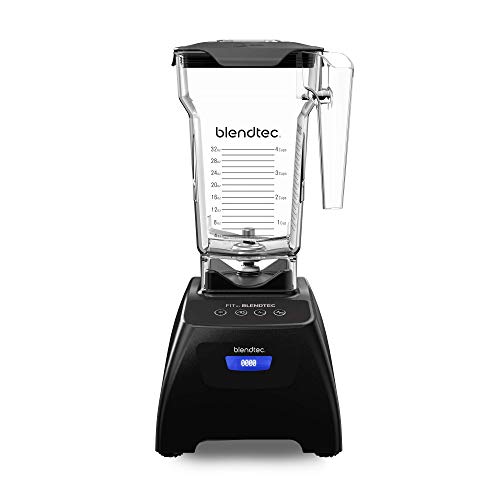
Blendtec Classic — Best for Large Batches
Blendtec’s long-running Classic line is the preset lover’s premium machine: a blunt safety blade, a wide jar that is unusually easy to scrape and clean, and programmed cycles you start with one touch and walk away from. The wide jar shape suits big households and batch cooking, and the blunt blade pulls mixture down aggressively while being safer to handle during washing than razor-edged rivals.
Best for: large households, batch cooks, and anyone who wants true one-touch programs at the premium tier. Not suited for: small kitchens (it is a big machine), very small batches, or cooks who prefer full manual control.
Strengths: powerful and consistent; easy-clean wide jar; strong presets. Trade-offs: premium tier; very loud at full power; thick mixtures can need a pause and a stir without a tamper.
First Setup and Care Essentials
Unbox thoughtfully: wash the jar, lid, and any cups in warm soapy water before first use, check that the blade assembly and gaskets are seated exactly as the manual shows, and run a half jar of water through a full cycle to flush the machine and teach yourself the controls without ingredients at stake. Place the base on a dry, level surface with clearance above — remember the towel trick if vibration noise bothers you — and read the two safety pages properly: never reach into a jar while the base is plugged in, never blend sealed hot liquids, and respect your jar’s maximum fill line, especially with hot or carbonated contents.
Your First Week: A Simple Routine That Teaches the Machine
Spend your first week deliberately. Day one, blend water and then a soft smoothie to learn the controls and the sound of a healthy cycle. Midweek, try your toughest realistic job — frozen fruit, greens, ice — using the loading order from the mistakes section: liquid first, soft ingredients next, frozen last, starting slow and ramping up. Notice whether the vortex forms, whether you need the tamper, and how much liquid your favourite recipes truly need in this jar; every machine has its own minimum working volume, and learning yours ends most early frustration. By the weekend, run one hot job if your machine allows it, observing the vented lid and the fill line in action. A week of this teaches you more than a month of random use, and it happens while returns are still easy if the machine genuinely does not suit you.
Daily care is three habits. Rinse or self-clean immediately after use, before residue dries. Keep the base dry — wipe splashes with a damp cloth, never immerse the motor unit. And inspect the gasket and blade area weekly; a worn gasket is the most common cause of leaks and the cheapest part to replace. Monthly, run a deeper clean with a baking-soda soak for smells and a careful check that the drive socket on the base is free of grit. Store the jar unsealed so it airs, and keep cups and lids dry before cupboard storage. Machines cared for this way routinely outlast their warranties by years; machines left dirty and damp routinely do not.
Mistakes to Avoid
Buying power you will never use — or skimping on power you need daily. Both errors come from shopping aspirationally instead of honestly. Ignoring jar size. A giant pitcher for solo smoothies and a personal cup for a family of five fail in opposite directions, and both fail daily. Blending hot liquid in a sealed personal cup. This is the one genuinely dangerous mistake on the list; steam pressure needs a vented lid, always. Overfilling. Past the fill line the vortex dies, the texture suffers, and hot contents can force the lid. Judging by the first smoothie. Every blender has a learning curve of liquid ratios and loading order — liquid first, soft ingredients next, frozen and ice last. Give a new machine two weeks before you judge it. Forgetting the after-costs. Replacement cups, gaskets, and jars are part of ownership; favour brands whose parts are easy to find. Finally, letting cleanup slide: more blenders are abandoned over dried-on residue than over any failure of power.
Blender: A Hands-On Fit Check Before You Commit
Start with the space, storage and everyday routine this {p} has to fit into. Most coverage of a blender concentrates on the first week of ownership, yet the decisions that matter most tend to surface later, once the blender has to earn its place in an ordinary weekday routine rather than a carefully staged first attempt. Write down the three jobs you expect it to do most often, in the order you actually do them, and judge every claim you read against that short personal list instead of against a generic ideal.
Use a short decision checklist to finish. One, does it fit the space and the storage you really have. Two, does it handle your three most common jobs without a workaround. Three, do the edge cases you listed stay manageable. Four, can every wear part be cleaned or replaced without drama. Five, would you still choose it if a friend described the same drawbacks in their own kitchen. A blender that passes all five is a sound buy; one that fails two or more is a compromise you are choosing with open eyes, which is a very different thing from being surprised later.
Troubleshooting is easier when you expect the usual failure points. With any blender, the recurring problems tend to cluster in the same places: uneven results from overloading or poor arrangement, wear showing first on the parts handled most often, and small annoyances with lids, seals, handles, controls or fittings that only appear after repeated use. Before buying, look for whether those wear parts can be cleaned properly, replaced or worked around, and whether the instructions address them directly rather than pretending they never happen.
When you check listings such as Vitamix 5200, Vitamix E310 and Ninja Professional Plus, use them as worked examples: run through the same checks below on each one in turn, so the comparison stays honest and like for like rather than based on whichever listing happens to shout loudest.
Finally, plan the first fortnight deliberately. Use the blender for one familiar job first, so you have a baseline you trust, then introduce the harder cases one at a time and note what changes. Small adjustments to arrangement, timing, quantity or preparation usually close most of the gap between disappointing first results and the performance the design is capable of. That short learning period is also the fairest test of measurement and fit: if the routine has not settled by the end of it, the mismatch is real, and it is better to know while returning or exchanging is still straightforward.
Edge cases deserve a deliberate pass. Think about the odd shapes, the thicker or thinner than usual loads, the leftovers, the second helping and the guest with different preferences. A well-chosen blender handles the exceptions gracefully, or at least predictably, while a poor match turns every exception into a workaround. List your two or three most common exceptions in advance and check, from the manual or the listing details, that nothing about them is ruled out by size, shape, material or care requirements.
Work through a realistic scenario, not a best case. Picture the busiest version of the job: more people to serve, less time than planned, ingredients or materials that are slightly out of the ordinary, and a clean-up waiting at the end. Ask how the blender behaves at that upper edge, because a model that only shines on a small, simple load will disappoint precisely when you need it most. If the honest answer is that you would split the job into batches or fall back on an older method, factor that into the decision now rather than discovering it later.
Frequently Asked Questions
Can one blender really replace a food processor?
Only partly. A good full-size blender beats a food processor at liquids: smoothies, soups, sauces, batters, and purees come out smoother because the vortex keeps everything moving through the blades. A food processor wins at dry and chunky work — slicing, shredding, dough, coarse chopping, and pastry — where a blender either needs added liquid or turns the result uneven. Many kitchens happily run a blender alone for years, but if you bake, make dough, or process large amounts of vegetables, the two machines complement rather than replace each other.
Is a personal blender enough if I live alone?
For a drink-focused routine, yes, and it may serve you better than a full-size machine. A quality personal blender handles solo smoothies with frozen fruit and greens, protein shakes, and small sauces with the fastest cleanup in the category. Its limits appear when your cooking widens: no hot liquids, no family-size batches, no nut butters, and guests mean blending in rounds. If your blending is ninety percent weekday drinks, buy the personal blender without guilt. If you cook soups and entertain, plan on a countertop machine first or as a second step.
How long should a decent blender last?
A well-built mid-tier blender used a few times a week should give many years of service, and premium machines are routinely expected to last a decade or more of daily use — that longevity is most of what the premium tier is selling. Lifespan depends less on the calendar than on habits: not overfilling, adding enough liquid for frozen jobs, cleaning promptly, and replacing worn gaskets and cups when they tire. The earliest failures usually trace back to chronic overloading or a motor repeatedly strained against dry, frozen mixtures without enough liquid to move.
Do I need a tamper, and what does it actually do?
A tamper is a plunger designed to push ingredients toward the blades through the lid opening while the machine runs, without ever touching the blades themselves. It matters most for very thick mixtures — smoothie bowls, nut butters, hummus, frozen desserts — where an air pocket forms above the blades and the mixture stops circulating. On thinner smoothies and soups you will rarely reach for it. If your blending leans thick, a machine designed around a tamper is a genuine advantage; if you mostly make drinks, it is an accessory that will live in a drawer.
Glass or plastic jar — which is the better choice?
Neither wins outright; they trade virtues. Glass resists scratches, stains, and odours, and feels reassuringly traditional, but it is heavy when full and can break in a way plastic will not — which is why many powerful machines avoid it. Quality modern plastic jars are light, tough, and kinder to your grip and your counter, though they can gradually cloud or hold onto strong colours and smells over years. Choose based on your reality: weaker grip or clumsy mornings favour light plastic; heavy staining ingredients and a careful hand favour glass where it is offered.
Why does my smoothie come out chunky even in a good blender?
Almost always loading and liquid, not the machine. Load in order — liquid first, then soft ingredients, then leafy greens, with frozen fruit and ice last — so the vortex forms early and pulls the hard pieces down steadily. Make sure there is enough liquid to keep the mixture circulating; a too-thick blend stalls above the blades no matter the motor. Use the tamper if your machine has one, start at a lower speed and ramp up, and give frozen mixtures a full cycle rather than stopping at the first sign of smoothness. Technique fixes most chunkiness.
Related Guides
Keep researching with the companion pieces in this series — the type comparisons and focused smoothie roundups linked throughout this guide are the natural next step once you know your profile. Choose by your real routine, buy the sturdiest machine in your tier that fits it, and your blender will quietly become the most-used appliance you own.