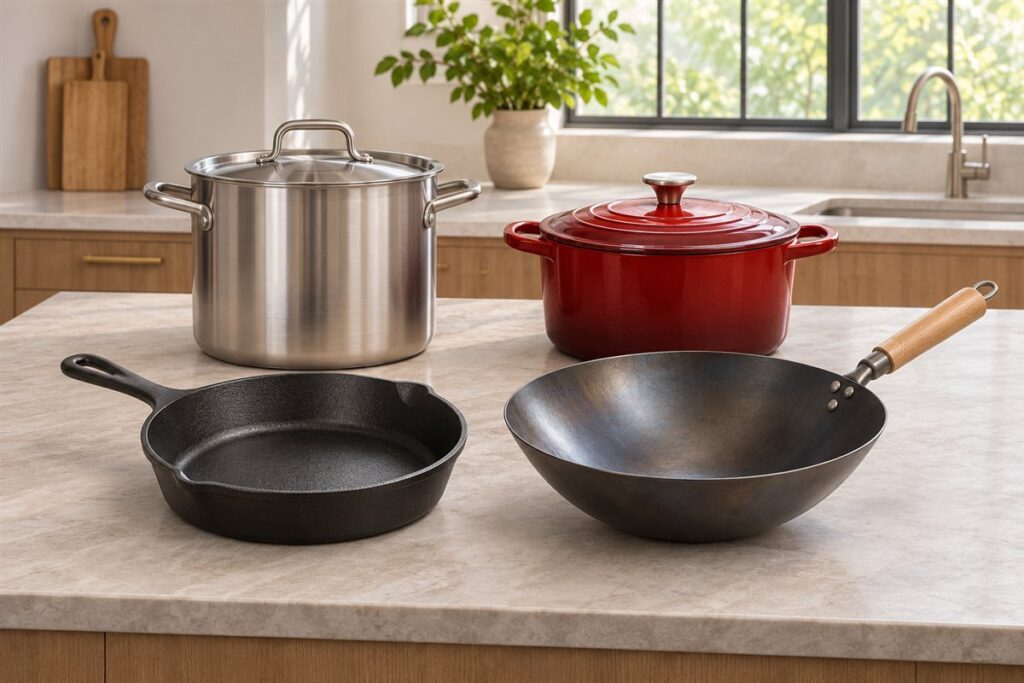
Cookware materials differ mainly in how fast they heat, how long they hold heat and how much care they need. Knowing a few plain definitions makes it much easier to read product descriptions and choose pans that fit your cooking.
Metals Used for Pan Bodies
Stainless Steel
An iron-based alloy with chromium that resists rust and staining. It does not conduct heat especially well alone, so many pans add an aluminum or copper layer inside the base or walls. Example: a clad skillet with layers of steel and aluminum.
Aluminum
Light and a quick conductor of heat. Bare aluminum can react with acidic foods, so it is often coated, anodized or clad in steel.
Copper
An excellent heat conductor that responds fast to burner changes. It is usually lined with another metal and needs polishing if you want to keep the shine.
Cast Iron and Carbon Steel
Iron-based pans that develop a seasoned surface from baked-on oil. Cast iron is thick and heavy, while carbon steel is thinner and lighter.
Surfaces and Coatings
- Nonstick coating: A slick layer that helps food release; best at moderate heat.
- Ceramic coating: A mineral-based slick layer, also sensitive to rough handling.
- Enamel: Glass-like finish fused onto cast iron, so no seasoning is needed.
- Anodized finish: A hardened surface made by treating aluminum.
Terms You Will See
| Term | Meaning |
|---|---|
| Clad | Layers of different metals bonded together |
| Core | A heat-spreading layer inside the body |
| Seasoning | Baked-on oil film on iron pans |
| Induction ready | Has a magnetic base that works on induction stoves |
| Reactive | May change the taste or color of acidic foods |
Choosing With This Knowledge
Decide what you need the pan to do, then choose the material that suits it. Quick, even heating suggests clad or aluminum. Searing and baking suggest iron. Easy release suggests a coating. Always follow the maker’s care and heat guidance.
A few more notes can help. Titanium and similar names on labels usually describe a reinforcement in a coating or a lightweight body, so read the description to see what the term refers to. Glass lids let you watch food without lifting them. Carbon steel and cast iron look similar, yet they behave differently because of thickness.
When two products look alike, compare the construction details: how many layers, how thick the base is, and what the handle is made of. Those facts say more about performance than a marketing name.
Building a Starter Set by Material
You rarely need every material. A small, thoughtful mix covers almost any recipe. Begin by listing the jobs you do weekly: scrambling eggs, searing meat, simmering sauce, boiling pasta, roasting, and making soup. Then assign each job to the material that handles it well.
A clad stainless skillet is a strong all-rounder for browning and pan sauces because it tolerates high heat and does not react with acidic ingredients. A coated pan, kept for eggs and delicate fish, saves oil and effort at moderate heat. A heavy iron skillet or enameled pot fills the role of searing, baking and long braising. A stainless saucepan with a lid covers sauces, grains and boiled vegetables, and a large stockpot handles pasta and soup.
Think of each piece as a tool with a limit. Do not expect a nonstick pan to sear like iron, and do not expect bare iron to simmer tomato sauce for hours without consequence. Buying fewer, better-matched pans is usually more satisfying than buying a large boxed set filled with sizes and materials you never reach for. If a set tempts you, compare its contents with your weekly list and note how many pieces you would use. Add specialty items, such as a wok or a roasting pan, only when your cooking points to them.
Stove and Induction Checks
Material and cooktop must work together. Induction stoves heat the pan directly through a magnetic field, so the base needs to contain magnetic metal. Cast iron, carbon steel and many stainless pans with a magnetic layer qualify. Pure aluminum and copper do not unless they have a magnetic plate bonded to the bottom. The easiest check is a small magnet: if it sticks firmly to the outside of the base, the pan will likely work, though the maker’s listing is the better source.
On gas, flame shape matters more than magnetism. Pans with a base much larger than the burner can heat unevenly, and pans with plastic handles need to stay clear of flames. Gas also allows quick adjustments, which suits responsive metals like copper, thin carbon steel and aluminum.
Electric coils and smooth glass tops reward flat bases. A warped pan loses contact and heats slowly. Heavy pans can scratch glass if dragged, and rough cast iron should be lifted, not slid. Check that the base size roughly matches the burner. Finally, remember oven compatibility is a separate question: handles, lids and coatings can limit the temperature even when the pan body can take more. Read the full specification for each piece and keep the manuals or a note of the limits somewhere easy to find.
Reading Construction Details
Product names tell you less than construction details. Start with how the body is built: a single sheet of metal, a disc of aluminum bonded under a steel base, or layers running through the walls as well. Fully clad construction usually heats more evenly up the sides, which helps when you simmer or reduce sauces, while an encapsulated base concentrates the extra metal on the bottom where the burner contact is.
Thickness matters, but only in the context of the material. A thick stainless pan holds heat better than a thin one, while thick cast iron is simply heavy. Compare weights if listed and imagine lifting the pan full.
Look closely at handles and rivets. Riveted handles are common on durable pans, but rivets inside the bowl can trap food. Welded or cast handles leave a smoother interior. Consider whether the handle stays cool, whether it is long enough for balance, and whether it can handle oven heat.
Lids can change how a pan cooks. A tight-fitting lid keeps moisture in, while a vented lid lets steam out. Glass lets you watch without lifting, but metal lids often tolerate higher oven temperatures. Examine rims for pour spouts and shape, since a flared rim pours cleanly and a straight one does not. These details predict day-to-day satisfaction better than a brand slogan.
Care Routines by Material
Each material wants slightly different treatment. Stainless steel is forgiving: soak, scrub and wash with detergent, and use a non-abrasive cleaner for stubborn marks or heat tint. Avoid scouring pads that leave scratches if you want the finish to stay smooth.
Aluminum and anodized pans prefer gentle detergents and soft sponges. Strong alkaline dishwasher detergents can dull or darken some finishes, so read the care sheet. Copper needs polishing if you want it bright, but the pan cooks just as well when tarnished. Do not use harsh cleaners on any lining.
Iron-based pans call for drying and light oiling, and enameled iron needs soft tools and care around the rim. Coated pans should be washed by hand with soft sponges, used at moderate heat and stored separated.
All materials share a few habits. Let hot pans cool before washing, to avoid warping and thermal shock. Do not soak wooden or plastic handles for long periods. Dry pans completely before storing. Keep the maker’s guide for each piece, and where there is a conflict between general advice and the maker’s instructions, follow the maker. Small habits of this kind are what actually extend the life of cookware, more than the material itself.
Signs It Is Time to Replace a Pan
Good cookware lasts a long time, but it does not last forever. Warping is a major warning sign: if a pan wobbles on a flat counter or spins on the burner, heat will concentrate unevenly and liquids will pool on one side. Loose handles are a safety issue and a reason to stop using the pan until it is repaired or replaced.
For coated pans, flaking, deep scratches or food that sticks despite proper cleaning mean the coating is spent. For enameled iron, chips on the cooking surface or a rough, crazed interior are grounds to retire the piece from food use. For bare iron and carbon steel, rust and stickiness are usually repairable, but a crack or severe warp is not.
Stainless and aluminum pans may show pitting, persistent staining or a bent rim. Cosmetic marks are not a concern, but deep corrosion or a damaged base is. Pay attention to smells too: a lingering burnt odor that does not wash out can signal residue that has built up beyond cleaning. If a pan is difficult to use safely or no longer does its job, replace it with a material suited to the task, and consider whether a different type would serve you better.
FAQ
Does a thicker pan always cook better?
Thicker pans tend to hold heat more evenly, but they are heavier and slower to respond.
What does reactive mean for my food?
Reactive metals can interact with acidic dishes such as tomato sauce, sometimes giving a metallic taste or discoloring the pan.
What is the best all-round cookware material?
There is no single best. Clad stainless steel is a popular all-rounder because it browns well and does not react with acidic food, but many cooks add a coated pan for eggs and an iron pan for searing.
How can I tell whether a pan works on induction?
Check the listing for induction compatibility, and test the base with a magnet. If the magnet sticks firmly, the pan likely works, though the maker's statement is the reliable answer.
Is aluminum cookware safe to cook in?
Aluminum is widely used in cookware and is often coated, anodized or clad in steel to limit contact with food. Check the maker's description and care guidance for the specific pan.
Why do some pans have a layered base?
A layer of aluminum or copper under or inside steel helps spread heat more evenly than steel alone. The listing should say how the layers are arranged.
Do I need a matching set?
No. Matching sets look tidy and stack well, but mixing materials lets you choose the best tool for each job. Compare the contents of any set with the pieces you would actually use.
Does heavier cookware always mean better quality?
Not always. Weight can reflect thick metal that holds heat well, but it can also make a pan hard to handle. Construction, base flatness and handle quality matter as well.
Which materials should I avoid putting in the dishwasher?
Many makers advise hand washing coated, cast iron, copper and some aluminum pieces. Always read the care sheet, because dishwasher approval varies by product.
The Short Version
Each material trades off speed, heat holding and upkeep. Learn the basic terms, match them to your cooking, and check the maker’s guide for limits.