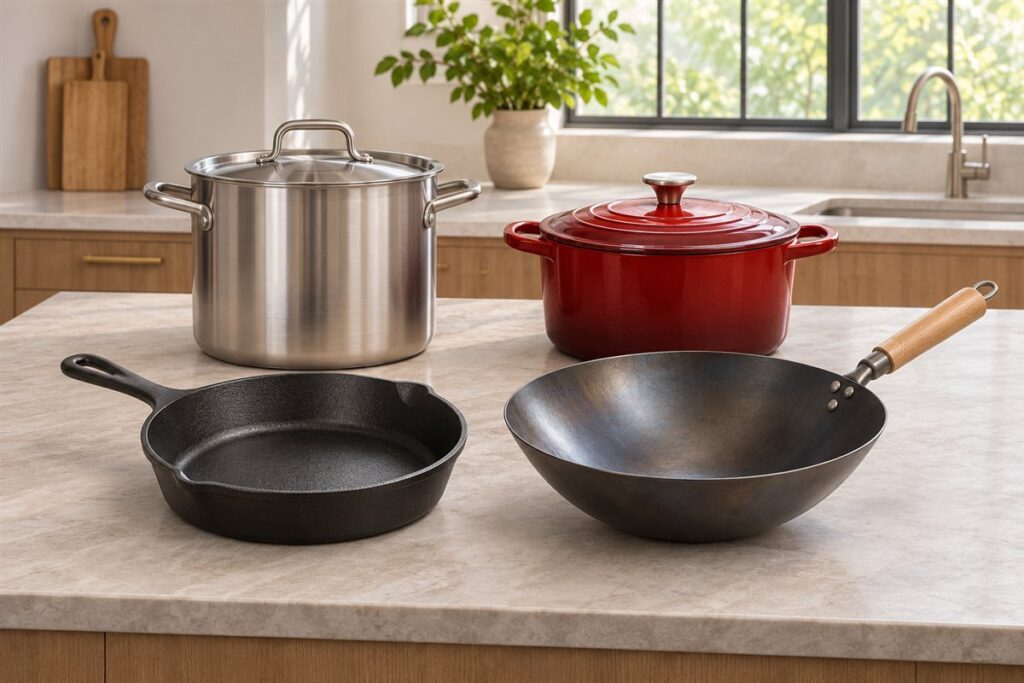
A cookware set is convenient if you are furnishing a kitchen from nothing and want matching pieces, while buying individual pans lets you choose the right material and size for each task. Many cooks end up with a small set plus a few single pieces.
When a Set Makes Sense
- You are equipping a first kitchen or a new home.
- You like a matching look and nesting storage.
- You want consistent handles, lids and care routines.
- You prefer one decision instead of many.
The drawback is that sets often include pieces you may rarely use, such as a very small pan or extra lids. The pieces may also be one material, even though different tasks call for different materials.
When Individual Pieces Win
Buying piece by piece lets you build around real habits. You can choose a stainless skillet for searing, a nonstick pan for eggs, a Dutch oven for braising and a saucepan with a good lid. You also replace worn items one at a time instead of replacing a whole set.
The drawback is that handles and lids will differ from piece to piece, and sizing takes some thought.
Side by Side
| Factor | Set | Individual |
|---|---|---|
| Convenience | High | Lower |
| Fit to your cooking | General | Tailored |
| Storage | Often nests neatly | Varies |
| Replacing one piece | May be hard to match | Easy |
| Material variety | Usually one | Mix as you like |
A Practical Middle Path
- List the pieces you used in the last month.
- If a set covers most of them, consider it, and read the contents list closely.
- If not, choose three or four key pans: a skillet, a saucepan, a larger pot and a baking tray.
- Add specialty items such as a wok, Dutch oven or grill pan only when a recipe calls for them.
Whichever route you choose, check stove compatibility, oven limits and the maker’s care guide for each piece.
Look inside the box before you commit. Count the actual cooking pieces, since lids and utensils are sometimes counted in a headline number. Check the pan sizes, because a set may include only small and medium skillets when you want a large one. See whether the set is compatible with your stove, including induction, and whether the pieces can go in the oven and dishwasher. Finally, consider what you already own. If you have a good skillet, a set that duplicates it adds little.
Materials Across a Set
Most sets are made from one material, so the choice of set is also a choice of how most of your cooking will behave. Stainless steel handles browning and can go from stovetop to oven, but food can stick if the pan is not heated and oiled properly. Nonstick surfaces release eggs and delicate fish with little fat, but coatings need gentle utensils and have temperature limits. Cast iron, enameled and copper-bonded options are also sold, each with their own weight and care needs.
Think about what you cook weekly. If you sear meat and make pan sauces, you may want stainless pieces. If you make eggs and pancakes every morning, a nonstick skillet matters more. Read the listing for construction details, such as layered bases, and check the care guide for each material before you commit.
What to Count Inside the Box
Set sizes are often described by piece count, which can include lids and utensils. Count the actual pans and pots, and note their sizes. A set with many pieces is not automatically better if half of them are lids or tools you already own.
- Skillets or frying pans in at least two sizes are useful.
- A saucepan and a larger pot cover most stovetop tasks.
- A stockpot or Dutch oven is needed for soups and batch cooking.
- Lids that fit multiple pieces save storage space.
Check whether the set includes tools, and whether they are compatible with the cookware surface. Plastic or silicone tools are often recommended for nonstick surfaces.
Stove and Oven Compatibility
Before buying, confirm that the cookware works with your cooktop. Induction needs magnetic bases, and the listing should say if the set is induction compatible. Gas, electric coil and glass-top stoves each have their own considerations, such as base flatness and weight. Check the base diameter against your burners, since a base that is too small or too large heats unevenly.
Oven use depends on the handles, lids and coatings. Some handles and knobs have lower temperature limits than the pan. The listing or manual should state the maximum temperature, and whether lids go in the oven. Broiler use may have its own limits. If you plan to move pans from stove to oven often, treat this as a priority.
Storage and Cabinet Space
Sets are usually designed to nest, which helps in a small kitchen. Measure your cabinet depth and height, and think about where lids will go. A set with long handles may need a drawer or hanging rack. Stackable designs save space but can scratch nonstick surfaces if pieces rub together, so protectors between pans are useful.
If you own a rack, check that the pan handles fit the hooks. Heavy pieces such as cast iron should sit on a lower shelf. Think about the cooking habits of everyone using the kitchen, and make sure frequently used pieces are easy to reach.
Warranty, Replacement and Long-Term Value
Cookware wears out at different rates. Nonstick coatings wear faster than stainless steel, and warped pans lose contact with the burner. Check the warranty terms and whether replacements for individual pieces are sold. If a single pan in a set fails, you may be able to replace only that one, which reduces waste.
Signs that a piece is due for replacement include a scratched or flaking coating, a base that wobbles on a flat burner, loose handles and lids that no longer fit. Think about long-term costs and effort, not only the first purchase. A smaller set of well-chosen pieces can outlast a larger set of mixed quality.
FAQ
Are sets good for beginners?
They can be, as long as the pieces suit the way you cook.
Can I mix a set with other pans?
Yes. Many kitchens combine a set with a cast iron skillet or an extra pot.
How many pieces do I really need?
Most home cooks cover the basics with a skillet, a saucepan, a larger pot and a baking tray. Add specialty pieces only when your recipes call for them.
Does a bigger set mean better value?
Not always. Lids and utensils may be counted in the total, and extra pieces you do not use add clutter. Count the useful pans rather than the headline number.
Is nonstick cookware safe?
Used according to the maker's instructions, it is widely sold for home use. Avoid overheating, use gentle utensils and replace pans with damaged coatings.
Will my set work on an induction cooktop?
Only if the listing says it is induction compatible, which usually means a magnetic base. Check the product details and bring a magnet to test if you are unsure.
Can I put cookware set pieces in the dishwasher?
It depends on the material and the maker's guidance. Some are dishwasher safe, but hand washing often prolongs the life of coatings and finishes.
What if one piece in my set gets damaged?
Check if the maker sells single replacements. If not, you can buy a similar individual piece. Compare sizes and handles so it fits your existing set.
The Short Version
Choose a set for convenience and a matching look, and individual pieces for tailored performance. A small set plus a few extras suits many kitchens.