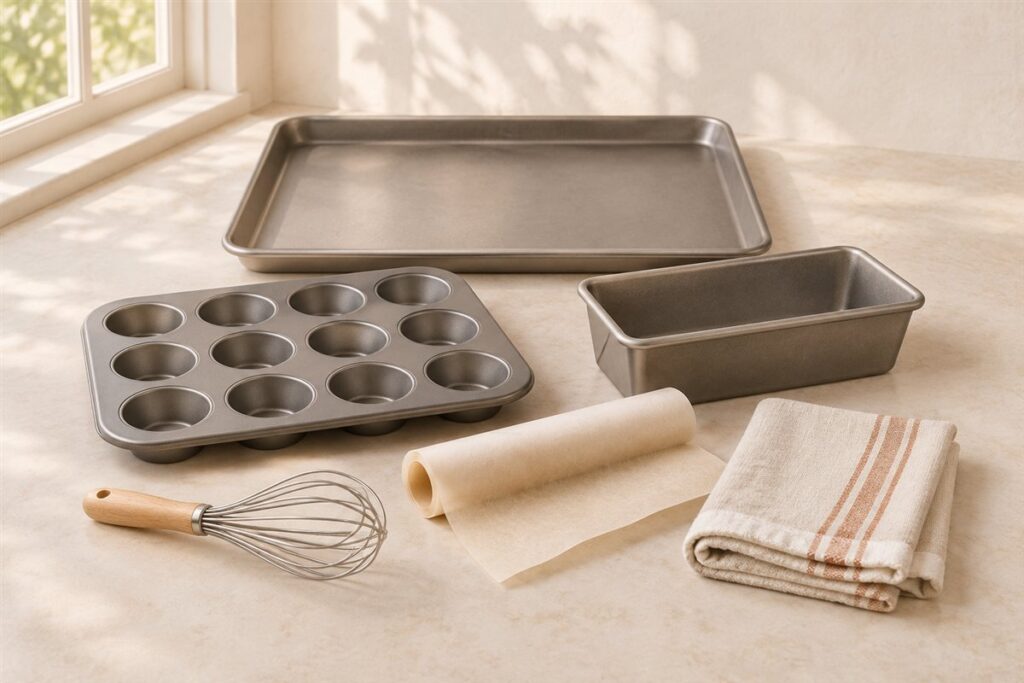
The best baking pan set is the one that covers the recipes you make most often and fits in your oven and cupboard. Look at which pans are included, what they are made of, and whether the sizes match your recipes before you think about anything else.
Begin With Your Baking Habits
List what you bake in a typical month. Cookies and roasted vegetables call for flat sheets. Brownies, bars and cornbread need a square or rectangular pan. Layer cakes want round pans, and loaves of bread or banana bread need a loaf pan. A set that includes pans you will never use is just storage clutter, so match the contents to your list.
Decision Criteria
| Factor | Why it matters | What to check |
|---|---|---|
| Pan types included | Determines which recipes you can make | Round, square, loaf, muffin and sheet pans as needed |
| Material | Affects browning and cleanup | Aluminized steel, aluminum, carbon steel or glass; read the maker’s care guide |
| Surface | Affects release and washing | Bare metal or a coated finish; note the utensil advice from the maker |
| Sizes | Recipes assume standard dimensions | Measure the inside of each pan, edge to edge |
| Oven fit | Pans that touch the oven wall bake unevenly | Measure the oven rack and leave room for air |
| Storage | Large sets take space | Nesting or stackable designs, and your cupboard depth |
| Maximum temperature | Coatings and handles have limits | The maker’s stated oven limit |
Material and Finish
Metal pans heat quickly and tend to give crisp edges. Lighter-colored pans usually bake more gently, while darker ones brown more, so you may need to watch the time. Glass holds heat for a long time and is common for casseroles and some cakes. A coated surface helps with release, but the maker will often advise against metal utensils and harsh scrubbing. Follow the care guide for whatever you buy.
Sizing and Storage
- Check the sizes your favorite recipes call for.
- Compare them with the sizes listed for the set, measured across the inside top.
- Measure your oven interior and rack space.
- Check how the pieces store, because nesting pans save a lot of room.
It can also make sense to build a collection one pan at a time instead of buying a full set, especially if you only need two or three types.
Core Pans Most Bakers Use
If you are unsure which pans matter, start from the recipes that appear most in your kitchen. A rimmed sheet pan is the most versatile: cookies, roasted vegetables, sheet-pan dinners and toast all use it. A second sheet pan of the same size lets you bake in batches and rotate trays.
Square and rectangular pans cover brownies, bars, cornbread, coffee cakes, cobblers and lasagna-style dishes. A rectangular pan around nine by thirteen inches is a common size that many recipes assume, while a smaller square pan suits a half batch or a thicker bar. Round cake pans are needed for layer cakes, and two matching pans make assembly much easier than baking in batches.
A loaf pan handles quick breads and sandwich-style loaves, and a muffin tin covers cupcakes, muffins and some savory bakes. Pie plates, springform pans and tart pans are specialty items; they are worth adding when you bake those items regularly, not simply because a set includes them. Cooling racks often come with sets and are useful, but check that they fit your sheet pans.
Compare the set’s list with your own. If you rarely bake cake, a set with three round pans may be wasted. If you bake bread and bars weekly, prioritize a set with solid loaf and rectangular pans. Count how many pieces you would use at least once a month, and treat the rest as extras rather than value.
Build Quality Checks
Because most sets arrive in a box, you often cannot handle the pans first, so look carefully at the description and photographs. Rims are a good clue: a rolled or reinforced rim adds stiffness and gives a better grip with mitts. Flat, thin edges are more likely to flex. Corners should be smooth, with no deep crevices that trap batter.
Check seams and joints. Pans with welded or folded seams that sit away from the cooking surface are easier to clean. Visible rivets or gaps inside the pan can hold crumbs. Pay attention to whether the base is flat. A pan that rocks on a counter will not sit evenly on an oven rack and may bake unevenly.
Weight can signal thickness. Heavier gauge metal resists warping and spreads heat evenly, but a pan that is too heavy can be tiring to handle with a full batter. A moderate weight that feels solid but manageable is a good target. If reviews mention warping after a few uses, that is a warning sign worth taking seriously, though individual results vary.
Finally, read the care instructions and temperature limits in the listing. Be sure you are comfortable with the cleaning requirements, and check whether the maker provides support or a warranty. Keep packaging for a while so you can return a set that arrives bent or flawed.
Oven Airflow and Rack Position
A pan set that does not fit your oven will frustrate you no matter how good it looks. Measure the width and depth of the rack and the interior of the oven. Leave a gap of a couple of inches around each pan so hot air can circulate. Pans that touch the oven walls or each other can block airflow, causing pale or burnt patches.
Position matters as much as size. The middle rack gives the most even bake for most items. Move cakes and delicate bakes toward the center, while placing roasting and sheet-pan meals on the upper or lower racks depending on the recipe. If you bake two sheets at a time, swap their positions and rotate them halfway through to even out browning, especially in ovens with hot spots.
Convection ovens move air with a fan, which can speed up browning. Low-sided sheet pans let air flow across food easily, while tall pans can block it. Many recipes suggest adjusting temperature or timing for convection, so follow the oven manual and the recipe.
Check the height of your tallest pan against the spacing of your rack levels. Deep pans like loaf tins or springform pans may not fit when racks are close together. If you have a small or countertop oven, confirm that full-size pans fit at all, and consider buying smaller-sized pans designed for compact ovens. A quick measurement saves a return.
Coated or Bare Pans in a Set
Many sets come with a coated finish across every piece, while others are bare metal. Coated pans release food more easily and wipe clean, which suits beginners and busy households. They require gentler tools, careful washing and attention to the temperature limit. Over time the coating can wear, and scratched pans may need replacing sooner than bare pans.
Bare metal pans, such as aluminum or steel, are straightforward and can handle more abrasive cleaning. They benefit from greasing, flouring or a parchment lining to release food, and they may stain or darken over time, which is usually cosmetic. Some bakers prefer them for sheet pans and roasting because there is no coating to degrade at high heat.
A mixed approach is also reasonable. You might choose coated cake pans for easy release and bare sheet pans for high-heat roasting. If the set is entirely coated and you roast often, consider whether you will be comfortable keeping the heat within the maker’s limit.
Color affects results as well. Dark finishes brown more quickly than light ones, so you may need to shorten baking times or lower the rack. Whatever you choose, read the guidance on dishwasher use, metal utensils and storage, and decide whether you will actually follow it in daily life.
Starting Small and Adding Later
A set is convenient, but it is not the only path. Many bakers start with two or three well-chosen pans and add as needs arise. This approach avoids paying for pieces that sit in a cupboard and lets you pick each pan on its own merits, such as a sturdy sheet pan from one maker and a particular cake pan from another.
If you do buy a set, check how it will expand. Does the maker sell individual replacements or additional sizes in the same line? Matching pans help with stacking and with consistent baking times, but they are not required. Mixed materials can work well when each is used for the right task.
Think about who will use the pans. A set for a new household might include a basic range, while a set for a keen baker may emphasize specialized shapes. If you are buying as a gift, ask about the recipient’s favorite bakes and the size of their oven.
Consider storage as you go. Nesting pans are friendly to small kitchens, but be careful about scratches when stacking coated pans; a cloth or paper liner helps. Plan a spot for the set before it arrives. Finally, keep the instructions and note any signs of wear so that you know when to replace individual pieces, instead of buying a whole new set.
FAQ
Is a larger set always better value?
Not necessarily. A larger set only helps if you will use most of the pieces. A smaller set that fits your recipes is more useful.
Should all the pans match?
Matching pans make a tidy stack and bake in a similar way, which can make timing easier. Mixed materials are fine if each pan suits its job.
What is the most useful single pan to start with?
A sturdy rimmed sheet pan is the most versatile, since it handles cookies, roasting and sheet-pan meals. Add a square or rectangular pan next for bars and cakes.
Do all the pieces in a set bake the same way?
Not necessarily. Size, depth and finish all affect timing and browning, so check each pan the first time you use it and note any adjustments.
Can I put baking pans in the dishwasher?
Only if the maker says so. Dishwasher detergent can dull finishes and shorten the life of coated pans, so hand washing is often recommended.
How do I stop pans from warping?
Avoid sudden temperature changes, such as running cold water over a hot pan. Sturdier pans with reinforced rims resist warping better than thin ones.
Should I buy a set with a lid or cover?
Lids are useful for transporting and storing bakes, but check that they fit the pan snugly and are not meant for use in the oven unless the maker says they are.
Do I need dark or light pans?
Light pans bake more gently, while dark ones brown more. Many cooks keep a mix and adjust time and rack position as needed.
How do I know my pans fit my oven?
Measure the interior and rack width, and compare them with the pan's outer dimensions, including handles and rims. Leave space around the pans for air to move.
The Short Version
Choose a set that includes the shapes you bake with, in the sizes your recipes use, made from a material you are willing to care for. Measure your oven and cupboard first, and read the maker’s guide for temperature limits and cleaning.