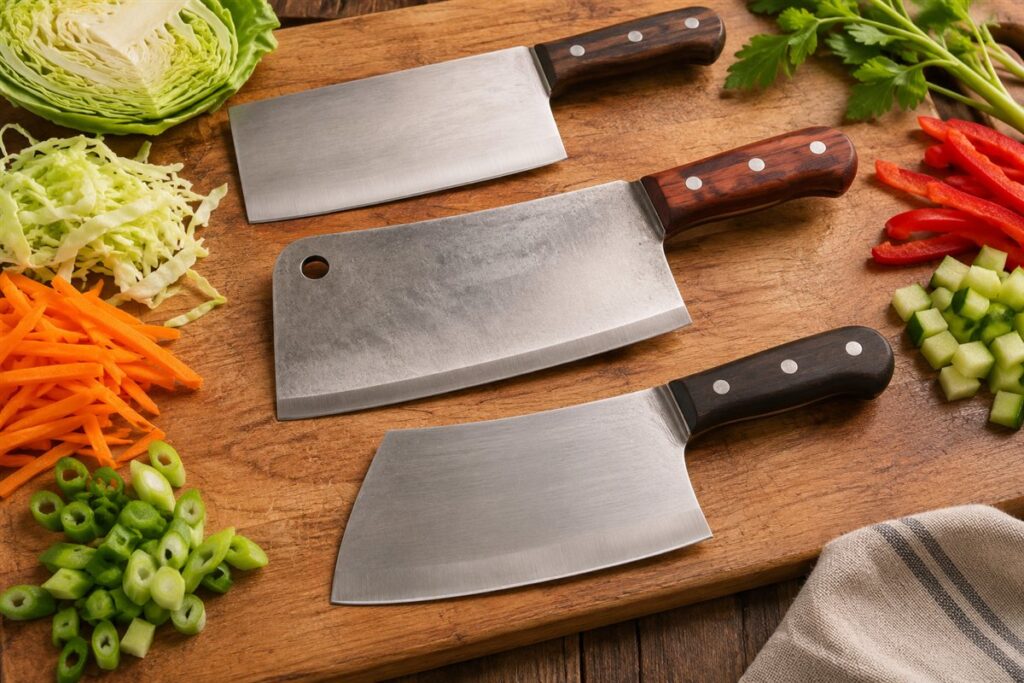
A cleaver is a broad, rectangular knife used for chopping, slicing and crushing. Two main styles exist: a lighter vegetable cleaver for everyday slicing and a heavier meat cleaver for cutting through bone and joints. Knowing which job you want to do decides which one to choose.
Two Very Different Tools
A vegetable cleaver, sometimes called a Chinese chef’s knife, has a thinner blade and is used for slicing, dicing and scooping food from the board. A meat cleaver is thick and heavy, and its weight does the work when you chop through bones. Using a light cleaver on bones can chip or bend it, so match the tool to the task.
Features to Compare
| Feature | Vegetable cleaver | Meat cleaver |
|---|---|---|
| Blade thickness | Thin and slicing-friendly | Thick and sturdy |
| Weight | Moderate | Heavy, with weight in the blade |
| Main jobs | Slicing, mincing, crushing garlic | Chopping bones and joints |
| Edge | Fine and sharp | Strong and slightly thicker at the edge |
| Cutting board | Any stable board | Thick wood or other heavy-duty board |
Handle and Balance
- A full tang, where the metal runs into the handle, helps with sturdiness.
- The handle should give you room for your hand without crowding the blade.
- Check the weight in your hand. Heavy models can tire your wrist.
- A hole in the blade lets you hang it up; make sure the hook is strong.
- Non-slip handle texture is useful with wet or greasy hands.
Deciding by the Jobs You Do
List what you chop in a typical week and let that point to the style.
- Mostly vegetables, herbs and boneless meat: A vegetable cleaver. The tall, flat blade glides through cabbage and onions, and the flat side moves chopped food from board to pan.
- Whole poultry, ribs or joints: A heavy meat cleaver, or have the butcher cut bone for you.
- A mix of both: Many cooks keep one of each, or use a vegetable cleaver for most work and leave bone to a heavier tool.
If you are unsure, begin with the vegetable cleaver. It does far more everyday jobs, and you can add a heavy model later if you find yourself cutting bone often.
Careful Use
- Place a damp cloth under a stable board.
- Hold the handle firmly and keep your other hand away from the chopping path.
- For vegetables, rock gently, keeping fingers curled back from the blade.
- For bones, make controlled, deliberate cuts, not wild swings, and stop if the blade sticks.
- Wash by hand, dry quickly and store in a block, sheath or strip.
A cleaver is a large, sharp tool. Follow the maker’s manual and keep children away.
A Walkthrough: Breaking Down a Chicken Carefully
This sequence shows how the heavy style is used for bone work, while following food-safety guidance for raw meat.
- Set a thick board on a damp cloth so it cannot slide. Keep a separate board for raw poultry and wash it, the knife and your hands straight after.
- Pat the bird dry so it does not slip.
- Use a smaller knife to separate the legs and wings at the joints, since joints can be cut without chopping through bone.
- Reserve the cleaver for the backbone or thick bone, placing the blade where you want the cut and tapping down with controlled force rather than a big swing.
- If the blade lodges in bone, do not twist or pry. Lift the blade and bone together, tapping gently on the board to free it.
- Wash tools in hot soapy water and dry them. Follow the guidance on cooking poultry fully and storing raw meat away from other foods.
Common Scenarios
A home cook who wants one knife for stir-fries
A vegetable cleaver slices thin, scoops quickly and gets used daily.
Someone who buys whole chickens
A heavy cleaver speeds up backbone and thigh work, though many cooks use a shears and a chef knife for most of the job.
A cook with smaller hands
Look for a lighter vegetable style with a rounded spine for comfort, and avoid very heavy models.
Meal prep for a large family
The wide blade handles batches of vegetables quickly, so a vegetable cleaver paired with a long board saves time.
Size and storage deserve a thought. Cleavers are wide, so they may not fit standard block slots, and a strip, sheath or drawer tray might suit them better. Cutting boards matter too, because a heavy blade can damage thin or brittle boards, and a board that slips is a hazard. Many cooks prefer a thick wooden board for cleaver work. Before buying, check the maker’s description of the steel and care needs, since some cleaver steels rust if left wet, and a thick edge may need a different sharpening method than a thin kitchen knife.
Mistakes to Avoid
- Using a thin cleaver on bone. The edge is made for slicing and can chip or bend.
- Chopping on a thin or hard board. A heavy blow can crack a thin board or bounce off a hard one.
- Gripping only the handle end. Choke up on the handle, or use a pinch grip as the maker suggests, for control.
- Leaving it wet. Some steels rust if not dried right away.
- Using it as a hammer. The blade is built for cutting, and pounding can damage the edge and handle.
Quick Troubleshooting
| Symptom | Likely cause | What to try |
|---|---|---|
| Food sticks to the broad blade | Moist or dense food clinging | Wipe the blade between cuts and slice with a smooth stroke |
| Blade bounces off bone | Dull edge or poor placement | Check sharpness, and set the edge on the bone before cutting |
| Chips along the edge | A thin edge used on bone | Switch tools, and have the edge repaired by a sharpening service |
| Wrist soreness | Model too heavy | Take breaks, or move to a lighter style |
| Rust spots | Left wet | Dry thoroughly after each wash and store in a dry spot |
Short Glossary
- Full tang: Metal that runs the whole length of the handle.
- Spine: The thick, unsharpened top edge of the blade.
- Heel: The rear of the cutting edge, closest to the handle.
- Bevel: The angled surface that forms the cutting edge.
- Honing: Realigning the edge with a rod rather than removing metal.
- Choke up: Gripping close to the blade for control.
Knowing these terms helps you read the maker’s description and compare models on the details that affect handling.
FAQ
Can I use a cleaver as my only knife?
Some cooks do, especially with a vegetable cleaver, but most prefer a small knife for detail work too.
Is it good for crushing garlic?
The flat side can do that, but press carefully and keep your fingers clear.
How should I sharpen a cleaver?
Follow the maker’s guide. Thin vegetable cleavers can be sharpened like a kitchen knife, while thicker meat cleavers have a sturdier edge that may need a coarser stone or a professional service.
What board should I use?
A thick, stable board, usually wood, is the standard choice. Place a damp cloth beneath to stop it from sliding, and avoid glass or stone surfaces.
Is a hole in the blade useful?
It lets you hang the cleaver on a hook, which is handy in a small kitchen. Make sure the hook is strong, and dry the blade before hanging it.
The Short Version
Choose a vegetable cleaver for daily slicing and a heavy meat cleaver for bones. Check weight and handle, use a sturdy board and handle it carefully. Match the blade to the job, dry it after washing, and keep raw meat tools apart from other foods.