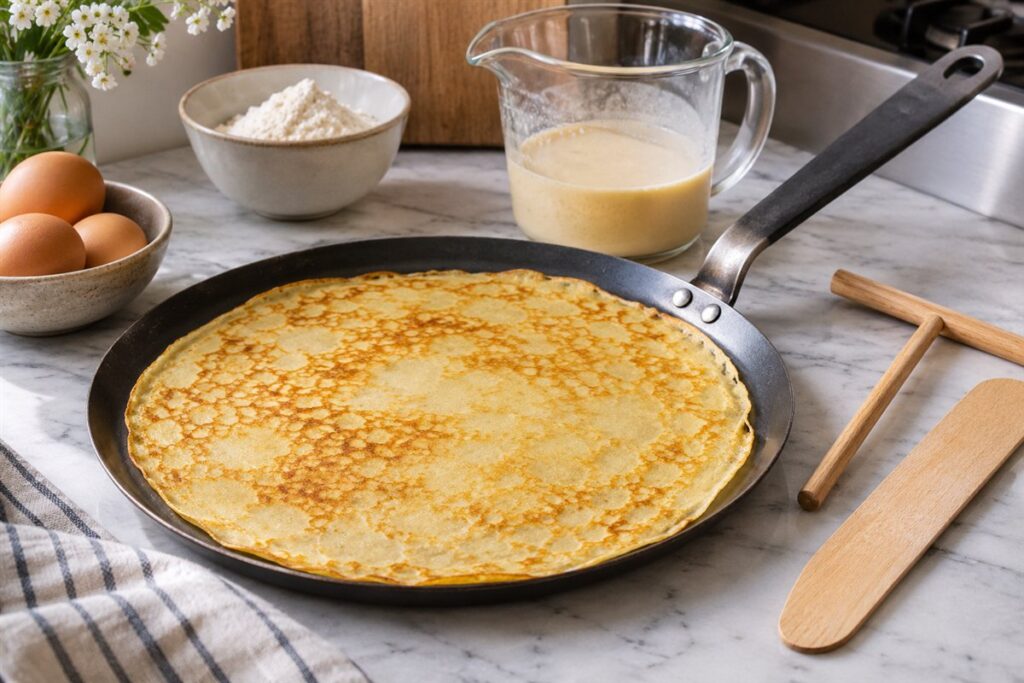
A crepe pan is a wide, flat pan with a very low rim so you can swirl batter and slide a spatula underneath. The most useful qualities are even heat, a smooth cooking surface and a comfortable handle. Choose one that matches your stove and how often you make crepes.
Why the Shape Is Different
Crepe batter is thin, so you need a flat surface and room to tilt the pan. A low rim lets a spatula glide in without bumping a wall. Most crepe pans are between 8 and 12 inches across, but makers vary, so look at the cooking surface measurement. A smaller pan makes tidy single servings, while a larger one is good for wraps and sharing.
Material Options
- Carbon steel: Traditional in many kitchens. It heats quickly and develops a natural slick layer with seasoning, but it needs oiling and careful drying.
- Cast iron: Holds heat steadily, though it is heavy to tilt and swirl.
- Coated aluminum: Light and easy to use, which suits beginners, but should be used with gentle tools and moderate heat.
- Stainless steel: Durable, but batter is more likely to stick without good technique.
Basic Technique
- Rest the batter for a short time so it thickens slightly and bubbles settle.
- Warm the pan on medium heat until a drop of water dances.
- Lightly wipe the surface with butter or oil using a paper towel.
- Pour in a small ladle of batter and tilt the pan quickly to coat the base.
- Cook until the edges lift, then flip with a thin spatula or a careful flick.
- Stack finished crepes on a plate, and re-oil the pan only when needed.
Handle, Weight and Stove Fit
A long, light handle gives you leverage for swirling. Check that the base is flat and sized for your burner; induction cooking needs a magnetic base. Keep the pan on moderate heat and follow the maker’s manual about temperature limits and cleaning.
Crepe making rewards a little practice. Your first one is often uneven, and that is normal, since the pan and batter are still settling in. Keep a plate and a paper towel nearby, and try a thinner batter if the crepes feel heavy. Sweet fillings such as sugar and lemon, jam or fruit, and savory fillings such as ham, cheese and spinach all work. If you plan to serve a group, hold finished crepes on a plate in a low oven, covered with a clean towel, while you cook the rest. Wash the pan gently and dry it fully so the surface stays smooth for the next batch.
A Worked Example: Choosing for a Weekend Brunch
Suppose you want to make crepes for four people on a gas hob, with a small cupboard.
- Decide on the crepe size. For four people, a pan with a cooking surface near the middle of the range gives crepes that fold neatly onto a plate.
- Check the burner. The base should be close to the burner diameter or a little larger, so heat spreads to the edges. A pan far wider than the burner leaves the rim cooler.
- Choose the material by habit. If you want the simplest route, a coated aluminum pan needs less seasoning. If you enjoy caring for a pan, carbon steel rewards the effort.
- Look at the rim. It should be low enough for a thin spatula to slide beneath the crepe, but not so low that batter runs over when you tilt.
- Check the handle. Hold it as you would to swirl the pan, and ensure it stays comfortable and does not conduct heat to your hand.
- Plan for the batch. You will need a plate for the stack, a ladle, a thin spatula and a low oven to keep crepes warm under a towel.
Common Scenarios
A beginner who makes crepes now and then
A coated, light pan with gentle sides is forgiving. Use moderate heat and nonmetal tools.
A cook who loves traditional methods
Carbon steel with seasoning gives a slick surface after use, and it can also fry eggs and sear small pieces. It needs drying and a thin coat of oil after washing.
A household with an induction hob
Confirm the base is magnetic, and make sure the whole base sits flat. A thin pan may warp on strong settings.
Pancakes and tortillas too
A crepe pan can double for thin pancakes, tortillas and flatbreads. Its low rim also helps with turning omelets.
Mistakes to Avoid
- Using a pan that is too hot. Batter sets before you can swirl it, leaving thick patches.
- Using a pan that is too cool. Batter soaks into the surface and tears when you try to turn it.
- Oiling too much. Excess fat makes lace-like holes and a greasy surface.
- Using metal tools on coating. Scratches shorten the life of the surface.
- Soaking a steel pan. Standing water can cause rust, and seasoning wears away.
Care and Upkeep Over Time
For coated pans, wash gently with a soft sponge, avoid abrasive pads and replace the pan if the surface flakes. For carbon steel, wipe out the pan after use, wash briefly if needed with warm water, dry on the heat for a moment, and rub in a very thin film of oil. Store the pan flat or hanging, and avoid stacking other pans on its surface. The maker’s guide will say what is right for your pan.
Quick Troubleshooting
| Symptom | Likely cause | What to try |
|---|---|---|
| Crepes tear when turned | Pan too cool, batter too thick, or tool too thick | Adjust one thing at a time and use a thin spatula |
| Thick, uneven crepes | Slow swirl or heavy batter | Tilt quickly and thin the batter with a little liquid |
| Crepes stick | Surface not seasoned or not oiled | Wipe with a thin film of fat and warm the pan fully |
| Dark spots on one side | Hot spot on the burner | Move the pan around and choose a pan that fits the burner |
| Pan wobbles on the hob | Warped base | Check on a flat surface and avoid sudden temperature changes |
Short Glossary
- Seasoning: A baked-on layer of oil that makes steel or iron slick.
- Cooking surface: The flat area inside the pan where batter sits.
- Rim height: The depth of the pan wall.
- Carbon steel: A light, responsive metal used for traditional pans.
- Offset spatula: A thin tool with a bent neck for sliding under food.
- Resting the batter: Letting it sit before cooking so it settles.
FAQ
Can I use a regular frying pan?
Yes, a flat nonstick frying pan can work, though the higher sides make flipping slightly trickier.
Why do my crepes tear?
The pan may be too cool, the batter too thick, or the spatula too thick. Adjust one change at a time.
What diameter should I buy?
A mid-sized pan suits most households, while a smaller one gives neat single servings. Compare the cooking surface to your burner, not just the top rim.
Do I need a special spatula?
A thin, flexible spatula, sometimes called an offset or crepe spatula, slides beneath the crepe easily. A thin silicone or wooden tool also works on coated pans, if the maker allows it.
Can I make the batter ahead?
Many recipes allow a rest period, and some batters can be kept cold for a short time. Follow food-safety guidance for any batter with eggs or dairy and use your recipe’s storage notes.
The Short Version
Choose a wide, shallow pan with a flat base and a handle that feels balanced. Carbon steel suits tradition, while coated aluminum suits easy daily use. Match the base to your burner and keep the heat moderate.