Disclosure: topratedkitchenware.com is reader-supported. When you buy through links on our site, we may earn an affiliate commission from Amazon and other retailers, at no extra cost to you.
Where to buy
This is the complete how to choose a dresser guide. Every linked pick below was verified against its manufacturer listing. Prose-only picks — where a product does not genuinely match what you searched for — are named honestly, with no purchase link, so you are never sent to the wrong product. Check the current price on Amazon from any linked pick.
- SONGMICS Dresser with 6 Fabric Drawers — Best for Small Spaces. Check on Amazon for the current price.
- MapleGrace 53-Inch Wide 6-Drawer Dresser, Black — Best Overall. Check on Amazon for the current price.
- MapleGrace 53-Inch Wide 6-Drawer Dresser, White — Best for Bright Rooms. Check on Amazon for the current price.
- SONGMICS Wide Dresser with 5 Fabric Drawers — Best Budget Pick. Check on Amazon for the current price.
- OneBlis 6-Drawer Dresser with LED Lights and Charging Station — Most Versatile. Check on Amazon for the current price.
- VASAGLE Modern 6-Drawer Dresser, Snow White — Best Compact Wooden Dresser. Check on Amazon for the current price.
Read the full guide ↓
Learning how to choose a dresser starts with a tape measure, not a product page. The right dresser is the one whose width, depth and drawer layout match your wall, your wardrobe and the way you actually get dressed in the morning — and the wrong one is a daily obstacle, however handsome it looked online. This guide walks through the whole decision: measuring, drawer counts, materials, stability and assembly, using six real dressers as worked examples.
The six examples deliberately span the market: two lightweight fabric-drawer chests on steel frames, two wide wooden six-drawer dressers in black and white, a feature-loaded dresser with LED lighting and a built-in charging station, and a clean white wooden chest from a storage-furniture specialist. Comparing them side by side shows which specifications actually change daily life and which are decoration. By the end you will know how to choose a dresser for a small bedroom, a shared couple’s room, a closet or a guest room — and what to check before any box arrives.
Key Takeaways
- Measure the wall, the door swing and full drawer extension before falling for any design.
- Six drawers in two columns suit couples; a tall single column suits small rooms and closets.
- Fabric drawers are light and forgiving; wood drawers carry heavier loads and feel more permanent.
- Depth around 15–16 inches keeps a dresser from swallowing a small bedroom’s floor.
- Anti-tip anchoring matters most for tall dressers and any home with children.
- Extra features like charging stations are worth it only if the dresser sits near an outlet you use.
In this guide
Quick Picks
| Pick | Badge | Why it stands out | Check |
|---|---|---|---|
| SONGMICS Dresser with 6 Fabric Drawers | Best for Small Spaces | Tall, narrow footprint stores a lot on little floor | Check on Amazon |
| MapleGrace 53-Inch Wide 6-Drawer Dresser, Black | Best Overall | Wide two-column layout divides naturally between two people | Check on Amazon |
| MapleGrace 53-Inch Wide 6-Drawer Dresser, White | Best for Bright Rooms | Same practical wide layout in a light, airy finish | Check on Amazon |
| SONGMICS Wide Dresser with 5 Fabric Drawers | Best Budget Pick | Wide, low profile doubles as a TV or mirror surface | Check on Amazon |
| OneBlis 6-Drawer Dresser with LED Lights and Charging Station | Most Versatile | Built-in outlets and USB ports end the bedside cable hunt | Check on Amazon |
| VASAGLE Modern 6-Drawer Dresser, Snow White | Best Compact Wooden Dresser | 47-inch width fits walls the 53-inch models cannot | Check on Amazon |
How These Picks Were Chosen
These six dressers were chosen to represent the real decision, not to fill a grid. The pool was checked product by product against the manufacturer’s listing data: drawer count, dimensions where published, frame and drawer materials, and any powered features. Two fabric-drawer models and four wood or wood-look models made the cut, in wide and tall formats, so that every major branch of the decision tree has a concrete example with a verified listing behind it.
This is research-led guidance, not a hands-on laboratory test: we did not load each drawer with weights or cycle the runners thousands of times. Where a listing does not publish a figure — drawer weight capacity is the common gap — this guide says so rather than inventing one, and the buying-guide sections explain how to judge that quality from construction details instead. Prices are never printed here because they move; each linked pick carries a check-price link so you see the current figure at the retailer.
The 6 Dressers That Show What to Look For

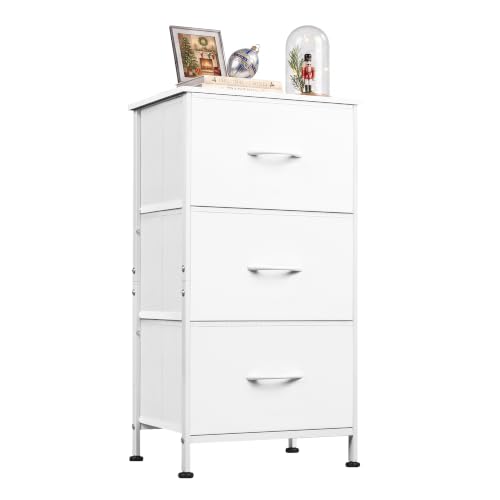
SONGMICS Dresser with 6 Fabric Drawers
Badge: Best for Small Spaces
Strengths
- Tall, narrow footprint stores a lot on little floor
- Steel frame keeps the unit light and easy to move
- Fabric drawers are quiet and gentle on walls and bed frames
Trade-offs
- Fabric drawers are not built for books or heavy tools
- Less substantial feel than a wooden chest
- Drawers pull out fully by hand — no runner glide
Key specs (from the listing)
- Format: tall chest of drawers
- Drawers: 6 fabric drawers
- Frame: steel
- Colour: Ink Black and Ebony Black
- Collection: BELLAH, model ULGS123B01
- Suggested rooms: bedroom, closet, entryway
Start with the tall option, because it teaches the first lesson of this guide: vertical storage is how small bedrooms win. The SONGMICS six-drawer chest stacks its storage in a single column on a steel frame, so it fits the sliver of wall beside a closet door or at the end of a bed where a wide dresser simply cannot go. The fabric drawers swallow folded clothes, gym kit and linens happily, and the whole unit is light enough for one person to reposition during a room reshuffle.
Judge it as organised soft storage, not furniture joinery. The steel frame gives the fabric boxes their shape and keeps the silhouette tidy in the Ink Black and Ebony Black finish, which suits modern, low-contrast bedrooms. The honest limitation is load type: pointy or heavy objects distort fabric drawers over time, so this is a clothes-and-linens piece. For renters and first apartments, that trade is usually worth it.
When you are learning how to choose a dresser for a tight room, use this model as your measuring exercise: mark its footprint on your floor with tape, open an imaginary drawer, and walk past it carrying a laundry basket. If that works, a tall fabric chest solves your storage problem at the gentlest tier in this guide.
Best for: Small bedrooms, closets and renters who need maximum folded-clothes storage on minimum floor space / Not suited for: Storing books, tools or heavy denim, or buyers who want a solid-wood furniture feel
Check on Amazon — see the current price and full listing details.
MapleGrace 53-Inch Wide 6-Drawer Dresser, Black
Badge: Best Overall
Strengths
- Wide two-column layout divides naturally between two people
- Published dimensions make fit-checking straightforward
- Wood construction suits heavier everyday loads than fabric
Trade-offs
- Wide footprint needs a long, clear wall
- Heavier to move and slower to assemble than fabric models
- Black finish shows dust sooner than pale finishes
Key specs (from the listing)
- Dimensions: 15.4″ D x 53.1″ W x 30.9″ H
- Drawers: 6
- Construction: wood dresser chest
- Colour: Black
- Suggested rooms: bedroom, living room, hallway
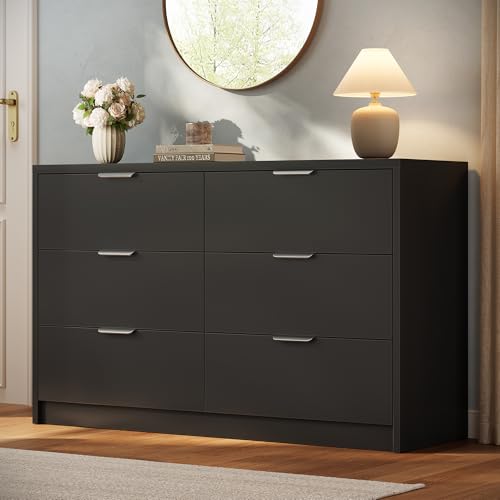
The MapleGrace in black is the classic couples’ dresser: six wooden drawers in two columns, a 53-inch top that takes a mirror and two lamps, and dimensions published plainly enough to tape out on your wall before ordering. At just under 31 inches tall it sits at comfortable folding height, and the roughly 15-inch depth keeps it from projecting into the room the way deep chests do.
Wood construction is the point here. Drawers built as boxes rather than fabric bins carry jeans, jumpers and a season of bedding without sagging, and the black finish pairs with both modern metal bed frames and traditional dark wood. The honest limitation is commitment: this is a heavier, wider piece that wants a permanent wall and a second pair of hands on delivery day. Measure your stairwell turns as well as the bedroom wall.
Use this dresser as the reference when you weigh how to choose a dresser for a shared room. Two equal columns end the ‘your drawers, my drawers’ negotiation, and the wide top becomes shared surface. If your wall cannot give it 54 clear inches, step down to the tall or the 47-inch option below rather than squeezing it in.
Best for: Couples and main bedrooms with a long wall who want durable wooden drawers / Not suited for: Small rooms, frequent movers, or anyone carrying it up narrow stairs alone
Check on Amazon — see the current price and full listing details.
MapleGrace 53-Inch Wide 6-Drawer Dresser, White
Badge: Best for Bright Rooms
Strengths
- Same practical wide layout in a light, airy finish
- White surface reflects light and suits smaller-feeling rooms
- Two-column drawers divide well for couples or kids’ clothes
Trade-offs
- White finishes show scuffs and make-up marks sooner
- Same wide footprint and weight as the black version
- Needs the same long clear wall to work
Key specs (from the listing)
- Dimensions: 15.4″ D x 53.1″ W x 30.9″ H
- Drawers: 6
- Construction: wood dresser chest
- Colour: White
- Suggested rooms: bedroom, living room, hallway
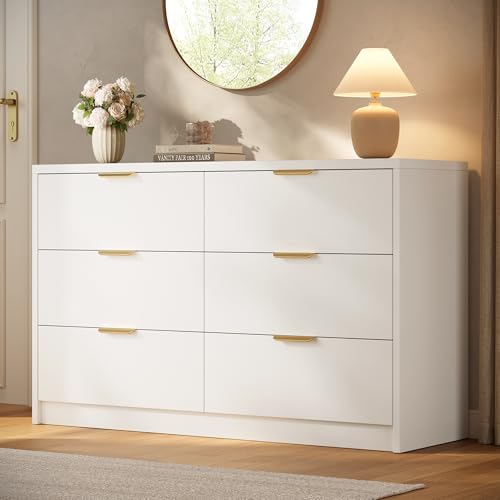
This is the same wide six-drawer MapleGrace layout in white, and including both colours is deliberate: finish is a genuine choosing factor, not an afterthought. In north-facing or small bedrooms a white dresser keeps the room feeling open, reflects lamp light, and disappears against pale walls in a way a black chest never will. The storage maths is identical — six drawers, two columns, a generous top.
The practical differences are about upkeep and styling. White shows foundation smudges, pen marks and the grey scuff of a vacuum cleaner sooner than black, so it suits households happy to wipe a top surface weekly. It also mixes more easily with the mixed-wood reality of most bedrooms, where the bed, the dresser and the nightstand rarely match exactly. The limitation mirrors its twin: width and weight demand a settled room layout.
When deciding how to choose a dresser finish, hold both options against your actual light. Order-of-magnitude rule: the darker and smaller the room, the stronger the case for the white version; the larger and brighter the room, the more the black version’s contrast becomes an asset rather than a shadow.
Best for: Bright, Scandinavian or small-feeling bedrooms that want the wide layout without visual weight / Not suited for: High-traffic family rooms where a white top will be marked daily
Check on Amazon — see the current price and full listing details.

SONGMICS Wide Dresser with 5 Fabric Drawers
Badge: Best Budget Pick
Strengths
- Wide, low profile doubles as a TV or mirror surface
- Five larger fabric drawers suit bulky folded items
- Light steel-frame build is easy to assemble and move
Trade-offs
- One drawer fewer than the six-drawer models
- Fabric drawers cap the sensible load per drawer
- Low height is less ideal as a changing or folding station for tall users
Key specs (from the listing)
- Format: wide dresser
- Drawers: 5 fabric drawers
- Frame: steel
- Colour: Ink Black and Ebony Black
- Collection: BELLAH, model ULGS322B01
- Suggested rooms: bedroom, closet, entryway
The wide five-drawer SONGMICS answers a different question: what if the wall is wide but the budget and the load are light? Five fabric drawers on a steel frame give broad, low storage that works under a window, beneath a wall-mounted television, or along the foot of a bed in a loft-style room. Fewer, bigger drawers suit jumpers, bedding and board-game boxes better than many small ones.
Like its tall sibling, it trades joinery for lightness. Assembly is a frame-and-bins job rather than a flat-pack marathon, and the finished unit can be shifted by one person when the room changes. The honest limitation is the same fabric ceiling on weight, plus one fewer drawer than the six-drawer designs — count your categories of clothing before assuming five is enough. For a guest room or a child’s room, five generous drawers is usually the right number anyway.
This model is the value benchmark for how to choose a dresser without overspending: list what will actually live in it, and if the list is five categories or fewer and nothing is heavy, a wide fabric dresser covers the need and leaves budget for the mattress and bedding that affect sleep more directly.
Best for: Guest rooms, children’s rooms and under-window walls needing wide, light storage / Not suited for: Heavy loads, or wardrobes that need six or more separate drawer categories
Check on Amazon — see the current price and full listing details.

OneBlis 6-Drawer Dresser with LED Lights and Charging Station
Badge: Most Versatile
Strengths
- Built-in outlets and USB ports end the bedside cable hunt
- LED lighting adds a night-light and display function
- Six drawers keep it a real dresser, not a gadget with bins
Trade-offs
- Needs to sit near a wall outlet for its features to work
- Electronics add failure points a plain dresser never has
- Floating modern styling will not suit traditional rooms
Key specs (from the listing)
- Drawers: 6
- Features: LED lights
- Power: built-in charging station with 2 AC outlets and USB ports
- Style: modern floating-look design
- Colour: Black
- Suggested rooms: bedroom, living room, closet
The OneBlis is the feature branch of the decision tree: a six-drawer dresser that also wants to be your charging hub and ambient light. Two AC outlets and USB ports built into the unit mean phones, a watch and a lamp plug in where you actually put them down at night, and the LED lighting gives the top surface a display glow or a low night light for hallway trips.
Judge the storage first and the electronics second: six drawers is a full-size allocation, and the modern floating-look black styling suits media bedrooms and gaming setups. The honest limitations are placement and complexity — the dresser must live within cord reach of a wall outlet, and lights and sockets are components that can fail years before drawers do. If you would place it on a wall with no outlet, you are paying for features you cannot use.
When learning how to choose a dresser, treat powered features as a location test, not a wish list. Stand where the dresser will go: if your phone charges there nightly and the outlet situation is currently an extension-cord tangle, the OneBlis solves two problems at once. If not, the plain wooden models above are the smarter spend.
Best for: Media bedrooms, gamers and anyone whose dresser top is the household charging station / Not suited for: Walls without a nearby outlet, traditional decor, or buyers who prize decades-long simplicity
Check on Amazon — see the current price and full listing details.

VASAGLE Modern 6-Drawer Dresser, Snow White
Badge: Best Compact Wooden Dresser
Strengths
- 47-inch width fits walls the 53-inch models cannot
- Six wooden drawers in a footprint between tall and wide
- Snow White finish brightens rooms like the white MapleGrace
Trade-offs
- Slightly less top surface and drawer volume than 53-inch rivals
- White finish needs regular wiping to stay crisp
- Assembly is a full flat-pack job, unlike the fabric models
Key specs (from the listing)
- Dimensions: 47 x 15.7 x 29.5 inches
- Drawers: 6
- Colour: Snow White
- Collection: KAILYN, model ULTS616WE01S
- Type: clothes storage cabinet / chest of drawers
The VASAGLE KAILYN dresser is the middle path: a wooden six-drawer chest at 47 inches wide, for the many bedrooms whose free wall measures between the tall fabric chest and the 53-inch couples’ dressers. Its published dimensions — 47 by 15.7 by 29.5 inches — make it one of the easiest models here to verify against a real wall before ordering.
VASAGLE’s storage-furniture background shows in the straightforward cabinet design: six drawers, a clean Snow White finish, no electronics and no fabric. It asks for a proper flat-pack assembly session and rewards it with a more furniture-like result than the steel-frame models. The honest limitation is scale — each drawer and the top surface are a touch smaller than the 53-inch pair, which matters if two adults are sharing it with bulky winter layers.
Use the VASAGLE to learn the final lesson of how to choose a dresser: buy the size your wall actually offers, not the size the category page defaults to. A 47-inch dresser that fits with breathing room beats a 53-inch dresser wedged between door trim and bed frame every day of the week.
Best for: Mid-size bedrooms and solo sleepers wanting wooden drawers in a moderate footprint / Not suited for: Couples with large wardrobes who can fit — and fill — a 53-inch dresser
Check on Amazon — see the current price and full listing details.
Comparison Table
| Pick | Badge | Key specs | Best for | Check |
|---|---|---|---|---|
| SONGMICS Dresser with 6 Fabric Drawers | Best for Small Spaces | Format: tall chest of drawers; Drawers: 6 fabric drawers | Small bedrooms, closets and renters who need maximum folded-clothes storage on minimum floor space | Check on Amazon |
| MapleGrace 53-Inch Wide 6-Drawer Dresser, Black | Best Overall | Dimensions: 15.4″ D x 53.1″ W x 30.9″ H; Drawers: 6 | Couples and main bedrooms with a long wall who want durable wooden drawers | Check on Amazon |
| MapleGrace 53-Inch Wide 6-Drawer Dresser, White | Best for Bright Rooms | Dimensions: 15.4″ D x 53.1″ W x 30.9″ H; Drawers: 6 | Bright, Scandinavian or small-feeling bedrooms that want the wide layout without visual weight | Check on Amazon |
| SONGMICS Wide Dresser with 5 Fabric Drawers | Best Budget Pick | Format: wide dresser; Drawers: 5 fabric drawers | Guest rooms, children’s rooms and under-window walls needing wide, light storage | Check on Amazon |
| OneBlis 6-Drawer Dresser with LED Lights and Charging Station | Most Versatile | Drawers: 6; Features: LED lights | Media bedrooms, gamers and anyone whose dresser top is the household charging station | Check on Amazon |
| VASAGLE Modern 6-Drawer Dresser, Snow White | Best Compact Wooden Dresser | Dimensions: 47 x 15.7 x 29.5 inches; Drawers: 6 | Mid-size bedrooms and solo sleepers wanting wooden drawers in a moderate footprint | Check on Amazon |
How to Choose a Dresser by Size, Storage and Build
Start with three measurements, not a style
Width is the wall space minus door trim and any radiator or outlet you must keep reachable. Depth is how far the dresser projects into the room — everything in this guide sits near 15–16 inches, which is the friendly zone for bedrooms; deeper chests eat walking space fast. Height decides function: around 30 inches is folding and mirror height, while tall chests trade top surface for floor space. Write all three numbers down and shop inside them.
Count drawer categories before drawer inches
List what will live in the dresser: underwear and socks, T-shirts, jumpers, trousers, gym kit, bedding, a junk drawer. Each category wants its own drawer or half-drawer. Most single sleepers land on four to five categories; couples sharing one dresser land on six or more, which is why the two-column six-drawer layout dominates this guide. Bulky categories (jumpers, bedding) need depth and height per drawer more than they need drawer count.
Match drawer construction to the load
Fabric drawers on steel frames carry folded clothes beautifully and fail slowly under heavy, hard objects. Wooden drawers cost more effort to assemble and move, and repay it with heavier loads and a longer service life. If the dresser will hold books, vinyl, tools or a printer, eliminate fabric immediately. If it will hold a child’s clothes for three years before a room redo, fabric is the rational, lighter choice.
Stability and anchoring are part of the purchase
Any dresser can tip if a child climbs open drawers, and tall narrow units are the most exposed. Plan the anti-tip anchor at purchase time: you need a wall stud or a suitable fixing behind the dresser’s position, which sometimes decides which wall the dresser must use. Wide low dressers are inherently steadier but still deserve anchoring in children’s rooms. A dresser that rocks on an uneven floor needs levelling before it needs filling.
Treat features and finish as the last filter
Only after size, drawers, construction and stability are settled should finish and features decide between finalists — exactly the black-versus-white MapleGrace choice, or the OneBlis charging station. Finish follows the room’s light; features follow the wall’s outlets. Buyers who reverse this order end up with beautiful dressers in the wrong size, which is the most common and most avoidable mistake in this category. Readers comparing by room size may also find Best Dresser For Small Bedrooms Under $200 useful alongside this guide.
Budget tiers, translated into construction
Tier language in this category maps to materials more honestly than in most. The gentlest tier buys steel frames and fabric drawers — light, adequate for clothes, finite in lifespan. The middle tier buys engineered-wood cabinets with proper drawer boxes, like the MapleGrace and VASAGLE designs here, and is where most households should aim for a primary bedroom. Above that sit solid-wood and soft-close hardware territories that this pool does not reach; they are worth it for a forever home and wasted on a two-year rental. Spend to the tier of the tenancy and the load, not to the photograph.
How to Set Up and Organise a New Dresser
Setting up a new dresser well takes an hour and repays it for years. Work in this order: position, level, anchor, then organise — loading drawers before anchoring is how dressers end up permanently in the wrong spot.
- Unpack in the room it will live in, and keep the hardware sorted in a tray; flat-pack dressers punish missing screws discovered at step nine.
- Assemble on a blanket or the flattened box to protect both the floor and the dresser’s finish.
- Position the dresser on its wall, leaving a finger’s width from the skirting board so it does not rock on the board’s edge.
- Level it: adjust feet if fitted, or shim a corner, until a marble or phone level app shows it steady and drawers stay where you leave them.
- Anchor it to the wall with the supplied anti-tip kit into a stud or a proper wall fixing — before any drawer is filled.
- Load drawers heaviest at the bottom: denim and books low, light linens and socks at the top, which also improves stability.
- Assign each drawer one category and label children’s drawers with pictures if the dresser serves a kids’ room.
- Leave the top surface one-third empty by rule; a dresser top that starts full becomes a dumping ground within a month.
Troubleshooting
Problem: A drawer sticks or rubs → Check the unit is level first — a racked frame binds drawers. On wooden runners, a rub of candle wax along the contact edge restores glide; on fabric drawers, redistribute the load away from the bulging side.
Problem: The dresser wobbles → Confirm it is not standing on the skirting board or a rug edge. Shim the short leg, re-check the level, and only then tighten frame screws in a cross pattern.
Problem: Drawers slide open by themselves → The unit is tilted forward, usually on thick carpet pile at the front. Raise the front feet slightly or move the dresser fully onto or off the rug.
Wide and Low or Tall and Narrow? Reading a Room Before You Buy
The footprint decision comes before every other decision, because a dresser you have to edge around will annoy you every single day. Measure the wall the dresser will sit on, then subtract the swing of the bedroom door and the clearance you need to open the bottom drawers fully — a drawer that only opens halfway in a tight room is storage you cannot actually use. As a working rule, leave at least the depth of the dresser plus the full drawer extension between the dresser front and the bed or opposite wall.
Wide, low dressers suit rooms with a long empty wall and give you a useful top surface for a mirror, a lamp or folded laundry. Tall, narrow chests suit small bedrooms, closets and entryways where floor space is the scarce resource, but they concentrate weight high up, so anchoring them to the wall is not optional, especially in homes with children. If you are furnishing a guest room, a mid-height wide dresser doubles as a luggage surface, which guests quietly appreciate more than an extra drawer.
Fabric Drawers vs Wood Drawers: An Honest Comparison
Fabric-drawer dressers on steel frames, like the two SONGMICS designs in this guide, trade heirloom solidity for lightness, easy assembly and gentle pricing tiers. The drawers are really structured boxes: excellent for clothes, linens and children’s items, less happy under books, tools or a decade of heavy denim. They also forgive small rooms, because a fabric drawer that brushes a bed frame does no damage.
Solid and engineered-wood drawers, like the MapleGrace and VASAGLE designs here, feel more substantial, glide more predictably when the runners are decent, and present a furniture finish that matches other bedroom pieces. Their trade-offs are weight, longer assembly and less tolerance for being dragged across floors. Neither family is ‘better’ in the abstract: match the drawer type to the load you actually store and how long you expect to keep the piece.
Dresser Placement: Light, Heat and Daily Traffic
Where a dresser stands affects it more than most buyers expect. Direct sun fades finishes unevenly — a black dresser under a south window will show a pale rectangle where a laundry basket usually sits. Radiators and heat vents dry wooden joints and warp fabric-drawer frames over seasons, so give heat sources a respectful distance. Traffic matters too: a dresser on the route from bed to bathroom will collect hip-height knocks, and its top will become a dropping zone for keys and cups unless you give that habit a tray to land on.
Finally, think about the mirror question at placement time. A wide dresser with a wall mirror above it becomes the room’s dressing station, which argues for the best-lit wall; a tall chest in a closet becomes pure storage, which argues for the darkest corner being acceptable. Deciding the dresser’s job in the room — station or storage — before it arrives prevents the slow migration of furniture that scars floors and tempers alike.
Three Rooms, Three Right Answers
A studio apartment with one clear wall beside the closet door: the tall SONGMICS wins, because floor area is the currency and its six fabric drawers hold a full wardrobe’s folded half without touching the room’s walking lines. A couple’s main bedroom with a long wall under the window: the wide MapleGrace, black or white by the room’s light, because two drawer columns end negotiation and the top becomes a shared dressing surface. A guest room that hosts grandchildren twice a year: the wide five-drawer SONGMICS, because five generous drawers cover guest storage and toy overflow, and its gentle tier is proportionate to its use.
Notice what the scenarios share: none of them starts with a product. Each starts with a wall, a load and a pattern of life, and the product falls out at the end. That order — room, load, life, product — is the whole method of this guide compressed into one habit.
In Daily Use: How the Picks Differ
In daily use the six separate less by drawer count than by friction. The fabric models open silently and forgive bumps; the wooden models glide with more authority and take heavier loads without complaint; the OneBlis adds a small nightly ritual of plugging in that its owners quickly refuse to give up. Assembly day separates them too — an hour for the steel frames, an afternoon for the flat-pack cabinets — and moving day separates them most of all, which is why renters and frequent movers should weight the light end of this pool more heavily than its specifications suggest.
Drawer by Drawer: Planning What Goes Where
A dresser succeeds or fails at the level of the individual drawer, so plan the contents before the furniture arrives. Top drawers take the small and the daily — underwear, socks, watches, the charging cable tangle — because they are opened most and reached easiest. Middle drawers take the folded wardrobe core: T-shirts, knitwear, trousers. Bottom drawers take the heavy and the bulky — denim, bedding, the winter jumpers — both because weight belongs low for stability and because bending for a jumper twice a week beats bending for socks twice a day.
Dividers and small boxes inside drawers are the cheapest upgrade in this entire category: they convert a drawer from a fabric cave into a filing system, and they matter most in the wide drawers of the MapleGrace and VASAGLE models, where folded stacks migrate. In fabric drawers, dividers also protect the structure — a heavy cluster of belts and buckles in one corner is how a fabric drawer base begins to bow. Finally, leave one drawer deliberately underfilled. A wardrobe breathes across seasons, and the household that owns a dresser with no spare capacity owns a dresser whose every drawer is a wrestling match by December. The empty quarter-drawer is not wasted space; it is the system’s pressure valve, and planning it is the last skill in learning how to choose a dresser well.
A Worked Example: Furnishing One Real Bedroom, Step by Step
Take a concrete room: twelve feet by eleven, one window on the short wall, a queen bed centred on the long wall, a closet with folding doors, and a free wall segment of exactly 58 inches between the closet trim and the door swing. The wardrobe to store: one adult’s full clothing, plus a shelf’s worth of spare bedding. Run the guide’s method in order. The wall offers 58 inches, so both 53-inch MapleGrace models fit with inches to spare, the 47-inch VASAGLE fits easily, and the tall SONGMICS would waste the wall’s width while crowding the door swing’s airspace — width, not height, is this room’s resource, so the tall chest is eliminated first, correctly, by measurement rather than taste.
Drawer categories come next: underwear and socks, gym kit, T-shirts, knitwear, trousers and denim, spare bedding — six categories, which eliminates nothing among the wide models but warns against the five-drawer SONGMICS unless bedding moves to the closet shelf. Load follows: the denim and bedding are heavy, which argues for wooden drawers over fabric for the bottom row at least, and pushes the decision toward the MapleGrace pair or the VASAGLE. Stability: no children in the home, a wide low unit, carpeted floor — anchoring is still fitted, but it is a ten-minute job rather than a deciding factor. Finally the filters that are allowed to decide at the end: the room faces north and feels dim by afternoon, so the white MapleGrace beats the black; and the wall’s only outlet already serves a lamp and a phone charger, so the OneBlis’s charging station, attractive in the abstract, solves a problem this room does not have.
The answer — the white 53-inch MapleGrace — was produced by elimination, and every eliminated model was eliminated for a stated reason tied to the room. That is what a worked example is for: not the answer itself, which belongs to this imaginary room, but the order of operations, which belongs to every room. Measure, count categories, weigh the load, check stability, then — and only then — let light, outlets and taste choose between the survivors. Readers who run their own room through the same five gates will find their shortlist has usually narrowed to one or two dressers before price is ever discussed, which is exactly where a buyer wants to be.
Common Buying Mistakes
- Buying by photograph scale: models are shot in large rooms, so a 53-inch dresser looks modest until it meets a real wall. Tape the footprint first.
- Counting drawers instead of categories, then discovering two people and six clothing types do not fit five drawers.
- Putting heavy loads in fabric drawers, which bow the bases and make every opening a wrestling match.
- Skipping the anti-tip anchor because the dresser ‘feels solid’ — tip-overs happen with drawers open and weight forward, not at rest.
- Choosing a powered dresser for a wall with no outlet, or a white finish for a make-up-heavy routine without expecting weekly wiping.
- Forgetting the delivery path: stair turns, door widths and lift size have ended more dresser plans than bedroom walls have.
Keep researching: If your shortlist narrows to a specific budget tier, Best Dresser Under $200 compares that tier in detail. Readers furnishing a particular room type may also want Best Dresser For Apartments Under $200 before they finalise a choice. For a narrower comparison built around one room and budget, see Best Dresser For Guest Rooms Under $200. And if the budget is the deciding factor from the start, Best Dresser Under $400 is the companion shortlist to work through. If your shortlist narrows to a specific budget tier, Best Dresser For Apartments Under $400 compares that tier in detail.
Final Recommendation
For most readers the MapleGrace 53-inch six-drawer dresser — in black or white to suit your light — is the first choice: real wooden drawers, a couples-friendly layout and published dimensions that make fit-checking honest. Choose the VASAGLE instead if your wall stops at 47 inches, the tall SONGMICS if floor space is the binding constraint, its wide sibling if the budget is, and the OneBlis if your dresser top is genuinely the household’s charging station. Readers working to a strict budget tier can cross-check sizes against Best Dresser Under $200 once they know their measurements.
Start your comparison with the top picks from this guide: SONGMICS Dresser with 6 Fabric Drawers, MapleGrace 53-Inch Wide 6-Drawer Dresser, Black, MapleGrace 53-Inch Wide 6-Drawer Dresser, White — check the current price on Amazon for each before you decide.
Frequently Asked Questions
How many drawers do I actually need in a dresser?
Count clothing categories, not drawers on a page. A single sleeper usually needs four to five drawers; a couple sharing one dresser needs six or more, ideally in two columns so each person gets a side. Bulky wardrobes need fewer, deeper drawers rather than many shallow ones.
What depth dresser is right for a small bedroom?
Around 15–16 inches of depth, as with every model in this guide, keeps walkways workable. Then choose height for storage: a tall chest gives the most capacity per square foot of floor, provided you anchor it to the wall.
Are fabric drawers durable enough for everyday use?
For folded clothes, linens and children’s items, yes — the steel frame carries the structure and the fabric bins carry soft loads for years. They are the wrong choice for books, tools or heavy hard objects, which distort the drawer bases.
Should a dresser be anchored if there are no children at home?
Anchoring is still recommended: an open, loaded top drawer shifts the centre of gravity forward in any household, and anchoring also steadies tall units on uneven floors. It takes minutes with the supplied kit.
Is a dresser with a charging station worth it?
Only if the dresser will stand within reach of a wall outlet and its top is where your household actually charges phones and watches. Otherwise the feature adds cost and complexity you will never use, and a plain wooden dresser is the better buy.
How do I check a dresser will fit before ordering?
Tape its published width and depth on your floor and wall, open a door and a drawer-space into the room, and walk the delivery path from front door to bedroom with the box dimensions in hand. If a listing does not publish dimensions, treat that as a reason to choose one that does.
Is a taller or wider dresser better for a small bedroom?
Taller, in almost every case: a tall chest stores the same clothes on half the floor footprint, which is the resource a small bedroom is short of. The conditions are anchoring it to the wall and being able to reach the top drawer comfortably — if the top drawer is above shoulder height for its main user, a wide low dresser is the safer daily tool.
How long should a dresser last?
A wooden dresser used normally should serve a decade or more; fabric-drawer units serve several years of clothes storage before drawers soften and frames loosen. Match the expected lifespan to the room’s horizon — there is no virtue in a decade dresser for a one-year tenancy, and no economy in replacing a cheap dresser three times in a forever home.