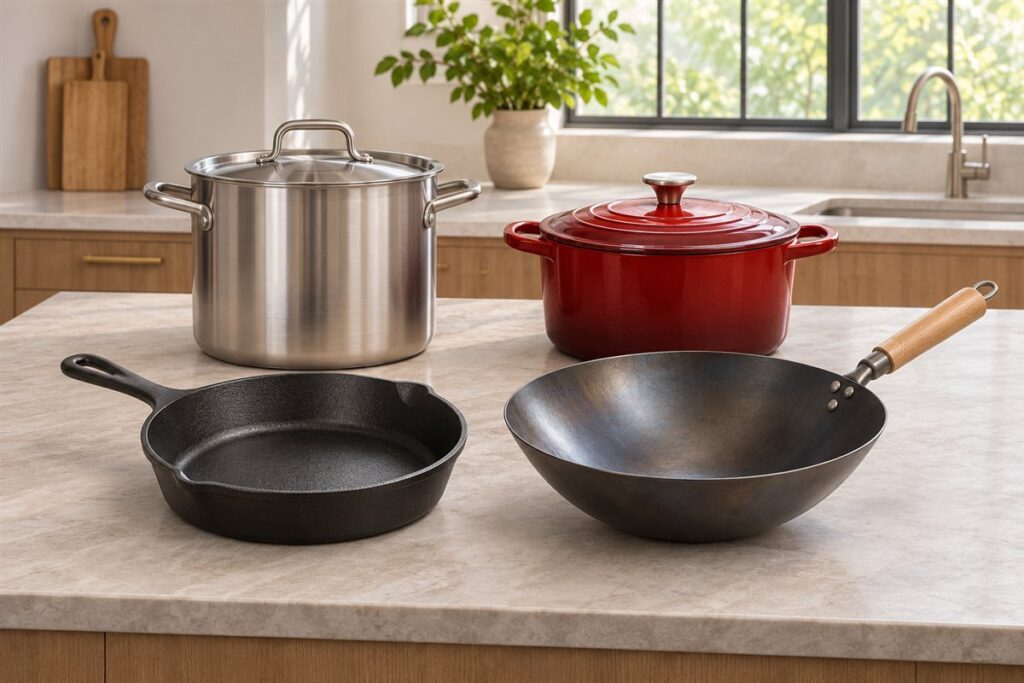
The right frying pan is the one that matches the food you cook most often and the stove you own. Think about size, material, weight and handle comfort before anything else. A short checklist makes the decision much easier.
Begin With How You Cook
If you mostly make eggs, pancakes and delicate fish, a pan with a slick coating is easy to live with. If you sear meat and want browned bits for a pan sauce, bare metal such as stainless steel, carbon steel or cast iron suits that style better. Many cooks end up with two pans: one coated and one uncoated.
Size matters just as much. A pan that is too small crowds the food, and crowded food steams instead of browning. A 10 or 12 inch pan is a common choice for a household of two to four, though makers label sizes differently, so check whether the number refers to the rim or the cooking surface.
Decision Criteria at a Glance
| Factor | Why it matters | What to check |
|---|---|---|
| Material | Controls heat response, browning and cleanup | Match it to your main dishes |
| Weight | Heavy pans hold heat; light pans are easy to flip and lift | Lift it with one hand if you can |
| Handle | Affects balance and comfort | Look for a firm rivet or weld and a grip that stays cool on your stove |
| Base | Flat bases sit evenly on the burner | Check induction compatibility with a magnet |
| Sides | Sloped sides help tossing; straight sides hold more | Think about stir-frying versus shallow frying |
| Oven use | Lets you finish dishes in the oven | Read the maker’s temperature limit |
Practical Tests Before You Buy
- Set the pan on a flat counter and press the rim. It should not rock.
- Hold it by the handle at arm’s length. If your wrist tires quickly, it may be too heavy for daily use.
- Look inside for rough seams or rivets that could trap food.
- Check that a lid, if you want one, fits snugly.
- Read the care sheet so you know whether the dishwasher is allowed.
Match the Pan to Your Stove
Gas works with almost any pan, but a wide base on a small flame leaves cold spots. Electric coil and smooth-top stoves need a flat base for good contact. Induction needs a magnetic base. Always follow the maker’s manual for heat limits, and keep handles turned away from open flames and out of reach of children.
Material-by-Material Comparison
Each pan material trades off ease, durability and heat behavior, so it helps to see them side by side in the context of frying. Stainless steel, especially clad construction with an aluminum or copper layer, handles high heat, resists staining and reacts little with acidic food. It can stick without enough fat or heat control, but it rewards good technique with browned bits that make pan sauces. It is a strong all-purpose pan for people who like to sear and deglaze.
Nonstick pans release eggs and delicate fish with little fat and wipe clean easily. They need moderate heat, gentle tools and careful handling, and they are best treated as wear items. They are not the best match for high-heat searing, and the maker’s heat limit is worth reading.
Cast iron is heavy and holds heat well, which suits searing, shallow frying and oven finishing. It needs seasoning, drying and some patience, and its weight can be tiring. Carbon steel behaves similarly but is lighter and quicker to respond, which many cooks like for eggs, fish and stir-fries once the seasoning builds up.
Enameled cast iron offers heat retention without seasoning, but enamel chips and some makers limit very high heat. Copper responds fastest but needs more upkeep. Aluminum pans heat quickly and are lightweight, and anodized versions add hardness, yet they are often coated for easy release. Choose the material that matches your main dishes, your stove and your willingness to maintain it.
Skillet Versus Saute Pan Shapes
Pan shape is as important as material. A frying pan or skillet has sloped or flared sides and a wide opening, which helps moisture escape so food browns instead of steaming. The slope also makes it easier to slide a spatula under delicate foods, to flip with a flick of the wrist and to reach every corner when stirring. This shape suits eggs, pancakes, fish fillets, cutlets and quick sautes.
A saute pan has tall, straight sides and a large flat base. It holds more liquid and contains splatter, which is useful for braising chicken thighs, simmering sauces or cooking a one-pan meal. It often comes with a lid and a helper handle. Because the sides are steep, moisture escapes less readily, so it browns slightly less well than a skillet, and flipping foods is harder.
There are in-between shapes, such as a chef’s pan or a slope-sided sauteuse. They offer some of the capacity of a saute pan and some of the access of a skillet. If you can own only one pan, a moderately deep pan with gently sloped sides and a lid is a flexible compromise.
Check depth, not just width. A shallow pan is better for browning and crisp edges. A deeper pan holds more food and liquid but can steam foods if overcrowded. Read the listing for interior measurements, not just the outer dimensions, and visualize the dishes you cook most.
Heat Control and Preheating
How you heat a pan affects results as much as what it is made of. Preheat gradually. A pan that is too cold causes food to stick or absorb oil, while a pan that is too hot can burn the outside before the inside cooks. For most materials, a medium setting for a few minutes is a reasonable start, adjusting to the stove and the pan.
Know your pan. Thin aluminum heats in moments and cools just as fast, so it needs closer attention. Thick stainless and cast iron take longer but hold heat well, so you can lower the burner once the pan is hot. A drop of water that dances and evaporates quickly can indicate a hot stainless pan, but nonstick and coated pans should not be preheated empty for long.
Dry food browns better. Pat meat and vegetables dry before they hit the pan, and avoid overcrowding, which lowers the temperature and creates steam. Cook in batches if needed. Add oil once the pan is warm, and watch for shimmering, but stop short of smoking.
Let meat release naturally. When a crust forms, it will usually lift from the pan with little force. Use a spatula that matches the surface, and turn the heat down if the pan begins to smoke. Match burner size to pan size. A small burner under a large pan creates a hot center and cold edges, while the opposite wastes energy and can scorch the sides of the pan.
Budget Tiers Without Price Tags
You do not need to buy the most expensive pan to cook well, but there are differences between levels of quality that are worth knowing. At the lower end, pans are often thin, light and quick to heat, with simple handles and coatings. They can be fine for occasional use but may warp, develop hot spots or lose their coating sooner. If you are on a tight budget, favor sturdiness of base and handle attachment over extra features.
In the middle range, you generally find heavier bases, better bonding of layers, more secure handles and more reliable coatings. Many cooks find this tier a good balance, particularly for a primary skillet. Clad stainless or a well-made hard-anodized or coated pan sits here, though quality varies by maker.
At the higher end, you may find fully clad construction, premium metals such as copper layers, refined finishes and strong warranties. These pans can be a pleasure to use and can last a long time, but the gains may be subtle if you cook simply. Spending more also makes sense for the one pan you use daily.
Compare construction details instead of relying on price. Check base thickness, weight, handle attachment, oven rating and care requirements. Consider the maker’s warranty and support. Mixing tiers is reasonable: perhaps a solid stainless skillet for searing and an inexpensive coated pan for eggs that you expect to replace.
Care and Replacement Signs
A frying pan lives a hard life, so care routines pay off. Let the pan cool a little before washing to avoid warping. Use a soft sponge for coated pans, and a non-abrasive pad for stainless. Dry iron and carbon steel completely and oil lightly. Check the care sheet for dishwasher guidance, and when in doubt, hand wash.
Use appropriate tools. Wood, silicone and nylon tools protect coatings and enamel. Metal tools can be used on stainless, cast iron and carbon steel with care. Avoid cutting food in the pan, and do not use abrasive pads on coated surfaces.
Stainless pans can develop rainbow-colored heat tint, white mineral spots or stuck-on residue. Gentle, non-abrasive cleaners restore the surface in most cases. Burnt-on food usually yields to a soak with warm soapy water, or a simmer of water in the pan.
It is time to replace a pan when it wobbles on a flat surface, because uneven contact leads to poor cooking. A loose handle is a safety hazard. A coated pan with peeling or deep scratches, or food that sticks constantly, has reached the end of its useful life. Rust or cracks in iron or carbon steel pans need attention, and a cracked pan should be retired. When replacing, think about what worked and what did not, and adjust your next choice.
FAQ
Is one frying pan enough?
Many people manage with one 10 or 12 inch pan, but a second pan in a different material gives you more range for eggs and searing.
Do I need a lid?
A lid is handy for steaming vegetables or finishing thicker cuts, so it is worth having if the pan does not include one.
Which frying pan material is best for eggs?
Nonstick and well-seasoned carbon steel or cast iron are popular for eggs. Stainless can work with good heat control and enough fat.
What is the difference between a frying pan and a saute pan?
A frying pan has sloped sides and suits browning and flipping, while a saute pan has tall straight sides and holds more liquid. Choose by whether you brown or braise more.
Can I use a nonstick pan on high heat?
Most makers advise moderate heat, and preheating an empty pan is discouraged. Check the guide for your pan, and use another type for hard searing.
How do I stop food from sticking to stainless steel?
Preheat the pan, add oil once it is warm, dry the food and let it release naturally before turning it. Avoid overcrowding.
Is a heavier pan always better?
A heavy pan holds heat well, but it is tiring to lift and slow to respond. Choose a weight you can handle comfortably.
Does an oven-safe handle matter?
It does if you plan to finish dishes in the oven. Check the maker's stated limit for the handle and any lid.
How often should I replace a frying pan?
It depends on use and material. Replace it when it warps, the handle loosens, or the coating fails, rather than on a set schedule.
The Short Version
Choose a frying pan by what you cook most, then confirm the size, weight and handle feel right in your hand. Make sure the base suits your stove and follow the maker’s care and heat instructions.