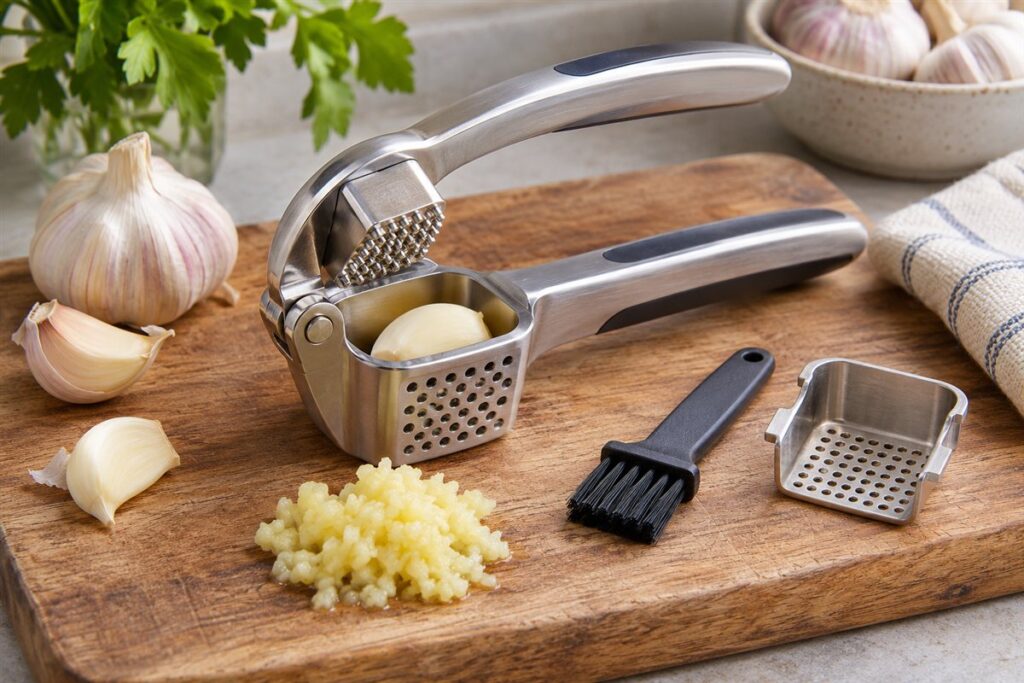
A good garlic press has a sturdy lever, a chamber big enough for a clove or two and a design that is simple to clean. Stainless steel and zinc alloy are common choices. Use the points below to compare presses and decide whether you need one, then follow the walkthrough, scenarios and troubleshooting notes to get the most from it.
How a Press Works
You place a peeled or unpeeled clove in a chamber and squeeze the handles. The garlic is forced through small holes, producing fine bits and juice. Pressed garlic has a stronger flavor than chopped, because crushing breaks more of the cells.
What to Look For
| Factor | Why it matters | What to check |
|---|---|---|
| Chamber size | A larger chamber takes whole cloves | Fits a large clove without trimming |
| Leverage | Longer handles need less effort | Squeeze it in the shop if possible |
| Material | Affects durability | Stainless steel or a strong alloy |
| Hole pattern | Affects how much garlic is pushed through | Even holes, no sharp rough edges |
| Cleaning | Garlic sticks in the holes | Hinged basket or a cleaning insert |
| Dishwasher use | Saves time | The maker’s guide |
Design Types
- Classic lever press: Two handles that hinge and squeeze. The most common design.
- Rocker or roller: A curved tool that you roll over garlic, with less force needed.
- Press with a cleaning tool: Small pins or brushes clear the holes.
Within the classic design, look closely at the hinge. A hinge that is a simple pin through two plates can work loose over time, while a hinge that is part of a single sturdy casting tends to stay aligned. The plunger face should line up with the holes so that it pushes the garlic through rather than jamming against the rim. When the handles close, there should be only a small gap, so you do not leave a thick disc of unpressed garlic behind.
Using and Cleaning It
- Put the clove in the chamber, skin on if the maker says it is fine.
- Squeeze steadily until the clove is fully pressed.
- Open the press and scrape off the garlic with a knife or spoon.
- Rinse right away, before the garlic dries and hardens in the holes.
- Use a small brush or wooden skewer to clear stubborn bits.
Worked Example: Garlic for a Pan Sauce
- Separate the cloves you need from the head. Two to three cloves suit a sauce for two, depending on taste.
- Trim the root ends. If the press is not made for unpeeled cloves, rub off the papery skin first.
- Press one clove at a time over a small bowl so the juice is collected too.
- Scrape the pressed garlic off the plunger face and out of the holes with the back of a knife.
- Add it to the pan once the other ingredients are softened, and cook briefly while stirring, since fine garlic browns quickly and can turn bitter.
- Rinse the press under running water immediately, pushing the plunger through the chamber to clear it.
Common Scenarios
Cooking for a crowd
A press with a large chamber saves time when you need many cloves. Load two small cloves at once if they fit.
Making a dressing or marinade
The fine paste blends smoothly into oil and acids, with no chunks, so it is a handy choice here.
Occasional cooking
If you use garlic once or twice a week, a simple press that rinses easily is enough. A complicated multi-part model may sit in a drawer.
Tender hands
Choose longer handles with a shaped grip, or try a rocker design. Check that the lever feels firm rather than flexing under pressure.
When You May Not Need One
If you prefer mild or textured garlic, a knife and a cutting board can be quicker, and there is nothing to wash. Some cooks use a fine grater or a mortar instead. A press is most helpful when you use garlic often and want a fine paste.
Each alternative has its own character. A knife gives you control over size, from coarse slices for roasting to a fine mince for sauces. A fine grater surface produces a paste similar to a press and cleans up with a quick brush, though it risks your knuckles if you grate down to a small piece. A mortar and pestle works well for dressings and pastes, and the bowl keeps everything contained. If you already own one of these tools and are happy with it, a press adds convenience rather than a new ability.
Mistakes to Avoid
- Letting garlic dry in the holes. It hardens and is far harder to clear. Rinse straight after use.
- Pressing very small or half cloves. They slip around in the chamber and leave much behind. Use whole cloves where possible.
- Using too much force. A press that bends or a plunger that jams usually means the clove is too big for the chamber. Cut it in half.
- Browning pressed garlic hard. The fine paste burns quickly. Add it late or at lower heat.
- Buying a thin lightweight press. Flexing handles waste your effort and can bend with use.
Quick Troubleshooting
| Symptom | Likely cause | What to try |
|---|---|---|
| Garlic squeezes out the sides | Clove too large or plunger misaligned | Cut the clove in half, and check that the plunger lines up with the chamber |
| Holes are blocked | Dried garlic residue | Soak in warm water and clear with a small brush or skewer |
| Skin sticks and tears | Skin is dry or clove is fresh and tight | Peel first, or press fewer cloves at a time |
| Press feels loose | Worn hinge pin | Check the maker for spare parts; if none, replace the press |
| Garlic smell lingers on hands | Oils on skin and metal | Rub your hands on a stainless steel surface under cold water, then wash |
Care and Upkeep Over Time
Rinse after every use, wash with warm soapy water, and dry fully, since moisture left in a hinge can lead to stiffness or corrosion on some materials. Use a dishwasher only if the maker’s guide allows it, and expect finishes to wear faster with harsh detergent. Keep spare cloves ready, wipe the board and your hands afterward, and replace the press if the plunger no longer lines up with the holes.
Glossary
- Chamber: The cup that holds the clove.
- Plunger face: The part that moves into the chamber and pushes the garlic through.
- Hinge: The joint where the two handles meet.
- Zinc alloy: A metal mixture often cast into press bodies.
- Mortar: A bowl, used with a pestle, to crush garlic by hand.
FAQ
Do I need to peel the cloves?
Some presses work with the skin on and leave it behind in the chamber. Check the maker’s guide.
Why does my press hurt my hand?
Short handles or a small lever arm need more force. Look for longer handles and a well shaped grip.
Is pressed garlic the same as minced?
Not quite. Pressing crushes more of the cells, so the flavor is sharper and spreads quickly through a dish. Mincing with a knife gives a milder, more textured result.
Can the press handle other foods?
Some people use it for ginger or small amounts of soft fruit. Check the maker’s guide, since fibrous foods can strain or bend the lever.
Which material lasts longest?
Solid stainless steel or a well made cast alloy generally holds up under repeated use. Look for thick handles and a firm hinge.
The Short Version
Choose a sturdy press with a roomy chamber, long handles and an easy cleaning design. Rinse it straight after use. If you rarely use garlic, a knife may serve you well.