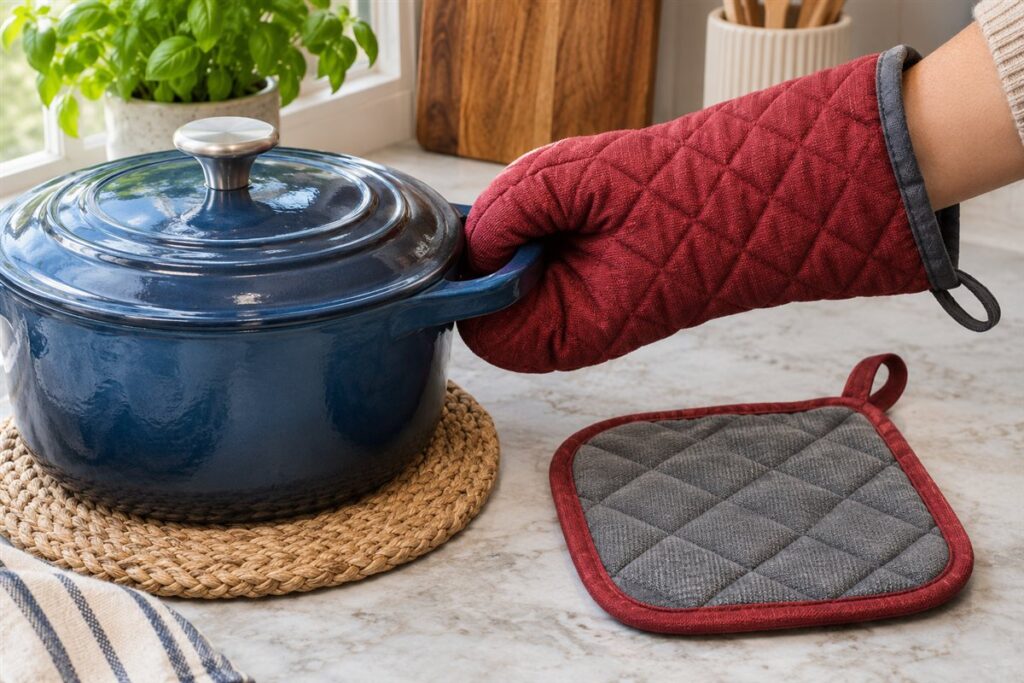
A good pot holder or oven mitt is thick, dry, well fitted and made of a material that the maker states can handle kitchen heat. Mitts protect more of your hand and wrist, while flat holders are quick to grab and store. Use the points below to choose the style that fits your cooking. No gear removes all risk, so follow the maker’s instructions.
Styles Compared
Oven mitts
Shaped like a glove or mitten, they cover the hand and often part of the forearm. They suit heavy pans, deep roasting dishes and oven racks.
Flat pot holders
Square or round pads you hold in your fingers. They are handy for pan handles and lids, but give less coverage.
Gloves with fingers
Give more dexterity for gripping, though they can be bulky.
Materials
| Material | Notes |
|---|---|
| Cotton, quilted | Soft and breathable, needs to be dry and thick, can scorch |
| Silicone | Grippy, wipe clean, check the maker’s heat limit |
| Aramid or similar fibers | Used in some high heat gear, check the label |
| Combination | Silicone outside, fabric lining inside, for grip and comfort |
What to Check
- Heat limit on the label: Look for the maker’s stated limit and what it covers.
- Fit: A mitt that is too loose slips, and one too tight cuts down feel.
- Length: Longer cuffs protect wrists when reaching into an oven.
- Grip: Textured surfaces help with slick pans.
- Lining: A smooth, soft interior is more comfortable.
- Care: Check for machine washing and drying instructions.
Safe Use
- Keep holders dry. Moisture carries heat to the skin faster.
- Do not use a worn, burned or thin one.
- Keep them away from flames and burners.
- Test the weight of a pan before lifting it, and keep a clear path to the counter.
- Replace any holder with holes or scorch marks.
A Worked Walkthrough: Lifting a Hot Roasting Pan
This is the job where the right gear and a calm routine matter most.
- Clear a space first. Put a heatproof trivet or a folded dry towel on the counter, and move anything that could be knocked over.
- Check your mitts are dry and undamaged. Look at the palm and fingers for thin spots and scorch marks.
- Put the mitts on and open the oven door fully. Pull the rack out partway so you can reach the pan without leaning into the heat.
- Grip both handles with your whole hand, not your fingertips, and keep the pan level so hot liquid does not slop over the edge.
- Lift slightly to feel the weight. If it is too heavy for one smooth movement, ask for help or slide the pan onto the counter in stages.
- Walk straight to the prepared space and set the pan down gently. Do not turn or twist while carrying.
- Keep the mitts on until the pan is down, then remove them and let them dry away from the stove.
Remember that handles, lids and pan sides stay hot for a long time. A towel draped over a hot handle is a useful reminder that the pan has just come out of the oven.
Common Scenarios
Baking bread and cakes
Long mitts with a good grip help you reach to the back of the oven for loaves and tins. A flat holder is useful for gripping a loaf pan by its short end.
Cooking on the stovetop
Pan handles can get hot, especially on cast iron or when an oven-safe pan has just come out of the oven. Keep a small holder within reach of the stove for sliding or tilting pans.
Handling a baking sheet
Thin sheets heat fast and are easy to drop. A flat holder in each hand gives you control, and gloves with fingers help if you need to pinch the edges.
Grilling outdoors
Choose gear with a long cuff and a heat limit suited to open flame, according to the maker’s guide. Wipe grease off before storing it.
Mistakes to Avoid
- Using a wet or damp holder. Water turns to steam and conducts heat to your hand in seconds.
- Using a towel as a substitute. Towels are thinner, slip easily and can catch light near flame or elements.
- Keeping a scorched or worn one. Thin spots may not be obvious, and the damage can hide an unprotected area.
- Assuming gear is heatproof forever. Materials age with heat and washing, so a holder that once worked well can lose its protection.
- Hanging it over the stove. A holder that dangles near a burner can catch fire. Store it at a safe distance.
Everyday Habits and Care
Keep two or three holders within reach of the stove and oven, and hang them on hooks so they stay dry. Wash fabric ones regularly, because grease build-up makes them less safe near heat. Never wring or soak a holder you plan to use on a hot pan, since steam can reach your skin quickly.
Follow the washing instructions on the label. Silicone usually wipes clean with soapy water and dries quickly. Cotton and quilted types can often go in the washing machine, but heat from a tumble dryer may shrink them or thin the padding, so check the label. Once a holder is stiff with grease, stained badly, or flattened, replace it.
Size and Comfort
Hand sizes vary, so try on a mitt if you can. A snug fit gives better control over heavy dishes, while a loose mitt can slide off. Left and right hand shapes, or mitts that work on either hand, both exist. Make sure the thumb has enough room to grip a pan handle without strain.
Quick Troubleshooting
| Symptom | Likely cause | What to try |
|---|---|---|
| Heat comes through quickly | Thin, damp or compressed padding | Dry it out and replace if it stays thin |
| Mitt slips off the hand | Too large or smooth lining | Choose a snugger size or a fitted lining |
| Slick pans slide | Worn grip surface | Choose textured silicone or replace the mitt |
| Fabric smells of smoke | Grease or scorching | Wash it as the label allows, or replace it |
| Stiff, hard fabric | Baked-in grease | Replace it, since greasy fabric is less safe near heat |
Glossary
- Cuff: The extended part of a mitt that covers the wrist.
- Quilting: Stitched layers of fabric and padding that trap air for insulation.
- Aramid: A heat-resistant synthetic fibre used in some protective gear.
- Heat limit: The maximum temperature or contact time stated by the maker.
- Trivet: A stand or mat that protects a counter from hot cookware.
FAQ
Can I use a dish towel instead?
A folded towel gives less protection and can slip or catch fire. A purpose made holder is the safer habit.
How often should I replace them?
When they are worn, thin, stained with grease or damaged.
Are silicone holders better than cotton?
They suit different needs. Silicone grips well and wipes clean, while cotton feels softer and bends easily around handles. Check the maker’s heat limits for either type.
Can I use a mitt on a grill?
Only if the maker says it is suitable. Keep the cuff away from flame, and remember that hot grill surfaces can heat any gear very quickly.
How many do I need?
Many kitchens do well with one pair of mitts for the oven and a couple of flat holders near the stove. Having spares means you can swap in a dry one if a holder gets damp.
The Short Version
Choose an oven mitt for heavy dishes and a flat holder for quick grabs. Check the heat limit on the label, keep them dry and replace worn ones. Clear a landing spot before you lift anything hot, and follow the maker’s guidance.