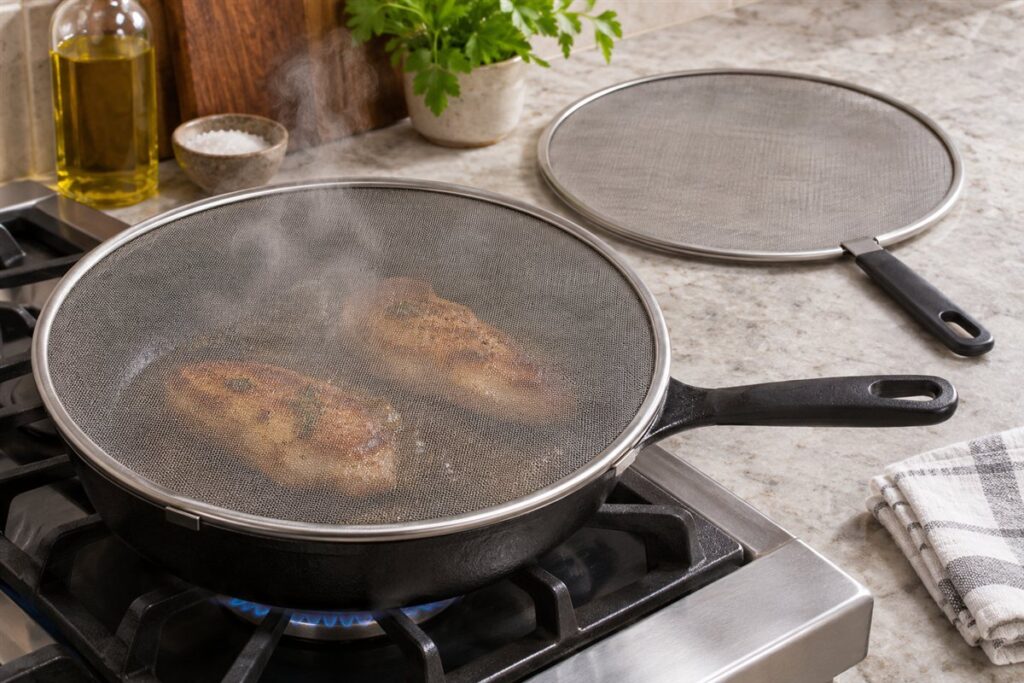
A splatter screen is a fine mesh disc with a handle that sits over a pan to catch spitting oil while letting steam escape. Choose one that is a little wider than your largest skillet, with a heat-resistant handle and mesh that is easy to wash. Take care around hot oil, and follow the maker’s safety advice. This guide covers size, build, safe habits, common situations and cleaning.
What It Does
When food hits hot fat, droplets can fly out. A screen stops most of them from reaching you and the stovetop, but it still lets steam out so food browns instead of steaming. It is not a lid, and it does not make hot oil cooking risk free.
Size
- Measure the top diameter of your largest skillet.
- Choose a screen at least as wide, ideally a little wider, so it covers the rim.
- If you own several pans, consider a larger screen that fits most, or a pair of sizes.
- Check that it fits inside your cabinet or drawer, or has a hanging hole.
Measure across the top edge of the pan, not the base, because many skillets flare outward. Use the inside rim diameter where the screen will rest. If the screen is far wider than the pan, it can overhang and reach a neighboring burner, so allow only a little extra on each side. For sloped or curved woks, a flat disc may not seat well, so check whether the maker describes a domed shape.
Features Worth Comparing
| Factor | Why it matters | What to check |
|---|---|---|
| Mesh | Finer mesh catches more spatter | Tight, even weave |
| Frame | Keeps the screen flat | Sturdy rim that does not bend |
| Handle | Needs to stay cooler than the pan | Heat resistant, folds or hangs |
| Material | Stainless steel is durable | Rust resistant, cleans easily |
| Feet or raised edge | Holds the screen off the food | Stable on the pan rim |
Handle and Frame in Practice
The handle is the part you will touch most, so look at how it attaches and what it is made of. A handle that is riveted or welded to the frame stays firm, while a loose joint wobbles when you lift the screen. Some handles fold flat for storage, and others have a loop for hanging. A long handle keeps your hand away from the pan, but check that it does not hang over a neighboring burner. The frame should hold the mesh flat, because a screen that sags in the middle can touch the food or sit unevenly on the pan rim. A frame with a slightly raised edge or small feet keeps the mesh clear of the pan and lets steam move out freely.
Safe Habits
- Pat food dry before it goes into hot oil, because water is the main cause of spattering.
- Lower food into oil away from you, and do not overfill the pan.
- Keep the handle clear of the burner flame or element.
- Let the screen cool before you wash it.
- Never leave hot oil unattended, and follow the pan and stove manuals.
A Worked Walkthrough: Pan-Frying Bacon or Sausages
- Choose a skillet with enough room for the food in a single layer, and set the screen nearby where you can reach it without stretching over the heat.
- Pat the food dry with a paper towel.
- Heat the pan gently, then add the food, laying each piece down away from you.
- Place the screen over the pan, with its handle pointing away from the burner flame.
- Lower the heat if you hear heavy popping, since high heat is the main reason for spattering.
- Lift the screen by the handle with a mitt to turn the food, tilting it away from you so any collected steam leaves in the other direction.
- When finished, remove the food, let the fat cool, and set the screen aside to cool before washing it.
Cook meat to the doneness described in food safety guidance, and use a thermometer when in doubt.
Common Scenarios
Weekend burgers
A screen wider than the pan covers the whole surface. Use the handle to lift it for flipping, and keep a mitt nearby.
Searing a steak
High heat means more spatter. A fine mesh helps, and a vent or range hood fan used as its manual describes clears smoke.
Frying in a small saucepan
A smaller screen or an oversize one that rests across the rim works. Make sure it sits stable and does not tip into the oil.
Cooking with a cast iron skillet
The heavy pan runs hot, so use a screen whose handle stays clear of the edge. Treat the pan handle as hot too.
Mistakes to Avoid
- Using the screen as a lid for long simmering. It lets steam out, so it will not hold moisture in.
- Letting the handle rest over the flame. The handle can heat up and cause burns.
- Buying a screen narrower than the pan. Oil escapes around the edge and the point is lost.
- Skipping the pat-dry step. A screen reduces spatter but does not stop it from being violent when wet food hits hot fat.
- Washing it while hot. Sudden cooling can bend the frame.
Cleaning
Grease collects in the mesh. Soak the screen in hot soapy water, then scrub with a brush from both sides. Check the care guide for dishwasher use. Dry well to keep metal from spotting. If grease has hardened in the weave, a longer soak with a little dish soap usually loosens it, and a stiff nylon brush reaches the gaps without damaging the wire. Rinse until no soapy film remains.
When You Might Skip It
For low-heat cooking, such as simmering sauces, a screen is rarely needed. It is most helpful when pan frying bacon, burgers and sausages, or when searing meat. If you only cook this way now and then, a basic model stored flat in a drawer is plenty.
Quick Troubleshooting
| Symptom | Likely cause | What to try |
|---|---|---|
| Oil still escapes | Screen too small or heat too high | Use a wider screen and lower the heat |
| Food steams instead of browning | Pan crowded or screen blocking vapor | Use a coarser mesh or cook in batches |
| Frame bends | Thin wire or sudden cooling | Let it cool before washing |
| Greasy film remains | Hardened fat in the mesh | Soak longer and brush both sides |
| Handle is hot | Held over the flame | Keep it clear of the burner and use a mitt |
Glossary
- Mesh: the woven wire that forms the screen.
- Frame: the rim that holds the mesh flat.
- Spatter: small droplets of fat thrown from a hot pan.
- Sear: to brown a surface at high heat.
- Range hood: the fan unit above a cooktop that draws smoke away.
- Overhang: the part of the screen that extends past the pan rim.
FAQ
Can I use a screen on a nonstick pan?
Yes, as long as the metal rim does not scrape the surface. Set it down gently.
Is a lid a better option?
A lid traps steam, which can soften a crisp crust. A screen gives a middle path.
Does the screen stop all spatter?
No. It reduces it a great deal but small droplets can still escape, so take care and keep the heat in check.
What material is best?
Stainless steel mesh is common because it is durable and washes easily. Check the maker’s description of the frame and handle too.
Can I use it for splatter in the microwave?
Only if the maker says it is made for it. Metal in a microwave can be dangerous, so follow the microwave manual.
The Short Version
Choose a fine mesh screen slightly wider than your biggest pan, with a heat resistant handle and a sturdy frame. Dry food first, and follow the maker’s safety instructions. Lower the heat if spatter is heavy, and let the screen cool before washing.