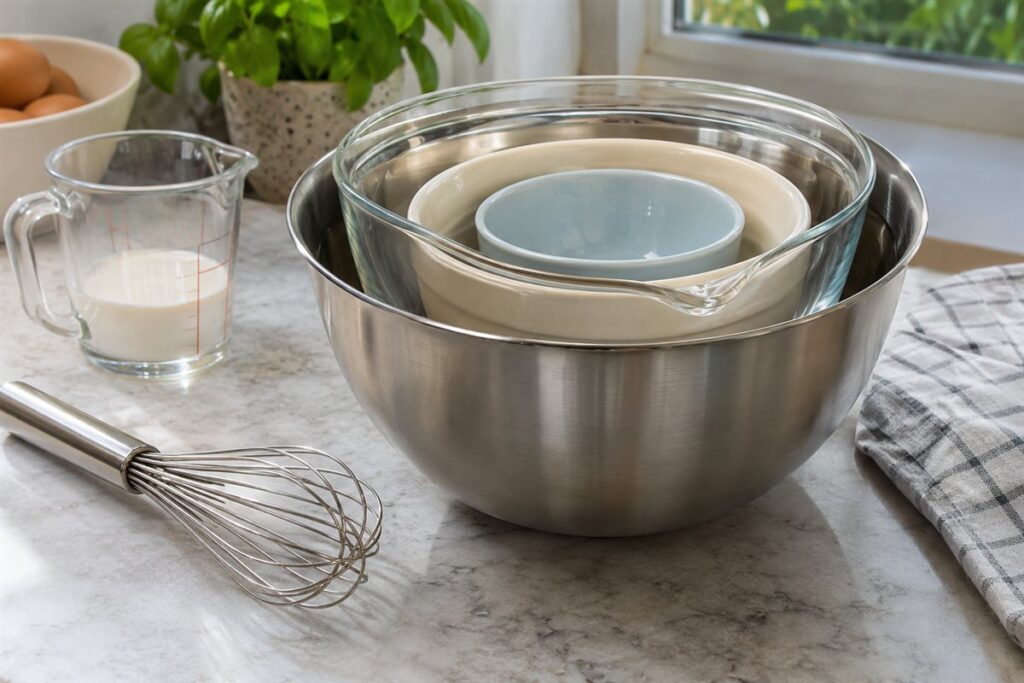
To choose mixing bowls, think about the sizes you use most, the material that suits your cooking and any handy extras like a pour spout or non-slip base. A nested set of three or four bowls covers most home kitchens. Here is a simple way to compare, followed by a worked sizing exercise, realistic cases, mistakes to avoid and a troubleshooting table.
Decision Criteria
| Factor | Why it matters | What to check |
|---|---|---|
| Size range | Too small and batter spills; too large is awkward | A small, medium and large bowl is a good mix |
| Material | Affects weight, heat use and cleanup | See the list below |
| Shape | Wide bowls suit whisking; deep ones suit dough | Think about what you mix |
| Base | A stable base keeps the bowl in place | Look for a flat or grippy bottom |
| Lid or cover | Lets you store food in the same bowl | Check the fit |
| Nesting | Saves cabinet space | Make sure bowls stack without sticking |
Material Choices
- Stainless steel: Light, tough and cool to the touch. A good everyday option, though it is not suited to microwaves.
- Glass: Lets you see the contents, resists stains and often works in the microwave. It is heavier and can break if dropped.
- Ceramic or stoneware: Sturdy and attractive, and can hold the cold when chilling dough, but it is heavy.
- Plastic: Light, but it may stain or hold odors over time.
- Silicone-lined or collapsible: Space savers that suit small kitchens.
Check the maker’s guide for oven, microwave and dishwasher use. Do not assume any bowl can go into a hot oven.
Sizing Your Set
- List your usual tasks: whisking eggs, mixing cake batter, tossing salad, kneading dough.
- Choose a small bowl for eggs and sauces, a medium bowl for batters, and a large bowl for salads and dough.
- Check that the biggest bowl fits in your sink and cabinet.
- Look for a rim that is easy to grip with wet hands.
Extras Worth Having
- A pour spout for batter.
- A non-slip ring or silicone base.
- Measurement marks inside the bowl.
- Matching lids for leftovers and prep ahead.
Care and Storage
Wash bowls with warm soapy water, and dry them well before nesting them, or moisture can collect between layers. Greasy batter can cling to plastic, so rinse with hot water first. Check the maker guide before using any bowl in the oven, microwave or dishwasher, since limits vary by material.
Think about how the bowls will live in your kitchen day to day. Bowls that are used for both prep and serving should look presentable and be easy to carry to the table, while bowls kept for messy jobs can be plainer and tougher. If you store them in an upper cabinet, weight matters more, because lifting a full stack overhead is harder than it looks. If you keep them in a low drawer or on an open shelf, check that the stack is stable and that the smallest bowl does not slip inside the larger ones. A short list of what you cook most often, taped inside a cabinet door while you shop, keeps the decision grounded in real use instead of in how a set looks on the shelf.
A Worked Example: Sizing a Set for Your Own Cooking
Use what you made in the last two weeks as your guide.
- Write down your last six dishes. Note which ones needed mixing, whisking, tossing or resting.
- Estimate the volume for each. A salad for four needs room to toss without spilling. A dough needs space to rise. A sauce or dressing needs very little.
- Sort the dishes into three groups. Small tasks, everyday tasks and big tasks. This gives you your small, medium and large bowls.
- Check your cabinet. Measure the height and width of the space and compare it with the stated size of each bowl, remembering that nested bowls take the height of the largest one.
- Check your sink and dishwasher. A large bowl that does not fit in the sink is hard to wash by hand.
- Choose the material. Think about whether you want to microwave in the bowl, whisk in it, serve from it or chill it.
- Look at the extras. A pour spout and non-slip base are worth having if you make batters, and lids matter if you prepare ahead.
Common Scenarios
A household that cooks every night
A set of three or four in a durable material, with at least one large bowl, covers daily prep and leftovers. Lids can double as storage.
A tiny kitchen with little cabinet space
Collapsible or tightly nesting bowls save room. Choose a set whose largest bowl still handles a family salad.
A baker who makes bread
A large, deep bowl gives dough room to rise. Wide bowls suit whisking, while deeper ones keep flour in.
Someone who reheats food in the bowl
Choose a material the maker states is suitable for the microwave, and check whether the lid is also suitable.
A family with young cooks
Light, non-slip bowls are easier for small hands to hold steady. Supervise whisking and any use near heat.
Mistakes to Avoid
- Buying only large bowls. They are clumsy for small jobs, such as whisking a couple of eggs.
- Ignoring weight. A heavy bowl is steady, but may be tiring to lift when full.
- Putting a bowl in the oven or microwave without checking. Not every bowl is made for heat, and sudden changes can crack glass and ceramic.
- Nesting damp bowls. Trapped moisture causes smells and sticking.
- Using a greasy plastic bowl for whipping. Fat residue can stop egg whites whipping properly. Use a clean bowl of another material.
Quick Troubleshooting
| Symptom | Likely cause | What to try |
|---|---|---|
| Bowl slides while you stir | Smooth base on a smooth counter | Place a damp cloth under it or use a non-slip base |
| Nested bowls are stuck | Tight fit or suction | Separate gently and allow air in; do not force |
| Plastic bowl smells | Absorbed odors or fat | Wash with hot soapy water and air dry |
| Batter splashes out | Bowl too small or too shallow | Switch to a larger, deeper bowl |
| Metal bowl dents | Thin walls or a drop | Use care when stacking, and replace if it affects use |
| Glass bowl chipped | Impact at the rim | Stop using it for food |
Glossary
- Nesting: Stacking bowls inside one another.
- Pour spout: A lip shaped to direct liquid out of the bowl.
- Stoneware: A dense, fired ceramic.
- Collapsible: Folding down for storage.
- Rim: The top edge of the bowl.
- Foot ring: A raised ring on the base that helps stability.
FAQ
How many bowls do I need?
Three is a comfortable number. Bakers who cook often might want a fourth for dry ingredients.
Do mixing bowls need to match?
No. Choose what works for each job. A mixed collection can serve you well as long as each bowl suits its task.
Is stainless steel or glass better?
Each has strengths. Steel is light and tough, while glass lets you see the contents and often suits the microwave. Choose based on how you cook.
Can I chill dough in a mixing bowl?
Often yes, if the bowl is suitable for the fridge and you cover it. Follow food-safety guidance for chilling and storing.
How do I stop a bowl from slipping?
Use a bowl with a non-slip base, or place a damp cloth or silicone mat under it.
The Short Version
Choose a nested set in a material you like, with a stable base and enough range of sizes. Stainless steel and glass are common choices for everyday use. Base your decision on what you actually cook, and check storage, sink and cabinet space first.