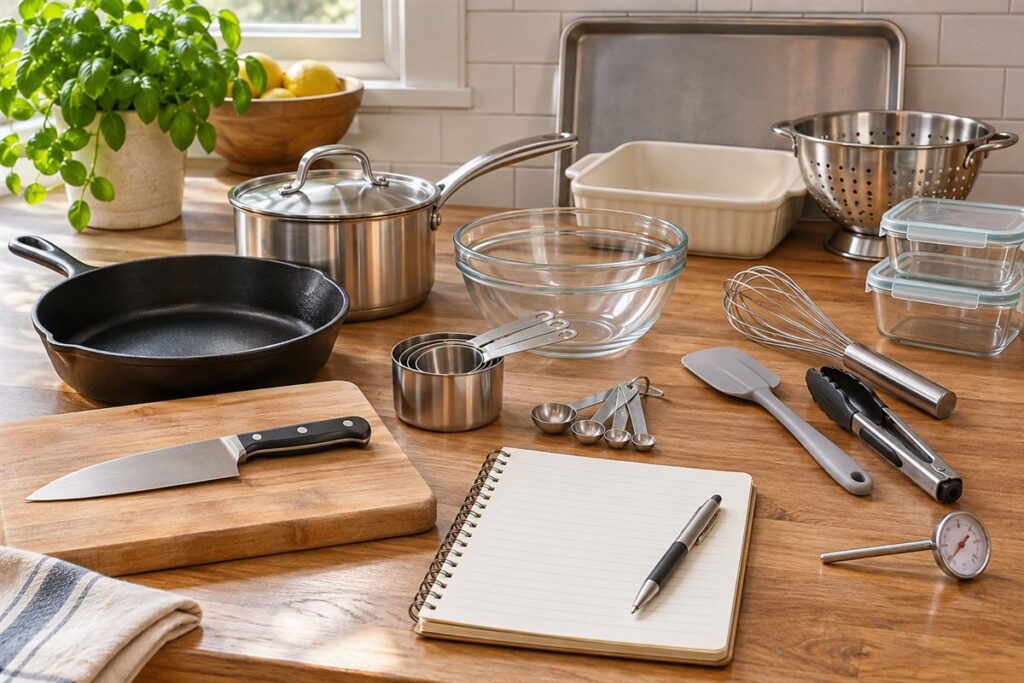
You can stock a kitchen gradually by adding one useful tool at a time, based on what your cooking actually needs. This approach spreads out the cost, prevents clutter, and helps you learn what you really use. Follow the steps below to build a sensible set over several months.
Step by Step
- Write down what you cook. List the meals you make most. Note the tools each one needs, such as a pan, a knife, or a baking dish.
- Buy the core first. A chef’s knife, a cutting board, a skillet, and a saucepan with a lid cover many dishes.
- Add measuring and mixing tools. Measuring cups, spoons, and a couple of bowls make recipes easier to follow.
- Cook for two weeks. Keep a note of every time you wish you had something else.
- Fill the gaps. Add one item at a time from your wish list, beginning with whatever you missed most often.
- Look over the set every season. Remove tools you never touched and replace worn ones.
A Sensible Order of Purchases
| Stage | Add | Why now |
|---|---|---|
| First | Knife, board, skillet, saucepan | Cover daily cooking |
| Second | Mixing bowls, measuring tools, spatula, tongs | Support recipes |
| Third | Sheet pan, baking dish, colander | Oven and pasta meals |
| Fourth | Thermometer, whisk, storage containers | Accuracy and leftovers |
| Later | Specialty items | Only when a habit demands them |
Ways to Add Without Overspending
- Borrow a specialty tool before you buy it.
- Ask family if they have extras they no longer use.
- Look at secondhand shops for sturdy items, and inspect handles and surfaces carefully.
- Wait for gift occasions and share a short wish list.
Check any secondhand cookware for damage, such as deep scratches, loose handles, or warping, and follow the maker’s guidance on use and care.
Why Slow Works
When you buy gradually, each item has a clear purpose. You are less likely to own duplicates, and you learn the strengths of each tool. The pace also gives you time to think about quality, size, and materials.
Keeping a Simple Wish List
Keep a note on your phone or the fridge where you add items you find yourself missing. Write down why you want each one and what you would use it for. After a few weeks, read the list again. Items that still seem useful move to the top, while impulse ideas fade away. This habit saves you from clutter and helps you buy with purpose.
Quality Over Quantity in the Core Tools
When you buy slowly, you can afford to be choosy about the first few tools, and those are the ones worth spending time on. A chef knife is used for nearly everything, so choose one that feels balanced and comfortable in your hand, and that you can maintain. A skillet and saucepan carry much of daily cooking, so consider thickness, handle comfort and whether the lid fits well. Heavier-bottomed pans generally heat more evenly, but they are also heavier to lift, so test the weight if you can.
Material choice affects care. Stainless steel is durable and versatile. Cast iron lasts for decades with care and holds heat well, but it is heavy and needs seasoning. Nonstick pans are convenient for eggs and delicate foods, but the coating wears over time and often limits utensil and heat choices, so follow the maker’s guidance. Check your cooktop type, especially for induction, which needs magnetic cookware.
- Buy the best you can reasonably afford for tools you use daily.
- Choose simpler, multi-purpose designs over specialized ones early on.
- Read care instructions and consider whether you will actually follow them.
A few well-chosen pieces often outperform a boxed set with many items you may never use. Slow building lets you choose each piece separately, matching it to your cooking rather than to a package.
Tracking What You Actually Reach For
The wish list described above works best if it is based on real observations, and there are simple ways to collect them. For a couple of weeks, keep a note on your phone or fridge whenever you improvise, struggle or wish for a different tool. Examples include using a fork as a whisk, balancing a pot lid on the wrong pan, or washing a single bowl three times in a row. Each of these points to a gap.
Also notice which tools you use again and again. These are the best candidates for upgrading when they wear out. A flimsy spatula you use every day is a better replacement target than a specialty tool you pull out twice a year. Keep an eye on what you borrow from friends or family too, since needing the same item repeatedly signals a real need.
- Frequent frustration: a tool worth buying soon.
- One-off annoyance: probably can be worked around.
- Idle fantasy: wait until a real recipe calls for it.
Review your notes monthly. Patterns emerge, and you can sort needs from wants. This process also teaches you about your own style of cooking, which is more useful than any generic list of essentials.
Starter Sets Versus Individual Pieces
Boxed sets can look like an easy shortcut, but they have tradeoffs. A set offers matched pieces, a consistent look and often a lower price per item compared with buying each separately, though prices vary. On the other hand, sets sometimes include pieces you will rarely use, or sizes that do not suit your cooking. Quality can also vary across items in the same set.
Building piece by piece gives you control. You choose the size and material for each item, and you can mix brands and styles. It takes more research and may cost more per item, but you pay only for what you need. Some people start with a small set of the most basic pieces and then add individual items.
- Check what each piece in a set is, and count the ones you would use weekly.
- Compare piece sizes against your household needs.
- Ask whether lids and handles will work with your stove and oven.
If you do buy a set, read the product listing carefully for what is included, since lids and accessories are sometimes counted as separate pieces. Think about storage, because a large set can fill a cabinet quickly. The right answer depends on your budget, space and how much you enjoy researching each purchase.
Secondhand Finds, Gifts and Hand-Me-Downs
Not every item has to be bought new, and secondhand sources can be a good fit for a slow build. Thrift stores, yard sales and online marketplaces often have sturdy items at modest prices. Cast iron is a classic example, since old pans can often be cleaned and reseasoned. Basic bakeware, mixing bowls and wooden tools are also common finds.
Inspect carefully. Check for cracks, warping, deep scratches, loose or wobbly handles and rust. Avoid nonstick pans with flaking coating. Look for sturdy construction and clean, intact lids. Wooden items should be free of splits and rough patches. Sniff for strong odors that may be difficult to remove. When in doubt, skip it. Wash secondhand items thoroughly before use, and follow the maker’s advice if you know the brand.
Gifts and hand-me-downs are also useful, but be selective. It is fine to say no to items that do not fit your kitchen. When people offer gifts, a short list of items you need makes it easy for them to choose well.
- Skip secondhand items that cannot be cleaned thoroughly.
- Be cautious with older items of unknown material or coating.
- Accept only what you will use.
Knowing When to Replace and Upgrade
A kitchen built slowly also needs maintenance and eventual upgrades. Worn tools are not only inconvenient but sometimes unsafe. Signs it is time to replace include cracked or melting plastic handles, wobbly or loose handles, deep scratches or flaking on nonstick coatings, warped pans that no longer sit flat, rust that cannot be removed, and knives that are chipped or cannot hold an edge even after sharpening. Wooden tools that are splintered or deeply cracked should go.
Upgrading is different from replacing. Consider an upgrade when you notice a tool limiting your results, such as a thin pan that scorches or a flimsy peeler that frustrates you. Upgrade one item at a time, and choose it based on the reason it fell short. If the pan scorched, look for a thicker base. If the peeler was awkward, look for a more comfortable handle.
- Keep a note of what you replaced and when.
- Donate or recycle old tools responsibly, following local rules.
- Do not replace working items just because newer versions exist.
Over time, your kitchen will settle into a reliable collection that fits how you cook. Revisit your list each season, and let your cooking habits guide what comes next rather than trends.
FAQ
What is the single most important tool?
For most cooks it is a comfortable, sharp knife, along with a stable board. Handle it with care and store it properly.
How long does it take to build a full kitchen?
There is no fixed timeline. Many cooks feel well equipped after several months of steady cooking and thoughtful additions.
Should I buy a cookware set or individual pieces?
Sets can be convenient and sometimes cost less per item, but may include pieces you rarely use. Individual pieces let you choose each one for your cooking.
Is it safe to buy secondhand cookware?
Often yes, if you inspect it carefully. Avoid pieces with flaking coatings, deep cracks, severe warping or loose handles, and wash everything well.
Which cookware material should I start with?
Stainless steel is versatile and durable, cast iron is long lasting, and nonstick is convenient for delicate foods. Choose based on your cooking and care habits.
How do I know if my cookware works with my stove?
Check the maker's guidance. Induction cooktops need magnetic bases, and flat bottoms work best on smooth electric tops.
What should I do about a gift I do not need?
You can donate it, regift it or return it if the giver agrees. Keep only items that fit how you cook.
How can I tell when a knife is worth upgrading?
If it feels uncomfortable, will not hold an edge after sharpening or has damage such as chips, an upgrade may help. A comfortable, sharp knife is a strong foundation.
Do I need specialty gadgets early on?
Usually not. Wait until a recipe or habit shows that you need one, and check whether an existing tool can do the job.
The Short Version
Begin with a knife, board, skillet, and saucepan, then add items one at a time as real gaps appear. Look over your set each season and avoid buying for hypothetical needs.