Disclosure: As an Amazon Associate, topratedkitchenware.com earns from qualifying purchases. Links on this page are affiliate links; they cost you nothing extra. Prices and availability change often, so check the current Amazon listing before you buy.
Weighing immersion blender pros and cons honestly is more useful than another breathless recommendation, because this is a tool with genuine, structural advantages and genuine, structural limits, and both sides follow from the same design: a sharp blade on a stick that you lower into food. The pros explain why soup cooks swear by it. The cons explain why smoothie obsessives and ice crushers should look elsewhere. This article sets out six of each, shows what the trade-offs mean for different cooks, compares the alternatives fairly, and finishes with the buying and care habits that shrink the cons to their smallest honest size.
Key Takeaways
- Verdict in one line: an immersion blender suits cooks who purée hot food, make sauces and value tiny washing up; it does not suit ice, frozen loads or big dry processing.
- The biggest pros: blend in the pot, tiny footprint, fast cleaning, texture control, modest tiers.
- The biggest cons: limited power for hard and frozen loads, splatter if technique slips, hand fatigue on big jobs, safety demands respect.
- Most cons shrink with technique and honest buying; the power ceiling does not, and should be accepted, not fought.
- Models named here are prose-only recommendations while listing verification is pending.
In this guide
Immersion Blender Pros and Cons at a Glance
Pros: blends in the cooking pot with no hot transfers; stores in a drawer; rinses clean in about a minute; precise texture control from rustic to silky; excellent at emulsions and small batches; modest tiers compared with full-size blenders. Cons: cannot match countertop power for ice, frozen fruit or nut butters; can splatter hot liquid if the blade surfaces; can suction onto pan bottoms; requires your hand and attention throughout; blades demand strict safety habits; results depend on technique more than on a timer. Neither list is a trick. Both are the same tool, described completely.
The Pros
Pro: It Blends Where the Food Already Is
This is the founding advantage and it never gets old. Soup is puréed in its own pot, gravy smoothed in its own pan, sauce finished in the jug it will be served from. Every deleted transfer is a deleted opportunity to spill near-boiling liquid, a deleted extra vessel to wash, and a deleted cooling delay while food waits its turn in a jug. For hot food especially, in-place blending is not a convenience feature; it is a safety and quality feature, and it is the main reason the category exists and thrives. Once a cook has finished a soup without a single ladle crossing the kitchen, going back feels like a punishment detail.
Pro: Storage and Footprint Are Almost Nothing
A stick blender lives in a cutlery drawer, a utensil crock or a slim cupboard slot. It asks for no counter territory, no negotiation with the coffee machine, no permanent parking that gathers dust and guilt. In small kitchens, rental kitchens and crowded family kitchens alike, that footprint is often the difference between owning blending capability and not owning it. Appliances that live out get used; appliances that must be fetched, assembled and rehomed get skipped. The immersion blender is engineered, almost accidentally, to always be the easiest tool to reach for.
Pro: Cleaning Takes About a Minute
Cleaning is easiest in the first minute after blending, and the classic trick earns its fame: fill a tall jug with warm water and a drop of washing-up liquid, submerge the blade, and run the blender briefly so it washes itself. Then disconnect the power, detach the shaft if your model allows it, rinse, and dry the blade area carefully with a cloth moved from the shaft toward the guard, never across the edge. Dried-on food is the enemy; a soup left to set on the guard turns a one-minute rinse into a scrubbing session with a bottle brush around a sharp edge, which is precisely the situation the safety rules exist to prevent. Build the rinse into the cooking routine and the tool stays the lowest-effort appliance you own.
The motor body never goes under the tap and never into water. Wipe it with a damp cloth, keep moisture away from the vents and the coupling, and let everything dry fully before storage so seals and bearings stay happy. Check the cord for nicks if it lives near the stove, store the shaft where the guard will not be knocked or used as a hook for hanging utensils, and keep the whole appliance out of children’s reach, unplugged or with its battery removed. Once in a while, run your eye over the guard and blades for dings from bones or cutlery; a damaged guard changes how the tool handles and is a reason to contact the maker about parts rather than to press on regardless.
Pro: Texture Control Lives in Your Hand
Because you move the tool and choose the moment to stop, texture is a decision rather than a programme. Pulse briefly for a rustic soup with body, keep going for silk, tilt and sweep for a sauce that keeps a little character. Countertop blenders, sealed and timed, push everything toward uniform smoothness; the stick lets a cook stop at every interesting point along the way. Skilled users exploit this constantly, blending three-quarters of a pot smooth and stirring the rest back in, or emulsifying a dressing to exactly the gloss they want. It is cooking, not processing, and many people simply enjoy it more.
Pro: Small Batches and Emulsions Are Its Home Ground
The core technique is simple to describe and takes a few batches to feel. Lower the shaft into the food at a slight angle so air is not trapped under the guard, submerge the blade completely, start on low, and then move the blender slowly up and down and around the vessel in overlapping passes. The up-and-down motion matters: food circulates through the blade zone in a vortex, and a blender held still will polish one column of soup while leaving the corners chunky. For a large pot, work in quadrants and finish with a slow sweep around the edges where pieces hide. Short bursts with pauses give you control over texture; continuous running is for the final smoothing pass once the big pieces are already broken down.
Texture control is the immersion blender’s party trick, and it comes from stopping early rather than from any special setting. For a rustic soup, a few short pulses leave body and visible pieces; keep going and the same pot turns silky. For sauces and dressings, the narrow beaker that ships with many models is the right vessel: the tight walls keep a small volume of liquid in constant contact with the blade, which is exactly what an emulsion like mayonnaise needs to form. Wide bowls defeat small batches, because the ingredients spread into a shallow layer the blade skims over. Match vessel to volume and most ‘my blender does not work’ complaints quietly disappear.
Pro: The Tiers Are Modest
Set against serious countertop blenders and food processors, immersion blenders occupy gentle territory: a capable entry model costs a fraction of a premium jug machine, and even premium sticks sit well below flagship countertop prices, in qualitative terms. That changes the risk maths of buying. A household can enter the category, learn its technique, and discover its true usage before deciding whether a premium upgrade is justified. Few appliances offer so much daily utility per unit of money and per inch of storage, which is why the type keeps appearing in first kitchens, second kitchens and holiday homes.
The Cons
Con: A Real Power Ceiling for Hard and Frozen Loads
Know the menu the tool genuinely loves. Soups of every kind, from broths with soft vegetables to thick bean and lentil pots, are its home ground. Sauces, gravies, salsas with soft ingredients, baby food, whipped cream with the whisk attachment, smoothies in the beaker, protein shakes, pancake batter, scrambled-egg mixtures and emulsions like mayonnaise and vinaigrettes all sit comfortably within its reach. Cooked ingredients blend far more willingly than raw ones; a raw carrot chunk will bounce around the guard where a simmered one collapses into silk. When a recipe asks the hand blender to do the heavy breaking-down, a few minutes of cooking first is the honest shortcut.
And know the limits, because they are real. Hard ice, frozen-solid fruit in quantity, hard cheeses, raw fibrous stalks, coffee beans, whole spices, thick doughs and dense nut butters ask for torque and blade geometry this tool does not have. Some premium models chew through a few ice cubes in a drink; that is a party trick, not a licence to treat the shaft like a crusher, and makers’ guidance consistently steers frozen work toward full-size blenders. Overloading shows up as a straining motor note, a hot smell and a guard clogged with unprocessed pieces. Stop, clear the guard safely with the power disconnected, reduce the load, add liquid, and continue. A cook who respects the limits keeps the same blender for years; a cook who fights them shops for a replacement by spring.
Con: Splatter Is Always One Mistake Away
Hot liquid is where immersion blenders earn their reputation and where most burns happen, so the technique matters as much as the tool. Keep the blade fully submerged before you press the trigger and keep it submerged until the blades have stopped completely. The moment a spinning blade breaks the surface of a hot soup, it throws a fan of scalding droplets across the stove, your hands and your shirt. Start at the lowest speed, let the vortex form under the surface, and only then raise the speed or begin to move. Let very hot liquids cool slightly before blending, following your maker’s guidance; a soup taken straight off a rolling boil steams, expands and spits far more than the same soup rested for a short while, and the gentler temperature is also kinder to plastic beakers and seals.
Watch for suction on pan bottoms, the second classic surprise. The bell-shaped guard can seal itself against the base of a pot under power, tugging the blender downward and holding it there while the motor strains. Break the seal by tilting the shaft slightly or lifting a fraction as you move, and keep the blender travelling in slow passes rather than parked in one spot. Modern anti-suction guard designs reduce the effect, but none eliminate it, and the habit of constant gentle movement also blends more evenly. Work in a pot deep enough that the liquid sits well below the rim, because a submerged blade displaces and churns; a shallow pan of hot liquid plus a spinning blade is a splatter equation that never favours the cook.
Con: Your Hand Is the Motor Mount
An immersion blender works only while you hold it, squeeze it and move it, and big or thick jobs make that honest labour. A large pot of dense bean soup is several minutes of gripping, guiding and listening, with the motor’s vibration in your palm throughout. For most cooks and most pots this is trivial; for very large batches, weak grips or wrist problems, it is a genuine consideration, and it is the countertop blender’s best argument: load, seal, press, walk away. If your cooking regularly involves industrial quantities, weigh this con heavily, because no technique removes it.
Con: The Blades Demand Permanent Respect
Start with the rule that governs everything else in this guide: the blades of an immersion blender are extremely sharp, far sharper than most people expect from a small kitchen appliance, and they sit exposed at the end of the blending shaft with only a shallow guard around them. Treat the blade end the way you would treat the edge of a chef’s knife that happens to spin. Before cleaning, before handling the blade end for any reason, and before reaching anywhere near the guard, unplug a corded model from the wall or remove the battery pack from a cordless one. A trigger brushed by a wet hand or a curious child can start the blades in an instant, and the injury that follows is the kind that sends people to urgent care. Never put fingers near the blade guard, even to flick off a stuck piece of food; use a spoon handle or a spatula, with the power source disconnected, every single time.
Keep the appliance away from children at every stage, not just while it runs. A hand blender left plugged in on the counter, or stored in a low drawer a toddler can open, is an accident waiting for a quiet moment. Store it unplugged, ideally in a high cupboard or a drawer fitted with a guard, and never let a child hold the motor body while you guide the shaft, however much they want to help with the soup. Older children who cook should learn the unplug-first rule before they are allowed anywhere near the tool, and they should be supervised until the habit is automatic. These are not cautious extras; they are the operating conditions the tool was designed around, and every maker guidance sheet says some version of the same thing.
Con: Results Vary With Technique
A jug blender’s result is mostly the machine’s; a stick blender’s result is a collaboration. The same model produces silk in practised hands and a lumpy, splattered disappointment in careless ones, which is why opinions about the category divide so sharply. The learning curve is short, a few uses, but it exists, and buyers who expect appliance-style automation sometimes judge the tool before they have learned it. If you dislike participating in your cooking processes, be honest about that now rather than after purchase.
Con: Attachments Can Become Expensive Clutter
The bundle is the category’s upsell, and its failure mode is a drawer of whisk and chopper parts that are washed more often in hope than in use. Each attachment also adds its own blades, seams and storage demands. This is a soft con, entirely avoidable by buying the smallest bundle that covers real jobs, but it is common enough to name: the pros-and-cons ledger of a system blender includes whatever you paid, in money and cupboard space, for capabilities that never left the box.
What the Trade-Offs Mean for You
Soup-led cooks get nearly all pros and barely meet the cons: buy mid tier or above and enjoy it. Sauce and dressing cooks trade a little splatter vigilance for emulsion excellence: variable speed is your mitigation. Smoothie-led households meet the power ceiling weekly if frozen fruit is the habit: read the honest assessment in is an immersion blender worth it and consider the countertop machine first. Small kitchens gain the most structurally, since footprint and washing up dominate their appliance maths. Batch and freezer cooks should weigh hand fatigue and duty cycles seriously and may end up owning both tool types, each for its half of the work.
| Option | Wins on | Loses on |
|---|---|---|
| Immersion blender | Hot food in place, small batches, storage, cleaning, tiers | Ice and frozen power, hands-free running |
| Countertop blender | Raw power, frozen drinks, large smoothies, set-and-forget batches | Footprint, washing up, hot transfers, tiers |
| Food processor | Slicing, grating, dough, large dry chopping | In-pot puréeing, emulsions in a beaker, quick small jobs |
The comparison every buyer runs is against the countertop blender, and the honest answer is that they overlap rather than replace. A full-size blender wins on raw power, on ice and frozen fruit, on large smoothies, on nut butters and on set-and-forget batch work where its jar and lid contain everything. The immersion blender wins on hot soup in the pot, on small quantities, on emulsions in a beaker, on storage, on washing up, and on the price tier it occupies, which is generally a step below serious countertop machines. Many kitchens that cook soup weekly end up owning both and reaching for the stick ninety times out of a hundred, because convenience compounds: the tool that is out, plugged and rinsed in a minute is the tool that gets used.
Against the food processor, the split is similar. A processor slices, grates, kneads and chops with a precision and speed the stick cannot approach, and its bowl handles dry ingredients the shaft simply stirs around. The hand blender purées in place, in the serving pot, with almost no washing up, where the processor demands transfer, assembly and a sink full of parts. For a small kitchen, the stick plus a sharp knife covers a surprising share of daily cooking; for a household that batches dough, slaw and pastry weekly, the processor earns its shelf. Neither purchase makes the other foolish. They solve different frictions, and naming your friction honestly is the whole of wise buying.
How to Buy Smart
Buy against the cons, not just for the pros. If splatter worries you, prioritise variable speed and an anti-splash guard. If hand fatigue worries you, prioritise a lighter body and an ergonomic grip. If the power ceiling worries you, be honest that a countertop machine may be the real purchase. If attachments tempt you, apply the monthly-use test to each one. The full framework is in the immersion blender buying guide, and the step-by-step choosing guide sits alongside it in this series. Two prose-only models that balance the ledger well for most kitchens:

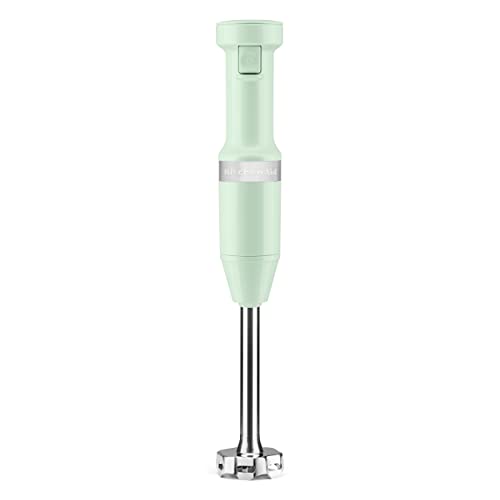
KitchenAid Variable Speed Hand Blender
Badge: Best for Everyday Versatility · Tier: mid tier (qualitative positioning; check price on Amazon on the current listing once verified links are added).
The KitchenAid Variable Speed Hand Blender is the household name in this category for a reason: it is built around the simple idea that one trigger should give you a gentle stir for a delicate sauce and a firm push for a pot of squash soup, with the speed following your squeeze rather than a dial you must stop and set. The removable blending arm clicks off for rinsing, the included blending jar suits smoothies and dressings, and the overall balance suits cooks who blend often and want the tool to disappear into the routine. As with every pick here, treat it as prose-only buying guidance for now: check the current listing for the exact configuration, attachments and finish on offer before you buy.
Best for: households that blend several times a week and want one dependable all-rounder. Not suited for: cooks who mainly crush ice or blend frozen fruit, who should be looking at a full-size countertop blender instead. Strengths: intuitive variable speed at the trigger, detachable arm for easy washing, a jar that makes small batches practical. Trade-offs: corded design ties you to a socket near the stove, and the attachment ecosystem is smaller than some rivals offer. Keep the blade fully submerged before squeezing the trigger, as with any model, and unplug before you handle the blade end.

Breville Control Grip
Badge: Best for Control and Anti-Suction Design · Tier: premium tier (qualitative positioning; check price on Amazon on the current listing once verified links are added).
The Breville Control Grip is the control enthusiast’s pick, shaped around an ergonomic handle and a bell-shaped guard designed to reduce the suction that glues lesser blenders to the bottom of the pan and to cut down on splashing. Its non-scratch guard rim is a thoughtful touch for cooks blending in coated or enamelled pots, and the bundled jug and whisk extend it beyond soup duty. It sits in the premium tier, and the premium buys refinement rather than brute force: steadier handling, calmer blending, less mess on the hob. Check the current listing for the exact bundle before buying, since packages and finishes vary.
Best for: frequent soup makers with good pans they want to protect, and cooks who value control over raw aggression. Not suited for: anyone shopping strictly at the entry tier, or cooks who need a cordless tool. Strengths: guard design that fights suction and splatter, comfortable grip for longer blending sessions, pan-friendly rim. Trade-offs: premium positioning, and a slightly larger footprint in the drawer than the slimmest sticks. As ever, submerge the blade fully before starting, start low, and disconnect the power before cleaning or touching the blade end.
Setup and Care That Reduce the Cons
Most cons are technique-shaped, so the care-and-use routine is the mitigation. Submerge before starting, start low, keep moving to defeat suction, work in deep vessels filled no more than two-thirds, let very hot liquids cool slightly, blend in bursts with rests on long jobs, rinse immediately, and store unplugged out of children’s reach. Add the vessel discipline from the technique sections, tall and narrow for small work, deep pots for large, and the daily experience of this tool is overwhelmingly its pros. The complete cleaning routine lives in how to clean an immersion blender properly.
Vessel choice shapes results more than brand choice does. Tall, narrow containers blend small quantities best; deep pots blend large ones; and anything shallow, wide or flimsy works against you. A sturdy stainless or enamelled pot handles the shaft without complaint, while nonstick coatings deserve respect: keep the guard gliding just above the base rather than grinding along it, because a scratched nonstick surface is a pan on its way out. Glass measures look tempting and most are safe for ordinary use, but a knocked guard can chip a thin rim, so heavy-duty vessels are the calmer choice for daily work. Whatever you use, fill it no more than about two-thirds, and remember that hot food expands its ambitions the moment the blades start.
One habit separates tidy cooks from splattered ones: blend in the cooking pot, at the stove, with the heat off, rather than transferring hot food to a countertop jug and back. Every transfer of near-boiling liquid is a spill and scald opportunity, and the immersion blender’s entire reason to exist is deleting those transfers from your cooking. Set the pot on a stable trivet if you move it, keep the cord routed away from burners and the pan’s hot rim, and give yourself elbow room before you start. The tool is forgiving about many things, but it rewards a calm, cleared workspace every single time.
Bottom Line
The pros are structural and permanent: in-place blending, tiny footprint, minute-long cleaning, hand-controlled texture, emulsion skill and modest tiers. The cons are equally structural: a power ceiling, technique dependence, hand labour and blades that must be respected. For cooks whose food matches the pros, and that is most home cooks who make soups, sauces and fresh small batches, this is one of the easiest recommendations in the kitchen. For frozen-drink specialists and industrial batch cooks, it is a second tool, not the main event. Decide which cook you are, and the ledger decides itself.
Think about the cook who lives alone, because appliance marketing rarely does. Their blending is a soup for two days, a sauce for one, a shake for now. Every full-size appliance taxes them with washing scaled for a family, while the stick blender’s beaker, shaft and one-minute rinse are proportioned exactly to their life. For this cook the category is not a compromise at all; it is the correctly sized tool, and the bigger machines are the awkward ones. A great deal of the worth-it debate dissolves once you notice that ‘best’ in kitchen tools usually means ‘best matched to the household’, and households come in ones as often as in fours.
There is also the matter of confidence for newer cooks. A stick blender is unusually legible: you see the food change under the guard, you hear the motor’s note shift as the mixture smooths, you stop the instant the texture matches the picture in your head. That feedback teaches blending as a skill rather than a setting, and skills transfer, to soups judged by eye, sauces rescued without panic, and a general sense that texture is something a cook controls. Several of the habits it teaches, patience with hot liquids, respect for sharp blades, cleaning as you go, are simply good kitchen craft wearing an appliance’s clothes.
Travel and second homes make a smaller, practical case. A stick blender packs into a suitcase corner or a car boot box, weighs little, and turns a holiday rental’s blunt knives and single saucepan into a workable soup and sauce kitchen. Families with a caravan, a boat or a grandparent’s house to stock often keep an entry-tier model at the second location rather than transporting the good one. It is not the use anyone buys for first, but it is the use that makes owners describe the tool as indispensable in a tone usually reserved for corkscrews and phone chargers.
A note on noise and neighbours, because nobody prints it on the box. Immersion blenders are not quiet, but their jobs are short: the burst pattern of blending means the sound arrives in seconds-long episodes rather than the sustained roar of a big machine working through a frozen load. Early-morning smoothie makers in thin-walled flats learn to use the beaker, keep bursts brief and close the kitchen door, and the same courtesy applies late at night. It is a minor point with a real effect on how welcome a tool feels in a shared home, and worth one honest paragraph in any complete account.
Finally, consider repair and end of life, the least glamorous part of ownership. A tool from an established maker comes with a support channel, spare shafts or seals for some lines, and instructions that assume you will keep it. A tool from an anonymous listing comes with none of that, and its failure is total and unfixable. Choosing the supported tool is partly an environmental decision and partly a financial one, since a repairable mid-tier blender that serves eight years costs less per year than a bargain replaced three times. The category’s modest tiers make the responsible choice unusually affordable, which is one more quiet point in its favour.
Run the experiment most owners describe from their first month. Week one, the blender makes soup twice and feels like a novelty. Week two, it smooths a gravy, emulsifies a dressing and blends a breakfast shake, none of which were planned purchases’ occasions, all of which happened because the tool was there, clean, in the drawer. By week four the household has stopped categorising these as uses of an appliance and started treating them as things cooking simply includes now. That drift from novelty to infrastructure is the honest shape of this tool’s value, and it is why counting only soup nights understates the case by half.
There is a counter-experiment, and fairness demands it. Put the same tool in a kitchen where dinner is assembled rather than cooked, where soup comes from a carton and smoothies from a café, and it will be used twice, admired once and forgotten. Nothing about the tool changed; the cooking did not contain its jobs. This is why every section of this article keeps returning to your actual menu rather than to the product’s abilities. Appliances do not have value in the abstract. They have value multiplied by the number of times a real household reaches for them, and that multiplier is written in your habits, not in any specification.
One more angle is the secondhand and hand-me-down life of these tools. Because they are simple, durable and cheap to run, immersion blenders pass between households happily: the upgraded owner passes the old stick to a student, the student passes it on again, and each transfer is a small vote that the category delivers. Few appliances survive that chain; complicated machines die at the first change of address. If you buy well and later upgrade, your first blender is a gift with years left in it, which softens the risk of starting at mid tier and discovering, a year on, that you have become a daily user who wants the premium guard and motor.
Energy and running costs barely register, and that itself is worth stating. The tool runs for seconds or minutes at a time, sips rather than gulps, needs no standby power when unplugged in its drawer, and consumes nothing but water and a drop of washing-up liquid in its care. There are no pods, filters, descaling cartridges or proprietary consumables quietly taxing ownership. In an era of appliances with subscriptions and consumable ecosystems, a tool whose entire running cost is a rinse is a small anachronism, and a welcome one. The worth-it ledger should record it: some purchases keep charging; this one mostly stops at the till.
Sentiment is not evidence, but patterns of sentiment across thousands of kitchens are a kind of evidence, and the pattern here is unusually consistent: owners describe the immersion blender the way they describe a good knife, as the thing they would replace tomorrow if it vanished. That is not how people talk about gadgets. It is how they talk about tools that have merged into their competence. If you cook the foods it loves, expect the same merger; if you do not, expect a drawer ornament. The checklist exists to tell you which future is yours before the money moves, and it has the final word in this article for a reason.
Soup night shows the workflow at its best. The vegetables simmer in the same pot they were chopped beside, the stock goes in, and when everything is tender the pot comes off the heat to rest briefly. The blender goes in, blade submerged, starting low, travelling in slow passes until the texture matches the plan, rustic or silky. A swirl of cream, a squeeze of lemon, and the soup is served from the pot it was blended in, with one shaft to rinse. Compare that with the old routine of ladling hot liquid into a jug blender in batches, and the reason this tool earns drawer space stops being abstract.
Sauce rescue is the quiet second career. A gravy that caught slightly, a pan sauce with shallot pieces that never softened, a tomato sauce that stayed stubbornly chunky: a few careful pulses in the pan or pot, heat off, blade submerged, and the texture comes right without a sieve or a second vessel. The same trick smooths a béchamel that threatened to lump and turns a rough romesco into something spoonable. Because the tool lives in a drawer rather than on the counter, it is present for these small saves in a way a bulky appliance never is, and small saves are where weeknight cooking is won.
Breakfast blending is where the beaker earns its keep. A smoothie for one, a protein shake after a run, a small batch of pancake batter without lumps: all of these are beneath a full-size blender’s dignity and perfectly sized for a stick and its jar. The beaker’s narrow walls keep a modest volume moving through the blade, the whole thing rinses in seconds, and the jar can go straight into a bag or the fridge door. Households that start the day this way tend to use the tool daily, and daily use is what turns a modest purchase into one of the best-value appliances in the kitchen.
Baby and toddler food is a chapter many households discover by accident. Steamed vegetables, soft fruits, cooked lentils and porridges purée in the beaker or a small pan to exactly the consistency a given month demands, smoother at first, textured later, in portions that match a small appetite rather than a freezer-filling batch. Hygiene rules apply with extra force: spotless equipment, freshly cooked ingredients, prompt chilling of leftovers, and the usual unplug-before-cleaning discipline so the tool that feeds the smallest eater is handled with the most care. A hand blender bought for soup often ends up remembered as the weaning appliance.
Entertaining changes the arithmetic again. Dips, whipped toppings, cocktail foams, a soup course blended to order: the stick moves between jobs with a rinse between each, where a single-jar blender becomes a bottleneck and a washing-up argument. Hosts use it tableside in a jug for dramatic effect and in the kitchen for the unglamorous work of smoothing, emulsifying and rescuing. Guests never see the tool, but they taste the difference between a sauce that was fixed and a sauce that was served apologetically. For households that cook for friends often, that quiet reliability is a large part of the value case.
Small kitchens make the strongest structural argument. A stick blender lives in a drawer, hangs from a rail or stands in a utensil crock; it asks for no counter footprint, no permanent parking spot, no negotiation with the coffee machine about territory. In a flat or a compact galley kitchen, that difference decides whether a blending capability exists at all. Renters and students lean on it for the same reason: one modest tool that covers soups, shakes, sauces and batters, moves house in a cutlery box, and never becomes the appliance that has to be left behind for lack of space.
Leftovers are where the tool quietly saves money. The last of a roast chicken becomes a soup, the soup’s second day becomes a smoother, richer version of itself, vegetable odds and ends become a sauce for pasta, and stale bread becomes crumbs in the chopper attachment. None of these transformations needs a big appliance; all of them need blending or chopping in modest quantities, in the vessel the food already occupies. A kitchen that wastes less because repurposing is easy will repay a modest hand blender’s tier many times over, in groceries unthrown and takeaways unordered, across a single season of cooking.
The learning curve deserves an honest paragraph. The first blend usually splashes a little, because everyone lifts the blade too early once. The second usually suctions, because everyone parks the blender once. By the third or fourth use the disciplines, submerge first, start low, keep moving, stop before surfacing, have become muscle memory, and the tool feels obvious. This is worth knowing before judging the category from a single messy attempt: the skill involved is small, real and quickly learned, and nearly every negative first impression traces back to technique that one more careful attempt would have fixed.
Seasonal cooking flatters the tool in rotation. Autumn and winter bring the soup pots, squash, roots, beans and lentils that are its heartland. Spring adds pea and asparagus soups and herb sauces. Summer shifts the work to gazpacho, smoothies, iced drinks with the beaker, dressings and dips for grilled food. Across the year the same stick covers the calendar without a single seasonal attachment or storage shuffle, which is more than can be said for many single-purpose appliances that shine for one month and gather dust for eleven. Versatility across seasons is a form of value that rarely appears on a specification sheet.
Immersion Blender: Weighing the Trade-Offs in Daily Use
Start with how the strengths and frustrations of a {p} balance out in a real kitchen. Most coverage of a immersion blender concentrates on the first week of ownership, yet the decisions that matter most tend to surface later, once the immersion blender has to earn its place in an ordinary weekday routine rather than a carefully staged first attempt. Write down the three jobs you expect it to do most often, in the order you actually do them, and judge every claim you read against that short personal list instead of against a generic ideal.
Maintenance decides how long the good results last. Set a simple rhythm: a quick wipe or rinse after each use, a deeper clean on a fixed day, and a periodic check of the parts that move, seal or bear weight. A immersion blender that needs fiddly disassembly for basic care will be cleaned less often, and performance drifts long before anything actually breaks. Prefer designs where the parts that get dirtiest are the parts that are easiest to reach, and be honest with yourself about which cleaning steps you will genuinely keep up.
Use a short decision checklist to finish. One, does it fit the space and the storage you really have. Two, does it handle your three most common jobs without a workaround. Three, do the edge cases you listed stay manageable. Four, can every wear part be cleaned or replaced without drama. Five, would you still choose it if a friend described the same drawbacks in their own kitchen. A immersion blender that passes all five is a sound buy; one that fails two or more is a compromise you are choosing with open eyes, which is a very different thing from being surprised later.
Measure before you commit. Note the footprint, the clearance above and behind the spot where the immersion blender will live, and the route you will carry it by when it is hot, full or awkward. A immersion blender that technically fits but blocks a cupboard door, crowds a neighbouring appliance or has to be dragged across a worktop every time will quietly fall out of use, whatever its merits on paper. In the Kitchen Appliances category especially, a few centimetres of clearance and a sensible storage plan separate a daily tool from a bulky regret.
When you check listings such as KitchenAid Variable Speed Hand Blender and Breville Control Grip, use them as worked examples: run through the same checks below on each one in turn, so the comparison stays honest and like for like rather than based on whichever listing happens to shout loudest.
Troubleshooting is easier when you expect the usual failure points. With any immersion blender, the recurring problems tend to cluster in the same places: uneven results from overloading or poor arrangement, wear showing first on the parts handled most often, and small annoyances with lids, seals, handles, controls or fittings that only appear after repeated use. Before buying, look for whether those wear parts can be cleaned properly, replaced or worked around, and whether the instructions address them directly rather than pretending they never happen.
Frequently Asked Questions
What are the biggest immersion blender pros and cons in one answer?
The biggest pro is blending food where it already is, especially hot soup in its pot, with drawer-sized storage and about a minute of cleaning. The biggest con is a firm power ceiling: ice, frozen loads and nut butters belong to countertop blenders. Around those poles sit texture control and emulsion skill on the pro side, and splatter risk, suction and technique dependence on the con side. Your cooking decides which list runs your kitchen.
Is splattering a serious problem with immersion blenders?
It is a serious technique point and a minor practical problem once learned. Keep the blade fully submerged before starting and until it stops, start at low speed, use deep vessels filled no more than two-thirds, and let very hot liquids cool slightly first. Anti-splash guard designs help further. Cooks who follow those rules blend hot soup in good shirts without incident; cooks who lift a spinning blade out of the pot redecorate the kitchen. The tool rewards a small, learnable discipline.
Can an immersion blender crush ice or frozen fruit?
Treat it as a no for practical purposes. A few cubes in a drink may survive contact with a sturdy model, but ice and frozen-solid fruit are the loads that strain motors, clog guards and shorten the tool’s life, and makers consistently direct that work to full-size blenders. If frozen drinks are a weekly ritual in your house, that single fact should steer your main purchase. The immersion blender’s empire is cooked, soft and liquid-supported food, and inside that empire it is superb.
Do immersion blenders scratch pans?
They can if the guard is dragged along a delicate coating under pressure, which is why technique asks for a light touch, constant movement and hovering just above the base. Pan-friendly guard rims exist on models designed with coated cookware in mind, and metal guards belong in metal or enamelled pots. In practice, cooks who blend gently report years of uneventful nonstick use, while the scratches that do happen trace back to pressing and grinding rather than to blending itself.
Are immersion blenders safe around children?
They are safe in a household that treats them like the sharp tools they are: stored unplugged or with the battery removed, out of children’s reach, never left plugged in on the counter, and used with the unplug-before-cleaning rule taught to every older child who cooks. The blades are extremely sharp and the trigger is easy to press, so casual storage is the real hazard, not supervised use. Households unwilling to run those rules should choose a sealed jug blender instead.
How long do immersion blenders usually last?
Longevity tracks treatment more than tier. Used within its design, bursts on cooked and soft foods, rested between long jobs, rinsed promptly and stored dry, a reputable model serves for years. Used against frozen loads, run continuously until the motor smells hot, or left wet and dirty, even a premium tool tires early. Buy from a maker with parts and support, treat the duty cycle kindly, and the category’s modest tiers look even better spread across a long working life.
Related Guides and Next Steps
Keep reading with the companion guides in this series and the closest matches from the wider catalogue: how to choose an immersion blender; how to clean an immersion blender; the immersion blender buying guide; the immersion blender review; is an immersion blender worth it; blenders built for soup making; blenders for soups and smoothies; blenders for smoothies with ice; blenders for smoothies with vegetables.