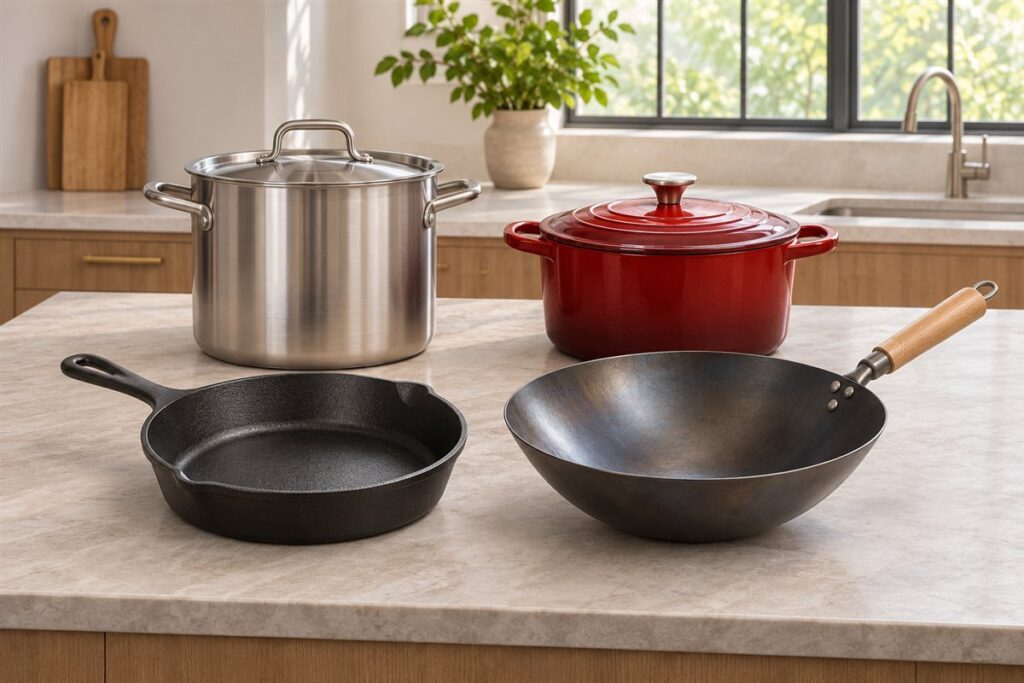
Induction cooktops heat cookware with a magnetic field, so a pan works only if its base is magnetic. Cast iron, carbon steel and many stainless steel pans work, while aluminum and copper do not unless they include a magnetic layer.
How Induction Heating Works
Under the glass surface is a coil that creates a changing magnetic field. When a magnetic pan sits on top, the field makes the metal in the base heat up directly. The cooktop itself stays cooler than a gas flame or electric coil, though it can warm from the hot pan.
Because the heating happens in the pan, response to dial changes is quick. This is one reason many cooks appreciate induction.
Materials and Compatibility
| Material | Induction? | Note |
|---|---|---|
| Cast iron and enameled cast iron | Yes | Heavy; avoid dragging on glass |
| Carbon steel | Yes | Responds quickly |
| Stainless steel | Depends | Many are fine, but check the base |
| Aluminum | No, unless fitted with a magnetic plate | Many pans add a steel disk |
| Copper | No, unless the base has a magnetic layer | Check the maker’s guide |
| Glass or ceramic | No | Not magnetic |
How to Check a Pan at Home
- Look for a coil-shaped induction symbol on the base or packaging.
- Hold a household magnet to the outside of the base. If it clings firmly, the pan will likely work.
- Check that the base is flat and sits fully on the surface.
- Confirm the pan size is not much smaller than the cooking zone.
Practical Tips
- Lift pans rather than sliding them, since rough bases can scratch glass.
- Use the pan size that fits the zone. Very small pans may not heat on some cooktops.
- Some pans hum or buzz. This is common and tied to base construction.
- Keep the cooktop clean and dry, and avoid placing metal utensils on it, as they may heat up.
Follow the maker’s manual and safety instructions for both the cooktop and the cookware. People with certain medical implants should check the cooktop maker’s guidance.
Cookware makers often print a coil symbol on packaging, but older pieces may carry no marking, so the magnet check is useful for pans you already own. Some stainless pans have a mix of metals, where the inside is nonmagnetic but the outer layer is magnetic, and these generally work. If you are changing from gas or electric, you may find that some of your pans work and others do not, so check each one before you decide to replace the whole collection. Cooking times may also change, since induction heats up fast.
Why Base Construction Matters
Whether a pan works on induction depends mostly on its base, not on its shape or the material of the sides. A pan can have a stainless interior and still fail if the base layer is not magnetic. Likewise, a pan with aluminum walls can work well if the maker has bonded a magnetic plate to the bottom.
It helps to understand the common base designs:
- Fully clad construction: Layers of metal run up the sides as well as across the base. These often include a magnetic outer layer, which is why many clad pans work on induction.
- Disk-bottom construction: A separate plate is bonded to the base only. The plate may be magnetic, which makes an otherwise unsuitable pan usable, but the sides may heat more slowly than the base.
- Single-material construction: Cast iron and carbon steel are magnetic throughout and work without extra layers.
The thickness and flatness of the base also affect results. A thin base may warp over time, and a warped base does not contact the glass evenly, which reduces heating and can cause uneven cooking. Look for descriptions of base thickness and layering in the product listing, but treat marketing terms with caution and rely on the maker’s stated induction compatibility.
When comparing two pans, check the product page for an explicit statement that the cookware is suitable for induction. If the description is vague, look for the symbol on the packaging, or ask the seller. A clear statement saves you from a return later.
Matching Pan and Cooking Zone
Induction cooktops sense the pan above each zone. If the pan is too small or sits off center, the zone may heat weakly or not at all. Most cooktops mark each zone with a ring, and the manual often states a minimum pan diameter for it to work reliably.
Keep these points in mind when matching sizes:
- Center the pan over the marked ring so the magnetic field reaches the base evenly.
- Choose a pan whose flat base is close to the size of the ring. The flat part is what matters, not the top rim, since many pans flare outward above the base.
- Be cautious with very small pans, such as a small butter warmer. They may not trigger the zone on some models, so check the cooktop manual.
- Oversized pans can overhang the zone, which may leave outer sections cooler. This is common with large griddles that span two zones.
Some cooktops have flexible or bridge zones that join two areas for larger pans. If you own a long griddle or oval roaster, check whether your cooktop supports this and how the manufacturer recommends using it.
When shopping for a set, look at the listed base diameter rather than only the top diameter. A pan advertised by its rim size may have a noticeably smaller flat base. Matching your most-used pan to your most-used zone is a simple way to get the best performance.
Protecting the Glass Surface
Most induction cooktops have a glass-ceramic surface. It is durable in normal use but can scratch or chip, and the damage is often caused by the bottoms of pans or by spills left on a hot surface.
- Check the base: Run a fingertip over the bottom of each pan. Rough spots, burrs or dried-on residue can scratch the glass.
- Lift, do not slide: Sliding a heavy pan, especially cast iron, can leave marks. Lift it into position.
- Wipe spills promptly: Sugary spills can be especially troublesome if left to cool and harden. Follow the cooktop maker’s cleaning instructions and use cleaners and tools they approve.
- Avoid dropping heavy items: Dropped lids and pans can crack the glass. Keep the cooktop clear when not in use.
- Dry the pan base: Water or residue under the pan can create marks and, as it heats, make noise.
Rough-cast cookware, such as some unfinished cast iron, has a textured base that may scratch more easily. Some cooks sand a rough base smooth, but you should follow the pan maker’s advice rather than altering cookware on your own. Enameled pieces can also chip, and exposed edges can scratch the glass.
A clean cooktop and clean pan bases make for better contact and less noise. If you notice scratches that worsen, check the cooktop warranty and manual before using abrasive products.
Common Problems and Quick Fixes
Most issues with induction cookware have simple causes. If the cooktop beeps, flashes an error or will not start, work through a short checklist before assuming the pan is faulty.
- No heat or an error message: The pan may be nonmagnetic, off-center or too small for the zone. Try the magnet test, recenter it and try a larger pan.
- Buzzing or humming: Often a sign of layered construction responding to the field, especially at higher power. It is usually harmless, but check the manual if it seems excessive.
- Uneven heating: A warped or thin base may be the cause. Set the pan on a flat counter and see if it rocks.
- Pan shuts the zone off: Some cooktops have overheat protection. Reduce the power and make sure the pan is not empty on high heat.
- Food sticks or burns: Induction can heat very fast, so start at a lower setting than you used on gas or electric and adjust gradually.
If a pan that once worked suddenly does not, look for a change in the base, such as a bulge or a separated disk. Also check whether a power-sharing feature is reducing output when several zones run at once, since some cooktops share a limited supply between zones.
When problems persist, consult the cooktop and cookware manuals, or contact the maker’s support. They know the model-specific limits better than general guidance can.
Building an Induction-Ready Collection
If you are moving to induction, you do not need to replace everything at once. Test what you own first, and fill gaps gradually based on how you cook.
- Run the magnet test on every pan and note which pass.
- Identify your most-used pieces, such as a skillet, saucepan and large pot, and check that these work.
- Replace only the pieces that fail and that you rely on regularly.
- When buying new, prefer listings that clearly state induction compatibility.
Think about the mix of materials as well. A magnetic stainless skillet, a cast iron pan and a nonstick pan with an induction-ready base cover most home needs. Choose weight carefully, since heavy pans are stable on the glass but harder to lift, while light pans respond quickly but may shift more easily.
Budget tiers usually reflect base construction and finish. More affordable pans may have thinner bases that heat quickly but are more likely to warp. Mid-range and higher-end pans tend to have thicker or layered bases, which help even heating and flatness. Read the maker’s description rather than assuming price guarantees quality.
If you have older cookware that fails the test, it can still serve on a portable gas or electric burner, or be passed to someone with a compatible stove.
FAQ
Can I use an adapter plate?
Some exist, but they heat slowly and may not suit every cooktop. Check the maker’s guide.
Is nonstick fine on induction?
Yes, if the pan body has a magnetic base.
Do I need to buy a whole new set for induction?
Not necessarily. Test your existing pans with a magnet and keep those that pass. Replace only the pieces you use often that do not work.
Why does my induction pan make noise?
Humming or buzzing can come from layered metal responding to the magnetic field, and it is often more noticeable at high power. Check the maker's guide if the noise is loud or changes suddenly.
Can a warped pan work on induction?
It may heat, but unevenly, because the base does not contact the glass fully. A badly warped pan is better retired or kept for other uses.
Will a smaller pan work on a large cooking zone?
It depends on the cooktop. Some models need the pan to cover a minimum area, so check the manual and use a zone that matches the pan's flat base.
Is cast iron safe for the glass surface?
Yes, if used with care. Lift it rather than sliding, and check that the base is smooth, since rough bases may scratch.
Do induction pans need special cleaning?
Clean them as the maker advises for the material. Keep the base clean and dry before use, because residue can mark the cooktop.
The Short Version
If a magnet clings to the base, the pan will usually work on induction. Check symbols, flatness and size for the best results.