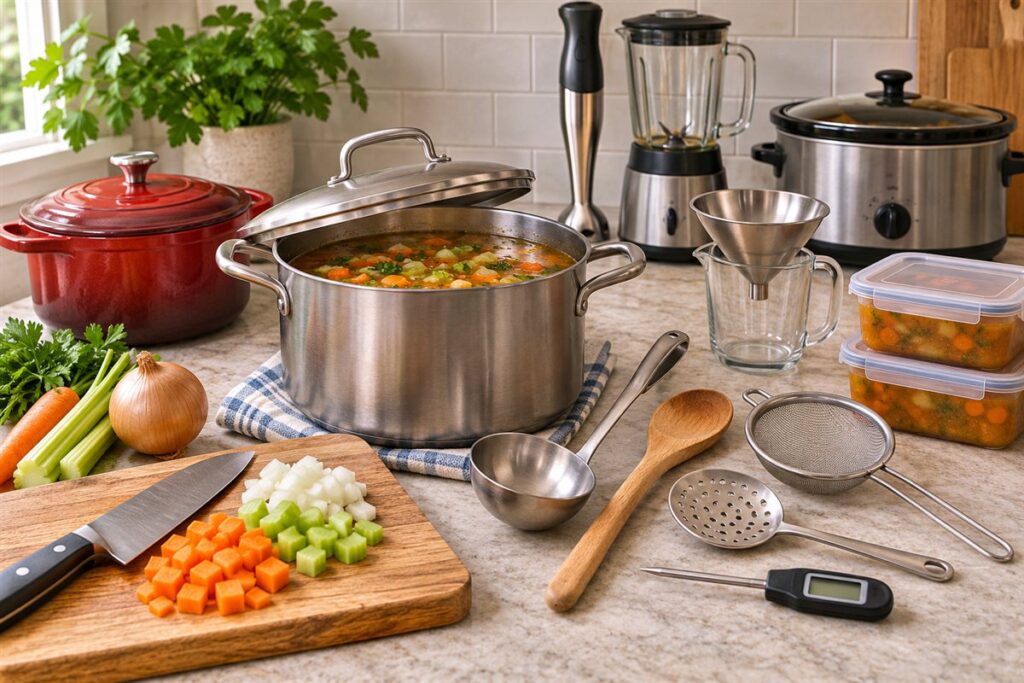
Soup needs very little equipment: a roomy pot with a lid, a sturdy spoon, a knife and board, and a ladle. A few extras, such as a blender and storage containers, make it easier to prepare and keep. This guide shows what each tool does and how to use it with care.
The Pot
A heavy-bottomed pot with a lid heats evenly and resists scorching. Choose one large enough that the soup fills it no more than about two-thirds, which leaves room to stir and prevents boil-overs. Stainless steel and enameled cast iron are common, and each has its own care rules, so follow the maker’s guide.
- Choose a lid that fits well so you can control simmering.
- Look for handles that stay firm and are easy to grip with mitts.
- Match the pot to your stove type.
Prep and Cooking Tools
- A chef’s knife and cutting board. Cut vegetables to even sizes for even cooking.
- A wooden spoon. Stirs without scratching.
- A ladle. Serves safely without tipping the pot.
- A fine strainer. Clears stock or lifts out solids.
- A skimmer. Removes foam and excess fat from the surface.
- A thermometer. Helps check that meat and poultry reach the doneness described in official food-safety guidance.
Optional Helpers
| Tool | Use | Care point |
|---|---|---|
| Immersion blender | Purees soup in the pot | Let soup cool a bit and follow the manual |
| Countertop blender | Smooth soups | Do not fill to the top; vent the lid as directed |
| Slow cooker | Hands-off simmering | Follow the maker’s guide |
| Funnel and jug | Fills containers neatly | Use heatproof items |
Cooling and Storing
Hot soup should not sit out for long. Divide large batches into shallow containers so they cool faster, then refrigerate promptly, and look to official food-safety guidance for storage times and for reheating until steaming hot. Leave a little space in freezer containers because liquids expand. Label each container with the date.
Simmering Basics
Most soups simmer gently, with small bubbles rather than a hard boil. Times vary widely, from a short simmer for quick vegetable soups to a longer one for beans or bones, so rely on the recipe. Taste near the end and adjust seasoning.
Cleanup and Care
Let the pot cool before washing, and follow the maker’s guide for cleaning, since enameled and stainless surfaces have different needs. Soak stuck bits with warm water instead of scraping hard. Dry the pot well, store it with the lid slightly ajar to let air move, and wipe your ladle and strainer straight away so food does not dry on them.
FAQ
What size pot should I buy?
A pot that holds several quarts suits most households. Choose bigger if you like to cook in batches, and check that it fits your stove and storage.
Is a blender needed for soup?
Only for smooth soups. A potato masher or a spoon can break up softer vegetables if you do not own a blender.
The Short Version
A roomy lidded pot, a ladle, a sturdy spoon, and a good knife are enough. Add a blender or strainer if you need them, and cool and store leftovers as food-safety guidance directs.