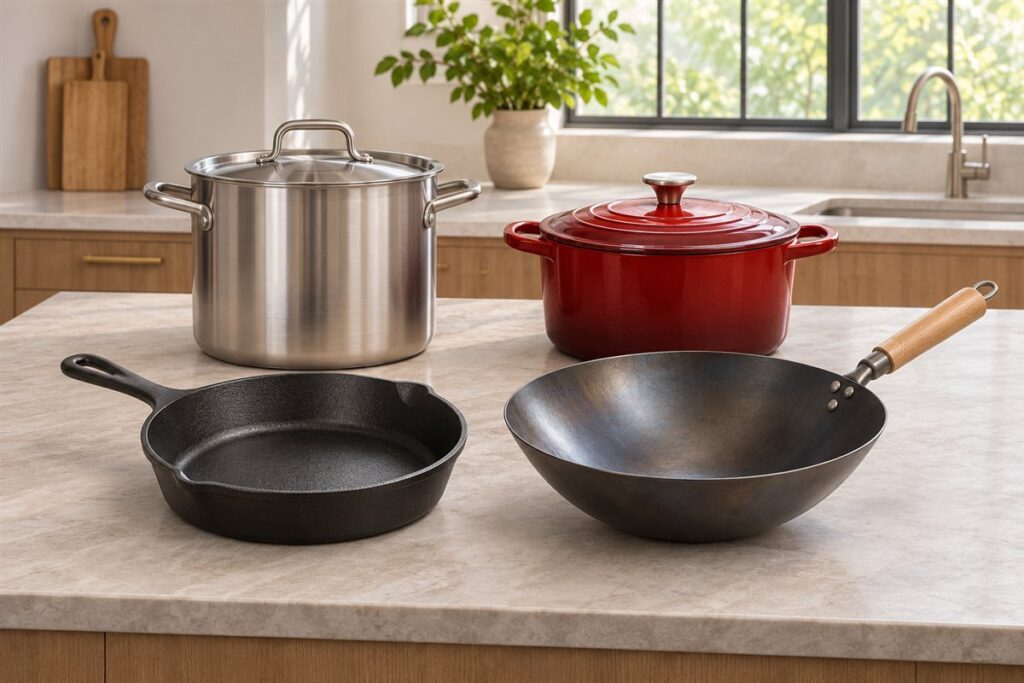
Most households do well with a Dutch oven between about 5 and 7 quarts, which fits a loaf of bread, a whole chicken or a family-size stew. Smaller sizes suit one or two people, while larger ones make sense for big batches and gatherings.
Common Sizes and What They Hold
| Capacity | Typical Use | Good For |
|---|---|---|
| 2 to 3 quarts | Small braises, side dishes, single loaves | One or two people |
| 4 to 5 quarts | Soups, stews, no-knead bread | Two to four people |
| 6 to 7 quarts | Whole chicken, roasts, large batches | Families of four to six |
| 8 quarts and up | Big stock batches, entertaining | Large households or meal prep |
Capacity is the volume to the brim, so the usable amount is smaller. Sizes also vary by maker, so check the maker’s guide for exact dimensions.
Think About How You Cook
- Bread: A round pot in the 4 to 6 quart range is common for no-knead loaves.
- Soups and stews: Fill no more than about two thirds, so a 5 quart pot makes roughly 3 to 4 quarts of food.
- Roasts and poultry: Measure the meat. A bird or roast needs room around it and under the lid.
- Leftovers and batch cooking: Bigger pots help, as long as you can lift them.
Practical Limits
Cast iron Dutch ovens are heavy, and a full 7 quart pot can be a lot to move from stove to oven. Check that you can lift it with both hands and a firm grip, and that your oven rack has the clearance.
Also look at your burner and storage space. A pot wider than the burner heats unevenly, and a tall pot may not fit under a cabinet shelf. Always use dry mitts and follow the maker’s manual and safety instructions.
Shape Matters Too
Round pots suit bread and soups. Oval pots suit long roasts and whole birds. Shallow braisers offer more surface for browning meats before slow cooking.
Lids and handles deserve a look as well. A tight lid keeps moisture in during braising, while looped handles that are large enough for oven mitts make the pot easier to lift. If you plan to bake bread, check that the knob can handle the oven temperature you need, as some knobs have lower limits than the pot, and the maker’s guide will say so. Consider the interior color too: light interiors make it easier to see browning, while dark ones hide stains.
Cast Iron Versus Other Constructions
Size choices depend partly on what the pot is made of. Enameled cast iron holds heat well and moves easily from stove to oven, but it is heavy, and the weight grows quickly with capacity. Bare cast iron is similar in weight and needs seasoning. Lighter options, such as aluminum or stainless steel stockpots with lids, are easier to lift and may be better for large batches.
If weight is a concern, consider a slightly smaller pot in cast iron or a larger one in lighter metal. Check the listed weight if it is given, and imagine lifting it full and hot. The coating, interior color and lid fit are also worth reading about in the listing and manual.
Matching Size to Household
Think about the number of people you cook for and how often you cook in batches. A single person or couple may be well served by a smaller pot, while a family that enjoys leftovers may want something bigger. If you entertain occasionally, one larger pot can be borrowed from a friend or bought separately, instead of sizing everything for rare events.
- Consider the largest recipe you make regularly.
- Check your oven’s rack height and spacing.
- Think about whether you will freeze portions.
A second smaller pot is useful for sides and sauces, and many cooks end up with two sizes over time.
Fit in Your Oven and on Your Stove
Measure the oven’s interior height with the rack set where you want it, then compare it with the pot’s height including the lid knob. Check the pot’s width, including handles, against the oven width and burner spacing. Wide pots can overlap neighboring burners and limit what else you can cook. A pot that fits only when the rack is in the lowest position may be inconvenient.
On an induction or glass cooktop, check the manufacturer’s guidance on weight and base finish. Heavy pots can scratch glass if dragged, so lift them. Heat gradually, because cast iron holds heat and sudden temperature changes can stress enamel.
Lifting, Moving and Safe Handling
A full Dutch oven can be very heavy and very hot. Use dry, thick oven mitts, and place a trivet or heat-safe surface where you will set the pot down. Plan the route from oven to counter before lifting. Handles can be hot, so stay alert for steam when you remove the lid, and open it away from you.
If you have limited grip strength or mobility, a pot with larger handles or a lighter material may be safer. Never move a pot while someone is walking behind you. Allow the pot to cool before washing, as sudden changes in temperature may crack enamel.
Care, Cleaning and When to Replace
Clean enameled pots with warm soapy water and a soft sponge. Soak stuck food rather than scraping with metal. Avoid abrasive cleaners that dull the finish. For bare cast iron, follow seasoning instructions in the manual and dry the pot well to prevent rust. Store with the lid slightly ajar or with a paper towel between pot and lid to let air circulate.
Chips in the enamel, deep scratches, rust spreading on the interior, a lid that no longer fits or a warped base are reasons to reconsider the pot. Small chips on the outside edge may be cosmetic, but chips inside can expose the metal, so follow the maker’s guidance on use and replacement.
FAQ
What is the single most useful size?
A 5 to 6 quart round pot is a flexible size for many homes.
Is bigger always better?
No. A pot that is too large for the food cooks unevenly and is harder to handle.
Can a Dutch oven go on any cooktop?
Most can be used on common cooktops, but check the maker's guidance. Lift rather than slide the pot on glass, and confirm compatibility with induction if that is your stove.
How full should I fill a Dutch oven?
Many recipes suggest leaving some space at the top so food can bubble and stir without spilling. Follow the recipe and avoid filling to the brim.
Is a lid knob safe at high oven temperatures?
It depends on the material. Some knobs have lower limits than the pot, so check the manual. Replacement metal knobs are sold for some models.
Do I need two Dutch ovens?
Not necessarily. Many cooks use one for most jobs and add a second size later. Your recipes and storage space should guide that choice.
How do I remove stains from the interior?
Soak with warm water and a gentle cleaner, then scrub with a soft sponge. Check the maker's advice before using any stronger cleaner on enamel.
Can I use a Dutch oven for baking bread in a small oven?
Possibly, if the pot with lid fits under the rack with room for air. Measure the height and check the oven manual before heating a heavy pot.
The Short Version
Choose roughly 3 quarts for one or two people, 5 to 7 quarts for most families, and larger only if you cook big batches and can handle the weight.