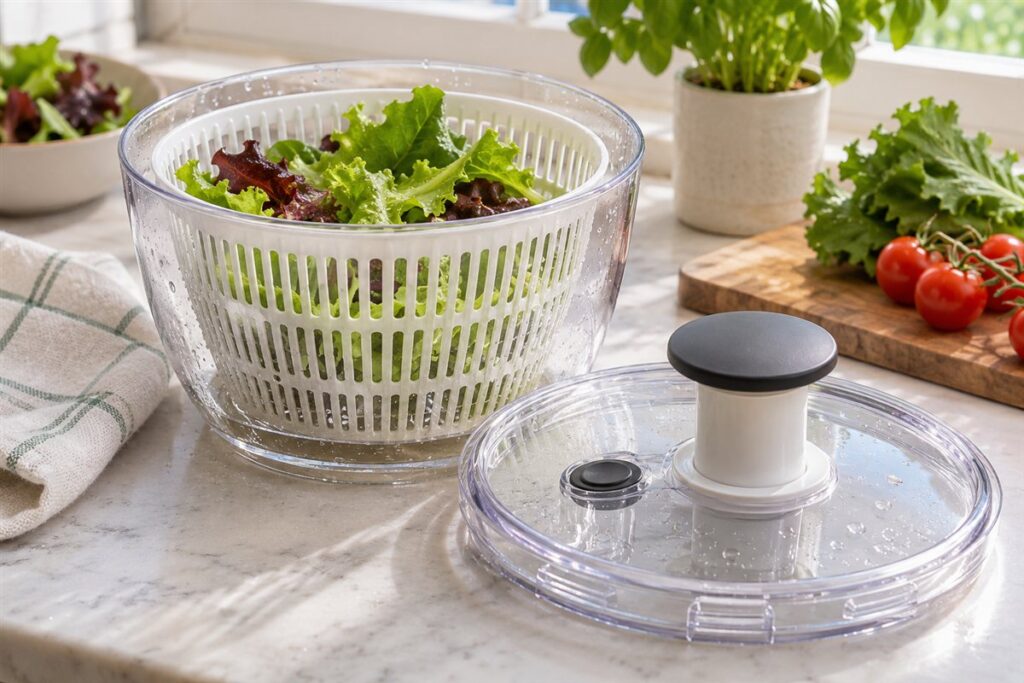
When you choose a salad spinner, look at the capacity, the spinning mechanism, the brake and how easily it comes apart for cleaning. A spinner that holds the amount of greens you eat in one meal, spins smoothly and stops quickly is the one you will actually use.
Why Dry Greens at All
Wet leaves dilute dressing, make salads limp and dull the flavor. They also spoil faster in the fridge. A spinner uses centrifugal force to push water off the leaves into the outer bowl, so greens come out crisp and dry in less than a minute. It also doubles as a rinsing bowl and, for some models, a serving bowl.
Mechanisms Compared
| Style | How it works | Pros and cons |
|---|---|---|
| Pump | Press a plunger or knob to spin the basket | Easy one-hand use and a small footprint; mechanism may wear |
| Crank | Turn a handle on the lid | Reliable and controllable; needs two hands |
| Pull cord | Pull a string to spin | Fast spin; cord may fray over time |
| Push-down or button | Press the top repeatedly | Simple and compact |
Features That Matter
Capacity
Large spinners hold enough for a family salad, while small ones suit one or two people. If you wash a whole head of lettuce at once, size matters. A very large bowl can be awkward to store, so compare the outside dimensions with your cupboard.
Brake
A brake button stops the basket quickly, which saves time and keeps your fingers away from a spinning part. Read the maker’s instructions and wait until the basket stops before lifting the lid.
Base and stability
A non-slip base keeps the spinner in place while you pump or crank. Look for a lid that locks and a wide bottom.
Bowl material
Clear plastic lets you see how wet the greens still are. Some bowls are attractive enough to use for serving, while others are best kept for the sink.
Cleaning and Storage
- Choose a spinner with parts that come apart easily, including the lid and the basket.
- Check the maker’s guide for dishwasher use, as some mechanisms are not meant for it.
- Let every part dry fully to avoid odors.
- Look for designs that nest or collapse for small cupboards.
A Worked Walkthrough: From Wet Greens to Crisp Leaves
A spinner works best with a simple routine. Here is one that suits most pump, crank and pull-cord models, though the maker’s guide comes first.
- Tear or chop the greens into pieces of manageable size. Whole heads dry poorly because water hides between the leaves.
- Fill the outer bowl with cold water and put the basket inside. Add the greens and swish them gently so grit sinks to the bottom. Follow food-safety guidance for washing produce.
- Lift the basket out, let the water drain, and tip out the dirty water. If the greens were gritty, repeat once more.
- Place the basket back into the dry outer bowl. Fill it to about half or a little more, since leaves need room to move for the water to leave them.
- Fit the lid and check that it is locked on. Place the spinner on a non-slip surface, or set a damp cloth beneath it.
- Spin for fifteen to thirty seconds, building speed gradually. Use the brake once you are done, and wait for the basket to stop before lifting the lid.
- Pour out the water, rearrange the greens, and spin again if they still look wet. Large loads often need two shorter spins.
- Tip the greens onto a clean towel for a final blot, or store them in the basket lined with a dry paper towel in the fridge, following food-safety guidance.
Common Scenarios
Weeknight salad for two
A small pump spinner is quick and takes little room. It is enough for a couple of handfuls of greens at a time.
Batch prep for the week
A large crank spinner handles a whole head of lettuce at once. Dry thoroughly and store greens with a dry towel, and follow food-safety guidance for how long they keep.
Washing herbs and berries
Soft herbs and berries are delicate, so spin them gently and for a short time. A lighter, slower spin keeps them from bruising.
Limited cupboard space
Look for a collapsible or nesting design. Measure the shelf and the lid height before you decide.
Mistakes to Avoid
- Overfilling the basket. Packed leaves hold water between them, so they stay damp. Spin smaller loads.
- Lifting the lid before it stops. The basket keeps spinning for a moment, and moving parts can catch your fingers. Wait for it to stop.
- Spinning delicate leaves too hard. They bruise. Use a slow, gentle spin.
- Putting the mechanism in a dishwasher. Some lids have parts not made for it. Follow the maker’s guide.
- Storing it damp. Trapped moisture leads to odours. Dry every part before closing it up.
Care and Upkeep Over Time
Take the spinner apart after each use. Wash the basket, bowl and lid in warm soapy water, paying attention to the rim and underside of the lid where bits collect. A small brush helps with the drain holes and cord or pump channels. Dry everything and store the pieces apart or with the lid slightly open. Check the brake and the non-slip base for wear, and replace the spinner if the basket wobbles or the lid no longer locks, since an unbalanced spin can make the unit move around.
Quick Troubleshooting
| Symptom | Likely cause | What to try |
|---|---|---|
| Greens still wet | Basket too full or spin too short | Use smaller loads and spin again |
| Spinner wobbles or walks | Unbalanced load or slippery base | Spread the leaves evenly and use a damp cloth underneath |
| Lid will not lock | Misaligned or damaged tabs | Realign it, and replace the spinner if the lid is cracked |
| Brake does not stop the basket | Worn pad or debris | Clean around the brake, and check the manual |
| Musty smell | Trapped moisture | Wash all parts and dry them fully |
Glossary
- Centrifugal force: The outward push that moves water off spinning leaves.
- Basket: The inner bowl with small holes that holds the greens.
- Brake: A control that stops the basket quickly.
- Pull cord: A string mechanism that spins the basket when tugged.
- Footprint: The space the spinner takes up in a cupboard or on a counter.
FAQ
Can I use it for things other than lettuce?
Yes. It can dry herbs, berries and washed vegetables. Do not overfill it.
Why are my greens still wet?
The basket may be too full, or you may need to spin longer. Blot the leaves with a towel for extra dryness.
Pump or crank: which is easier?
Pump models are quick and work with one hand, which many people like. Crank models give steady control and are often seen as sturdy. Try the action in the store if you can, and think about your hands and your storage space.
Is a bigger spinner always better?
No. A very large spinner is bulky to store and awkward to wash for small households. Choose one that matches the amount you usually prepare, with a little room to spare.
Do I need to dry greens at all if I use a towel?
A towel works for small amounts, but it takes longer and can bruise leaves. A spinner is faster and gentler for larger quantities, and the same bowl doubles as a rinsing basin.
The Short Version
Choose a spinner with the capacity you need, a smooth mechanism, a brake and parts that wash easily. Leave space in the basket so leaves can move, and follow the maker’s care instructions. Spin in smaller loads, wait for the basket to stop, and dry every part before storing it.