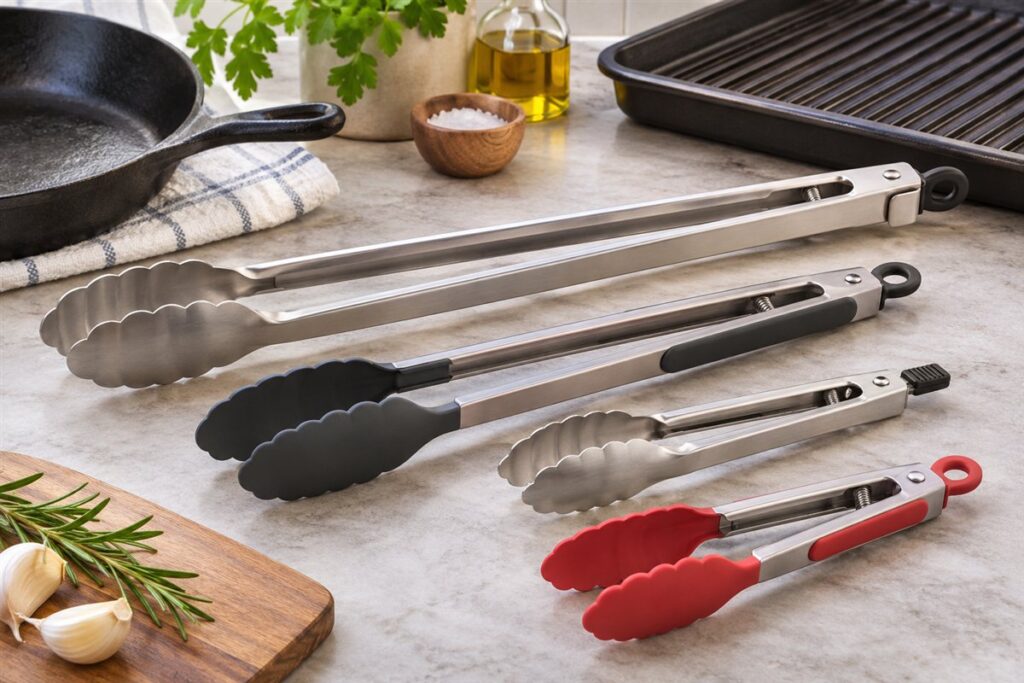
Choose tongs by length, tip shape, spring action and how well they lock for storage. A pair around nine to twelve inches long suits stove-top cooking, while longer tongs keep your hand further from a grill. Make sure the tips are suited to your cookware. The sections below cover each factor, a worked example of using tongs on the stove, and the care and problems that come with long use.
Where Tongs Help
Tongs turn chicken pieces, lift pasta from boiling water, toss salads, move hot items out of the oven and plate food neatly. They keep your hands away from heat and splatter, and they offer a firmer hold than a spatula for many foods.
Length
Shorter tongs, around seven to nine inches, give precision for serving and for working with small items. Medium tongs of nine to twelve inches are a good general kitchen size. Long tongs, sixteen inches and above, are made for grills and deep pots. Choose the length by the heat source you use most. Since hot oil, steam and flames can all be risky, keep your hand well away from heat and follow the maker’s safety instructions.
Features to Compare
| Feature | Why it matters | What to check |
|---|---|---|
| Tip material | Protects cookware and handles heat | Metal for grills; silicone or nylon tips for nonstick pans, with the maker’s heat limit |
| Tip shape | Affects grip on food | Scalloped or flat tips grip well; narrow tips for small items |
| Spring tension | Controls how easily you squeeze | Firm but not tiring; try it in your hand if you can |
| Locking | Keeps tongs closed in a drawer | A simple slide or pull-ring lock |
| Grip | Comfort and heat insulation | Non-slip, heat-resistant handle, if the maker says so |
| Build | Durability | Sturdy stainless steel with a clean seam |
Spring Action and Locking
Look at how the tongs open. A spring that is too stiff tires your hand during long cooking sessions. One that is too loose makes it hard to lift heavy food. Locking mechanisms vary, so ask whether you can lock and unlock them with one hand. A locked pair also hangs on a hook or fits in a utensil crock.
Everyday Use
- Use silicone-tipped tongs on nonstick pans to avoid scratching.
- Use a dedicated pair for raw meat and another for serving to avoid cross-contact.
- Do not overload the tongs with heavy food, which can bend the arms.
- Wash after use, with attention to the hinge where food collects.
A Worked Example: Searing and Plating Chicken Pieces
- Choose a medium pair with tips that match the pan. Metal tips work in stainless or cast iron, while silicone tips protect a nonstick surface.
- Use one pair for raw meat only. Set a second, clean pair aside for plating.
- Lay the pieces in the pan with the tongs, placing them away from you so hot fat does not splash toward your hand.
- Leave the pieces alone until they release naturally, then turn them by gripping the sides, not by piercing the meat.
- Rotate the pan or rearrange the pieces as needed, always lifting instead of dragging.
- Cook to the doneness temperature given in food-safety guidance for that meat, checking with a thermometer made for that purpose.
- Switch to the clean pair for transferring the cooked pieces to a plate, so no raw juices reach cooked food.
- Wash the raw-meat tongs in hot soapy water as soon as you can, paying attention to the hinge.
Matching Tongs to the Way You Cook
Think about your last week of cooking and note what you reached for. If you mostly cook on the hob with nonstick pans, a medium pair with silicone tips will see the most use. If you grill often, a long pair with metal tips and a heat-resistant handle matters more. If you cook for a crowd, a lightweight pair with a gentle spring will tire your hand less over a long service. Cooks with smaller hands may prefer a shorter, narrower pair, while larger hands often find a wider handle more comfortable. Choosing from your real habits avoids owning a drawer of tongs that never leave it, and one well-chosen pair often does the work of three.
Common Scenarios
Grilling outdoors
Choose a long pair with a heat-resistant handle so your hand stays well back from the flames. Metal tips cope with grill grates.
Cooking pasta
Medium tongs with scalloped edges lift strands out of boiling water. Hold the pot steady and tilt strands over the pot to drain before moving them.
Tossing and plating a salad
Short or medium tongs with flat, smooth tips lift leaves gently. Lightweight tongs reduce hand strain on a big salad.
Baking and oven tasks
Tongs help nudge a tray or turn vegetables on a hot sheet, but keep the handles away from direct oven heat and use mitts as needed.
Mistakes to Avoid
- Using metal tips on nonstick. The metal can scratch the coating and shorten the life of the pan.
- Using the same pair for raw and cooked food. Raw juices can transfer to cooked items, which food-safety guidance warns against.
- Choosing very short tongs for the grill. Your hand gets close to the heat, which makes burns more likely.
- Squeezing too hard. Food can be crushed, and the arms can bend over time.
- Leaving silicone tips on a hot surface. Contact with a hot element or grate can melt or mark them.
Care and Upkeep Over Time
Rinse the hinge soon after use because food collects where the arms meet. Use a small brush to reach the gap, and dry the tongs before storing them to prevent water spots. Check the tips for wear: silicone can tear and scalloped metal edges can bend. If the spring weakens so the tongs no longer spring open, or the lock slips, consider a replacement. Store tongs locked so they do not tangle with other tools, and keep long grill tongs on a hook, where the handles will not get crushed.
Quick Troubleshooting
| Symptom | Likely cause | What to try |
|---|---|---|
| Food slips from the tips | Smooth tips or too much oil | Choose scalloped tips and pat food dry first |
| Hand tires quickly | Spring is too stiff | Look for a lighter tension or a better grip |
| Tongs will not stay locked | Worn or dirty lock | Clean it, and replace the tongs if it still slips |
| Tips misalign | Arms bent by overloading | Do not lift heavy items; gently reshape or replace |
| Odors in the handle | Trapped moisture or grease | Wash thoroughly and dry before storing |
FAQ
How many pairs do I need?
Two is a good beginning: one medium pair for the stove and one longer pair for grilling or deep pots. Add a short pair for serving if you entertain often.
Are tongs dishwasher friendly?
Many metal ones are. Silicone tips and handles may have limits, so check the care guide. Hand washing the hinge can help if food stays trapped there.
Can I use tongs on nonstick cookware?
Yes, with silicone or nylon tips and within the heat limit stated by the maker. Avoid scraping the coating.
What length is best for a gas hob?
Medium tongs of nine to twelve inches give enough distance for most stove work. Use longer ones if you cook with large pots or open flames.
Why do my tongs stick shut?
Dried food in the hinge or a bent arm can cause this. Clean the hinge with warm water and a brush, and replace the tongs if they stay stiff.
The Short Version
Choose medium tongs for general cooking, longer tongs for the grill, and tip materials that match your cookware. A smooth spring and a simple lock make them easier to live with. Keep one pair for raw food and another for serving.
Related Guides
- How to Choose a Salad Bowl and Tongs for Serving at Home
- Kitchen Tools for Grilling Season: What to Have Ready
- 6 Best Kitchen Tongs: Silicone, Nylon and Stainless (2026)
- 6 Best Tea Tongs: Sugar Cube and Tea Bag Tongs (2026)
- How to Choose Serving Bowls and Platters for Your Table