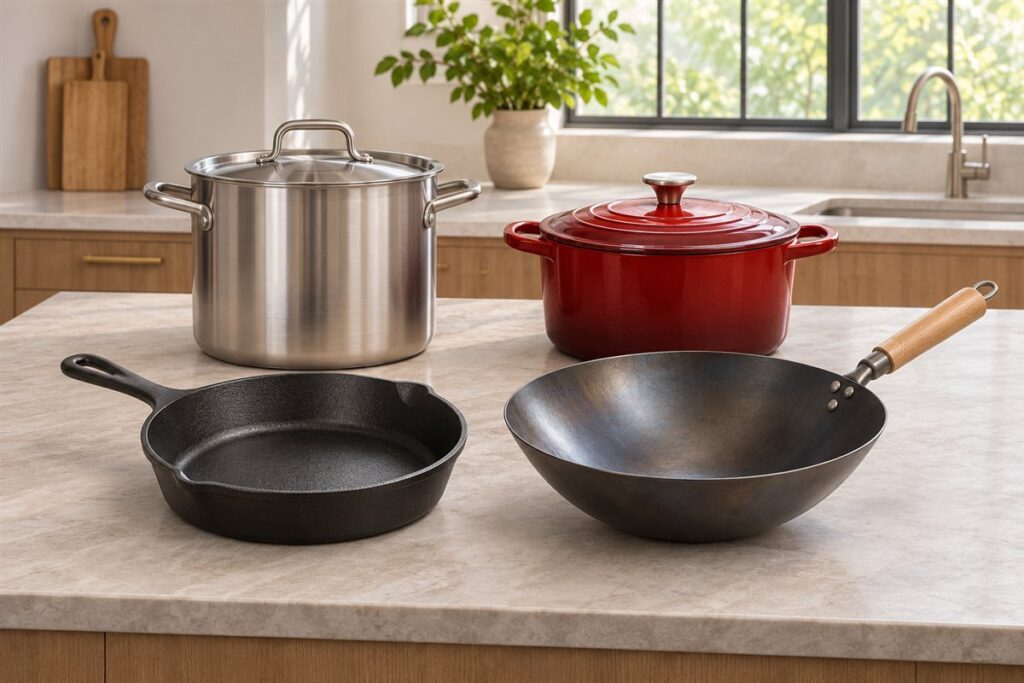
An induction cooktop heats the pan itself with a magnetic field, so it responds very quickly and the surface stays cooler than a gas or coil burner. To cook well on one, you need magnetic pans, a flat base and slightly different heat habits. The learning curve is short.
Check Whether Your Pans Work
Hold a magnet against the base of the pan. If it sticks firmly, the pan will normally work. Cast iron, many stainless steels and enameled iron usually do. Pure aluminum, copper and glass do not, unless the base has a magnetic layer. Look for an induction symbol on the box or base, and read the maker’s notes. Pan size should roughly match the cooking zone for even heating.
Adjusting How You Cook
- Place the pan in the center of the marked zone.
- Begin with a lower setting than you would use on gas. Induction heats fast.
- Add oil and food once the pan warms; thin pans can overheat quickly.
- Change heat levels in small steps. The pan responds almost instantly.
- Use the boost or power function sparingly and never leave a pan unattended.
- Lift the pan off the zone to stop cooking immediately; the zone will turn off.
Common Surprises
| What you notice | Why it happens | What to do |
|---|---|---|
| Buzzing or humming | Vibration in layered metal at high power | Lower the setting or try a different pan |
| Pan will not heat | Base not magnetic or off-center | Check with a magnet and re-center |
| Hot spots | Pan smaller than the zone or warped base | Use a pan that fits the zone |
| Scratches on glass | Dragging pans | Lift pans and keep bases clean |
Care and Cautions
The glass stays hot after you remove the pan, because heat transfers back from the cookware, so wait for the hot-surface light to go out. Wipe spills once the surface cools, using a soft cloth and a cleaner approved by the cooktop maker. People with pacemakers or other medical devices should ask their physician or read the cooktop manual about distance from the unit. Follow all manufacturer instructions.
One advantage is control. Because the heat is produced in the pan, water boils quickly and gentle simmers hold steady at low settings, which suits sauces and melting chocolate. Many cooks also like that the kitchen stays cooler and that spills do not bake onto a burner. Keep the cooktop clear of metal objects such as knives or spoons, since they can heat up if left on a zone. Use cookware with a flat, clean base, and wipe off any grease or grains that may sit under it.
Pan Base, Size and Zone Matching
Induction works through contact between the pan base and the cooking zone, so shape and size matter. A flat base sits fully on the glass and receives the field evenly. A warped or domed base can create gaps that cause hot spots, noise or poor heating. Place a ruler across the base to check for a gap. Pans can warp over time, especially when heated empty or cooled quickly, so check older pans before assuming they will work.
Zone size matters too. If the pan is much smaller than the zone, the cooktop may not detect it or may heat it unevenly. If the pan is larger than the zone, the center will heat first and the edges may be slower. Many cooktops list a minimum pan diameter, so check the manual. Some models have flexible zones that adapt to pan size, which can help with large or oval pans.
Center the pan on the marked circle. Avoid sliding pans across the glass, which can scratch. If you use a griddle or a large roasting pan across two zones, check that the cooktop supports bridging. Thick-bottomed pans may heat more evenly because they spread the heat, but they also take longer to cool. Choose pans with a magnetic base and a flat, stable shape for the best results.
Heat Settings, Power Levels and Boost Modes
Induction responds immediately, so settings feel different from gas or electric coils. A medium setting can be hotter than you expect, and low settings may hold a simmer without a flame. Start lower than you normally would and adjust upward in small steps. Watch for signs that the pan is too hot, such as smoking oil or food browning too fast, and lower the setting at once.
Power boost modes push extra power into the pan for a limited time. They are useful for boiling water or searing, but they should be used with attention. Do not use boost with an empty pan, and avoid it with thin pans that heat quickly. Some cooktops limit boost when multiple zones are in use, because they share power. If the heat seems to drop, check the manual to see how power is shared between zones.
Simmer and melt functions vary. Some cooktops have a dedicated low setting, while others cycle the power on and off to keep a low temperature, which can create a clicking sound. This is normal in many designs. For delicate sauces, chocolate or custard, test the lowest setting with a small amount first. Also note any timers, child locks or pause functions on your cooktop, since they can make cooking easier and safer.
Noise, Humming and Vibration
Many induction users notice sounds that other cooktops do not make. A low hum or buzz often appears at high power, particularly with layered or clad pans, because the layers of metal vibrate slightly in the magnetic field. Clicking can come from the cooktop cycling power at low settings. A fan may run to cool the electronics, which can continue after you finish cooking. These sounds are generally normal, but check the manual for guidance.
If the noise bothers you, try lowering the setting, moving the pan slightly or using a different pan. Pans with a thicker or more solid base tend to produce less noise, though this varies. Heavy loads or vibrating lids can add rattling, so check that the lid sits firmly. Using adjacent zones at the same time can sometimes create a whine, and changing power levels may help.
- Check that the pan base is flat and clean.
- Avoid sliding the pan, which can create scraping noises.
- Reduce the power if humming is loud.
- Keep the vents on the cooktop clear.
If you hear unusual noises such as loud crackling, popping or smell burning, turn off the cooktop and consult the manufacturer.
Cleaning and Protecting the Glass Surface
The cooktop surface is usually glass-ceramic, which is durable but can scratch or stain. Wipe spills promptly once the surface is cool, because sugary spills can bond to hot glass and cause damage. Use a soft cloth or sponge with a cleaner recommended by the cooktop maker. Avoid abrasive pads, scouring powders and harsh chemicals, which can dull or scratch the surface.
Pan bases can leave marks. Check the bottom of each pan for rough spots, burnt-on food or residues, and clean them before use. Do not drag pans, and lift them when moving. Avoid placing hot pans on cold surfaces or cold items on a hot cooktop. Heavy cast iron pans can chip glass if dropped, so handle them with care.
For stubborn residue, use a scraper designed for glass cooktops, held at a low angle and used as directed. Some makers sell cleaning creams that remove marks. Dry the surface after cleaning to avoid streaks. Protect the surface by keeping sharp or heavy objects away. Do not use the cooktop as a counter or cutting surface, and check the manual for care instructions specific to your model.
Upgrading Cookware: What to Look For
If some of your pans do not work, you can upgrade gradually. Start with the pans you use most often, such as a frying pan, a saucepan and a stockpot. Look for an induction label and a flat, solid base. Stainless steel with a magnetic layer is popular, cast iron and enameled iron are naturally compatible, and some carbon steel pans also work. Aluminum and copper pans need a magnetic base layer to function.
Think about weight, handle comfort and compatibility with your oven and dishwasher. A heavy pan holds heat well but can be tiring to lift. Consider lid fit and handle temperature. Check the maker’s guidance for induction use, as some pans have limits on power levels. Simpler budget pans can work well, though thin bases may heat unevenly or warp. Mid-range pans often have thicker bases and better build. Premium sets may offer additional features, but they are not essential.
Before buying a set, test each pan with a magnet and check the diameter against your zones. Buy individual pieces if you only need a few. Converter disks exist, but they heat slowly and are not ideal. Over time, a small collection of well-chosen pans will cover most needs without a large outlay.
FAQ
Can I use a converter disk?
Some disks exist, but results vary and they heat unevenly. Check your cooktop maker’s advice.
Do I need all new pans?
Not necessarily. Test the ones you own with a magnet first.
Why does my induction cooktop click on low settings?
Many cooktops cycle power on and off to maintain low heat. This is usually normal, but check the manual if the sound is loud.
Can I use cast iron on induction?
Usually yes, as it is magnetic. Lift it rather than sliding it to avoid scratching the glass.
Why does my pan heat unevenly?
The pan may be warped, the wrong size for the zone or off-center. Check the base for flatness and center the pan.
Is it normal for the fan to keep running?
Yes, many cooktops run a fan to cool the electronics after use. It should stop when the unit has cooled.
Can I use a wok on induction?
A flat-bottomed wok with a magnetic base works. Round-bottomed woks need a matching induction wok burner, so check the cooktop model.
What happens if I leave an empty pan on the zone?
The pan can overheat quickly, which may damage it or the cooktop. Never heat an empty pan, and watch thin pans closely.
Do I need special cleaning products?
Use products recommended by the cooktop maker. Soft cloths and non-abrasive cleaners are usually safest.
The Short Version
Use magnetic, flat-bottom pans that fit the zone, begin on lower heat and adjust in small steps. Read the cooktop manual for care and safety guidance.