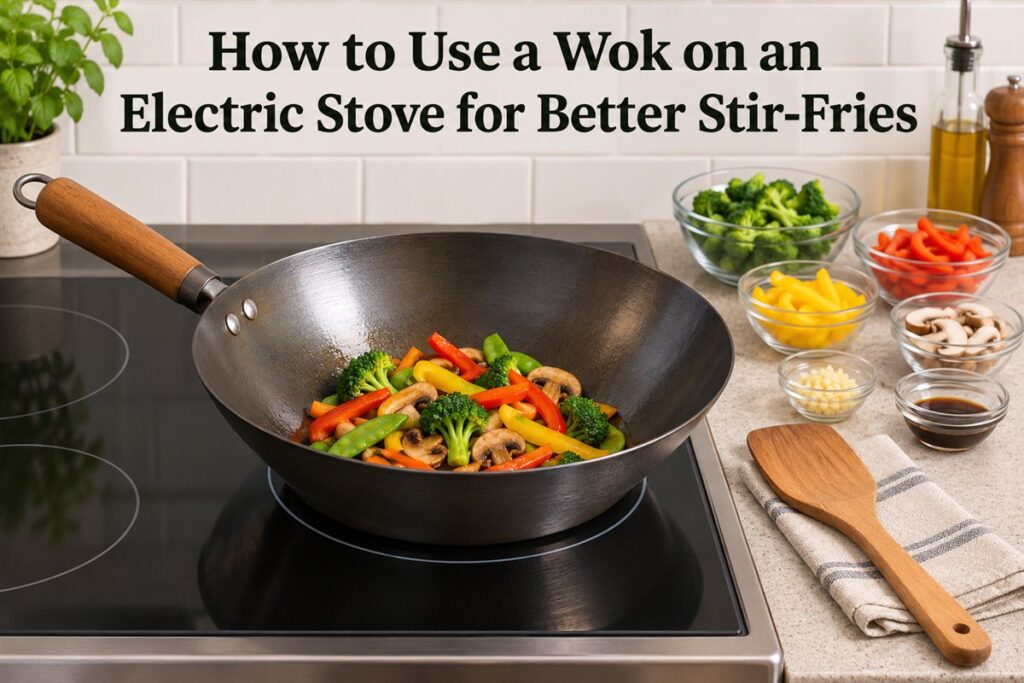
You can make good stir-fries on an electric stove, but the wok shape and heat source need some adjustment. A flat-bottom wok and a patient preheat make the biggest difference. The other trick is cooking in small batches so the pan does not cool down.
Choose the Right Wok
Round-bottom woks need a gas flame and a ring to sit steadily. On electric coil or smooth-top stoves, a flat-bottom wok makes full contact with the heating surface and works much better. Carbon steel is a common material for its quick response, though some cooks like heavier pans that keep heat. Check the maker’s guide for stove compatibility, and look at your stove manual for cookware advice, especially on glass tops.
Steps for a Stir-Fry
- Prepare all ingredients before you turn on the heat. Cut them into similar sizes and keep sauces measured.
- Place the wok on the largest element and preheat on medium-high for a few minutes, until a drop of water sizzles away.
- Add a thin layer of high-heat oil and swirl it up the sides.
- Cook protein first in a single layer, in small batches, and move it to a plate.
- Stir-fry vegetables from firmest to softest.
- Return the protein, add sauce, toss briefly and serve right away.
Hot oil can spatter, so keep food dry, stand back slightly and never leave the wok unattended.
Electric Stove Tips
| Challenge | What helps |
|---|---|
| Slow temperature changes | Lift the wok off the heat briefly instead of waiting for the element to cool |
| Cool sides of the wok | Use a wok that fits the element, and move food up the sides when needed |
| Food steaming instead of browning | Cook smaller batches and dry ingredients well |
| Scratches on a glass top | Lift, do not slide, and keep the base clean |
Seasoning and oil choice matter here too. If your wok is carbon steel, a good seasoning helps food release, and a high-heat oil such as peanut, canola or sunflower copes with the temperatures involved. Do not crowd the wok, and let the surface recover its heat between batches. Because electric elements cycle on and off, you may notice temperature swings, so keep an eye on the pan and move food constantly. If the food begins to steam and turn grey, lift the pan off the heat for a few seconds, then return it and cook a smaller portion. A little patience gives results closer to restaurant stir-fries than you might expect.
Matching the Wok to Your Electric Element
On an electric stove, the contact between the pan and the heating surface decides how well the wok performs. A flat base that sits fully on a coil or a smooth top picks up heat evenly, while a rounded base touches only at a small spot and leaves the rest of the pan cooler. Before buying or using a wok, place it on the cold element and check that it sits flat without rocking.
Size matters too. A wok whose base is much smaller than the element wastes heat around the edges and can overheat the surrounding area, while one with a much larger base than the element leaves outer zones cooler. Aim for a base that is close to the size of your largest element. A wok with a wider top still gives plenty of room to toss food even if the base is modest.
Check your stove manual for guidance on cookware. Smooth glass or ceramic tops may have rules about base flatness, weight and material, and some advise against pans with rough or heavily textured bottoms. Induction cooktops are a different matter entirely: they require a magnetic base, and a flat-bottom wok designed for induction is a better match than a traditional round one. If you are unsure which type of stove you have, check the manual or the appliance label.
Finally, think about handle length and weight. A long handle helps with tossing and keeps your hand away from the heat, but a heavy wok can be awkward when full. Try to pick one you can lift comfortably with food in it.
Preheating and Managing Heat on a Slow Element
Electric elements take longer to heat up and longer to cool down than gas flames, so planning ahead replaces the instant control a flame offers. Start the preheat earlier than you think necessary and give the wok a few minutes. When it is ready, a drop of water should sizzle and evaporate quickly. Use a dry wok for this test, then add oil.
Because the element cycles on and off, the pan temperature will fluctuate. Try to work with that rather than against it:
- Keep batches small so the temperature does not crash when food goes in.
- If the wok begins to cool and food steams, lift it off the element for a few seconds, then return it.
- If something is cooking too fast, move the pan to a cooler element rather than waiting for the hot one to drop.
- Consider keeping a second element at medium heat as a staging area for resting food.
Do not leave the wok empty on a hot element for a long time, as it can overheat, discolor and in some cases warp. Stay with the pan once it is heating.
Avoid sudden temperature changes such as plunging a hot wok into cold water, which can distort the metal and, on a glass top, create a safety hazard. Let it cool a bit and then wash it as the maker advises. Always use dry oven mitts, because steam and hot oil can cause burns.
Preparation and Batch Cooking for Better Results
Stir-frying is fast, and the pace leaves no time for chopping. The best preparation is to have everything cut, measured and within reach before the heat is on. Cut ingredients to similar sizes so they cook in the same time. Dry vegetables and meat after washing, since extra water cools the pan and creates steam rather than a sear.
Group ingredients by cooking time. Aromatics like garlic and ginger go in briefly, so add them near the start of a step, not alongside long-cooking items. Firm vegetables, such as carrots or broccoli stems, go in before soft ones like leafy greens or bean sprouts. Sauces should be mixed ahead in a small bowl so they can be poured in quickly.
On an electric stove, batch size matters more than it might on gas. Overfilling the wok leads to cooled food, release of moisture and a stewed result. Cook protein in small portions, move it to a plate, and then bring everything back together at the end. If you are cooking for several people, it is better to run two quick batches than to crowd one.
Keep the food moving. Use a long spatula or a wok spoon to push food up the sides, where it stays warm but cooks less, and bring it back down as needed. This gives you some of the control you would have with a flame.
Oils, Seasoning and Cleaning Your Wok
Choose an oil with a high smoke point, since stir-frying uses strong heat. Many cooks use peanut, canola, sunflower or similar neutral oils. Add a small amount at a time, swirl it to coat the surface and add more only if the food begins to stick. Avoid oils that smoke at low temperatures, since they may burn and leave a bitter taste.
If your wok is carbon steel, it needs seasoning to form a nonstick-like surface and prevent rust. Follow the maker’s instructions to prepare a new wok. After each use, wash with hot water and a soft brush, dry it thoroughly, and rub a very thin film of oil on the inside. Skipping the drying step is the most common cause of rust.
Woks with a nonstick coating or stainless steel finish have different rules. Nonstick coatings should not be overheated or scratched, so use wooden or silicone tools and moderate heat. Stainless woks tolerate higher heat and metal tools but may need more oil to prevent sticking. Always follow the care guide for your specific model.
On a glass or ceramic top, clean the wok base before each use so food residue does not burn onto the stovetop. Lift the wok when moving it. If the base becomes rough or warped, it may scratch the surface or sit unevenly, which is a good time to consider replacing it.
Troubleshooting Common Stir-Fry Problems
If your results do not match your expectations, a few predictable causes are usually responsible.
- Food is soggy or grey: the pan was too cool, the batch too large or the ingredients too wet. Preheat longer, cook less at once and pat food dry.
- Food sticks: the wok might not be hot enough before the oil went in, or the seasoning is thin. Preheat fully and use enough oil. Do not stir too early, as food releases more easily once it has seared.
- Burnt garlic or spices: they went in too early or the heat was too high. Add them later or lower the heat for that step.
- Uneven cooking: pieces vary in size or the wok does not sit flat. Cut evenly and check the base.
- Too much liquid at the end: add sauce sparingly, and let it reduce briefly. Thickeners such as cornstarch mixed with cold water can help if the maker of the recipe suggests them.
It also helps to accept that an electric stove will not reproduce every detail of restaurant-style wok cooking. You can still achieve crisp vegetables and well-browned protein by working in small batches and watching the heat. Treat each attempt as practice and adjust one variable at a time, such as preheat length or batch size, so you can see what makes the difference.
FAQ
Can I use a frying pan instead?
Yes. A large, flat skillet works well on electric stoves if you keep batches small.
Do I need a lid?
Not for stir-frying, but one helps if you add a splash of water to steam greens.
Can I use a round-bottom wok on an electric stove?
It usually makes poor contact with the element and can sit unsteadily, so a flat base is the safer choice. Some makers sell ring supports, but check your stove manual before using one on a smooth top.
Which element should I use?
The largest one that fits the base of your wok, so heat is spread across the pan. Make sure the pan is centered and does not overhang dangerously.
Is a nonstick wok a good option?
It can be easier for beginners, but nonstick coatings have temperature limits and should not be preheated empty at high heat. Check the maker's guide for the safe range.
Will a wok damage a glass-top stove?
A clean, flat base is unlikely to cause problems if you lift rather than slide it. Rough, dirty or warped bases can scratch, so check the stove manual and the condition of the pan.
How much oil should I use?
A thin layer is usually enough, with a little more added if food starts to stick. Too much oil makes the dish greasy, while too little can cause scorching.
Why does my stir-fry take longer on electric heat?
Electric elements respond slowly, and a crowded pan loses heat quickly. Preheating fully and cooking small batches helps bring the time down.
The Short Version
Use a flat-bottom wok, preheat fully and cook in small batches. Prepare everything first, watch hot oil, and follow your stove and wok manuals.