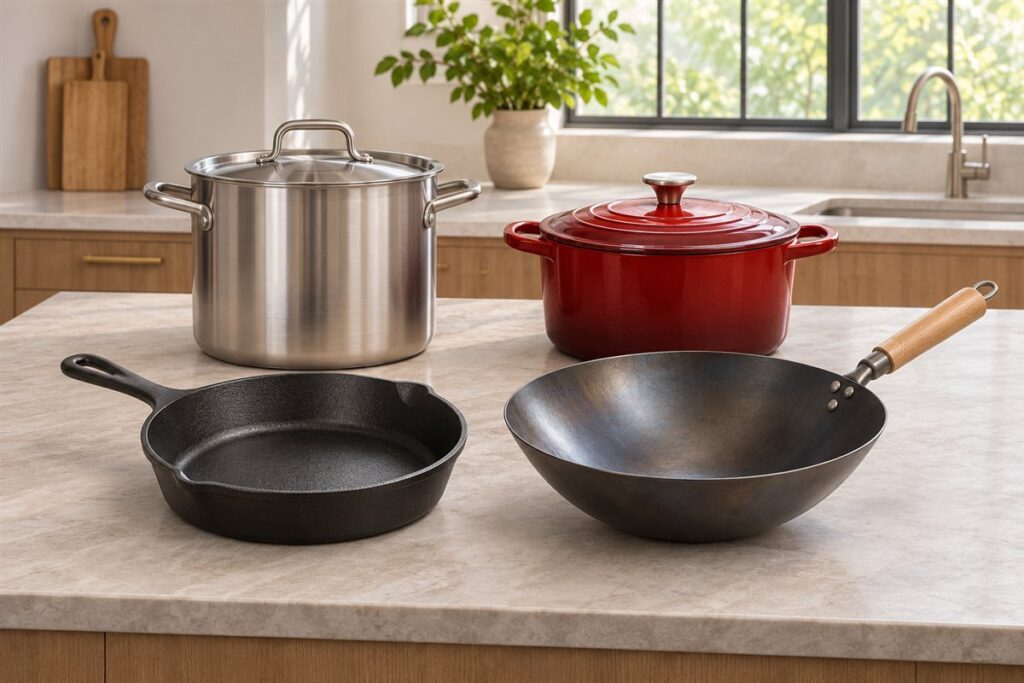
A carbon steel wok heats fast, responds quickly to changes in flame and builds a natural dark finish with use. To choose one, focus on base shape, diameter, weight and handle type, then match them to your stove. Your home burner matters more than the label.
Round Bottom or Flat Bottom
A round-bottom wok concentrates heat at the center and suits gas burners with a wok ring. A flat-bottom wok sits steadily on electric, induction and many gas stoves. If you have a flat electric or induction cooktop, a flat base is almost always the practical option. Check the maker’s guidance on compatibility.
Size, Weight and Handles
- Diameter: A 12 to 14 inch wok is a common home size. Larger woks give room to toss but can overhang the burner.
- Weight: Thin, light steel heats fast and is easy to lift. Thicker steel holds heat longer but is heavier.
- Long handle: A single long handle suits tossing and stir-frying.
- Two loop handles: These are common on traditional woks and are good for steaming and carrying.
- Handle material: Wood stays cooler in use but is not always suited to the oven. Check the maker’s limits.
Seasoning Steps
- Wash off the factory coating as directed by the maker.
- Dry fully over low heat.
- Rub a very thin film of high-heat oil over the inside and outside.
- Heat gently until the surface darkens, then let it cool.
- Repeat as the maker advises. Cook oily foods first to build the finish.
Hot oil can splash, so keep your face back, use dry utensils and never leave a heated wok unattended.
Everyday Care
Wash with warm water and a soft brush, dry on the burner, and add a trace of oil. Avoid soaking or leaving it wet, as carbon steel can rust. Acidic sauces may dull the finish, so rinse promptly.
Before you buy, consider the way you cook. A wok is happiest with high heat, quick movement and small batches, so a home stove with a weak burner may limit what it can do. Hand-hammered woks are often favored for their texture, which helps food climb the sides, but machine-pressed ones are lighter and common. Whichever you choose, ventilate the kitchen, since high heat and oil create smoke, and keep a lid nearby to cover the pan in case of trouble. Wooden or metal wok spatulas with a curved edge match the shape of the pan well.
Stove Fit in Detail
A wok depends on contact with a strong heat source, so the match with your stove deserves a closer look. On a gas burner, a round-bottom wok sits in the flame and heats the lower curve intensely, but it needs a stable support such as a wok ring. Check that the ring is designed for your burner and that it sits securely on the grates. A flat-bottom wok on gas still works and removes the stability worry, though the heat is concentrated over a smaller area.
On an electric coil or radiant cooktop, flat contact is essential. The base of the wok should rest fully on the element. A slight bow in the base can cause wobbling or hot spots, and the heat output may be less than a gas flame, so a thinner, lighter wok that responds quickly can be a good match. Look at the diameter of the flat portion, since a base that is smaller than the burner wastes heat.
Induction cooking adds a requirement. The pan must contact the glass, and the contact area should match the induction zone. Woks made for induction often have a gently concave base that fits the shape of a dedicated induction wok burner, while flat-bottom woks work on standard induction hobs. Because carbon steel is magnetic, it generally works, but check the maker’s information.
Whatever stove you have, lift the pan to move it, avoid sliding it across glass, and keep the handle clear of other burners. If your burner has low output, cook in smaller batches so the pan keeps its heat.
Stir-Frying Technique at Home
Good stir-frying relies on preparation. Cut ingredients to a similar size so they cook at the same pace, and arrange them in order of cooking time before you turn on the heat. Dry vegetables and meat with a towel, because surface moisture lowers the temperature of the pan and causes steaming instead of searing.
Preheat the wok until it is hot, then add a small amount of high-heat oil and swirl to coat the surface. Add aromatics briefly, then the main ingredients in stages. Keep the food moving with a spatula or by tossing, and keep batches small enough that ingredients touch the hot metal. Overloading the wok drops the temperature quickly, particularly on a home stove, and you get stewed food. If necessary, cook in two rounds and combine at the end.
Use the shape of the wok. The center is the hottest zone, and the sloped sides are cooler, so you can push cooked food up the sides while you start the next ingredient. Add sauces near the end, around the edge or onto the food, and let them reduce briefly.
Keep a lid or a large tray nearby in case of a flare-up, and never add water to hot oil. Ventilation is important because high heat produces smoke and fumes. A pre-measured sauce, a bowl for finished food and a clean cloth for the handle keep the process smooth.
Troubleshooting the Finish
A new wok will not behave like an old one. The first seasoning layers are thin, and food may stick or the surface may look blotchy. Dark brown, blue or even rainbow-like colors are a normal result of heating carbon steel and are not a fault. Keep cooking and the finish will gradually deepen and even out.
If food sticks, check the basics: Is the wok hot enough before you add oil? Is the food dry? Is there enough oil? Did you leave food untouched long enough to release? Sticking is often a technique issue and not a sign of a defective pan. If the surface looks dry or gray, rub in a thin coat of oil and heat gently, then wipe off the extra.
Rust appears as orange patches, usually after storage in a damp place or after being left wet. Scrub the rust off with a non-scratch pad, dry thoroughly, and rebuild the seasoning with a thin layer of oil. A sticky, tacky surface typically means too much oil was left on; wash it off, dry and re-oil with a lighter hand.
Flaking black bits may be loose carbonized oil. Brush it away and continue cooking. If the wok has lost most of its seasoning, strip it back and begin again following the maker’s guidance. Be patient: the finish improves with regular use.
Accessories That Help
A few accessories make a wok easier to use, though you do not need all of them. A wok ring helps stabilize a round-bottom wok on a gas burner. Check that it fits your grates and that the wok sits securely. A flat-bottom wok may not need one.
The right spatula makes a difference. A wok spatula with a curved edge matches the bowl and scrapes the surface, and a long ladle-style tool helps move sauces and liquids. Wood or heat-resistant silicone handles stay comfortable, while metal tools are durable but can scrape the seasoning if used roughly. Choose lengths that keep your hand away from the heat.
A lid is useful for steaming vegetables or finishing dishes with a little water. Domed lids give room for steam. A steaming rack or bamboo steamer that sits inside the wok adds versatility, provided it fits the diameter and sits stably. Make sure any rack is the right height so the water level stays below the food.
A cooling rack or splatter screen helps with deep-frying, and a long-handled skimmer removes food from hot oil. Keep a heat-resistant pad for resting the hot wok. Choose accessories that match your wok’s diameter and shape, and avoid anything that scratches or does not suit the heat you are using.
Other Jobs a Wok Can Do
A wok is more than a stir-fry pan. Its deep, sloped shape makes it good for shallow and deep frying with less oil than a flat pot, because the oil pools at the center. Use a thermometer and keep the oil at a safe level, no more than about halfway up, and never leave it unattended. Make sure the wok is stable and dry before adding oil.
With a lid and a rack, a wok doubles as a steamer for dumplings, fish, buns and vegetables. Add water below the rack, bring it to a simmer, and add food to the rack. Check the water level during cooking so the wok does not boil dry, which could damage the pan.
Woks also work for braising, simmering sauces and cooking noodles in small batches. Acidic or long-simmered dishes can affect the seasoning, so use these sparingly or accept that you may need to refresh the finish. Some cooks use a wok for smoking or even popcorn, but those uses should follow the maker’s advice and sensible safety rules.
Because the wok is deep, it handles tossing without spilling. Match the size to the job. A large wok suits family meals, while a smaller one suits a single portion. Store the wok dry, with a thin coat of oil, and hang it or place it on a rack where it will not be knocked.
FAQ
Is carbon steel better than cast iron for a wok?
It is lighter and quicker to respond, which many cooks prefer for stir-frying.
Will it work on induction?
Carbon steel is magnetic, but the base must sit flat on the surface. Check the maker’s notes.
Do I need a wok ring?
A round-bottom wok on gas usually needs one to stay stable. A flat-bottom wok generally sits on the burner without one.
Why is my wok turning different colors?
Blue, brown and black patches are normal as carbon steel heats and oil builds up. They typically even out with use and are not a defect.
Is a hand-hammered wok better than a pressed one?
Hand-hammered woks have a textured surface that some cooks like, while pressed woks are lighter and widely available. Both can work well, so choose for weight, handle and fit with your stove.
What oil should I use for stir-frying?
Choose an oil with a high smoke point that you enjoy cooking with, and use only as much as you need. Check the oil's label for guidance on heat.
How do I stop food from sticking?
Make sure the wok is hot before adding oil, dry the food, and avoid overcrowding. Leave food alone briefly so it releases on its own.
Can I put my wok in the dishwasher?
Makers of carbon steel cookware generally advise against it, because it can strip seasoning and cause rust. Wash by hand, dry it on the burner and add a trace of oil.
How big a wok do I need for a family?
A larger diameter gives more room to toss, but it must suit your burner. Many families cook in batches in a mid-size wok, so choose a size you can lift and store.
The Short Version
Choose a flat base for most home stoves and a round base for gas with a ring. Add a comfortable handle, season it, and dry it after each wash.