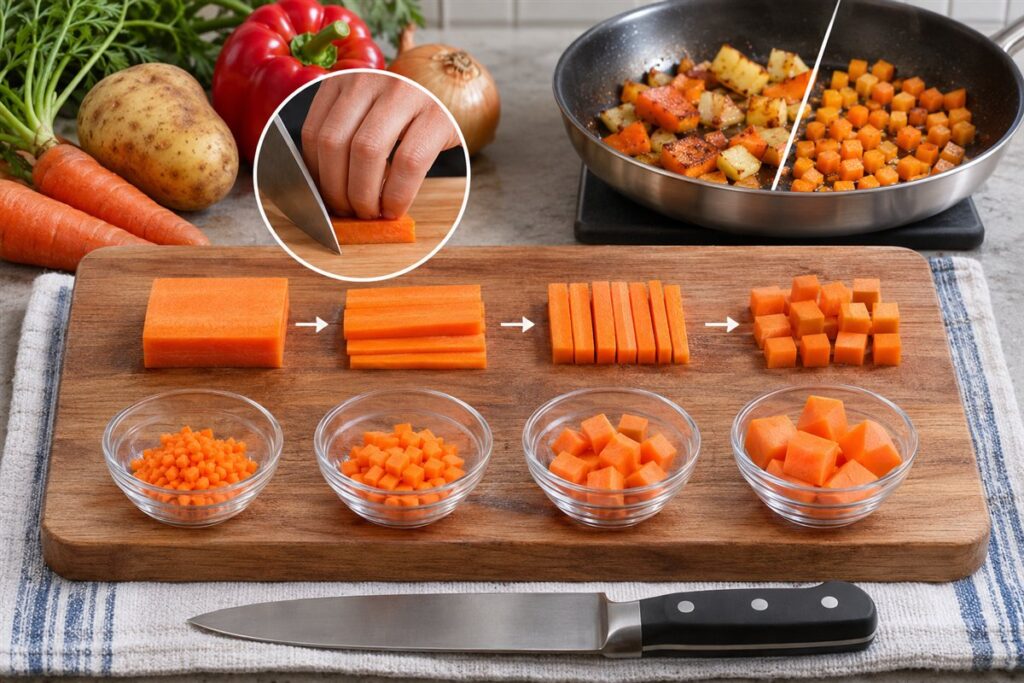
To dice vegetables evenly, create a flat, square-sided piece first, cut it into planks, cut the planks into sticks, then cut across the sticks into cubes. Even pieces cook at the same speed, so nothing ends up raw in the middle or mushy at the edges. The method works for carrots, potatoes, peppers and many more.
Why Even Size Matters
Heat reaches small pieces faster than large ones. If your pieces vary, some will be done while others lag behind. A consistent cut also looks tidy and helps seasoning spread evenly.
The Basic Dice
- Place a board on a damp towel and gather a sharp chef knife.
- Trim a thin slice from one side of the vegetable so it rests flat. Never cut a rolling item.
- Trim the other sides so you have a rough rectangle.
- Cut the block into planks of the thickness you want your dice to be.
- Stack two or three planks, if they are stable, and cut them into sticks of the same width.
- Gather the sticks and cut across them to make cubes.
- Save the trimmings for stock or a quick snack.
Hold the vegetable with a claw grip, knuckles forward and fingertips tucked, and follow the knife maker’s safety guidance.
Common Dice Sizes
| Name | Approximate size | Typical use |
|---|---|---|
| Brunoise | About 1/8 inch | Garnish and fine sauces |
| Small dice | About 1/4 inch | Soups and sautes |
| Medium dice | About 1/2 inch | Stews and roasting |
| Large dice | About 3/4 inch | Long braises |
Handling Odd Shapes
- Round vegetables: cut in half first and lay the flat side down.
- Long vegetables: cut into shorter lengths before dicing.
- Soft vegetables: use a very sharp knife and a gentle sawing motion to avoid crushing them.
- Peppers: remove the core and seeds, then lay the skin side down to cut.
Building a Rhythm
Work slowly at first and let speed come naturally. Use the whole blade rather than chopping with the tip, and keep the tip near the board. Clear the board between vegetables so pieces do not mix, and use a bench scraper to move piles safely.
Practice on common vegetables such as carrots or onions until the motion feels natural. Check a few cubes against each other as you go, and trim any oversized pieces before cooking. Keep the knife sharp by honing it as the maker advises.
Knife Features That Help With Dicing
You do not need a specialty knife to dice well, but certain features make the job easier and safer. A chef knife with a reasonably long, straight-edged blade lets you slice through a plank in one smooth stroke. A blade that curves too sharply may rock more than you want for precision work, while one that is very straight can feel less forgiving to beginners. Pick what feels natural when you hold it in a pinch grip.
Blade height matters because your knuckles guide the side of the blade. A blade with a bit of height above the edge gives your guiding hand something to rest against and keeps your fingers farther from the cutting edge. Very thin, narrow blades can be harder to control in this way. Handle comfort is just as important. A handle that fits your hand without hot spots lets you work longer without fatigue.
Edge condition outweighs almost everything. A sharp edge bites into carrot or potato skin and cuts cleanly, while a dull one slips and crushes. Hone the edge as the maker advises, and have it sharpened when honing no longer restores the bite. Check the product listing or manual to learn what care the blade needs, including whether it can go in the dishwasher. If you are buying a new knife, handle it in person if you can or read the return policy, since feel is personal.
Board, Height and Posture for Steady Cutting
Even dice depend on repeatable motion, and repeatable motion depends on a comfortable setup. Start with the board. It should be large enough to hold the vegetable, the planks and the cubes without crowding, and it should sit on a damp towel or non-slip mat so it cannot shift. A board that is too small makes you stop to move pieces, which breaks your rhythm.
Next, think about height. If the counter is too low you hunch, and if it is too high your shoulders rise. Your forearm should be about level when the knife rests on the board. If your counter is low, a thicker board can raise the work surface a little, while a lower table or an adjustable stool can help if the counter is high. Check that your elbow can move freely and is not wedged against your side.
Stand with your feet apart and your body angled slightly, with the knife hand near the board and the guiding hand across from it. This lets the blade travel straight ahead rather than across your body. Keep the board edge near your waist so you are not reaching. Good lighting over the work area helps you see cut lines, and a clean, dry board keeps the vegetable from sliding. Small adjustments to posture make a surprising difference to evenness.
Dicing by Texture: Firm, Juicy and Soft Vegetables
Vegetables differ in how they respond to the knife, and adjusting your approach helps keep the dice even. Firm, dense vegetables such as carrots, beets and potatoes need a stable base and a confident downward push. Cut them into planks and use a firm, steady stroke rather than a hacking motion. Very hard roots may need a sharper knife and shorter planks for control.
Juicy vegetables, such as tomatoes, cucumbers and zucchini, release liquid, which makes the board slippery. Pat the board or cut pieces dry as needed. Use a sharp knife and slicing motion, because pressing down squashes them. For tomatoes, cut a halved piece with the skin side down and make careful strokes. For cucumbers, scooping out watery seeds first keeps the dice firm.
Soft or layered vegetables, such as peppers, onions and mushrooms, require different handling. Peppers are easiest to dice skin side down. Mushrooms can be sliced first and then cut into strips and cubes. Leafy or stemmy vegetables like celery work best when you cut them into lengths first and then split them into sticks.
- Dry slippery vegetables before cutting.
- Square off round shapes first for a stable base.
- Cut each type separately so the sizes do not mix.
With practice you will learn to read each vegetable and adjust your pressure and speed.
Cooking With Your Dice: Timing and Pan Choices
Once you have even cubes, how you cook them decides whether the work pays off. Pieces of the same size go into the pan together and finish together, but only if the pan and heat suit them. A wide pan gives vegetables room to brown, while a deep, crowded one steams them. If you are cooking a large batch, use a larger pan or cook in batches so the pieces are not stacked.
Match the dice size to the cooking time. Fine pieces soften quickly and suit fast sautes and sauces, while larger cubes hold up to roasting or long simmers. If different vegetables go in the same pot, cut slow-cooking ones smaller or add them first, and add quick-cooking ones later. Dense vegetables like potatoes and carrots take longer than peppers or zucchini at the same size.
- Preheat the pan so the vegetables sizzle on contact.
- Stir often enough to prevent scorching, but leave them alone long enough to brown.
- Salt lightly early on to help soften and draw out moisture, then adjust at the end.
Taste a piece as it cooks to check doneness, and follow your recipe for times, since ovens, pans and stoves vary. If some cubes are done early, scoop them out and keep going with the rest.
Troubleshooting Uneven Results and Building Skill
If your cubes are still uneven, try to find the pattern. Rectangular rather than cube-shaped pieces usually mean the planks and sticks were cut at different thicknesses. Wedge-shaped pieces suggest the vegetable was not squared off. Ragged edges point to a dull knife or sawing with the tip. Small crumbs mixed with the dice often come from forcing the knife rather than letting the blade slide.
A few practice habits help. Set a guide by cutting your first plank and using it as a thickness reference for the rest. Use a ruler for a few attempts to calibrate your eye, then put it away. Practice on inexpensive vegetables like carrots and potatoes, and save the results for soup or roasting so nothing goes to waste. Work in short sessions, since attention fades quickly, and slow down when you see errors creeping in.
Consider filming your hands, or simply watching them, to check your claw grip and blade angle. Keep your elbows relaxed, and let the knife do the work. Over time you will cut more evenly without thinking about it. Also accept that perfection is not required. For stews and rustic dishes, close is good enough, and consistent enough to cook evenly.
FAQ
Do I need a special knife for dicing?
No. A sharp, comfortable chef knife matters more than any special feature. Maintain it as the maker recommends.
How can I keep my cubes from sliding?
Squaring off the piece creates a stable base, and a damp towel under the board stops it moving.
How long does it take to get good at dicing?
It varies from person to person. Short, regular practice with a sharp knife usually brings noticeable improvement within a few sessions.
Should I wash vegetables before or after dicing?
Wash and dry them before cutting. Washing diced pieces can make them waterlogged and harder to brown.
Why are my dice rectangular instead of square?
The planks and sticks were probably cut to different widths. Use your first plank as a thickness guide and match the sticks to it.
Is a bench scraper necessary?
It is not required, but it moves piles of diced vegetables safely without exposing the knife edge, and it helps keep the board tidy.
Can I dice ahead of time?
Often yes. Store dice in a covered container in the fridge and follow food-safety guidance. Some vegetables, like potatoes, may need cold water to prevent browning.
What is the best way to dice a pepper?
Remove the core and seeds, flatten the pepper skin side down, and cut it into strips and then into cubes. The skin side down makes the knife grip better.
The Short Version
Square off the vegetable, cut planks, then sticks, then cubes. Choose a dice size that suits the dish and use a claw grip with a sharp knife.