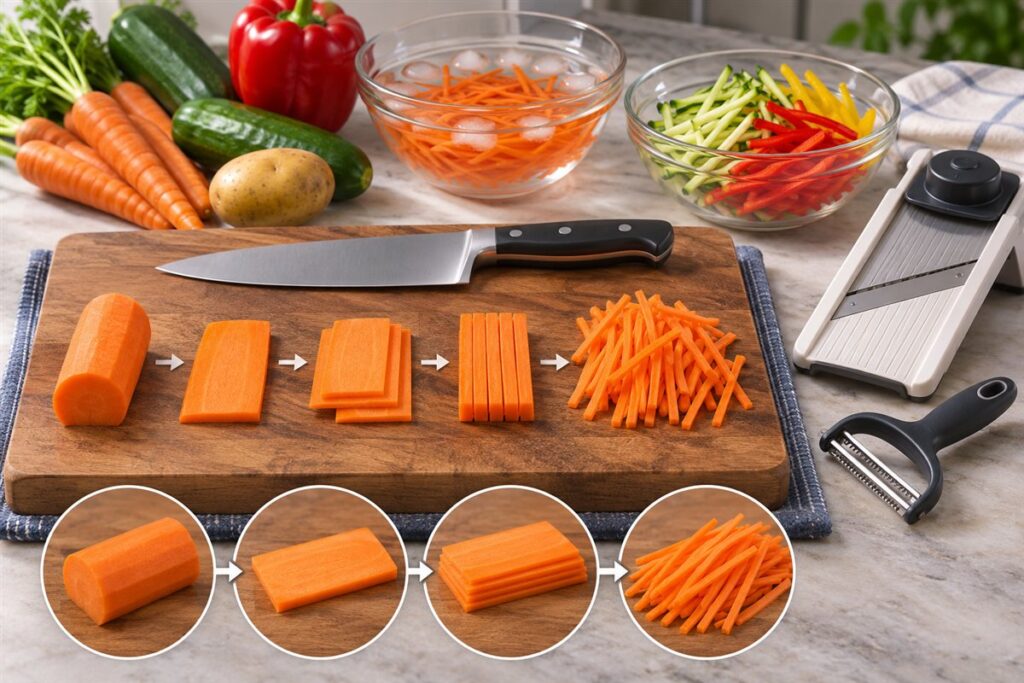
Julienne means cutting vegetables into thin, even matchsticks. You trim the vegetable flat, slice it into thin planks, stack a few planks and cut them lengthwise into strips. The result cooks fast, looks neat and works well in salads, stir-fries and garnishes.
What You Need
A sharp chef knife or a slim utility knife gives the cleanest strips, and a board that does not slide keeps the work steady. Choose firm vegetables, since soft ones squash. Read the maker’s safety instructions for your knife before you begin.
- A stable cutting board on a damp towel.
- A sharp knife with a comfortable handle.
- A bowl for finished strips and one for trimmings.
Cutting Matchsticks Step by Step
- Wash and dry the vegetable. Peel it if the skin is tough.
- Cut the vegetable into sections about two to three inches long.
- Trim one side to make a flat base so the piece cannot roll.
- Slice the section lengthwise into thin planks, about one eighth of an inch thick.
- Stack two or three planks, keeping them aligned.
- Cut the stack lengthwise into strips of the same width as the plank thickness.
- Gather the strips and use them right away, or keep them in cold water for a short time so they stay crisp.
Keep your fingertips curled back and your knuckles guiding the side of the blade.
Which Vegetables Work
| Vegetable | Notes |
|---|---|
| Carrots | Firm and easy; good for salads and slaws |
| Zucchini | Cut the outer part and use a gentle touch |
| Bell peppers | Cut skin side down for control |
| Cucumber | Remove seeds if watery for salads |
| Potatoes | Rinse after cutting and dry well before cooking |
Uses and Variations
Julienne cuts cook quickly, so they suit fast stir-fries and quick sautes. Raw strips add crunch to spring rolls and noodle bowls. A thinner version is often called fine julienne, while a slightly thicker version is called batonnet. Choose the size that fits the dish, and keep strips similar within a batch.
Keep the work area tidy as you go. Move finished strips into a bowl, brush trimmings aside with the side of the knife away from the edge, and wipe the board if it gets wet. A tidy space makes each cut more predictable, and it helps you keep the strips the same length.
Store cut strips in a covered container in the fridge, and use them within a short time for the best texture. Follow food-safety guidance for prepared produce.
Prepping Vegetables for Thin, Straight Cuts
Good matchsticks start before the knife touches the vegetable. Choose pieces that are straight, firm and of fairly even thickness, since a curved or tapered vegetable gives short, uneven strips. A long, straight carrot is easier than a knobby one, and a firm cucumber works better than a soft one. When a vegetable is irregular, trim it into a rough rectangle first and save the trimmings for stock or snacking.
Peeling is a matter of taste and texture. Carrots and potatoes are often peeled because the skin can be tough or bitter. Cucumbers, zucchini and peppers are often left unpeeled for color and crunch, although tough or waxed skins may call for peeling. Wash and dry thoroughly, because surface water makes the board slippery and the planks harder to stack.
- Cut long vegetables into sections shorter than your knife blade so the strokes stay controlled.
- Trim the ends so every section starts square.
- Chill softer vegetables briefly, as colder flesh holds its shape better, though avoid freezing them.
The flat base matters more than anything else in this stage. A vegetable that rocks will give you planks of changing thickness, and then your strips will vary no matter how careful you are. Take the extra moment to square off one side before you do anything else.
Knife, Mandoline and Julienne Peeler Compared
You can make matchsticks with several tools, and each has strengths. The chef knife is the most flexible choice. It handles almost any vegetable, lets you control the thickness, and needs no extra storage. The tradeoff is skill, since it takes practice to cut uniformly at speed.
A mandoline slices planks or strips quickly, and many models have interchangeable blades for matchstick cuts. It suits large batches where consistency matters, but it has an exposed, very sharp blade, so always use the guard or holder the maker provides and follow their safety instructions. Check the product listing for blade options, adjustments and cleaning details, and look at how easy the unit is to assemble and store.
A julienne peeler has a serrated or toothed blade that makes thin strips as you pull it along a firm vegetable. It is compact, inexpensive in relative terms, and suits carrots, zucchini and cucumbers well. It works poorly on very soft or very large vegetables, and the strips are often shorter and thinner than hand-cut ones.
- Beginners: a knife and patience, or a peeler for small jobs.
- Frequent large batches: a mandoline with proper hand protection.
- Small kitchens: a peeler takes the least room.
Some cooks own more than one, and that is fine, but you can learn on a single tool.
Dishes That Show Off Matchstick Cuts
Julienne cuts earn their keep in dishes where texture and appearance count. Raw matchsticks add crunch to slaws, noodle salads, fresh rolls and sandwiches. A dressing clings well to thin strips, and the pieces are easy to eat with chopsticks or a fork. When used raw, cut them just before serving, or keep them in cold water briefly to stay crisp, then drain and pat them dry.
In cooked dishes, matchsticks suit fast methods. Stir-fries cook strips in a short time over high heat, so have everything cut and ready before the pan is hot. Quick sautes, frittatas and fried rice also take well to thin strips. Strips of potato can be shallow-fried or baked into crisp piles, following your recipe for oil, temperature and time.
- Match the thickness to the cooking time. Thinner strips cook faster and can burn.
- Combine vegetables with similar cooking times, or add denser ones first.
- Use matchsticks as a garnish for soups and plates, where they add color and height.
Keep in mind that the thin strips lose heat and moisture quickly. Serve them soon after cooking for the best texture. If a dish needs to be made ahead, add the strips at the last stage or reheat gently.
Common Julienne Mistakes and How to Fix Them
If your strips come out inconsistent, the cause is usually one of a few things. Planks of uneven thickness are the top culprit, because everything downstream inherits the error. Slow your first cut and keep the knife moving in a straight line from the heel to the tip, using the guide hand knuckles as a fence. Strips that are too short often point to sections that were cut too short before slicing.
- Stacks slipping: limit stacks to two or three planks, and keep the edges aligned. If the vegetable is slippery, dry it or use a damp towel under the board.
- Crumbling strips: the vegetable may be too soft or the knife dull. Use a firmer vegetable and sharpen the edge.
- Thick centers and thin ends: square off the vegetable before slicing planks.
- Wet, limp strips: avoid soaking too long, and dry them well before use.
- Tired hands: take breaks, since precision falls when you are fatigued.
If your strips are not perfect, do not discard them. Mixed lengths work well in soups, fried rice and quick pickles. Aim to improve gradually, and measure your first few planks against a ruler to train your eye. After a short while your hands will learn the right thickness.
Storing, Crisping and Reusing Cut Strips
Thin strips have a lot of surface area, so they dry out, discolor or turn limp faster than larger pieces. For short-term storage, place them in a covered container with a slightly damp paper towel on top, and keep them in the fridge. Use them soon, and follow food-safety guidance for prepared produce. Hard vegetables such as carrots hold up well, while softer ones like cucumber and zucchini fare better when stored dry and cut close to serving time.
To refresh limp carrot or celery strips, soak them briefly in cold water, then drain and dry. Potatoes are a special case, since cut surfaces darken quickly. Keep potato strips in cold water until cooking, then drain and dry them thoroughly so they brown rather than steam.
Think about using trimmings and leftovers. Short offcuts can be tossed into stock, omelets or sauces. Peels from clean, unwaxed vegetables can sometimes go into a stock pot as well. If you have excess strips, quick pickling in a simple brine is an option, following a tested recipe and safe storage guidance. Label containers with the date, and discard anything that smells off or turns slimy. Plan your batch around how much you will actually eat so little goes to waste.
FAQ
Can I use a mandoline or a peeler instead?
Some tools make matchsticks, but they have exposed blades. Follow the maker’s safety guidance, including any hand guard.
Why do my strips vary in thickness?
Uneven planks are the usual cause. Slow down on the first cut, and keep your knife sharp.
What is the difference between julienne and batonnet?
Both are matchstick shapes, but julienne is thinner. Batonnet is a slightly thicker stick often used for roasting or frying.
Which vegetables are hardest to julienne?
Very soft or watery vegetables, such as ripe tomatoes, tend to squash. Firm, straight vegetables like carrots are the easiest to start with.
Is a mandoline safe to use?
It can be used safely if you follow the maker's instructions and always use the supplied guard or holder. Never use bare fingers near the blade.
How can I keep potato strips from turning brown?
Keep them in cold water until you are ready to cook, then drain and dry them well before heating.
Can I julienne leafy vegetables?
Leaves are usually cut into ribbons rather than matchsticks. Stack, roll and slice them across for thin strips.
How thick should matchsticks be?
They are typically thin, often around an eighth of an inch, but the right size depends on your dish. Keep strips in one batch similar in thickness.
Should I peel vegetables before cutting them into strips?
It depends on the vegetable and the dish. Peel tough or waxed skins, and leave thin, edible skins on for color after washing well.
The Short Version
Trim flat, slice thin planks, stack them and cut into strips. Use firm vegetables, a sharp knife and a stable board, and follow the knife maker’s safety advice.