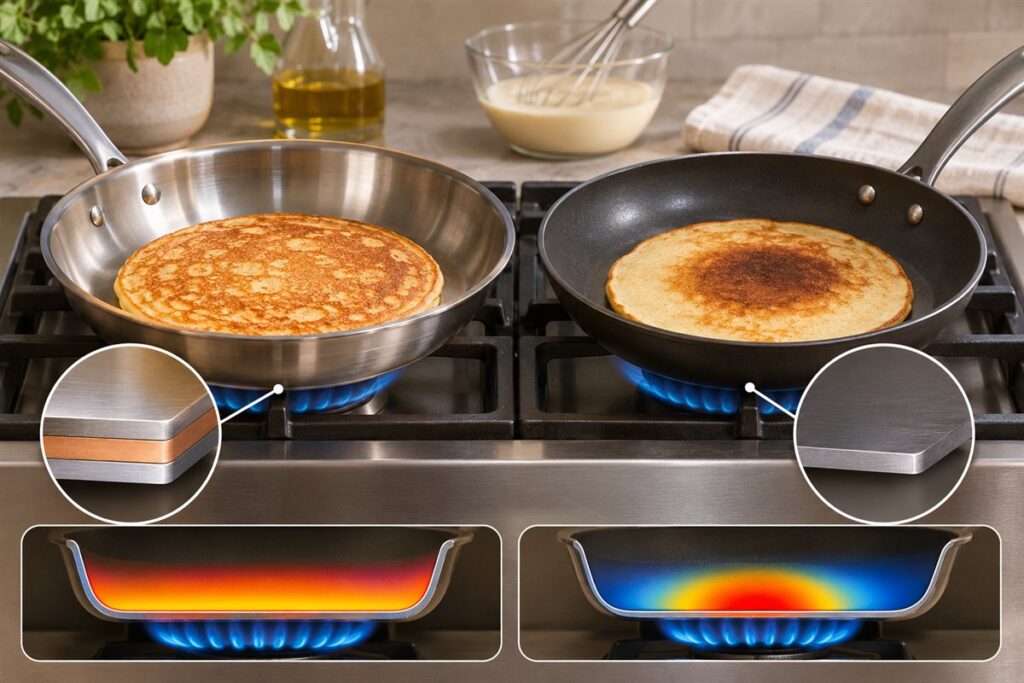
Cookware heats evenly when its base spreads heat across the whole surface instead of leaving a hot spot over the flame or coil. Metal choice, thickness and how well the pan matches your burner all play a part. This guide covers what to look for, how to cook around uneven heat, and how to fix common problems.
What Spreads Heat
Some metals carry heat sideways faster than others, and a thicker base gives heat more room to travel before it reaches the food. Layered bases, which join different metals, aim to combine good spreading with other benefits such as stove compatibility. Details differ by maker, so check the maker’s guide.
- Material: Metals differ in how quickly they carry heat.
- Thickness: A thicker base smooths out hot spots.
- Flatness: A base that rocks or lifts at the edge loses contact with the heat.
- Construction: Layers or a bonded disc can improve spreading.
Matching the Pan to the Burner
Even a well-made pan can heat unevenly if it does not match the burner. A small burner under a wide pan leaves the outer area cooler. A pan smaller than the burner can let flame lick up the sides. Where you can, choose a base close to the size of the heating element.
On induction, the heat is made in the pan itself, so the base matters in a different way. Follow the cooktop’s manual for pan size guidance.
Cooking Habits That Help
- Warm the pan gently for a minute or two before adding food.
- Use moderate heat for most tasks so the metal has time to spread it.
- Do not overfill; crowded food cools the pan and cooks unevenly.
- Move food now and then, or rotate the pan on the burner if one side browns faster.
- Choose a pan with a flat, undamaged base.
A simple home check is to scatter a thin layer of flour in a dry pan over moderate heat and see how evenly it colours. Treat this as a rough guide only, and never leave a hot pan unattended.
Signs of Uneven Heating
| What you see | Possible cause |
|---|---|
| Browning in a ring or centre only | Burner and base size do not match |
| One side cooks faster | Burner is off-centre or pan is warped |
| Food sticks in patches | Hot spots or a pan not fully warmed |
Why It Matters in the Kitchen
Even heat is what lets a pancake colour all over, a sauce cook without catching and an omelette set without rubbery edges. When heat is uneven, you spend more time moving food around and adjusting the burner. A pan with good heat spreading is more forgiving, which is helpful for beginners.
Evenness also affects safety and consistency. A hot spot can scorch oil or sugar in one patch while the rest of the pan is still cool, and a cool zone can leave the middle of a thick piece of meat behind its edges. Use a food thermometer and food-safety guidance to judge doneness, not just the color of the crust. Over time you will learn your own burners, much as you learn the quirks of a favorite oven.
Walkthrough: Mapping Your Pan’s Hot Spots
You can learn how a particular pan behaves with a simple, low-risk exercise. Use a pan you want to understand, and keep a close eye on it throughout.
- Place the pan on the burner it will normally use, and make sure the base sits flat. If it rocks, note it, because that affects every result.
- Dust the dry surface with a thin, even layer of flour, or lay slices of plain bread across the bottom in a single layer.
- Heat gently over low to medium heat, never walking away from the stove.
- Watch where the flour or bread darkens first. A dark ring suggests the burner is smaller than the pan, a dark center suggests a hot core, and one dark side suggests the pan or burner is off-center.
- Turn off the heat and let the pan cool before handling.
- Sketch or note the pattern. Next time, rotate the pan, keep thicker food over the cooler side, or move the pan to a better-matched burner.
Common Scenarios
Pancakes brown in the middle only
The pan is probably larger than the burner. Preheat longer on low heat, or use a smaller pan on that burner.
Sauce catches in one corner of the pot
Lower the heat and stir across the bottom with a flat-edged spoon. A thicker pot or a heat diffuser, if the maker allows, can help.
Searing on an electric coil
Coils heat in a ring pattern. A thick, flat base spreads the heat, and warming the pan for a few minutes evens the surface before food goes in.
Cooking on induction
Induction heats quickly and directly, so use moderate settings and check the cooktop manual for pan sizes. A pan that is too small for the zone may not heat evenly or may not be detected at all.
Mistakes to Avoid
- Preheating an empty pan on high. Rapid heating can create strong hot spots and may harm coatings or warp thin bases.
- Choosing a pan much wider than the burner. The outer ring stays cool, so food cooks unevenly.
- Crowding the pan. Food gives off steam, lowers the pan temperature and browns poorly.
- Using a warped pan on a glass cooktop. Poor contact heats unevenly and may mark the surface.
- Pouring cold liquid into a very hot pan. The sudden change can warp the base.
- Ignoring the maker’s heat limits. Coated and thin pans usually need moderate temperatures.
Quick Troubleshooting
| Symptom | Likely cause | What to try |
|---|---|---|
| Pan spins or rocks on the burner | Warped base | Place on a counter to check flatness and replace if needed |
| Dark ring on the food | Burner ring smaller than the pan | Use a smaller pan or a lower setting and a longer preheat |
| Scorched spots on the base | Heat too high or thin base | Lower the heat and stir more often |
| Food steams instead of browning | Pan overcrowded or too cool | Cook in batches after the pan is warm |
| Bottom sticks in the center | Hot core in thin cookware | Add fat, lower the heat, or switch to a thicker pan |
Glossary
- Conductivity: how readily a metal carries heat.
- Hot spot: an area of the pan hotter than its surroundings.
- Clad: bonded layers of different metals in the pan wall or base.
- Disc base: a thick metal disc attached to the bottom of a pan.
- Warping: a change in the flatness of the base.
- Preheat: warm the pan before adding food.
FAQ
Does a heavier pan always heat more evenly?
Often, thickness helps, but design matters too. A heavy pan with a warped base can still heat unevenly.
Why does my pan have a hot spot?
Usually the burner is smaller than the base, or the base is slightly warped. Try a closer burner match.
Can I fix a warped pan?
Slight warping may not matter on gas, but it can cause trouble on flat cooktops. Makers rarely recommend repairs at home, so consider replacing a pan that rocks.
Is nonstick heated differently from stainless?
The base construction matters more than the coating. A coated pan often needs lower heat because the coating has limits, so follow the maker’s guide.
Does the lid change how evenly food cooks?
A lid holds in steam and warms the top of the food, which can even out cooking for simmering and braising. For browning, leave the lid off so steam escapes.
The Short Version
Even heating comes from a thick, flat, well-built base matched to the burner, plus patient preheating and moderate heat. Follow the maker’s guide for limits.