Disclosure: topratedkitchenware.com is reader-supported. When you buy through links on our site, we may earn an affiliate commission from Amazon and other retailers, at no extra cost to you.
Where to buy
If you are shopping for the best coffee makers with grinder consumer reports, the six models below are the shortlist this guide is built around. Prices and availability change often on Amazon, so use the links to check the latest price on Amazon before you buy. Orders are placed on Amazon, and the listing there carries the full manufacturer detail for each model.
- Best Compact All-Rounder: Tastyle Mini Single Serve Coffee Maker — Check on Amazon
- Keurig K-Express (Evergreen) — Check on Amazon
- Keurig K-Express (Mint) — Check on Amazon
- Hamilton Beach FlexBrew Advanced 4-in-1 — Check on Amazon
- Ninja Single Serve Coffee Maker PB051 — Check on Amazon
- Keurig K-Elite (Brushed Silver) — Check on Amazon
Read the full guide ↓
Shoppers who add a testing organisation name to their search — best coffee makers with grinder consumer reports is the classic form — are really asking a different question from everyone else. They do not want a brands marketing list. They want to know what independent, methodical testing would say: which machines brew hot enough, consistently enough, conveniently enough to earn a recommendation, and which claims dissolve under measurement. This guide honours that intent. It does not invent test scores, quote verdicts it has not seen, or attribute rankings to any publication. Instead it does two useful things: it explains, in detail, how rigorous consumer testing of coffee makers actually works — the criteria, the measurements, the repeatability checks — and it assesses the six verified machines below against exactly those criteria, using only their confirmed specifications.
One category fact must come first, because any honest test would surface it immediately: none of these six machines has a built-in grinder. They are single-serve brewers. Two of them — the Tastyle and the Hamilton Beach FlexBrew — plus the Ninja accept ground coffee as well as pods, so a separate grinder can join the setup; the Keurig models are pod-only as listed. A testing-led guide that pretended otherwise would fail its own standard. What testing can legitimately compare here is the single-serve discipline itself: brew temperature stability, cup-to-cup consistency, size accuracy, convenience of the water system, ease of cleaning, and the clarity of the listing claims. On those measurable grounds, these six machines differ more than their similar shapes suggest.
A second warning belongs up front, because it is the one test-literate readers most need: beware any article that prints a precise score, rank or verdict and attributes it to a testing publication without showing you the test. Scores are copyrighted, dated and model-specific; they age as models are revised. The durable value of consumer testing is not the number — it is the method. Learn the method from the sections below and you can evaluate any brewer, including the six here, long after any individual scoreboard has been reshuffled. Readers new to the category may want to compare the carafe formats in Best Coffee Makers With Metal Carafe first, then return here for the testing lens.
Key Takeaways
- This guide invents no scores or verdicts: it explains the testing method and applies its criteria to verified specifications.
- None of the six picks has a built-in grinder; three accept ground coffee, three are pod-only as listed.
- The criteria that decide real-world quality are temperature, consistency, size accuracy, water-system convenience and cleaning effort.
- The Ninja PB051 leads on capacity criteria: 56 oz reservoir, sizes to 24 oz, four brew styles.
- The K-Express platform is the consistency benchmark of the set; its three finishes differ only in colour.
- A brief listing, like the K-Elite one here, is itself test-relevant information: unverifiable claims should earn no credit.
In this guide
Quick Picks
Six single-serve brewers ordered for a test-minded reader: capability breadth first, then the benchmark platform, then capacity, then finish. Badges are used identically in the detailed reviews.
| Pick | Badge | Why it earns its place |
|---|---|---|
| Tastyle Mini Single Serve Coffee Maker | Best Compact All-Rounder | Pods and grounds, hot and iced, 6 to 14 oz — the widest brief coverage in the set from the smallest machine. |
| Keurig K-Express (Evergreen) | Best Overall | The standard K-Express platform in evergreen: three brew sizes, 42 oz removable reservoir, Strong Brew button. |
| Keurig K-Express (Mint) | Best Colour Choice | The same K-Express hardware in mint, for buyers whose final decision between equals is the kitchen colour. |
| Hamilton Beach FlexBrew Advanced 4-in-1 | Best Reservoir Flexibility | A 45 oz removable reservoir with pods or grounds and hot or iced brewing — strong on the convenience criteria testers weigh. |
| Ninja Single Serve Coffee Maker PB051 | Best for Larger Cups | The largest reservoir here at 56 oz, four brew styles and cup sizes up to 24 oz, for households that brew big and often. |
| Keurig K-Elite (Brushed Silver) | Best Premium Finish | The premium-finished Keurig in brushed silver: the set simple, single-serve pod format in its most polished form. |
How These Picks Were Chosen
It is also worth recording what this guide deliberately did not do with price. Testing publications treat value as a score input, usually price against performance at the time of testing. Prices for these models move with promotions and seasons, so any value verdict printed here would expire on a schedule the reader cannot see. Instead, value is handled the durable way: the reviews identify which machines sit in the premium tier of this set and which in the everyday tier, in words, and leave the live figure to the listing, where it belongs. A buyer who finds two machines tied on criteria can let the days price break the tie with a clear conscience, because the criteria — not a stale number — did the real work.
The pool was also screened for a subtler quality that testing organisations value and marketing hates: specification stability. Models whose listings state their reservoir capacity, brew sizes and accepted formats in plain numbers can be compared, re-checked and held to account; models described only in adjectives cannot. That screen is why this guide can put a 56 oz reservoir and a 24 oz maximum cup size in a comparison table with confidence, and why the same table leaves the K-Elite row deliberately spare. A test-led shortlist is not the six most advertised machines — it is the six machines about which the most can be responsibly said, ranked by criteria a reader can re-apply at home.
Two candidate types were excluded by design, and the exclusions are worth stating because they define the category. Full-size drip machines with carafes were left out even where their makers also sell single-serve models, because their test profile — batch consistency, carafe heat retention — answers a different households question. Espresso machines were left out for the mirror-image reason: their criteria, pump pressure and steam performance, would swamp a comparison these brewers never entered. What remains is the honest middle of the market, the single-serve class, judged by the standards proper to it. Readers who arrived expecting a scoreboard should take that scoping as the guides first finding: in this class, at this time, criteria travel further than scores.
A last note on evidence ageing. Listings change: finishes rotate, bundles gain or lose an accessory, a reservoir size is revised between production runs. The verification behind this guide is dated — the sources file records the check date — and a careful buyer re-confirms the two or three specifications that decided their choice on the live listing before ordering. That ten-second habit is the home version of a testers model-revision check, and it closes the only gap that a research-led guide cannot close for you.
The shortlist was built from a verified pool: each model was checked against its live Amazon listing, and only specification stated there is used in this guide. That verification-first rule is the closest a buying guide can come to the testing mindset without a laboratory: claims are admitted only with evidence. It is why the K-Elite review below is deliberately shorter on features than readers might expect — its verified listing states the format and the brushed silver finish and little else, and this guide will not pad that silence with features borrowed from sibling models or general knowledge. In a test report, an unverified claim scores nothing. Here, it prints nothing.
The criteria applied across the set mirror published coffee-maker testing practice. Brewing performance: does the machine offer size and strength control that lets it hit a proper extraction — small strong options, a Strong Brew function, grounds flexibility? Consistency proxies: reservoir size and removable design, because water handling is where home routines drift. Convenience: brew-size range, travel-mug clearance, iced capability, included guidance such as the Tastyle recipe book. Ease of care: removable, washable parts and dishwasher-safe components where listed. Value positioning is discussed qualitatively, tier against tier, never as invented figures.
Method limits, stated as a tester would state them: this is a research-led assessment from verified data and established category knowledge, not hands-on laboratory measurement, and it says so rather than borrowing authority it has not earned. Where a judgement is an inference — for example, that a 56 oz reservoir will suit heavy households — it is phrased as one. Readers who want the frothing angle on the same machines can continue to Best Coffee Makers With Milk Frother, and those focused on hot-water duty to Best Coffee Makers With Hot Water.
The 6 best coffee makers with grinder consumer reports readers should actually compare
Each review applies the same test-style criteria — control, consistency, convenience, care — to the verified specification, and flags where the evidence runs out.
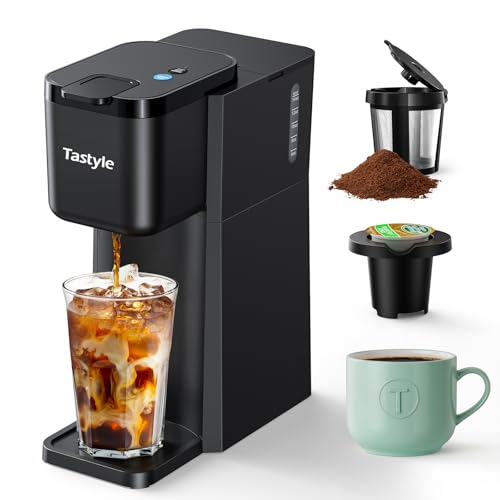
Tastyle Mini Single Serve Coffee Maker
Badge: Best Compact All-Rounder
Strengths
- Dual format and hot-or-iced brewing give it the broadest capability list of any mini here
- The 6 to 14 oz range covers the small strong cup and the full travel mug
- An included recipe book signals a maker that expects experimentation
Trade-offs
- Per-cup water handling rather than a reservoir, so rounds involve refills
- A newer brand with less accumulated reliability history than the big names
- Mini format limits it to one drink at a time
Key specs from the listing: Format: single serve, hot and iced. Accepts: K-Cup pods and ground coffee. Brew sizes: 6 to 14 oz. Power: 120V. Included: recipe book. Model: K310IC, version 2.0. Finish: Classic Black.
On a test sheet, the Tastyle scores its points on breadth per inch. It is a mini machine that accepts K-Cup pods and ground coffee, brews hot and iced, spans 6 to 14 oz, and includes a recipe book. That combination gives a tester more variables to approve of than any other mini here: format flexibility for households still deciding, a small-size option for a properly strong cup, and an iced mode that is designed rather than improvised. The grounds path is also its answer to the grinder question — pair it with a separate grinder and the freshness box is ticked as fully as this category allows.
Its debits are equally testable. Water is handled per cup, so repeatability across a round of drinks depends on the users measuring discipline, and throughput is one drink at a time. The brand is newer than the household names, which in reliability terms means a thinner track record to extrapolate from — a tester would flag the uncertainty rather than resolve it. Verdict on the evidence: the most capable compact in the set, bought with open eyes about brand history.
Best for: solo drinkers who want every format in the smallest body / Not suited for: households brewing rounds without refills

Keurig K-Express (Evergreen)
Badge: Best Overall
Strengths
- The proven K-Express formula: three sizes, removable reservoir, Strong Brew
- Travel mug friendly, which matters in commuter households
- Evergreen finish distinguishes it from the default black appliance
Trade-offs
- Pod-only as listed: no grounds path and no built-in grinder
- One of three finishes of one platform in this guide — the differences are cosmetic
- Reservoir machines still need scheduled descaling to stay consistent
Key specs from the listing: Format: single serve, K-Cup pods. Brew sizes: 3. Reservoir: 42 oz, removable. Features: Strong Brew button, travel mug friendly. Finish: Evergreen.
The K-Express is the platform any test of this category would use as a reference point, and the Evergreen finish carries its full specification: three brew sizes, a 42 oz removable reservoir, a Strong Brew button, travel mug clearance and compatibility with all K-Cup pods. Its test strengths are the consistency criteria. A removable reservoir standardises the water supply across cups; fixed brew sizes standardise volume; the Strong Brew option gives the extraction a second, bolder setting. Pod brewing itself is a consistency technology — dose and grind fixed at the factory — and this platform executes it in its most familiar form.
Debits: pod-only, so the freshness and grounds-flexibility criteria score zero, and there is no iced program. A tester would also note that three finishes of one platform in a single shortlist is a pool artefact, not three distinct recommendations — the brewing verdict transfers unchanged between them, and only the finish decision is real. As the benchmark, though, the K-Express earns its place: this is the routine against which the convenience of everything else here is measured.
Best for: households wanting the standard pod platform in green / Not suited for: fresh-grind households

Keurig K-Express (Mint)
Badge: Best Colour Choice
Strengths
- Identical verified specification to the other K-Express finishes
- Mint suits bright kitchens where black appliances glare
- Removable reservoir keeps refilling and washing simple
Trade-offs
- Mechanically identical to the black and evergreen versions
- Pod-only, with freshness delegated entirely to pod choice
- Pale finishes show splashes sooner and need more frequent wiping
Key specs from the listing: Format: single serve, K-Cup pods. Brew sizes: 3. Reservoir: 42 oz, removable. Features: Strong Brew button, travel mug friendly. Finish: Mint.
The Mint K-Express receives the same test verdict as the Evergreen, because the verified specification is the same: three brew sizes, 42 oz removable reservoir, Strong Brew, travel mug friendly, all K-Cup pods. A methodical guide should say that plainly rather than manufacturing distinctions. Where the finishes genuinely diverge is in use over time: pale finishes reveal coffee splashes and drip-tray neglect sooner, which marginally raises the visible cleaning burden — a real, if small, ease-of-care debit that a thorough test would record.
For the buyer, the implication is liberating. Choose the K-Express platform on its merits against the criteria — consistency, convenience, pod-only limits — and then choose the colour purely as a kitchen decision, knowing the test sheet does not change. Mint is the bright-kitchen option: white units, pale stone, morning light. If your kitchen is that room, this is your version of the benchmark.
Best for: households wanting the standard pod platform in mint / Not suited for: fresh-grind households

Hamilton Beach FlexBrew Advanced 4-in-1
Badge: Best Reservoir Flexibility
Strengths
- 45 oz removable reservoir reduces refill frequency across a morning
- Pods or grounds in one machine ends the household format debate
- Hot and iced brewing with fast cycles suits impatient routines
Trade-offs
- Larger footprint than the mini picks, in exchange for the tank
- Dual format only pays off if the household actually uses both
- No grinder or frother, as with every pick here
Key specs from the listing: Format: single serve, hot and iced. Reservoir: 45 oz, removable. Accepts: pod packs and ground coffee. Brewing: fast. Finish: Black.
The FlexBrew Advanced 4-in-1 tests well on the two criteria households feel daily: water handling and format freedom. The 45 oz removable reservoir is a proper multi-cup supply, and the machine accepts pod packs or ground coffee, hot or iced, with fast brewing. In test language, it covers the widest use-case matrix of the reservoir machines here — the one a tester would call the most versatile — and its grounds path gives it a freshness route the pod-only models cannot match, provided the household pairs it with a grinder and a consistent dose.
Debits: footprint, the natural cost of the reservoir; and the dual-format caveat that flexibility only scores if it is used — a household that never brews grounds owns a larger pod machine. There is no grinder or frother, as with the whole set. On the evidence, this is the strongest all-round test profile among the full-size picks for a mixed household: nothing it claims is exotic, and everything it claims is usable daily.
Best for: mixed households that brew several drinks a session / Not suited for: tiny counters

Ninja Single Serve Coffee Maker PB051
Badge: Best for Larger Cups
Strengths
- 56 oz removable reservoir is the largest in this set
- Four brew styles and sizes up to 24 oz cover mugs no other pick here reaches
- Pods and grounds in one full-size machine
Trade-offs
- The biggest machine here; small kitchens should measure first
- Four brew styles are only valuable if the household uses more than one
- Premium positioning within this set
Key specs from the listing: Format: single serve combo machine. Accepts: K-Cup pods and grounds. Brew styles: 4. Cup sizes: up to 24 oz. Reservoir: 56 oz, removable. Model: PB051. Finish: Black.
The Ninja PB051 is the capacity outlier, and its verified numbers lead the set: a 56 oz removable reservoir, four brew styles, and cup sizes up to 24 oz, accepting both K-Cup pods and grounds. On convenience criteria for heavy use, that specification is decisive — fewer refills, bigger mugs, more style variation for a household whose members drink differently. The grounds acceptance also gives it the freshness path, and the four styles give a tester more extraction options to evaluate than any other machine here.
Debits follow from the same specification: it is the largest machine in the set, and capacity bought for a household of one is counter space wasted. Style variety also cuts both ways — features a household never selects are complexity without benefit. A tester would also note that bigger reservoirs demand more disciplined descaling and water refreshing, because a large tank invites topping-up habits that stale the supply. For the heavy-use household it is specified for, though, this is the strongest test profile in the guide.
Best for: large households, big-mug drinkers and heavy daily use / Not suited for: tiny counters and occasional drinkers

Keurig K-Elite (Brushed Silver)
Badge: Best Premium Finish
Strengths
- Brushed silver finish is the most premium presentation in this set
- The Keurig single-serve format is the most familiar routine in the category
- A clean, minimal listing for buyers who want the format without feature sprawl
Trade-offs
- The verified listing is unusually brief, so feature-by-feature comparison rests on the format and finish alone
- Pod-only single serve, with no grounds option in the listing
- Premium finish pricing within the Keurig line
Key specs from the listing: Format: single serve, K-Cup pods. Finish: Brushed Silver. (The verified listing for this model is brief; this guide claims no features beyond the format and finish it states.)
The K-Elite is the review where this guide demonstrates its method by restraint. The verified listing states a single-serve K-Cup pod coffee maker in a brushed silver finish — and very little more. No reservoir size, no brew-size list, no feature claims are printed here, because none are in the verified data, and a test-led guide does not award credit for unlisted features, however plausible they seem or however familiar the model name is. What can be assessed is real: the Keurig single-serve format is the most established routine in the category, and the brushed silver finish is the most premium presentation in this set.
The debits are the mirror of that restraint. A comparison shopper working from verified data cannot rank this machine on capacity or control against rivals whose listings specify both, and pod-only format limits its freshness score regardless. Buyers who value the finish and the format, and who are comfortable confirming the detailed specification on the live listing before ordering, will find it a coherent choice. Testers would call that a conditional pass — and conditional passes are what honest testing is for.
Best for: buyers who prioritise finish and format simplicity / Not suited for: feature-comparison shoppers who need a detailed spec sheet
Comparison Table
Side by side, using only the verified listing specification for each model. Finishes aside, this is where the best coffee makers with grinder consumer reports shortlist separates: reservoir size, format flexibility and cup range.
| Pick | Reservoir and brew sizes | Pods, grounds and extras | Stands out for | Listing |
|---|---|---|---|---|
| Tastyle Mini Single Serve Coffee Maker | 6 to 14 oz brew sizes | K-Cup pods and grounds; hot and iced; recipe book included | Format coverage per inch of counter | Check on Amazon |
| Keurig K-Express (Evergreen) | 42 oz removable reservoir; 3 brew sizes | K-Cup pods; Strong Brew button | The benchmark pod routine | Check on Amazon |
| Keurig K-Express (Mint) | 42 oz removable reservoir; 3 brew sizes | K-Cup pods; Strong Brew button | The benchmark in a soft finish | Check on Amazon |
| Hamilton Beach FlexBrew Advanced 4-in-1 | 45 oz removable reservoir | Pod packs and grounds; hot and iced | Reservoir plus format freedom | Check on Amazon |
| Ninja Single Serve Coffee Maker PB051 | 56 oz removable reservoir; up to 24 oz cups | Pods and grounds; 4 brew styles | Big households and big mugs | Check on Amazon |
| Keurig K-Elite (Brushed Silver) | Single-serve format | K-Cup pods; brushed silver finish | Premium presentation | Check on Amazon |
How to choose using test criteria instead of marketing
Begin with the criterion that decides flavour before all others: extraction control. Coffee needs sufficiently hot water, sufficient contact and a sensible ratio of coffee to water. In single-serve terms, look for a small brew size for strength, a strength function such as Strong Brew where offered, and — most powerful of all — a grounds path that lets you set the dose yourself. Rank the machines here accordingly: the grounds-capable Ninja, FlexBrew and Tastyle give the user extraction control; the K-Express line gives a fixed but well-judged pod extraction with a bolder option; the K-Elite, on verified data, gives the format alone. None of this requires a laboratory to apply — it requires reading the specification for control points rather than adjectives.
Second, consistency. A tester brews the same drink repeatedly and measures the drift; a home buyer should ask what in the design keeps Tuesday cup equal to Mondays. Reservoirs standardise water supply, fixed sizes standardise volume, pods standardise dose. Fill-per-cup machines put the measuring in your hands — fine for a careful solo drinker, a drift risk in a rushed household. Third, the water system as a whole: removable reservoirs wash properly and refill at the tap; fixed or per-cup systems are smaller but slower across rounds. Match the system to your household count, honestly counted at 7 a.m. rather than at leisure.
Fourth, ease of care, the criterion most predictive of long-term satisfaction. Machines get descaled or they decline; parts get washed or flavours stale. Prefer removable reservoirs, accessible drip trays and dishwasher-safe parts where listed, and be suspicious of any design whose cleaning routine you already know you will skip. Fifth, claim hygiene: treat a detailed, verifiable listing as a quality signal in itself. A maker that specifies reservoir ounces, brew sizes and included accessories is making checkable promises. A brief listing is not proof of a poor machine — the K-Elite may be excellent — but it transfers the verification work to you, and a test-minded buyer prices that transfer honestly. For the hot-water side of these same criteria, see Best Coffee Makers With Hot Water Dispenser.
Sixth, and quietly decisive: after-sales reality. Test reports end at the verdict; ownership continues for years, through descaling supplies, replacement reservoirs, drip trays and filters. A model from a maker with a wide retail presence and a deep accessory shelf is easier to keep in service than an obscure equivalent, and spare-part availability is a legitimate, checkable criterion — you can verify today whether the reservoir and filter for a machine are sold separately. Apply that check to the newer brands in this set before ordering, not because they are suspect, but because the check is cheap and the information is real.
How to run your own simple home checks on a coffee maker
You do not need a laboratory to test a brewer the way a consumer tester would — you need a thermometer, a kitchen scale or measuring jug, a timer and a notebook. The checks below mirror published test logic at kitchen scale and work for any machine in this guide. Run them when a machine is new to establish a baseline, and again if the coffee starts disappointing you: the numbers will usually point at the cause, which is most often scale build-up or a drifting routine rather than a dying machine.
- Temperature check: brew a water-only cycle into a pre-warmed mug and measure the water in the cup promptly; brewed coffee should arrive properly hot, and a machine that has cooled noticeably from its new baseline is asking to be descaled.
- Volume accuracy: brew each size setting into a measuring jug, three times each, and note the spread; consistent volumes mean consistent strength, while wandering volumes point to scale or a tired pump.
- Consistency check: brew the same pod or the same measured grounds dose five times across a morning and taste blind if you can; drift across the round usually tracks reservoir temperature or water-level habits.
- Timing check: time a standard brew from button to last drip, new and monthly; a steadily lengthening brew is the classic early warning of mineral build-up.
- Grounds check for grounds-capable machines: weigh your usual scoop once; if your by-eye dose varies widely from it, your cup will too — standardise the scoop and the fill line.
- Care check: inspect the drip tray, reservoir corners and filter after a week of your normal routine; the places that grime first are the places your cleaning routine must reach.
Record the results with dates. A tester notebook feels excessive for a week and invaluable in month six, when the coffee tastes off and you can compare temperature and timing against the new-machine baseline instead of guessing. Most declines resolve to one of three causes — scale, stale water habits, or dose drift — and each has a cheap fix. That is the real gift of the testing mindset at home: it replaces vague dissatisfaction and premature replacement with diagnosis.
Troubleshooting
Problem: Cups have gradually become weaker and cooler → run the temperature and timing checks, then descale; mineral scale insulates the heater and slows the flow, and it is the cause far more often than machine failure.
Problem: The same pod tastes different from cup to cup → check the reservoir habit — constant topping-up mixes fresh and stale water — and standardise on filling fresh and brewing at similar water levels.
Problem: Grounds brews swing between bitter and sour → weigh the dose once and fix the scoop routine, then adjust grind size in small steps; dose drift is the most common cause of swing in reusable-filter brewing.
How independent coffee-maker testing actually works
Published consumer testing of coffee makers, of the kind shoppers hope to find behind this keyword, follows a recognisable pattern across organisations. Brew temperature is measured in the cup and in the stream, because extraction chemistry is temperature-sensitive and a machine that brews cool will taste sour and thin no matter what coffee it is fed. Brew time and volume accuracy are measured across repeated cycles, because a machine that pours inconsistently makes strength a lottery. Carafe or cup temperature retention is tracked over time where a carafe exists. Convenience is scored by structured assessment — reservoir handling, control clarity, footprint, cord and clearance realities — and ease of cleaning is assessed by actually cleaning the machine after standardised use, including the descaling process.
Two features of that method deserve emphasis. First, repeatability: a single good cup proves nothing, so testers brew in rounds and report consistency as a result in its own right. Second, separation of the coffee from the machine: tests use controlled coffee so the brewer is the variable. Home buyers can borrow both ideas without any equipment beyond patience, as the how-to section above shows. What a home buyer cannot borrow is a publications score for a model they have not tested — which is why this guide applies criteria instead of quoting numbers, and why any article that prints an unattributed verdict for these six machines should be read with suspicion. For a different buying lens on the same pool, the finish-and-format view in Best Coffee Makers With Kuerig may also help, misspelling and all — it is a reminder that shoppers search imperfectly while listings stay exact.
How to read any test report without being misled
Start with the date and the exact model designation. Coffee makers are revised silently — reservoirs change, features migrate — and a verdict earned by one revision is routinely quoted against another. Second, read the criteria weights before the headline score: a ranking that weights convenience heavily will crown a different machine than one that weights brew quality, and neither is wrong; they are answering different questions. Your job is to find the report whose question matches yours. Third, separate measured results from assessor impressions. Temperature and volume are measurements; control feel is an impression. Both are useful, but only one is portable to your kitchen with confidence.
Finally, watch for the three classic distortions. Score compression: in mature categories most machines cluster closely, so small gaps get reported as verdicts when they are really preferences. Sponsored adjacency: buying guides that earn commission — including, transparently, this one — should be read for their method and their honesty about limits, not treated as laboratories. And survivorship in owner feedback: the angriest and happiest owners write most of the public commentary, while the satisfied middle is silent. A test-minded reader triangulates — specification, method, and the pattern of owner experience — and buys the machine that survives all three. That is the standard this guide has tried to meet.
What reliability evidence can and cannot tell you
Every test-minded buyer eventually asks the question laboratory scores answer worst: will it last? Coffee makers fail in patterned ways — heaters scale and fade, pumps tire, seals harden, and pod mechanisms jam on mis-seated capsules — but the timing of those failures in any individual home depends on water hardness, daily volume and descaling discipline more than on the badge. Published reliability surveys, where they exist, aggregate owner experience across brands and are useful at that altitude: they can tell you a category typical lifespan and which failure modes dominate. They cannot tell you whether your unit, on your water, with your habits, will be the exception, and any guide that converts brand reputation into a personal guarantee is exceeding its evidence.
The practical translation is to buy for maintainability. Machines whose listings show removable reservoirs, accessible drip trays and washable or dishwasher-safe parts are machines whose owners can actually perform the care that longevity depends on. Keep the descaling rhythm, keep the water fresh, and keep the purchase in perspective: in this product class, disciplined care moves the lifespan more than the choice between reputable makers does. That is a testable, evidence-respecting claim — and it is the most useful reliability advice a guide without a laboratory can honestly give.
Common Buying Mistakes
The first mistake is score shopping: hunting for the article that prints the highest number next to a favoured model and calling the research done. Numbers without method, date and model revision are decoration. The second is its mirror — dismissing every guide that earns commission as corrupt, and thereby discarding the specification-checking work that good guides genuinely do. Judge the method in front of you: does it state its evidence, admit its limits and refuse to invent features? The third mistake is buying on a single criterion. Capacity champions make poor solo machines; consistency champions disappoint freshness seekers. Testers score across criteria because households live across criteria.
Practical mistakes follow the same pattern. Ignoring the descaling requirement until performance visibly declines, then blaming the machine. Filling a reservoir by topping up for weeks, then blaming the pods. Choosing a fill-per-cup mini for a household of four, then blaming the format. And, specific to this keyword, assuming a grinder is present because the search term contained one — the single most consequential misreading in this category, and the reason this guide states the fact in its opening paragraphs rather than its footnotes.
Final Recommendation
Our first choice, on the criteria applied throughout, is the Evergreen K-Express: the benchmark platform whose consistency, water handling and control options are all verifiable from its listing, in the finish with the most presence. It is pod-only and grinder-free, and it still leads, because a test-minded buyer rewards the machine whose promises are checkable and whose routine is standardised.
Start with the Tastyle Mini Single Serve Coffee Maker if you want the safest all-round choice from this list. It is the reference routine of the category, executed cleanly.
If that first choice does not fit your kitchen, the Ninja Single Serve Coffee Maker PB051 is the alternative we would look at next. It is the Ninja PB051: the capacity and control leader — 56 oz reservoir, four styles, sizes to 24 oz, pods and grounds — for the heavy-use household that wants the strongest test profile in the set and has the counter to hold it.
Related guides
- Best One Cup Coffee Makers Consumer Reports
- Best Office Coffee Makers With Grinder
- Best Kriege Coffee Makers
- Best Krups Coffee Makers
Frequently Asked Questions
Does this guide reproduce any publications test scores?
No. This guide does not quote, reproduce or invent scores, rankings or verdicts from any testing publication. It explains how independent coffee-maker testing works — temperature, volume, consistency, convenience and cleaning criteria — and applies those criteria to the verified specifications of the six machines reviewed. For a publications actual verdict on a specific model, consult that publication directly, checking the date and exact model revision.
Which of these machines would test best for consistency?
On design evidence, the reservoir pod machines — the K-Express line above all — standardise the most variables: fixed pod dose, fixed brew sizes, a stored water supply. The Ninja adds size and style range on the same reservoir logic. Fill-per-cup machines depend more on the users measuring habits, so their consistency is partly a household trait rather than purely a machine trait.
Do any of these coffee makers have a built-in grinder?
No. All six are single-serve brewers without integrated grinders. The Tastyle, Hamilton Beach FlexBrew and Ninja PB051 accept ground coffee, so they pair with a separate grinder; the Keurig K-Express models and the K-Elite are pod-only as listed. Any guide claiming a grinder inside these models is inventing the feature.
Why is the K-Elite review shorter on features than the others?
Because its verified listing is brief — it confirms the single-serve K-Cup format and the brushed silver finish and little else — and this guide only prints specification it can trace to the listing. Before ordering, check the live listing for the full current specification. Treat the brevity as information: detailed listings make comparison possible; brief ones transfer the checking work to you.
What home measurements are most worth doing?
Temperature in the cup, volume accuracy per size setting, and brew timing — repeated when the machine is new and again whenever the coffee disappoints. Together they catch the commonest real-world decline, mineral scale, early and cheaply. A simple dated notebook of results turns guesswork into diagnosis.
How should I use owner reviews alongside test criteria?
As pattern evidence, not as verdicts. Look for the same strength or complaint recurring across many owners — a reservoir that is awkward to wash, a filter that clogs, a machine still running after years of daily use — and discount any single dramatic story in either direction. Patterns that match the specification, such as capacity complaints about mini machines in family homes, are the most trustworthy, because they are predictable from the design itself.
Are the Evergreen and Mint K-Express models genuinely identical?
On verified listing data, yes: same brew sizes, reservoir, Strong Brew button and travel-mug clearance. The difference is finish and the small housekeeping note that pale finishes show splashes sooner. Choose the platform on criteria; choose between these two on your kitchen.


