Disclosure: As an Amazon Associate, Reviews Took earns from qualifying purchases. Links to Amazon on this page are affiliate links; they cost you nothing extra.
Check wattage and attachments.
This guide is built from Amazon product listings and maker specs, not our own testing, so confirm size, contents and current price on each product page. Health products are for general information and are not medical advice.
Check the current price on Amazon before you buy.
Last updated: November 2, 2026.
In this guide
Quick Picks
| Product | Type | Best for |
|---|---|---|
| Braun MultiQuick 7 3-in-1 Immersion Blender & Food Processor | Immersion blender | soups and sauces |
| MasterChef Immersion Blender Handheld Hand Blender Stick 400W | Immersion blender | soups and sauces |
| MegaWise 3‑in‑1 Immersion Hand Blender 12‑Speed Titanium | Immersion blender | soups and sauces |
| MEGAWISE 1000W Hand Blender Multi-Attachment Immersion Blender | Immersion blender | soups and sauces |
| TMIGIA Immersion Blender Corded Stick Mixer 2 Speed Blend | Immersion blender | soups and sauces |
| Turelar Immersion Blender Corded 400W 2 Speed Emulsifier Blend | Immersion blender | soups and sauces |
| Turelar Immersion Blender Handheld Corded 1100W 5 in 1 Hand | Immersion blender | soups and sauces |
| Turelar Immersion Blender Corded 400W 2 Speed Emulsifier Blend | Immersion blender | soups and sauces |
Our Picks

Top pickBest for soups and sauces
1. Braun MultiQuick 7 3-in-1 Immersion Blender & Food Processor
A Braun MultiQuick 7 3-in-1 Immersion Blender & Food Processor (immersion blender), per the listing. Check price on Amazon.
Good for: soups and sauces. Watch out: Check speed settings.


Best for soups and sauces
2. MasterChef Immersion Blender Handheld Hand Blender Stick 400W
A MasterChef Immersion Blender Handheld Hand Blender Stick 400W (immersion blender), per the listing. Check price on Amazon.
Good for: soups and sauces. Watch out: Check speed settings.

Best for soups and sauces
3. MegaWise 3‑in‑1 Immersion Hand Blender 12‑Speed Titanium
A MegaWise 3‑in‑1 Immersion Hand Blender 12‑Speed Titanium (immersion blender), per the listing. Check price on Amazon.
Good for: soups and sauces. Watch out: Check speed settings.
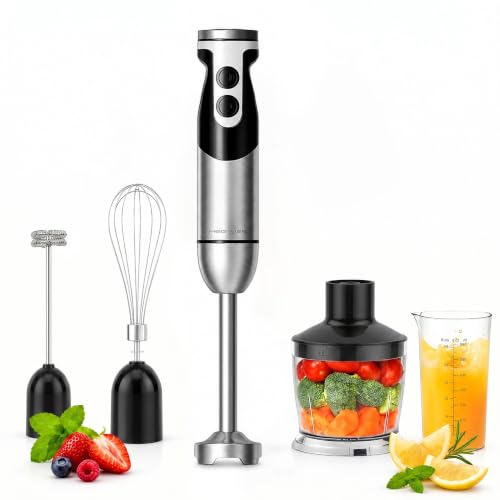
Best for soups and sauces
4. MEGAWISE 1000W Hand Blender Multi-Attachment Immersion Blender
A MEGAWISE 1000W Hand Blender Multi-Attachment Immersion Blender (immersion blender), per the listing. Check price on Amazon.
Good for: soups and sauces. Watch out: Check speed settings.

Best for soups and sauces
5. TMIGIA Immersion Blender Corded Stick Mixer 2 Speed Blend
A TMIGIA Immersion Blender Corded Stick Mixer 2 Speed Blend (immersion blender), per the listing. Check price on Amazon.
Good for: soups and sauces. Watch out: Check speed settings.

Best for soups and sauces
6. Turelar Immersion Blender Corded 400W 2 Speed Emulsifier Blend
A Turelar Immersion Blender Corded 400W 2 Speed Emulsifier Blend (immersion blender), per the listing. Check price on Amazon.
Good for: soups and sauces. Watch out: Check speed settings.

Best for soups and sauces
7. Turelar Immersion Blender Handheld Corded 1100W 5 in 1 Hand
A Turelar Immersion Blender Handheld Corded 1100W 5 in 1 Hand (immersion blender), per the listing. Check price on Amazon.
Good for: soups and sauces. Watch out: Check speed settings.
Best for soups and sauces
8. Turelar Immersion Blender Corded 400W 2 Speed Emulsifier Blend
A Turelar Immersion Blender Corded 400W 2 Speed Emulsifier Blend (immersion blender), per the listing. Check price on Amazon.
Good for: soups and sauces. Watch out: Check speed settings.
How to Choose
Size and capacity
Pick a size that fits your household.
Power and speed
Check wattage and settings.
Cleaning
Removable, dishwasher-safe parts help.
What an Immersion Blender Does Best
An immersion blender, also called a hand or stick blender, puts the blade at the end of a wand that you lower directly into the food. That makes it ideal for pureeing soup in the pot, smoothing sauces, emulsifying dressings and mayonnaise, and blending small batches of smoothies or baby food. There is no need to ladle hot liquid into a jar, which saves cleanup and reduces the chance of spills and burns.
It also has limits. It is not the best tool for crushing large amounts of ice, grinding tough ingredients or making very large batches of thick smoothies, where a countertop blender usually performs better. Think about what you will actually use it for, and match your expectations to the design.
The models in this roundup include basic stick-only blenders as well as multi-attachment sets that add a whisk, a chopper and a beaker. A set with extras can replace several small appliances, but only if you will use them. If you mostly make soups and sauces, a straightforward blender is often sufficient. If you also want to whisk cream or chop onions, an attachment set may be worth considering. Read the listing carefully to see exactly what is included.
Reading Wattage and Speed Settings
Listings often highlight wattage, and a higher number suggests a stronger motor, but it is not the whole story. Blade design, shaft length and the shape of the bell guard also affect results. Wattage figures from different makers are not always measured the same way, so use them as a rough guide to relative strength, not an exact comparison.
For soups, sauces and light blending, a modest motor is usually fine. For thicker mixtures, frozen fruit or large batches, more power helps and reduces the strain on the motor. If you plan to blend tougher ingredients, check the maker’s guidance for what the blender is designed to handle, and avoid pushing it beyond its limits.
Speed control is just as useful. Variable speed lets you start slowly to avoid splashes and increase gradually, while two-speed models are simpler. A turbo button gives a burst of power. Trigger controls that you hold down are intuitive, but can tire the hand during long blending, so consider a model with a lock or a comfortable grip. Also look at noise, which tends to rise with power, if you use the blender early in the morning.
Shaft, Blade Guard and Pot Safety
The shaft material and blade guard decide how the blender behaves in different cookware. Stainless steel shafts are durable and can handle hot food and tough ingredients, while plastic shafts are lighter but can stain or scratch and may not tolerate heat as well. Check the manufacturer’s information about the maximum temperature for the shaft.
The blade guard, the bell-shaped end around the blades, protects your pans and lets liquid circulate. It matters for nonstick cookware. A metal guard can scratch a nonstick surface, so some makers recommend a plastic or coated guard, or blending in a separate container. If you often blend in a nonstick pot, look for that detail.
Handle safety is critical. Keep the blender submerged before turning it on, and turn it off before lifting it out, to avoid splatter. Unplug it before removing or attaching parts, and keep fingers away from the blade. Use a deep container to avoid splashes, and let very hot soups cool slightly before blending. Never put the motor housing in water. Follow the manual for continuous run limits, as many blenders need rest periods to prevent overheating.
Attachments and What Is Worth Having
Many hand blenders come as kits. A chopper bowl is useful for onions, herbs, nuts and small quantities of vegetables. A whisk attachment helps with whipping cream, eggs and light batters. A measuring beaker with the right shape lets you blend in the same container you measure in, which is handy for emulsions such as mayonnaise.
Before paying extra for attachments, think about your habits. If you rarely whisk or chop, they may sit in a drawer. Look at the quality of each piece, how they attach and whether the gearing feels sturdy. Attachments that connect through a plastic gearbox may be fine for light jobs but limited for heavy use.
Also check storage. A kit with many pieces needs a drawer or a case, and a lid or container helps. The listing should say whether the pieces are dishwasher safe. Consider the corded length, since a longer cord helps you move around the stove. Some blenders are cordless with batteries, which offer freedom but need charging and often have less sustained power. If you value flexibility, look at the details of any cordless version before buying.
Cleaning, Storage and Everyday Habits
An immersion blender is easy to clean if you do it right away. Fill a tall glass with warm water and a drop of dish soap, run the blender for a few seconds and rinse. Detachable shafts can be washed by hand or in the dishwasher if the manual allows. Dry the parts and store them where the blade is not exposed.
Wipe the motor housing with a damp cloth, and never submerge it. Check the seal where the shaft meets the housing for food residue, which can build up over time. If your blender is used for strongly colored or flavored foods like tomato sauce or curry, plastic parts can stain or retain odors, so wash soon and consider baking soda for stubborn smells.
Signs of trouble include a burning smell, wobbling blades, a shaft that no longer locks, leaking from the joint or a motor that cuts out frequently. Stop using it and consult the manual or maker. If the cord is frayed, replace the appliance. Good habits, such as keeping within the stated run time and avoiding overly thick or frozen mixes, help the blender last longer.
Which immersion blender should you buy?
The right immersion blender depends on what you cook and how many tools you want in one box. Match your habits to the models in this roundup using the points below, and always confirm contents on the listing.
- If you want a name-brand option with a food processor included, look at the Braun MultiQuick 7 3-in-1 Immersion Blender & Food Processor. It is the one pick here that pairs the stick with a processor, so it suits cooks who chop as well as puree.
- If you want the simplest stick for soups and sauces, the MasterChef Immersion Blender Handheld Hand Blender Stick 400W, the TMIGIA Immersion Blender Corded Stick Mixer 2 Speed Blend and the Turelar 400W 2 Speed models keep things basic.
- If you like fine control over speed, the MegaWise 3-in-1 Immersion Hand Blender 12-Speed Titanium is described as a 12-speed model, which helps when you want to start gently and build up.
- If you want more attachments and a higher-wattage motor, consider the MEGAWISE 1000W Hand Blender Multi-Attachment Immersion Blender or the Turelar Immersion Blender Handheld Corded 1100W 5 in 1 Hand.
Wattage figures are the makers’ own, so treat them as a rough guide. A higher number does not guarantee better results, and a modest motor is often enough for soups.
Think about how often you will reach for it. A household that makes soup weekly and mayonnaise now and then gains little from a five-piece kit. A cook who whisks, chops and blends several times a week will use the extra pieces. Pick the simplest model that covers your real habits, then check storage space for the parts.
Stick-only or multi-attachment hand blender: which is better?
A stick-only hand blender is better for small kitchens and simple jobs, while a multi-attachment kit is better if you want one motor to do several tasks. Neither is better in every case, so decide by what you will actually use.
A stick-only model is quick to pull out, quick to wash and easy to store. It handles pureeing soup, smoothing sauces and blending small batches. With fewer parts there is less to lose and less that can wear out.
A multi-attachment kit typically adds a chopper, a whisk and a beaker, and some listings add more. That can save you from buying a separate small chopper or whisk. The trade-off is a bigger box, more pieces to wash and parts that attach through a gearbox that you should check for sturdiness.
- Choose stick-only if you mostly make soup, sauces or baby food and want easy cleanup.
- Choose a kit if you whisk cream, chop onions or herbs and have drawer space for extras.
- Be careful with a long attachment list on a low-priced model, since piece count does not show quality.
Check the listing to see exactly which pieces come in the box, how they connect and whether the parts can go in the dishwasher.
How do you use a hand blender for soup, sauce and mayonnaise?
Use a deep container, submerge the blade before turning it on and move the blender slowly up and down. This simple method gives smoother results and fewer splashes with almost any immersion blender.
For soup, take the pot off the heat and let it cool for a moment. Tilt the pot slightly, keep the bell guard below the surface and start on a low speed. Move the blender around until no chunks remain, then increase speed if the model allows it.
For sauces, blend in short bursts and scrape down the sides if thick pieces cling to the pot. For a creamy texture, add liquid a little at a time instead of all at once.
Mayonnaise and dressings rely on emulsifying. Use a tall, narrow beaker that fits the blender head closely, and follow a trusted recipe for the order of ingredients. The usual approach is to keep the blade near the bottom at first, then lift slowly as the mixture thickens. Raw egg carries food safety concerns, so check current guidance from a food safety authority.
- Never lift the blender out of the liquid while it is running.
- Unplug before changing parts.
- Respect the run-time limit in the manual.
What to check before you buy a hand blender
Before you buy a hand blender, confirm the contents, the power and speed controls, the shaft material and the return and warranty terms. Spending five minutes on the listing can save you from a mismatch.
- What is in the box: Does it include a chopper, whisk or beaker, and do you want them?
- Shaft material: Stainless steel is usually more durable for hot food, while plastic may stain or scratch. Check the maker’s guidance.
- Blade guard: If you use nonstick pots, look for advice on protecting the surface.
- Speed controls: Two speeds are simple. More settings give finer control. A turbo button adds a burst of power.
- Cord length: A longer cord helps if your outlet is far from the stove.
- Cleaning: Check which parts are dishwasher safe and which must be hand washed.
- Storage: Make sure you have room for the parts, not just the stick.
- Voltage and plug: Confirm the product suits your outlets.
- Warranty and returns: Read the terms on the listing and keep your receipt.
- Feedback: Look at how many people rated it, and read comments about durability and noise, not only the average.
If a detail is missing from the listing, check the manual or ask the seller before you order.
Is a hand blender worth it, and who should skip it?
A hand blender is worth it if you often puree soups, smooth sauces or blend small batches and want easy cleanup. It is less useful if your main need is big, icy or very thick blends.
The honest downsides are worth stating. Most corded stick blenders are not made for crushing large amounts of ice. Larger batches of thick smoothies can strain the motor. Higher wattage can mean more noise. Cheaper kits can have plastic gearing that suits light use more than heavy daily use.
Is it worth paying more? A higher-priced model may offer a sturdier build, better controls or a wider set of tools, but it is not always necessary. If you blend a pot of soup now and then, a basic model is likely enough. If you use it every day, durability and comfort deserve more weight.
Who should skip it?
- People who mainly make frozen drinks or large, thick smoothies and already own a countertop blender.
- Cooks with very little storage who dislike washing small parts.
- Anyone who wants a cordless tool, since the models here are described as corded.
Compare the picks above, check the current listing for size, attachments and what is included, then choose the one that fits how you will cook.
Reading This List by Kit Level, Not by Wattage
The eight blenders in this guide form a ladder of kits more than a ladder of power. At the top sits the Braun MultiQuick 7 outfit, a system built around a motor body with a whisk, a chopper and processing attachments for cooks who want one motor to run a small food-processor’s worth of jobs. The MegaWise models in the middle of the list follow the same multi-attachment idea at a friendlier scale, with several speeds and titanium-clad blades in one case. The MasterChef and the Turelar and TMIGIA stick-only or light-kit models at the simpler end do one job, blending in the pot or the jug, with two speeds and minimal washing-up. Your real decision is which rung of that ladder your cooking occupies, because attachments you never fit are just cupboard tenants, while a stick-only blender asked to chop nuts and knead will disappoint weekly.
Wattage headlines mislead in this category more than most. What reaches the food depends on blade design, shaft length, speed control and how the motor behaves under load, not on a peak number measured in free air. A well-shaped blade guard that draws food in and keeps the vortex moving will outperform a stronger motor with a flat, splashing guard. Variable speed matters more than top speed for most kitchens: a gentle start keeps soup in the pot and cream from over-whipping, while full power is reserved for fibrous blends. When you compare the picks above, spend your attention on speed range, guard shape and the attachment list, and let wattage be a tiebreaker rather than the argument.
The jobs that separate a stick from a system
Three jobs divide owners. The first is soup in the pot, which every pick here does well and which rewards shaft length and a guard that will not scratch your cookware. The second is emulsions and sauces, mayonnaise, dressings and hollandaise-style blends, where low-speed control and a tall, narrow vessel matter more than power. The third is everything a chopper bowl adds: onions without tears, breadcrumbs, nut butters in small batches, pesto, baby food and whipped cream with the whisk. If your cooking includes the third group weekly, the system picks in this guide justify themselves quickly. If it does not, the simpler sticks give you the first two jobs with less to wash, less to store and less to lose in the back of a cupboard.
Technique: The Vortex, the Angle and the Pause
Immersion blending looks effortless in demonstrations and splashes enthusiastically for beginners, and the difference is technique rather than equipment. Start with the blade fully submerged before you switch on, every time, because a blade started at the surface throws food before it blends it. Work the head slowly up and down and tilt it slightly so the vortex can pull unblended pieces down into the blades; a blender held rigidly in one spot polishes a small circle of soup and leaves the rest coarse. For thick mixtures, pulse in short bursts and let the contents settle between them, which prevents the motor labouring in an air pocket it has carved for itself.
Hot liquids deserve respect and a method. Blend soup in the pot it cooked in, off the heat, with the pot no more than comfortably full, and keep the head below the surface throughout, because hot soup thrown by a lifted blade scalds. Work in a deep vessel for cold blends too; a shallow bowl of smoothie becomes a fountain. If you blend in a measuring jug for dressings and mayonnaise, choose a jug only slightly wider than the head, because the close fit is what lets a small volume of oil and egg form an emulsion instead of a swirling failure. That vessel trick, more than any attachment, is the secret behind the mayonnaise these blenders are famous for.
Knowing when the blend is done
Each mixture announces its endpoint differently. Soup is done when the vortex runs smooth and no pieces surf the surface. Mayonnaise is done when it thickens suddenly and holds the head’s pattern for a moment. Whipped cream with a whisk attachment is done earlier than instinct suggests, and thirty seconds too long turns it grainy on the road to butter. Smoothies with fibrous greens need patience in stages: liquid and greens first until the colour is even, then fruit and ice, so the blades meet each ingredient in an order they can handle. Learning these endpoints on your own machine takes a handful of attempts and then becomes automatic, which is why the same blender seems to improve over its first month in a kitchen. It is not improving; you are, and a model with honest speed control lets that learning show.
Cleaning, Storage and the Life of the Blade
The fastest clean in the kitchen belongs to this category when it is done immediately: a jug of warm water with a drop of washing-up liquid, a few seconds of blending, a rinse, and the shaft is clean before the meal is served. Left until after dinner, the same shaft needs soaking and a brush around the blade, and dried smoothie under the guard is genuinely stubborn. Most shafts detach for washing and many tolerate a dishwasher, though hand washing keeps blade edges and seals happier for longer. Never immerse the motor body, and dry the shaft’s coupling before storing so the connection stays free of corrosion.
Storage shapes use as much as cleaning does. A blender that hangs by the pans or stands in a jug on the counter gets grabbed for small jobs; one buried in its box of attachments gets bypassed in favour of a fork. If you buy a system, decant the pieces you use weekly into the drawer or crock where they will actually live, and store the rarely used attachments separately without guilt. Blade guards and shaft protectors are worth keeping, because the blade edge that meets drawer clutter dulls and chips, and a dull immersion blade tears food instead of cutting it, which shows up as longer blending times and warmer motors.
Corded consistency and what it asks of your kitchen
Every pick in this guide is corded, which gives them sustained power without batteries to fade, and asks only that you think about sockets and cord reach. A cord that reaches from the socket to the hob and the main board covers nearly all real blending; check that your layout offers that, or plan the small reorganisation once. While blending, route the cord away from hot hobs and out of the mixture’s splash zone, and never let it trail where a child or a pet can pull a pot’s worth of soup into motion. These are habits, not hardships, and they are the whole safety curriculum of a tool whose blade is otherwise safely shrouded in its guard.
Comparing the Picks on the Work They Will Actually Do
Put the Braun system and a simple Turelar stick side by side in your mind and run a week of your cooking through both. Monday’s soup: equal. Tuesday’s pesto for pasta: the system’s chopper wins clearly, the stick manages in a tall jug with patience. Wednesday’s smoothie: equal, with the stick quicker to wash. Thursday’s whipped cream for a dessert: the whisk attachment wins; the stick cannot do it. Friday’s curry paste from fibrous aromatics: the chopper wins again. That honest rehearsal tells you whether the attachments in the larger kits are features or furniture in your kitchen, and it is a better guide than any star the products might carry elsewhere.
The middle picks, the MegaWise multi-attachment models, exist for the household whose rehearsal lands between those poles: some chopping, some whisking, a lot of blending, and a wish not to own a separate food processor. Their value is consolidation. One motor, one drawer, one set of habits. If your kitchen already owns a good food processor, consolidation buys you little and the simple sticks look smarter. If it does not, a system can quietly replace two appliances, which is why the same model can be the wrong choice in one home and the obvious choice in another.
Troubleshooting blends that will not come together
A blend that stays chunky usually lacks liquid, room or time rather than power. Add liquid a spoonful at a time until the vortex forms, blend in a vessel sized to the volume, and give fibrous ingredients their staged order. A blend that splashes needs the head deeper and the speed lower at the start. A motor that smells warm is being asked to run too long in too thick a mixture; pulse, rest and thin the blend rather than pushing through, because these motors are built for minutes of work, not continuous grinding. A whisk that leaves cream uneven is usually moving too fast; slower whisking builds a finer, more stable foam. Nearly every disappointment in this category resolves with vessel, liquid or patience, which is reassuring: the tool you bought is almost certainly capable of the result you wanted.
More Questions That Come Up in the First Month
Can I blend in any pot or pan?
Most, with two cautions. Nonstick and enamelled surfaces can be marked by a metal blade guard dragged along them under pressure, so keep the head moving gently and avoid pressing it into the base; models with coated or bell-shaped guards are kinder here. Very light, thin pans can travel with the vortex, so hold the handle. Beyond that, the pot the soup cooked in is the natural blending vessel, and using it is the entire point of the tool: no decanting, no extra washing, no lost heat.
How small a quantity can I blend?
Smaller than most people expect, provided the vessel fits the head closely. A single portion of dressing or mayonnaise blends beautifully in a narrow jar because the mixture has nowhere to escape the blades. In a wide bowl the same quantity smears around the edges and never forms a vortex. Match vessel to volume and a stick blender becomes a small-quantity specialist, which is one of its clearest advantages over a countertop blender that needs a minimum load to work at all.
When should I choose the countertop blender instead?
For large volumes of very smooth drinks, for crushing a lot of ice, and for long blends that would tire a hand and a small motor. The two tools overlap in the middle and specialise at the edges, and many kitchens that cook seriously keep both without redundancy. If you must choose one, choose by your most frequent job: soups, sauces and small batches point to the stick; daily big smoothies point the other way. The picks in this guide cover the stick’s territory thoroughly, from the simplest two-speed model to a full system.
Whichever rung of the ladder you choose, give it the first-month grace every good tool deserves. Learn its speeds on familiar recipes, find its home within arm’s reach of the hob, and keep its shaft clean by reflex. By the end of that month it will have stopped being a purchase and become the way your kitchen makes soup, which is the only verdict that matters in the long run.
Blending for babies, elders and special diets
One more use deserves mention because it quietly motivates many purchases in this category. A stick blender purees a small portion of the family meal to exactly the texture a baby, an elderly relative or someone recovering from dental work needs, without cooking separately or washing a full-size machine. The chopper bowls in the system kits portion and mince with the same convenience. Texture control is the key skill: blend in short pulses and check often, because the distance between soft pieces and a uniform puree is a few seconds, and different eaters need different points along that line. For households in that season of life, even the simplest pick in this guide can earn its place at every meal, and the more capable systems become close to indispensable.
Finally, judge your shortlist by the hand as much as by the head. Weight, grip shape and button placement decide whether a blender is pleasant through a big pot of soup or tiring by the second minute, and a model whose speed button must be held with real pressure will annoy a cook with stiff fingers every single time. If you can, imagine the longest blend you make and choose the grip that survives it comfortably. The specifications will take care of themselves; the comfort is yours to insist on.
And keep the box of attachments honest. Once a year, look at what has not been fitted since the last look and consider passing it on or storing it out of the way. A kit edited down to what your cooking truly uses feels lighter every day, and the blender at its centre, whether a full system or a simple stick, stays the fast, friendly tool it was bought to be.
That annual honesty, plus a clean shaft and a comfortable grip, is the entire long-term ownership programme for this category. It is not much to ask for a tool that returns smooth soup, glossy sauces and five-minute dressings whenever you reach for it.
Reach for it often, then. Small, frequent use is what these blenders are built for, and a kitchen that blends a little every day gets far more from any pick in this guide than a kitchen saving one for occasional marathons.
Start with tonight’s soup, in its own pot, and notice how little washing-up follows. That first easy success is the one that turns a new blender into a habit, and the habit is where all the value in this category has always lived.
From there, the ladder of kits can wait. Master the stick you have, and you will know exactly whether your cooking is asking for a chopper, a whisk or nothing more at all.
That self-knowledge, earned over a month of ordinary meals, is worth more than any single attachment in any box.
Keep it close, keep it clean, and let it make the everyday jobs effortless. That is all this category promises, and it is plenty.
Truly, it is more than plenty for most kitchens.
Enjoy it from the first pot.
Frequently Asked Questions
Is it easy to use?
Most have simple controls.
What do I need extra?
Check included accessories.
Is it safe?
Follow the manual.
Can an immersion blender replace a countertop blender?
For soups, sauces and small batches, often yes. For crushing lots of ice or making large thick smoothies, a countertop blender usually works better.
Is a higher wattage always better?
Not necessarily. Wattage hints at motor strength, but blade design and construction also matter, and a moderate motor handles most soups and sauces.
Can I use it in a nonstick pot?
Some blenders have a guard that may scratch nonstick surfaces. Check the manual, and consider blending in a separate container if it advises so.
Can I blend hot soup directly in the pot?
That is a common use, but keep the blender submerged, start at low speed and let very hot liquid cool a little. Follow the maker's temperature guidance.
Are the attachments dishwasher safe?
It depends on the model and the part. Check the listing or manual before putting any piece in the dishwasher, and never submerge the motor unit.
How do I avoid splashing?
Use a deep container, keep the blade fully submerged before starting and begin at a low speed. Turn it off before lifting it out.
How long can I run it continuously?
Limits vary by model, so look in the manual. Many blenders need rest breaks to prevent the motor from overheating.
Is a 1000W immersion blender better than a 400W one?
Not automatically. A higher wattage suggests a stronger motor, which helps with thick mixtures, but blade design and build quality also matter. For soups and sauces, a 400W model is often sufficient.
Can you use an immersion blender to make mayonnaise?
Yes, many people do, using a tall beaker that fits the blender head. Follow a trusted recipe and check food safety guidance for raw eggs.
Can an immersion blender crush ice?
It depends on the model, so check the maker's guidance. Many stick blenders are not designed for large amounts of ice, and a countertop blender is usually the better tool.
Is a stainless steel shaft better than plastic?
Stainless steel is usually more durable and handles hot food well, while plastic is lighter but may stain or scratch. Check the manufacturer's temperature guidance either way.
Do I need a food processor attachment on a hand blender?
Only if you chop onions, herbs or nuts often. If you mainly puree soup and sauces, a stick-only model is simpler to store and clean.
How do I stop my hand blender from splattering?
Keep the blade fully under the liquid before you start, use a deep container and begin on a low speed. Switch it off before lifting it out.
How do I know when to replace my immersion blender?
Replace it if you notice a burning smell, a wobbling blade, leaking at the joint or a frayed cord. Stop using it and check the manual or the maker before trying again.
Bottom Line
Handheld blenders blend straight in the pot.
More Kitchen Guides
- Best Nonstick Electric Griddles and Skillets
- Best Disposable Parchment Air Fryer Liners
- Best Belgian and Mini Waffle Makers
- Best Cold Press and Citrus Juicers
- Best Programmable Slow Cookers
- Best Multi-Cookers for Home Kitchens
- Best Immersion Circulators for Sous Vide
- Best Ninja and Black+Decker Food Processors

