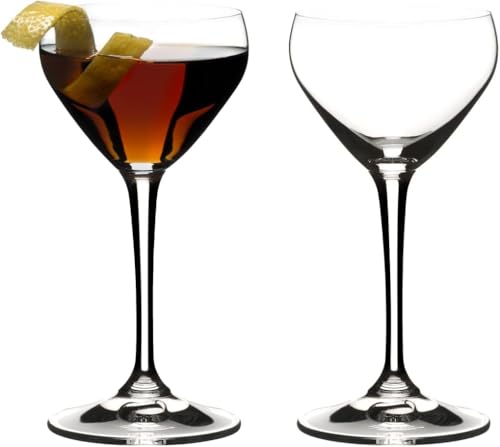
The Nick and Nora is a small, stemmed cocktail glass with a rounded bowl. It sits between a martini glass and a coupe, and its shape holds a drink without spilling when you carry it. It suits spirit-forward cocktails served up, such as a martini, a Manhattan or a Gibson.
The six sets below range from classic crystal-style glasses to modern bar designs. We have not used these products ourselves, and we avoid capacities and dimensions we cannot verify. Please confirm size, material and set count on the current listing before you buy.
Think about how you will use them. Thin glass feels elegant but needs gentler handling, while thicker glass copes better with daily use and the dishwasher. If you entertain often, choose a set count that matches your guest list.
The name comes from the fictional couple in a classic film series, and the glass has enjoyed a revival in modern cocktail bars. Its smaller size also nudges you toward well-balanced, properly chilled drinks rather than oversized pours.
As an Amazon Associate we earn from qualifying purchases. Links below are affiliate links, and they do not change the product information we give.
What to Look For
| Feature | Why it matters |
|---|---|
| Glass type | Crystal-style glass is lighter and clearer; standard glass is tougher |
| Bowl shape | A rounded bowl keeps aromas and prevents spills |
| Stem | A sturdy stem keeps the drink cold and is easy to hold |
| Capacity | Smaller glasses suit spirit-forward drinks and avoid warming |
| Care | Check whether the set is dishwasher safe |
In this guide
Specs at a Glance
| Glass | Material | Style | Notes |
|---|---|---|---|
| Riedel Drink Specific Nick and Nora | Crystal-style glass | Thin, elegant | From a respected glassware maker |
| Libbey Nick and Nora | Glass | Classic | Bar-friendly design |
| Viski Nick and Nora | Crystal-style glass | Modern | Cocktail-focused brand |
| JoyJolt Nick and Nora | Crystal-style glass | Stemmed | Sold as a set |
| Cocktail Kingdom Nick and Nora | Glass | Bar standard | Used in cocktail bars |
| Godinger Nick and Nora | Glass | Decorative | Giftable set |
The 6 Best Nick and Nora Cocktail Glasses
Top pickBest for special occasions
1. Riedel Drink Specific Glassware Nick and Nora
A thin, elegant glass from a respected glassware maker. It is designed with cocktail drinkers in mind, and the shape shows off a drink’s color and aroma.
Suits: special occasions. Strengths: refined shape and clarity. Weaknesses: thin glass needs careful handling. Skip it if you want a tough everyday glass.
View Riedel Nick and Nora Glasses on Amazon
Best for home bars
2. Libbey Nick and Nora Cocktail Glasses
A classic glass from a long-established maker of bar and restaurant glassware. It aims for a practical shape that stands up to regular use.
Suits: home bars. Strengths: a trusted maker and everyday durability. Weaknesses: a plainer look. Skip it if you want delicate crystal.
View Libbey Nick and Nora Glasses on Amazon
Best for hosts
3. Viski Nick and Nora Cocktail Glasses
A modern take from a brand focused on cocktail and spirits accessories. The glasses are made for home entertaining and presentation.
Suits: hosts. Strengths: a stylish, cocktail-first design. Weaknesses: check the care instructions. Skip it if you always use the dishwasher.
View Viski Nick and Nora Glasses on Amazon
Best for gifting and home bars
4. JoyJolt Nick and Nora Cocktail Glasses
A stemmed set sold in a box, aimed at people who want attractive glasses for martinis and other chilled cocktails. It is a good set to give as a gift.
Suits: gifting and home bars. Strengths: a ready-to-use set. Weaknesses: details vary by listing. Skip it if you need a specific capacity.
View JoyJolt Nick and Nora Glasses on Amazon
Best for serious home bartenders
5. Cocktail Kingdom Nick and Nora Glasses
A bar-standard glass from a supplier known to professional bartenders. The design is practical and made for serving cocktails in a busy setting.
Suits: serious home bartenders. Strengths: a trade-focused design. Weaknesses: plain styling. Skip it if you want a decorative look.
View Cocktail Kingdom Glasses on Amazon
Best for gifts and display
6. Godinger Nick and Nora Cocktail Glasses
A decorative set from a giftware brand, often chosen for weddings and housewarmings. It adds a vintage feel to a bar cart.
Suits: gifts and display. Strengths: a decorative look. Weaknesses: details differ from listing to listing. Skip it if you want a plain bar glass.
View Godinger Nick and Nora Glasses on Amazon
Care and Setup
- Chill the glasses in the freezer before serving.
- Hand wash delicate crystal by the bowl and base, not the stem.
- Dry with a lint-free cloth for a clear shine.
- Store them upright so the rims do not chip.
- Keep a few spares, since stemware is easy to break.
- Use a stirring glass and strainer to serve drinks cleanly.
Mistakes to Avoid
- Twisting the stem while washing.
- Overfilling the glass so it spills.
- Using the dishwasher on delicate sets.
- Serving ice-filled drinks in a stemmed glass.
- Stacking the glasses inside one another in a cupboard.
Shape, Capacity and the Right Pour
A Nick and Nora is a small glass, and that is part of its appeal. A smaller capacity means a drink is finished before it warms, and the cocktail you make fits the glass without leaving a large empty space. When you shop, check the listed capacity and think about the drinks you make most. A classic stirred cocktail made with two ounces of spirit plus modifiers and dilution fills a small glass comfortably, but a larger recipe may not.
The bowl shape matters as much as the number. A deeper, more upright bowl holds the drink without spilling when you carry it across a room, and it keeps aromas closer to your nose. A glass with a very wide, shallow bowl behaves more like a coupe, which looks pretty but spills more readily. If you move around a lot while hosting, favor the deeper shape.
Leave a little room below the rim. A full glass is harder to carry and easier to spill, and a small gap helps the aroma gather. Test a new glass by pouring in water to the level your usual recipe reaches, then see how much space remains. If your recipes tend to be generous, look for a slightly larger glass, and if you like a restrained pour, choose a smaller one. Always check the capacity on the listing rather than guessing from photos.
Thin Crystal Versus Sturdy Glass
The material and thickness of a glass change how it feels in the hand and how long it lasts. Thin crystal-style glass has a fine rim and a light weight that many drinkers love, because the drink seems to flow cleanly onto the tongue. It also looks elegant on a bar cart. The cost is fragility: thin stems and rims chip and snap more readily, and replacement can be a hassle if the set is discontinued.
Thicker, standard glass is heavier and more forgiving. It handles frequent use, accidental knocks and, in many cases, the dishwasher. It may feel less delicate, but it suits a busy home bar, a party where many hands are on the glasses, or a household with children and pets. Bar-supply styles are often designed for repeated use, so the stems and bases are built to take punishment.
Think honestly about how you will use the set. If you entertain regularly and wash up in a hurry, a sturdier glass will save you stress. If you host occasionally and enjoy careful handling, a thinner glass will add a sense of occasion. Many people end up with a small set of finer glasses for special evenings and a larger set of tough ones for everyday use. Check the listing for the material and any care notes, since terms such as crystal-style can describe very different glass.
Chilling and Serving Technique
A drink served up has no ice to keep it cold, so the glass has to do some of the work. Chill the glasses before you mix. Place them in the freezer for a short while, or fill them with ice and water while you stir, then tip out the water just before you strain. A cold glass keeps the cocktail at a pleasant temperature for longer and slows the drink from warming in your hand.
Check the care notes before chilling. Very thin glass can be stressed by sudden temperature changes, so let it cool gradually rather than moving it from a hot dishwasher straight into the freezer. A glass that is wet when it goes into the freezer can also stick to a shelf, so dry it first or stand it on a mat.
The stem is there for a reason. Hold the glass by the stem so your hand does not warm the bowl. When you pour, aim to strain the drink cleanly, leaving the ice behind in the mixing glass. If a drink is to be garnished, add a twist or olive at the end and express the oils over the surface.
Serve drinks one at a time rather than lining up several glasses and letting them sit. A well-made drink starts to change as soon as it is poured, and a small glass lets you drink it at its best before it warms.
Set Counts, Spares and Gifting
Stemware breaks, so buy with a few spares in mind. Decide how many people you usually serve at once and add a couple of glasses on top. A set of two is enough for a couple, while a set of four or six suits regular hosting. Check the count on the listing, because the same glass is often sold in several pack sizes and the photo may show more pieces than you receive.
If you are giving a set as a gift, think about the recipient’s habits. Someone who loves cocktails may appreciate a bar-standard glass they can use every week, while someone who prefers display pieces may enjoy a decorative set in a gift box. Check that the packaging is sturdy and that the glass is described clearly, so the recipient knows how to care for it.
Consider whether the glass will work with other barware you own. A Nick and Nora pairs well with a mixing glass, a strainer and a jigger, so a set that matches the style of your other tools makes a tidy bar. If you already own coupes or martini glasses, a Nick and Nora adds a smaller option that suits stirred, spirit-forward drinks.
Finally, think about storage. Stemware needs a shelf with enough height, and rims should not be stacked inside one another. If space is tight, look for a shorter stem or a rack that hangs the glasses upside down.
Signs a Glass Should Be Retired
Even a well-cared-for set has a lifespan, and a damaged glass is a hazard. Run a finger gently around each rim to check for chips, and look at the stem and base for hairline cracks. A glass with a chipped rim can cut a lip, and a cracked stem can fail without warning. Retire any glass that shows damage, rather than saving it for casual use.
Cloudiness is another sign. Glass that has been through many dishwasher cycles can develop a milky film that does not wipe off. Mineral deposits from hard water can look similar, and a soak in a mild solution may clear them, so check the maker’s care advice before trying. If the film is permanent, the glass may be etched and will never look clear again.
Watch for wobble. A stem that is slightly off-center or a base that rocks on a flat surface makes the glass prone to tipping, and a drink in a tipsy glass is a spill waiting to happen. Test each glass on a flat counter and replace any that do not stand steady.
Keep the pieces you retire out of the cupboard, and wrap broken glass carefully before you dispose of it. Replace glasses in matching pairs when you can, so the set stays uniform and looks good on a tray.
Nick and Nora Cocktail Glasses FAQ
What is the difference from a coupe?
A Nick and Nora has a deeper, more upright bowl, so it spills less than a wide coupe.
What drinks suit it?
Martinis, Manhattans, Gibsons and other spirit-forward drinks served up.
Are they dishwasher safe?
Some are. Check each listing and the maker’s care notes.
How big is a typical Nick and Nora glass?
Sizes vary by maker, but they are generally smaller than a standard martini glass. Check the capacity on the listing and compare it with the volume of your usual recipe.
Can I serve a drink on the rocks in a Nick and Nora?
It is designed for drinks served up, without ice. Ice makes a stemmed glass top-heavy and crowds the small bowl, so use a rocks glass for drinks with ice.
Should I chill the glass in the freezer?
A chilled glass keeps a drink cold longer. Let thin glass cool gradually, and make sure it is dry before it goes in the freezer.
Are Nick and Nora glasses only for cocktails?
No. People also use them for small pours of wine, dessert drinks and even small servings of chilled desserts. They are versatile if you like a smaller glass.
How do I get rid of water spots?
Dry the glass with a lint-free cloth right after washing, and rinse with filtered water if your tap water is hard. Check the maker's care notes before using any soak.
Is lead-free glass important?
Many modern sets are lead-free, and the listing usually says so. If it matters to you, look for a clear statement in the product details rather than assuming.
How should I store a set?
Stand the glasses upright on a shelf with space around them, and avoid stacking them inside one another. A felt liner under the base can help prevent scratches.
Choosing Glass for the Way You Serve
The same glass behaves differently depending on how you serve a drink. A stirred cocktail such as a Manhattan or martini is served up, meaning chilled and strained with no ice, and is where this glass shines. The small bowl and upright sides keep the drink cold and keep aromatic ingredients close to your nose. A shaken drink with citrus foam also works, since the sides help hold the foam in place.
If you serve a mix of drinks, consider whether the glass can also handle things like small aperitifs, sorbet or an after-dinner spirit. A glass that is only good for one drink becomes a shelf ornament, while a versatile shape earns its space.
Stem, Rim and Ergonomics
Look closely at the stem and the rim. A thin stem looks elegant, but it also feels delicate and can snap if it hits a faucet. A thicker stem is sturdier and often more comfortable for people with larger hands. The rim also matters: a thin rim feels refined against the lip, while a rolled or thick rim is more durable and feels heavier.
- Pick up the glass when it is empty and when full. The balance should feel steady, not top-heavy.
- Check that your fingers do not touch the bowl when you hold the stem, or the drink will warm.
- Consider whether the base is wide enough to stay upright on a crowded bar or tray.
Hosting With Nick and Nora Glasses
If you plan to host, think about the number of glasses and the mechanics of service. A set of four serves a small dinner, while six or eight is better for a larger gathering. Because the bowl is small, a drink lasts only a few sips, which encourages a second round and keeps the pour size sensible.
Prepare ahead. Chill the glasses before guests arrive, batch cocktails in a pitcher that you can stir with ice and strain, and keep garnishes ready. A small tray makes carrying multiple stemmed glasses safer. Remember that stemmed glasses are fragile when stacked, so plan a rinse and wash routine before the party ends rather than leaving them overnight.
Garnishes and Drink Styles That Show Off the Glass
The compact shape rewards simple garnishes. A single citrus twist, a cocktail onion or a skewered olive looks right and does not overwhelm the glass. Large garnishes, such as a whole slice of fruit, tip the balance and spill more easily.
Classic recipes served up are the most natural fit, and many modern bartenders also use the shape for lighter stirred drinks. If you like experimenting, try serving a small portion of a mixed drink in this glass to see how it handles. Clear, spirit-forward drinks display well in clear glass, while heavily layered drinks may look better in a different shape.
Is a Premium Set Worth It for Home Use?
Higher prices usually buy thinner glass, a more refined rim and better quality control. If you host often and care about the sensation of drinking from fine glass, that may be worth it. If you serve cocktails casually or have a busy household, a sturdier, less costly set is a more practical choice, and you will worry less when one breaks.
Many owners buy a small premium set for special occasions and keep a basic set for everyday use. That approach spreads the cost and keeps the nicer glasses safe from daily wear.
Rinsing, Polishing and Everyday Care
Cocktail glasses show every smear, especially those used with citrus or sugary drinks. Rinse promptly after use so sugar does not dry on the rim, then wash gently in warm soapy water. A soft cloth and a bit of steam give a clean finish without scratching. If you use a dishwasher, check that the glass is rated for it and leave enough space between pieces so the stems do not knock together.
Hard water leaves cloudy spots over time. A quick soak in diluted white vinegar can remove them, but do not leave thin or decorated glass in an acid solution for long. Dry and polish right away.
Matching the Glass to Your Bar Setup
Think about where the glasses will live. A bar cart with limited space favors a compact, stackable-friendly design, while an open shelf allows taller and more decorative shapes. Consider the rest of your barware, such as a mixing glass, a jigger and a strainer. A matching style across tools gives the bar a cohesive look and makes shopping simpler.
If you often make drinks for one or two people, a small set is enough. If you like entertaining, plan your storage before you buy, since stemware takes more room than tumblers. A cabinet with an adjustable shelf, or a rack under a shelf, keeps the glasses safe and accessible.
Living With a Nick and Nora Glass: What Ownership Is Really Like
A Nick and Nora glass earns its reputation in the first minute of a drink, when the small bowl keeps aromas close and the stem keeps your hand off the liquid. Living with the shape day to day brings quieter lessons. The bowl is deliberately modest, so drinks are poured smaller than in a coupe or a martini glass, and that changes how you batch and serve: a recipe written for a large cocktail glass needs scaling down, or the evening needs a second, smaller round. Most owners come to see that as the point of the glass. It favors drinks that are meant to be sipped slowly and finished while still cold, rather than large pours that warm up halfway through.
Storage is the practical question nobody asks in the shop. These glasses are tall for their capacity, with a stem and a flared bowl that do not nest, so a set of six takes more shelf height than tumblers of similar volume. Measure your cupboard before ordering a full set, especially if your shelves were fitted for wine glasses with wider bowls. If space is tight, a set of four covers most home entertaining, since Nick and Nora drinks are usually served to a small group at a time. Owners with open shelving should also think about dust: an upturned bowl collects it quickly, so a rinse before use becomes part of the ritual.
Breakage is the honest cost of delicate glassware, and it is worth planning for rather than fearing. Thin rims chip when glasses knock together in a sink, and stems snap when a glass is set down hard on stone. The households that keep a set intact for years share two habits: they wash these glasses separately, by hand, in warm rather than very hot water, and they dry them on a towel rather than leaving them to drain on a rack where they can topple. Buying from a range that is still in production matters too, because replacing one broken glass from the same line keeps the set matching.
The last ownership lesson is about matching the glass to the drinker. Guests who are new to spirit-forward cocktails often prefer the Nick and Nora to a large martini glass precisely because the serve is smaller and the drink stays cold to the last sip. Guests who like a drink they can nurse for an hour may find the pour gone too soon. A good home bar keeps both options. Use the Nick and Nora when the drink itself is the event — a well-made Manhattan-style serve, a stirred drink with a garnish that deserves the presentation — and reach for something larger when the drink is background to a long conversation.
Choosing Among the Six Glasses in This Guide
The Riedel Drink Specific Nick and Nora is the pick for the drinker who notices small differences. Its bowl is shaped with intent, and it suits someone who makes stirred, spirit-led drinks often enough to appreciate a glass designed around them. If your home bar is used a few times a year, that refinement may be more than you need; if you make a Friday cocktail most weeks, it is the glass you will reach for first and the one whose feel in the hand you will compare everything else against.
Libbey and JoyJolt occupy the practical end of this guide, and they answer different worries. Libbey’s version suits the host who entertains groups and wants a set that can go out for a party without anxiety about the cost of a casualty. JoyJolt’s glasses suit the household that values easy care and everyday use, where the glasses might serve a weeknight drink as readily as a celebration. Neither choice is a compromise in the glass itself; they are answers to the question of how roughly your household treats its glassware, which only you can answer honestly.
Viski and Cocktail Kingdom speak to presentation. Viski’s design leans decorative, which makes it a natural gift and a good match for a bar cart that is part of the room’s furniture. Cocktail Kingdom’s glass comes from the professional bar world, and it suits the home bartender who wants the same proportions used behind good bars, with a feel that is about balance rather than ornament. If you are building a bar to learn technique, the professional-style glass reinforces good habits; if you are building a bar to look beautiful in a living room, the decorative glass does that job better.
Godinger’s entry is the one to consider when the occasion matters as much as the drink — holidays, anniversaries, a table set with intention. Cut patterns catch light and read as formal even with a simple drink inside. The trade-off is that patterned glass shows water spots and fingerprints more readily, so it asks for a polish after washing. Many owners end up owning two tiers without planning to: an everyday set from the practical end of this guide and a formal set for occasions. That is not excess; it is how most working home bars actually evolve.
Serving Technique: Getting the Most From a Small Bowl
Temperature is the first technique to master with this glass shape. Chill the glass before you pour — a few minutes in the freezer or a fill of ice water while you stir the drink — because a small serve in a room-temperature glass warms noticeably faster than a large one. Stir or shake the drink to a proper chill before it goes in, since the glass will not do that work for you. The reward is a drink that tastes as cold at the final sip as at the first, which is the entire reason the shape exists.
Pour to the right level and resist topping up. A Nick and Nora looks and drinks best filled below the widest part of the bowl, leaving room for aroma to gather and for the drink to move without spilling when carried. Overfilling defeats the design and makes the first sip a negotiation with the rim. If your favorite recipe makes more than the glass holds, serve the remainder in a small carafe on the side, the way good bars do, and top up your own glass as you go. It looks generous rather than stingy, and the second pour is still cold.
Garnish with restraint. The small bowl crowds easily, so one considered garnish — a single cherry, a neat twist expressed over the surface, a small olive — reads as elegant, while a pile of fruit reads as clutter and flavors the drink unevenly. Express citrus oils over the drink rather than dropping a thick wedge in, and if you use a pick, choose one short enough that it does not tower over the glass. The aim is for the garnish to be the drink’s final ingredient, not its decoration budget.
Carrying and serving deserve a thought too. A filled Nick and Nora is top-heavy in the hand of someone walking across a room, so serve guests where they sit when you can, or carry glasses on a small tray with a cloth under them to stop sliding. Hold the stem, not the bowl, when handing a glass over, and mention it lightly to guests who grip the bowl out of habit — not as a correction, but because the drink genuinely stays colder. Small courtesies like these are most of what separates a home serve that feels like a bar serve from one that merely uses the same glass.
Keeping Thin Glassware Clear, Chip-Free and Ready
Cloudiness is the slow enemy of cocktail glassware, and it usually comes from the wash rather than the drink. Hard water leaves mineral film, detergent leaves residue, and both dull a bowl that should be sparkling. Wash in warm water with a small amount of mild detergent, rinse in clean warm water, and dry immediately with a lint-free cloth, holding the bowl and stem with separate hands so you never twist against the stem joint. If film has already built up, a soak in warm water with a splash of white vinegar, followed by a gentle wash, clears most of it without abrasives.
Chips happen at predictable moments: glasses clinking in a washing-up bowl, a rim meeting a tap, a glass set down onto a hidden spoon. Wash Nick and Nora glasses one or two at a time, never in a crowded sink of pans and cutlery, and keep a soft mat or towel in the base of the sink. Store them upright, with a little space between neighbors, rather than rim-down on a hard shelf, which loads the thinnest part of the glass. If you must store rim-down, a shelf liner takes the edge off the contact.
Etching — the permanent, misty damage that no wash reverses — is caused by very hot water and strong dishwasher detergents over time, which is why this guide treats hand washing as the default for the finer glasses here. If you do use a dishwasher for the sturdier sets, choose a gentle cycle, keep glasses from touching, and skip heated drying. Check each glass against the light occasionally; early film can be removed, while etching cannot, and catching the difference early saves a set.
Finally, build a small pre-party habit. Take the glasses out an hour before guests arrive, hold each to the light, and polish away spots with a dry cloth. Rinse any glass that has sat on an open shelf. It takes five minutes and it is the step guests unconsciously register as quality, because a sparkling glass photographs well, feels clean in the hand, and makes even a simple drink look considered. Glassware care is mostly this: small, regular attention instead of occasional rescue missions.
Building a Small Repertoire Around the Glass
A Nick and Nora glass comes alive when you have three or four drinks you can make in it without thinking, because the glass was designed for a family of serves: stirred, spirit-forward cocktails, served cold and up, in modest measure. Build that repertoire deliberately rather than collecting recipes at random. Start with one whiskey-based drink, one gin-based drink, and one lower-strength option for the guest who wants the ritual without the full force. Learn each one at the size the glass wants — smaller than the serves in most large cocktail glasses — and adjust the recipe’s dilution, not its proportions, to land the drink exactly where the bowl fills best.
Scaling recipes down is a skill worth practicing on paper before you practice it on guests. Most classic recipes were written for the glasses of their era, which were closer to the Nick and Nora than to the oversized cocktail glasses that followed, so the classics often fit this glass with no violence at all. Where a modern recipe overshoots, reduce every ingredient by the same fraction rather than trimming only the base spirit, because balance lives in the ratios. Keep your adjusted versions in a notebook at the bar; a repertoire written down is a repertoire you actually own, while one held in memory quietly shrinks to a single drink.
Ice is the repertoire’s hidden ingredient. Stirred drinks for this glass want hard, cold ice that chills and dilutes in a controlled way, because the serve is small and every degree and drop shows. Ice that has sat in a warm kitchen, half melted in its bag, over-dilutes a small drink before it is properly cold. Keep a dedicated supply for cocktail hour, crack or cube it consistently, and stir with confidence — the drink should leave the mixing glass properly cold, since the Nick and Nora will not chill it further and its small volume warms faster than a large serve would.
Presentation within the repertoire should stay as disciplined as the recipes. One garnish per drink, chosen because it belongs to the drink: the cherry where the recipe calls for depth, the twist where it calls for brightness, the olive where it calls for brine. In a small bowl, garnish is a large fraction of what the eye sees, and consistency — the same drink looking the same every time you serve it — is what makes guests feel they are in the hands of someone who knows the drink. That feeling, more than any flourish, is what a home bartender is really building.
Grow the repertoire one drink per season rather than ten in a month. A drink added slowly gets made often enough to become reliable, its ingredients get used while fresh, and its place in your rotation is earned by requests. By the end of a year you will have a card of drinks you can produce calmly for any guest, each of them sized for this glass and each of them yours. That is the moment the glassware stops being a purchase and becomes part of how your home entertains — which was, all along, the point of choosing a classic shape rather than a fashionable one.
The repertoire also teaches you when not to use the glass. A long, juicy drink, a serve built on crushed ice, a cocktail meant to be nursed through a film — these belong elsewhere, and forcing them into a Nick and Nora helps neither the drink nor the glass. Owning a shape means honoring its specialty. The hosts whose Nick and Nora glasses are loved are the ones who reach for them precisely when the drink is right: cold, strong, aromatic and small, arriving at the table like a punctuation mark at the end of the day.
More Questions, Answered
Can I serve wine in a Nick and Nora glass?
You can, in a pinch, for a small pour of something aromatic, but it is not what the shape is for. The bowl is sized for a cocktail serve, so a wine pour looks short and needs constant refilling. Keep the glasses for cocktails and use proper wine glasses for wine; each will do its own job better.
How many Nick and Nora glasses should a home bar start with?
Four is a sensible start for most homes, since these drinks are usually made for a couple or a small group. Move to six if you host cocktail evenings regularly. Starting with four also lets you learn whether your household treats thin glassware gently before you invest in a larger matching set.
Why does my drink taste stronger in this glass than in a tumbler?
Two reasons: the serve is smaller and less diluted by the time you finish it, and the bowl concentrates aroma near your nose, which heightens the impression of the spirit. If drinks taste too intense, lengthen them slightly with a little extra dilution during stirring rather than changing the recipe’s proportions.
Is it worth buying a second, sturdier set for parties?
For many hosts, yes. A practical set for larger gatherings takes the breakage risk and the dishwasher, while your finer set stays for small evenings. It costs less than replacing broken glasses from a delicate set one by one, and it removes the stress of handing your best glassware to a crowded room.
What should I do with a glass that has a tiny rim chip?
Retire it from serving. A chipped rim is unpleasant against the lip and the chip can spread into a crack. Some people keep a chipped glass for measuring or for flowers, but it should not go back into service for drinks. Note which glass it was, so you can replace it from the same range while it is still available.
Which classic drinks suit a Nick and Nora best?
Stirred, spirit-forward classics are its home ground — the family of drinks built on a base spirit with vermouth, bitters or liqueurs, served without juice or soda. Think of the drinks you would order ‘up’ in a good bar and in a modest pour. If a recipe’s character survives being small and cold, it belongs in this glass.
How do I chill the glass if my freezer is full?
Fill the glass with ice and cold water while you make the drink, then empty and shake it dry just before pouring. Two minutes of ice water brings the bowl down effectively, and the method has the advantage of working anywhere, including a picnic or a friend’s kitchen where your glasses have traveled with you.
Related guides
Frequently Asked Questions
Do Nick and Nora glasses need a stem?
The classic design has one, and the stem keeps your hand from warming the drink. Stemless versions exist and are sturdier, but they warm faster and are less traditional. If you serve up drinks, a stem is usually the better choice.
Can I use a Nick and Nora glass for a small martini?
Yes. The glass suits spirit-forward drinks such as martinis and Manhattans, and its upright sides reduce spills. A typical pour fits comfortably, though very large martini portions may overflow, so check capacity before pouring.
How many glasses should I buy for a dinner party?
Plan one per guest, plus a spare or two for breakage and second rounds. Four to six suits most small gatherings. For larger parties, consider a sturdier set or rent glassware so you are not washing delicate stems late at night.
What garnish works best in a Nick and Nora glass?
Keep it simple: a citrus twist, a cocktail onion or an olive on a short pick. The small bowl does not leave much room, so large or heavy garnishes can tip the glass or crowd the drink.
The Short Version
For a refined shape, the Riedel. For everyday use, the Libbey. For a modern look, the Viski. For a gift set, the JoyJolt. For bar standard, the Cocktail Kingdom. For a decorative set, the Godinger.

