Disclosure: topratedkitchenware.com is reader-supported. When you buy through links on our site, we may earn an affiliate commission from Amazon and other retailers, at no extra cost to you.
Where to buy
If you are shopping for the best coffee makers without pods, the shortlist below is built only from machines and methods that brew without a pod: three linked electric picks whose verified listings confirm grounds brewing, plus three classic pod-free methods covered honestly without links because the verified pool held no matching product for them. Prices and availability change often, so use the links to check the latest price on Amazon before you buy.
- Best Overall: Elite Gourmet Single-Serve Coffee Maker — Check on Amazon
- Tastyle Mini Single Serve Coffee Maker — Check on Amazon
- Hamilton Beach FlexBrew Advanced 4-in-1 — Check on Amazon
- Classic Drip Coffee Maker With Carafe — prose-only pick, described in full below with no purchase link
- French Press — prose-only pick, described in full below with no purchase link
- Pour-Over Dripper — prose-only pick, described in full below with no purchase link
Read the full guide ↓
The search for the best coffee makers without pods usually starts with a bin. A pod a day is a small thing; a pod a day for a year is a drawer, then a bag, then a quiet guilt every time the trash goes out — alongside a per-cup cost that never stops nibbling. This guide takes the request literally: every pick below brews coffee with no pod involved in the daily routine. Three are electric machines whose verified listings confirm they brew ground coffee; three are the classic manual and carafe methods, covered in prose because honesty about links matters more than filling a grid.
A disclosure about the pool, because it shaped this guide: the verified single-serve pool for this category is dominated by pod machines, including several Keurig models that brew only from K-Cup pods. Those machines are not in this guide, even as also-rans, because a pod-only machine cannot be a pick in a without-pods guide no matter how good it is at its own job. They are named in the sources file with the reason for their exclusion. What remains is smaller and better: machines and methods that genuinely answer the keyword.
The pod-free world divides by effort. At one end, the Elite Gourmet and Hamilton Beach FlexBrew automate everything except the scoop. In the middle, the Tastyle Mini keeps a pod holder for guests while making grounds the default. At the far end, the French press and pour-over dripper remove electricity entirely and hand the process back to you, with the drip carafe standing by for households that drink together. None of these requires a grinder purchase, either — all run happily on coffee bought already ground, a point the companion guide to Best Coffee Makers Without Grindee explores from the other direction.
A final expectation to set before the picks: pod-free coffee asks for a scoop and a rinse where pods asked for neither, and in exchange it returns control — over the coffee, the strength, the cost shape and the waste stream. Readers who have made the switch rarely describe the extra twenty seconds; they describe the coffee. The reviews below are written for that reader, with the trade-offs of each format stated where you will actually feel them: in the morning queue, at the sink, and in the last sip of the cup
Key Takeaways
- Every pick here brews its daily coffee without a pod — pod-only machines were excluded from this guide entirely, and the sources file names them.
- The Elite Gourmet is the simplest pod-free electric: reusable filter, one button, up to 14 oz.
- The Hamilton Beach FlexBrew removes the last friction excuse with a 45 oz reservoir for family pod-free brewing.
- The Tastyle Mini is the diplomat: grounds by default, pods only when you choose them.
- Manual methods (French press, pour-over) and the classic drip carafe deliver pod-free coffee with no proprietary parts at all.
In this guide
Quick Picks
Badges here describe the pod-free route each pick represents, from fully automatic to fully manual. The three prose-only picks carry no purchase link by design — they are real methods described so you can compare approaches, not products this guide could verify.
| Pick | Badge | Brewing format | Standout point | Where to check it |
|---|---|---|---|---|
| Elite Gourmet Single-Serve Coffee Maker | Best Overall | Ground coffee, reusable filter | Brews up to 14 oz, loose-leaf tea too | On Amazon |
| Tastyle Mini Single Serve Coffee Maker | Most Versatile Pod-Free | Grounds or K-Cup pods | Pod-free with grounds, pods when you choose | On Amazon |
| Hamilton Beach FlexBrew Advanced 4-in-1 | Best Reservoir, Pod-Free Capable | Grounds or pod packs | 45 oz reservoir, hot and iced modes | On Amazon |
| Classic Drip Coffee Maker With Carafe | Best for Brewing a Full Pot | Ground coffee, carafe | Prose-only: the original pod-free family brewer | Prose-only |
| French Press | Best Full-Immersion Flavor | Ground coffee, immersion | Prose-only: no electricity, no pods, full body | Prose-only |
| Pour-Over Dripper | Best Hands-On Control | Ground coffee, manual drip | Prose-only: total control over a single cup | Prose-only |
Elite Gourmet Single-Serve Coffee Maker (Best Overall): The purest pod-free answer in this guide: a reusable filter, your own ground coffee, one button, and up to 14 oz brewed straight into a travel mug. No pod holder, no pod piercer, no pod anywhere in the design.
Tastyle Mini Single Serve Coffee Maker (Most Versatile Pod-Free): The bridge machine: brew your own grounds on normal mornings so no pod is involved, keep a few pods only for guests or emergencies, and use the iced mode all summer. Pod-free by default, pod-capable by choice.
Hamilton Beach FlexBrew Advanced 4-in-1 (Best Reservoir, Pod-Free Capable): The family-sized pod-free option: a removable 45 oz reservoir feeds cup after cup of grounds-brewed coffee without refilling, hot or iced, so a household can go pod-free without the per-cup fill ritual.
Classic Drip Coffee Maker With Carafe (Best for Brewing a Full Pot): Covered without a link because the verified pool held no carafe model: the classic drip machine remains the cheapest pod-free way to brew coffee for a whole table, using ground coffee and a paper or permanent filter.
French Press (Best Full-Immersion Flavor): Covered without a link as a classic manual method: coarse grounds steep in hot water and a mesh plunger separates them, producing the fullest-bodied pod-free cup and needing no electricity at all.
Pour-Over Dripper (Best Hands-On Control): Covered without a link as the precision manual option: hot water poured in slow spirals over a paper filter gives the cleanest, brightest pod-free cup and turns brewing into a two-minute craft.
How These Picks Were Chosen
The method for this guide had two gates. First, the keyword gate: a pick qualifies only if its normal daily brewing uses no pod. Electric candidates were checked against their verified listings for a grounds basket or reusable filter — the Elite Gourmet (reusable filter for grounds), the Tastyle Mini (listed for K-Cup and ground coffee, used here in grounds mode) and the Hamilton Beach FlexBrew (listed for pod packs and grounds, used here in grounds mode) passed. Pod-only Keurig models from the same pool failed this gate and were excluded rather than linked, and they are documented in the sources file.
Second, the coverage gate: a without-pods guide that only listed single-serve electrics would mislead the many shoppers whose real answer is a carafe drip machine, a French press or a pour-over cone. Those three methods are covered as prose-only picks — full reviews, honest trade-offs, no invented product links — because no verified pool product matched them. Specifications in this guide come only from verified listings for the electric picks; the method picks are described by their well-established type characteristics, with no fabricated model details.
The exclusion decision deserves one more sentence, because it is the decision this whole guide stands on. It would have been easy to fill six linked slots with popular pod machines and add a line about reusable accessories; many roundups do exactly that. But a shopper who searches for coffee makers without pods is asking to leave the pod format, and an accessory they may never buy does not change what a pod-only machine is. Excluding those models cost this guide three product links and bought it the only thing a buying guide really sells: recommendations that answer the question that was asked.
Comparisons weighed cost shape (qualitatively — pods are the premium per-cup tier, bagged grounds the lower tier), waste, effort per cup, and how each option scales from one drinker to a household. This is a research-led guide with no hands-on testing claims; where owner experience themes are mentioned, they reflect widely reported patterns for each type.
The 6 Best Coffee Makers Without Pods

Elite Gourmet Single-Serve Coffee Maker
Badge: Best Overall
Strengths
- Reusable filter means any ground coffee works, with zero pod waste
- One-touch brewing with auto shut-off keeps the routine foolproof
- Dishwasher-safe parts make the daily rinse genuinely easy
Trade-offs
- Fill-and-brew for every cup, so it suits one drinker at a time
- 600 W heating is modest for back-to-back cups
- Single-cup format cannot serve a table of guests at once
Key specs from the verified listing
- Single-serve brewing for ground coffee
- 14 oz brew capacity with travel mug
- 600 W heating power
- Reusable filter for grounds and loose-leaf tea
- One-touch operation with auto shut-off
- Dishwasher-safe parts
Every other machine in the wider single-serve world wants to sell you a pod ecosystem; the Elite Gourmet wants a scoop. Its reusable filter takes ordinary ground coffee — a grocery bag, a roaster blend, the last of a bag you want to finish — and brews up to 14 oz in one touch. That is the whole pod-free proposition in its simplest form: the coffee stays a food you buy by the bag, the machine stays a kettle with a filter, and nothing proprietary stands between them.
Ownership is equally plain. The filter rinses in seconds and the parts are dishwasher-safe, auto shut-off removes the did-I-leave-it-on worry, and the same filter brews loose-leaf tea, which quietly makes this the only two-drink machine in the guide. The honest limits are scale and speed: 600 W and a per-cup fill mean a solo drinker is served beautifully while a queue of four is not. If your mornings are one person and one mug, this is not the budget compromise — it is the correct design. Households that also keep pods for guests should read the Tastyle review next, and anyone whose household runs on pods today can compare the opposite philosophy in Best Coffee Single Serve Coffee Makers.
Best for: solo drinkers who buy ground coffee by the bag and want zero pod waste / Not suited for: households brewing for several people at the same time
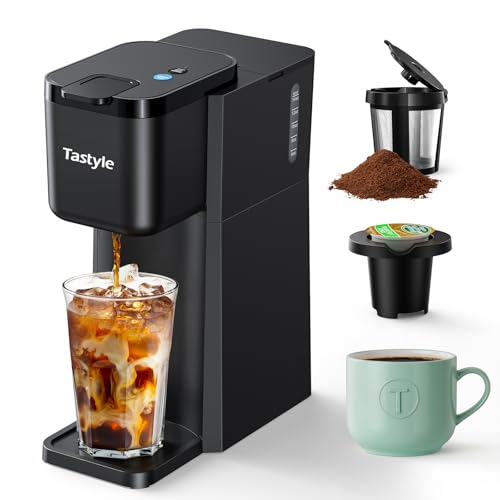
Tastyle Mini Single Serve Coffee Maker
Badge: Most Versatile Pod-Free
Strengths
- Grounds basket makes pod-free brewing the everyday default
- Pod option remains for guests without owning a second machine
- Iced mode and a 6 to 14 oz size range widen the menu
Trade-offs
- Mini format means filling per cup rather than a reservoir
- A younger brand with a shorter track record than the big names
- Owners must rinse the grounds basket — the small chore pods exist to avoid
Key specs from the verified listing
- Brews K-Cup pods and ground coffee
- Hot and iced coffee modes
- Brew sizes from 6 to 14 oz
- Recipe book included
- 120 V, model K310IC version 2.0
Most pod-free guides demand a vow: never pods, ever. The Tastyle Mini is more realistic. Its grounds basket makes your own coffee the default — scoop, brew, rinse — while the K-Cup holder waits quietly for the morning you oversleep or the guest who only drinks a particular pod. That optionality is not a failure of pod-free principles; it is how households actually live, and it prevents the common outcome where a strict pod-free machine gets replaced within a year by a pod machine bought in frustration.
The rest of the design supports the flexible brief: brew sizes from 6 to 14 oz, a dedicated iced mode that brews strong enough to survive ice, and a recipe book that encourages using both formats. The trade-offs are the mini format itself — water is filled per cup — and a brand name with less history behind it than Keurig or Hamilton Beach. Judge it as the household diplomat: not the purest pod-free machine here, but the one most likely to still be pod-free in practice two years from now.
Best for: mixed households that want pod-free daily brewing without banning pods outright / Not suited for: purists who want a machine physically incapable of using a pod

Hamilton Beach FlexBrew Advanced 4-in-1
Badge: Best Reservoir, Pod-Free Capable
Strengths
- 45 oz removable reservoir ends the fill-per-cup routine
- Brews grounds for pod-free coffee and pod packs when wanted
- Hot and iced modes cover the full year in one machine
Trade-offs
- The largest footprint among the linked picks here
- More parts to wash than a simple filter brewer
- Pod-pack compatibility means the pod-free discipline is up to you
Key specs from the verified listing
- 4-in-1 single-serve brewing
- Hot and iced coffee modes
- Removable 45 oz water reservoir
- Uses pod packs and ground coffee
- Fast brewing design
The objection that kills most pod-free plans is not flavor — it is friction. Filling a little machine cup by cup is charming for one person and tedious for a family, and that is exactly the problem the FlexBrew Advanced solves with a removable 45 oz reservoir. Load it with water, load the grounds basket with coffee, and the household brews pod-free cups back to back, hot or iced, at a pace that feels like a normal family coffee maker rather than a hobby.
Hamilton Beach labels the design 4-in-1 because it spans hot and iced, pods and grounds; for this guide the grounds half of that personality is the headline. The honest notes: the reservoir format takes the most counter room of any linked pick here, and because the machine can use pod packs, staying pod-free is a household decision rather than a mechanical guarantee. If your family wants the pod-free economics and waste profile with family throughput, this is the machine that removes the last practical excuse. The reservoir-first thinking here pairs naturally with the on-demand habits covered in Best Coffee On Demand Makers.
Best for: families that want pod-free brewing with reservoir convenience / Not suited for: tiny counters or strict no-pod-hardware households
Classic Drip Coffee Maker With Carafe
Badge: Best for Brewing a Full Pot
Strengths
- Brews a full carafe at once for families and guests
- Uses any ground coffee with inexpensive paper or permanent filters
- Programmable versions can have coffee waiting at wake-up time
Trade-offs
- Coffee sits on a warming plate and stales within the hour
- A carafe is glassware to wash, chip and eventually replace
- Brewing a full pot for one person wastes coffee
Key specs from the verified listing
- Brews a full carafe in one cycle
- Ground coffee with paper or permanent filter
- No pods, cartridges or proprietary parts
- Type described in prose — no single verified model is linked
No honest pod-free guide can skip the machine that defined pod-free brewing for decades. A classic drip maker runs hot water through a basket of ground coffee into a glass carafe, and for a household that drinks coffee together — weekend breakfasts, guests, a working-from-home couple on the same schedule — it remains the most economical and least wasteful format ever sold. There is no pod, no proprietary anything, and the filter choice (paper for a cleaner cup, permanent mesh for zero ongoing waste) is yours.
It is listed prose-only for a transparent reason: the verified product pool for this guide contained single-serve machines, and rather than invent a link, this guide describes the type and lets you shop it with clear criteria — a thermal carafe beats a warming plate for flavor, a removable filter basket beats a fixed one for cleaning, and a mid-pot pour feature matters if your household cannot wait for the full brew. Its weaknesses are the mirror of its strengths: brewed coffee waits badly, and a pot brewed for one person is mostly poured away. If your household drinks together, start here; if it drinks in shifts, the single-serve picks above fit better.
Best for: households that drink coffee together and want a full pot at once / Not suited for: solo drinkers or staggered schedules
This is a prose-only pick: it is covered in full so you can compare the approach, but there is no Amazon link for it in this guide.
French Press
Badge: Best Full-Immersion Flavor
Strengths
- Full-immersion steeping gives the richest, heaviest cup of any method here
- No electricity, no filters to buy, nothing proprietary
- Travels anywhere a kettle exists — camping included
Trade-offs
- A hands-on four-minute routine, not a button press
- Fine sediment in the last sips is part of the format
- Glass beakers can break; the cup cools while it steeps
Key specs from the verified listing
- Full-immersion steeping, then a mesh plunger separates the grounds
- No electricity required
- No paper filters to buy
- Type described in prose — no single verified model is linked
The French press is the pod-free method for people who taste the difference and enjoy the ritual. Coarse ground coffee steeps directly in hot water for several minutes, then a mesh plunger traps the grounds at the bottom. Because the coffee and water stay in contact the whole time — and because a metal mesh lets natural oils through that paper filters absorb — the cup is noticeably fuller and rounder than drip coffee from the same bag of grounds.
It appears here prose-only, as a method rather than a linked product, and its demands should be stated plainly: you need a kettle, a timer habit, and a tolerance for a little sediment in the final sip. In exchange it asks for no electricity, no counter space, no descaling and no replacement parts beyond an occasional mesh screen, and it travels from kitchen to campsite without complaint. Buy any well-made press with a sturdy frame and a replaceable screen and it will outlast several electric machines. For drinkers who find single-serve coffee thin, this is the corrective — and it costs less than any machine in this guide while using the same bag of ground coffee.
Best for: flavor-first drinkers who enjoy a short hands-on ritual / Not suited for: anyone who wants coffee at the press of a button
This is a prose-only pick: it is covered in full so you can compare the approach, but there is no Amazon link for it in this guide.
Pour-Over Dripper
Badge: Best Hands-On Control
Strengths
- The cleanest, brightest cup of any pod-free method here
- Total control over pour, timing and strength
- Costs very little and stores in a drawer
Trade-offs
- Demands attention for the full brew — no walking away
- Paper filters are an ongoing purchase and add waste
- Technique-sensitive: a careless pour makes a dull cup
Key specs from the verified listing
- Cone dripper with a paper filter over a mug or server
- Manual pour controls strength and timing
- No electricity required
- Type described in prose — no single verified model is linked
Pour-over is where pod-free brewing becomes a craft. A cone dripper holding a paper filter sits on your mug; you pour hot water in slow spirals, watch the coffee bloom, and control strength with your pour rather than a button. The paper filter removes oils and fine particles, so the cup tastes cleaner and brighter than French press coffee from identical grounds — the two manual methods in this guide are a genuine flavor fork, not two names for one thing.
Like the press, it is covered prose-only as a method, and its costs are attention and filters rather than money. Two to three focused minutes per cup is either a pleasure or a deal-breaker depending on your mornings, and the paper filters, while compostable with the grounds, are a repeat purchase the filter-basket machines avoid. What you get back is the highest ceiling of any method in this guide and a skill that transfers to every café dripper you will ever meet. If the idea of improving at coffee appeals to you more than the idea of automating it, this is your pick — start with a simple cone, a kettle with a narrow spout, and the same ground coffee the electric picks use.
Best for: detail-minded drinkers who want the cleanest cup and enjoy the process / Not suited for: rushed mornings or anyone who dislikes repeat filter purchases
This is a prose-only pick: it is covered in full so you can compare the approach, but there is no Amazon link for it in this guide.
Comparison Table
Read the format column first: it tells you what you will actually be doing each morning. The link column exists only where a verified product backs the pick.
| Pick | Badge | Format | Water handling | Best use | Link |
|---|---|---|---|---|---|
| Elite Gourmet Single-Serve Coffee Maker | Best Overall | Ground coffee, reusable filter | Fill per cup, up to 14 oz | Solo pod-free brewing | Check on Amazon |
| Tastyle Mini Single Serve Coffee Maker | Most Versatile Pod-Free | K-Cup pods or grounds | Fill per cup, 6 to 14 oz | Flexible pod-free brewing | Check on Amazon |
| Hamilton Beach FlexBrew Advanced 4-in-1 | Best Reservoir, Pod-Free Capable | Pod packs or grounds | 45 oz removable reservoir | Family pod-free brewing | Check on Amazon |
| Classic Drip Coffee Maker With Carafe | Best for Brewing a Full Pot | Ground coffee, carafe | Full carafe reservoir | Family pots | Prose-only |
| French Press | Best Full-Immersion Flavor | Ground coffee, immersion | Kettle-filled beaker | Rich manual cups | Prose-only |
| Pour-Over Dripper | Best Hands-On Control | Ground coffee, manual drip | Kettle-poured | Precision single cups | Prose-only |
How to Choose the Best Coffee Makers Without Pods for Your Routine
Start with the effort question, honestly answered. Pod-free brewing always involves coffee grounds, and the only choice is who handles them: a machine with a filter you scoop and rinse (Elite Gourmet, FlexBrew, Tastyle in grounds mode), or you, with a kettle and a press or dripper. If your mornings are timed to the minute, automate the handling and keep the manual methods for weekends. If your mornings have slack and you enjoy process, the manual methods reward you with the best cups in this guide and the lowest running costs.
Match the format to the household pattern
One drinker, one mug: the Elite Gourmet or a manual method. Several drinkers in sequence: the FlexBrew reservoir exists precisely for you. Several drinkers at the same moment: only the carafe drip format truly serves that pattern, which is why it earns a prose-only place here. Mixed households with pod loyalists visiting or living in: the Tastyle pattern — grounds daily, pods occasionally — prevents a second machine purchase. Notice that every one of these answers uses the same input, a bag of ground coffee, so switching formats later costs a machine, not a new supply habit.
Ground coffee freshness is your one new job
Pods protect coffee with sealed packaging; a bag does not. Pod-free ownership therefore includes one small discipline: buy bag sizes you finish within a few weeks, store the bag sealed and away from heat, and consider a simple airtight canister. That habit, more than any machine feature, decides whether pod-free coffee tastes alive or tired. It is also why the manual methods shine in comparisons — they are usually used by people who already keep fresh coffee, and the method gets credit for the supply.
What about the coffee itself: grind labels decoded
Pod-free shopping introduces one shelf decision pod users never face: the grind. Bags labeled for drip or all-purpose use suit the filter-basket electrics and the carafe format. Press drinkers should look for coarse grind where a roaster offers it, and pour-over drinkers for medium to medium-fine. When a bag gives no grind guidance, the default grocery grind is a medium intended for drip machines, which behaves well in every electric pick here and acceptably in the press if you pour promptly. Buying beans ground at a local roaster, in small amounts, is the freshness shortcut that makes all of these methods taste a tier better without owning a grinder.
Finally, count the true consumables. Paper filters for drip and pour-over are a small ongoing purchase; permanent filters and presses need none. Descaling applies to every electric pick here. None of these costs rivals the pod premium they replace, but a clear-eyed list prevents the one pod-free regret that matters: discovering your chosen method has a chore you hate. If you would rather keep pods but simplify everything else, the rankings in Best Coffee Single Makers cover that neighboring choice.
How to Brew Great Pod-Free Coffee, Method by Method
Each format in this guide has a small technique that separates a good cup from a shrug. The steps below assume ordinary pre-ground coffee unless a method says otherwise.
- Filter-basket electrics: add a level scoop per cup of water, seat the reusable filter fully, and brew immediately rather than letting grounds sit damp in the basket.
- Reservoir machines: refresh the tank water every day or two; a big reservoir is convenience, not storage.
- Drip carafe: brew the amount you will drink within the hour, and move leftovers to a thermal mug instead of leaving the warming plate to cook them.
- French press: use a coarser grind if you buy beans ground to order, steep about four minutes, break the crust, then press slowly and pour promptly.
- Pour-over: rinse the paper filter first, pour a small amount to let the coffee bloom, then add water in slow spirals, keeping the level steady.
- All methods: warm the mug, and taste before adding anything — pod-free coffee rewards small adjustments.
Troubleshooting
Problem: pod-free coffee tastes muddy or bitter → the grind is likely too fine for the method or the water sat on the grounds too long; for press coffee, pour immediately after pressing, and for filter baskets, avoid overfilling, which forces overflow and uneven extraction.
Problem: the cup tastes weak compared with pods → pods dose precisely, and a timid scoop under-doses; increase the coffee slightly before changing anything else, and check that your bag is still fresh.
Problem: grounds keep escaping the reusable filter → the filter is overfilled or not seated; reduce the scoop a little and press the filter firmly into place before brewing.
Water deserves a sentence of its own, because pod-free methods expose it. Every format here brews with your tap water unfiltered by any pod, so if your water tastes strongly of chlorine or runs very hard, a simple filter jug improves every method at once and slows scale in the electrics. Coffee is almost entirely water; pod-free drinkers, who control everything else about the cup, tend to notice water quality sooner than pod users do, and fixing it is the cheapest upgrade in this entire guide.
Cleaning is the other half of pod-free technique. Rinse filters and presses the same day — dried grounds are the difference between a ten-second rinse and a scrub — and descale electrics on schedule. A clean pod-free setup has no stale-oil flavors hiding in it, which is most of what people are tasting when they say a café cup seems brighter.
The Real Economics and Waste Math of Leaving Pods Behind
Exact prices belong on retailer pages, where you can check the latest price on Amazon, but the shape of pod-free economics is stable. Pods bundle coffee, grinding, dosing and sealed packaging into the most expensive common way to buy a cup; bagged ground coffee is among the cheapest, and the gap compounds daily. A household brewing two cups a day does not need a spreadsheet to feel the difference across a year — it shows up as a noticeably smaller coffee line in the grocery budget, which can then fund better beans rather than more packaging.
There is also a resilience dividend nobody puts on the box. Pod-free equipment has no proprietary supply chain: a grocery store anywhere sells ground coffee and paper filters, a press works during a power outage with any kettle, and a dripper works on a camp stove. Pod households, by contrast, are one empty box away from no coffee at all. For most readers that is a minor point; for rural households, travelers and the simply forgetful, it is occasionally the whole argument.
Waste follows the same direction. Pod-free waste is mostly compostable grounds, plus paper filters if you choose methods that use them, plus the occasional bag. Pod waste is small per unit but structurally non-compostable in most municipal systems and relentless in volume. Neither footprint should be exaggerated — a coffee habit is not an oil refinery — but shoppers who cite waste as their reason for switching can trust that the switch is real, especially with permanent-filter electrics like the Elite Gourmet or the zero-consumable French press. The press, incidentally, is the one method here that also appears in dedicated guides to Best Coffee Press Makers, where its flavor case is argued in full.
Keeping a Pod Machine for Guests Without Derailing Your Pod-Free Kitchen
The most common way pod-free plans collapse is social: a partner, a parent or a stream of guests who expect pods. The Tastyle pattern solves it inside one machine, but households that already own a pod brewer have another option — demote it. Move the pod machine to a guest shelf or a less central spot, keep a small box of pods for visitors, and let the pod-free brewer own the daily counter. Ritual follows placement more reliably than it follows intentions.
This two-tier setup also clarifies buying: the daily machine deserves the research and the better coffee budget, while the guest machine just needs to work. Several households discover the guest machine quietly stops being used at all, at which point the kitchen is fully pod-free without a single argument. If you are starting from zero and know guests are the sticking point, buy the dual-format machine first and let the same evolution happen inside one appliance.
Pod-Free in Small Spaces and Shared Kitchens
Pod-free brewing is quietly the small-kitchen winner, a point the counter-space debate usually misses. The Elite Gourmet occupies less room than most pod machines because it carries no pod storage, no capsule carousel and no reservoir; the manual methods occupy no counter at all, living in a cupboard or drawer and emerging for two minutes at a time. In a studio apartment or a shared house, that difference between an appliance that lives out and a method that puts itself away is the difference between a workable counter and a cluttered one.
Shared kitchens add a second benefit: nothing proprietary means nothing to run out of communally. A bag of ground coffee and a filter serve whoever is home, guests included, without a negotiation about whose pods are whose. The one shared-kitchen discipline is the rinse — the person who brews rinses the filter — and households that adopt that tiny rule find pod-free equipment stays cleaner than the pod machine it replaced, whose used-pod bin was nobody’s job. Readers furnishing a first small kitchen may also want the compact-machine rankings in Best Coffee Pot Makers for the days a full pot for friends is the actual requirement.
Common Buying Mistakes
Buying a pod-only machine because it was highly rated elsewhere. Ratings for pod machines measure pod performance. In a without-pods search, the only question that matters is whether the verified listing confirms grounds brewing.
Assuming pod-free means effort-free. Grounds must be scooped and filters rinsed. Choose the format whose small chore you mind least, or the machine will be abandoned by spring.
Letting an opened bag of ground coffee fade for two months. Stale grounds make every method in this guide taste flat. Smaller bags, sealed storage, steady turnover.
Brewing a full carafe for one person. The pot format is for tables, not individuals; solo drinkers get fresher coffee and less waste from single-cup formats.
Skipping the rinse until grounds dry onto the filter. Same-day rinsing takes seconds and prevents the stale flavors that make people drift back to pods.
Final Recommendation
The first choice for most readers is the Elite Gourmet Single-Serve Coffee Maker: it is the simplest honest answer to the search — a reusable filter, your own ground coffee, one button — and it makes pod-free brewing feel easier than the pod routine it replaces. Households should step up to the reservoir convenience of the Tastyle Mini pattern of flexibility or the FlexBrew for volume, depending on whether guests or family throughput is the bigger factor.
One last framing for anyone hesitating at the switch: pod-free is not a purity test, and this guide is not asking you to throw away a working pod machine tonight. It is asking you to make your next purchase — and your daily default — pod-free, using the format that fits your household pattern. The households that succeed at the switch are the ones that choose for their real mornings rather than their ideal ones, keep the coffee fresh, and rinse the filter the same day. Do those three things and the pod era ends without drama, one ordinary breakfast at a time.
Choose the carafe drip format if your household drinks together, the French press if flavor and simplicity outrank automation, and the pour-over if the ritual itself is the reward. What every route here shares is the point of the search: coffee that starts as coffee, not as a pod.
Related guides
Frequently Asked Questions
Can a Keurig brew without pods?
A standard Keurig is built around the K-Cup pod, and the pod-only models in the wider pool are excluded from this guide for exactly that reason. Machines that brew grounds directly — the Elite Gourmet, and the grounds modes of the Tastyle Mini and Hamilton Beach FlexBrew — are the honest pod-free electrics.
Does pod-free coffee taste as good as pod coffee?
It can taste better, because you choose the coffee and its freshness. Pods win on sealed consistency; pod-free brewing wins when the bag is fresh and the dose is right, and manual methods like the French press offer a fuller cup than most pods produce.
What is the cheapest pod-free way to make coffee?
In running-cost shape, bagged ground coffee through a simple filter or press is the lower-cost tier, and a French press or basic dripper has almost no equipment cost. Exact prices change constantly, so compare current listings when you shop.
Do I need a grinder to go pod-free?
No. Every pick and method in this guide works with coffee bought already ground. A grinder is an optional freshness upgrade, not a requirement, and many pod-free households never buy one.
Which pod-free option is best for a family?
For staggered mornings, the Hamilton Beach FlexBrew with its 45 oz reservoir; for everyone drinking at once, a classic carafe drip maker. Both use the same bag of ground coffee.
What grind should I buy for a French press?
A coarser grind suits immersion brewing and reduces sediment. If you buy pre-ground coffee labeled for all-purpose or drip use, it will still work — just pour promptly after pressing and expect a little more sediment in the last sip.
How do I keep ground coffee fresh without pods?
Buy amounts you finish within a few weeks, keep the bag sealed with air pressed out or move the coffee to an airtight canister, and store it in a cool cupboard away from the stove and the machine steam. Grounds and used paper filters, happily, are compostable, so the freshness habit and the waste habit reinforce each other: small fresh bags, fully used, with the remains going to the garden rather than the trash.


