Disclosure: topratedkitchenware.com is reader-supported. When you buy through links on our site, we may earn an affiliate commission from Amazon and other retailers, at no extra cost to you.
Where to buy
The six picks below are the verified selection for this guide to best mini mixers, with the category honesty stated up front: the true minis here are the hand mixers — drawer-sized, one-hand tools for small jobs — while the two Cuisinart stand mixers are included and labelled as step-up picks, because their footprint is compact for a stand mixer but they are not mini appliances. Each review is clear about which it is. Each name links to its Amazon listing, where you can check the latest price on Amazon before you order.
- Hamilton Beach 6-Speed Hand Mixer
- KitchenAid 5-Speed Hand Mixer, Empire Red
- LILPARTNER Hand Mixer
- KitchenAid 5-Speed Hand Mixer, Contour Silver
- Cuisinart Stand Mixer, Periwinkle Blue
- Cuisinart Stand Mixer, Ruby Red
Read the full guide ↓ for the reasoning behind each pick, the honest trade-offs, and the checks that matter more than the label.
The best mini mixers answer a storage problem before a mixing problem. Most kitchens do not lack mixing power; they lack counter space, cupboard depth, and the patience to haul a full-size stand mixer out for two egg whites, a small batter, or a single batch of whipped cream. A mini mixer — in practice, a good hand mixer, or at the category’s upper edge a compact-footprint stand mixer — lives in a drawer, starts in seconds, washes in a minute, and handles the eighty percent of mixing jobs that were never big enough for the big machine in the first place.
This guide ranks six verified picks across that honest spectrum. Four are hand mixers from Hamilton Beach, KitchenAid, and LILPARTNER, spanning six speeds, five speeds, and seven speeds, with the attachment and storage differences that decide daily convenience. Two are Cuisinart’s 5.5-quart stand mixer in two colours — included because ‘mini’ searches constantly meet it, reviewed transparently as the step-up for readers whose small jobs have quietly become medium ones, and badged so nobody buys one expecting a drawer tool.
Choose by job size and storage reality. If your mixing life is small batches, sauces, eggs, cream, and the occasional cake, the hand mixers are the category’s heart and the top of this ranking. If you knead, batch, and multitask, the stand mixers at the end are your section. The buying guide helps you place your own kitchen on that line, and our Best Mini Stand Mixers guide goes deeper on the counter-standing end of the same decision.
Key Takeaways
- True mini mixers are hand mixers: drawer-stored, one-hand, and sized for the small jobs that dominate real kitchens.
- The Hamilton Beach 62682G leads the minis with six speeds, QuickBurst for stubborn pockets, and a bowl rest for pauses.
- KitchenAid’s KHM512 appears in two colours here — same mixer, choose on finish; its Turbo Beaters suit small-batch work beautifully.
- The two Cuisinart 5.5-quart stand mixers are step-up picks, not minis — buy them when your batches, not your storage, are the constraint.
- Storage is the spec that decides satisfaction: snap-on cases and bowl rests beat raw speed counts in daily use.
In this guide
Quick Picks
Four true minis ranked first, two step-up stand mixers clearly badged last — the table’s format column keeps the category honest.
| Pick | Badge | Best for | Link |
|---|---|---|---|
| Hamilton Beach 6-Speed Hand Mixer | Best Overall | Everyday mini mixing — small batters, eggs, cream, sauces | Check on Amazon |
| KitchenAid 5-Speed Hand Mixer, Empire Red | Best Classic Mini | Small-batch bakers who value calm control and easy cleanup | Check on Amazon |
| LILPARTNER Hand Mixer | Most Versatile Mini | Varied small jobs — whipping, mixing, light dough work | Check on Amazon |
| KitchenAid 5-Speed Hand Mixer, Contour Silver | Best Understated Mini | Small kitchens wanting the classic mixer in a neutral finish | Check on Amazon |
| Cuisinart Stand Mixer, Periwinkle Blue | Best Step-Up (Not a Mini) | Bakers whose small jobs have become batch jobs and dough | Check on Amazon |
| Cuisinart Stand Mixer, Ruby Red | Best Step-Up in Red (Not a Mini) | Batch bakers wanting the step-up platform in a bold finish | Check on Amazon |
How These Picks Were Chosen
This guide is research-led. Each pick was verified against its listing for format, speeds, stated motor figures where published, attachments, and storage design, then classified honestly: hand mixers as the category’s true minis, and the two 5.5-quart stand mixers as compact-footprint step-ups rather than mini appliances. No hands-on testing is claimed, and no stand mixer is described as drawer-sized or one-handed, because it is neither.
Ranking weighted the mini virtues in order: storage footprint, start-up friction (how fast the tool goes from drawer to mixing), small-batch competence, and cleanup. Raw capacity counted only at the step-up end, where it is the point. That weighting is why a 250-watt hand mixer outranks a 5.5-quart stand mixer in a guide with ‘mini’ in its title — the keyword is a size promise, and this guide keeps it.
The 6 Best Mini Mixers
The first four reviews are the true minis, ranked. The last two are the step-up stand mixers, reviewed on their own merits and labelled without disguise.

Hamilton Beach 6-Speed Hand Mixer
Badge: Best Overall
The 62682G is the mini category done right. Its 250-watt motor is strong for a hand mixer, its six speeds cover the small-job range from folding to whipping, and its two convenience features are the ones mini buyers actually feel: QuickBurst, a momentary extra push that clears the pocket of flour or the last lump without changing speed, and a bowl rest that lets the mixer sit on the bowl’s edge while you add ingredients, instead of dripping across the counter. The snap-on case keeps mixer and beaters together in the drawer, which is where mini mixers live or die.
Its boundary is batch size, stated plainly: this is a small-job champion, and double batches and bread dough are the step-up stand mixers’ work at the end of this guide. Inside its brief — which is most of what most kitchens mix — it has no weakness worth a paragraph.
Strengths
- Six speeds plus a QuickBurst button for the last stubborn pocket
- The bowl rest makes mid-recipe pauses clean and one-handed
- A stated 250-watt motor, strong for the mini class
Trade-offs
- Traditional beaters only — no whisk in this box
- White finish shows its working history
- Hand mixing still means you are the stand
Key specs from the listing
- Speeds: 6, plus QuickBurst
- Model: 62682G
- Motor: 250 watts
- Attachments: Traditional beaters
- Features: Bowl rest, snap-on storage case
Best for: Everyday mini mixing — small batters, eggs, cream, sauces / Not suited for: Bread dough and double batches, which belong to the step-ups
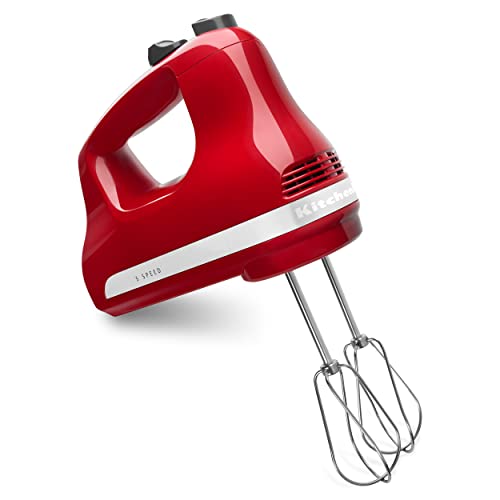
KitchenAid 5-Speed Hand Mixer, Empire Red
Badge: Best Classic Mini
KitchenAid’s KHM512 in Empire Red is the classic mini: five well-judged speeds, Turbo Beaters that keep small mixtures moving instead of packing around the shafts, and the two details that separate a drawer tool from a drawer ornament — a cord that locks to whichever side you work from, and beaters that eject with one button into the dishwasher. For egg whites, cream, small batters, and mashed anything, it is the calmest tool in this guide.
Empire Red is also a decision: this finish is bought to be seen, ideally beside its matching relatives on a counter or in an open drawer. Performance shoppers indifferent to colour should compare its silver sibling below and take whichever finish their kitchen prefers — the mixer underneath is the same trusted machine.
Strengths
- Turbo Beaters glide through small mixtures without clogging
- The swivel cord locks to your working side, out of the bowl
- Dishwasher-safe beaters make the mini promise complete: fast cleanup
Trade-offs
- Five speeds, with no burst function
- No whisk listed among the attachments
- A colour statement that must match the kitchen it joins
Key specs from the listing
- Speeds: 5
- Model: KHM512
- Attachments: Turbo Beaters
- Features: Lockable swivel cord, easy-release button
- Colour: Empire Red
Best for: Small-batch bakers who value calm control and easy cleanup / Not suited for: Anyone needing a whisk attachment in the box

LILPARTNER Hand Mixer
Badge: Most Versatile Mini
The LILPARTNER is the mini that refuses to be narrow: seven speeds — the widest range among the true minis — and five stainless accessories spanning whipping, mixing, and light dough work. For a small kitchen that can only justify one mixing tool, that breadth is the argument: the same drawer slot covers cream, batter, dough hooks for a small loaf’s first stage, and everything between, with dishwasher-safe cleanup across the whole set.
Breadth has a storage price, and in a guide about mini living that price must be named: five accessories need a home, ideally a single pouch or box, or the mini promise dissolves into drawer archaeology. Keep them together and this is the most capable small mixer here; scatter them and it becomes five reasons to order takeaway.
Strengths
- The widest speed range among the minis
- Whisks and dough accessories stretch the small-job brief furthest
- Dishwasher-safe attachments keep the versatility cheap to use
Trade-offs
- Five accessories are five things to store in a mini kitchen
- Light pink is a whole aesthetic commitment
- Accessory breadth tempts jobs the motor class should decline
Key specs from the listing
- Speeds: 7
- Attachments: 5 stainless steel accessories
- Care: Dishwasher-safe attachments
- Colour: Light Pink
Best for: Varied small jobs — whipping, mixing, light dough work / Not suited for: Purists who want two beaters and nothing else to store

KitchenAid 5-Speed Hand Mixer, Contour Silver
Badge: Best Understated Mini
This is the Empire Red pick’s sibling in Contour Silver, and the guide treats it with the same honesty as the colour variants elsewhere: one mixer, two finishes, reviewed twice because buyers shop finishes seriously. The silver version is the understated choice — the KHM512’s Turbo Beaters, lockable swivel cord, and one-button beater release, in a finish that matches stainless kitchens and disappears into a drawer without an opinion.
Choose between the two KitchenAids on the kitchen you have, and between the KitchenAid pattern and its rivals on attachments: no whisk here, against the LILPARTNER’s full set; no burst button, against the Hamilton Beach. What the KHM512 offers instead is the calmest, most proven small-mixing behaviour in the guide — which, for a tool used daily, is not a consolation prize.
Strengths
- The same proven mini performance as its red sibling
- A neutral finish that disappears into any kitchen
- Easy-release, dishwasher-safe beaters for fast cleanup
Trade-offs
- Identical mechanics to the Empire Red pick — finish is the only decision
- No whisk in the box
- Five speeds without a burst option
Key specs from the listing
- Speeds: 5
- Model: KHM512
- Attachments: Turbo Beaters
- Features: Lockable swivel cord, easy-release button
- Colour: Contour Silver
Best for: Small kitchens wanting the classic mixer in a neutral finish / Not suited for: Colour-led kitchens, which have the Empire Red option above
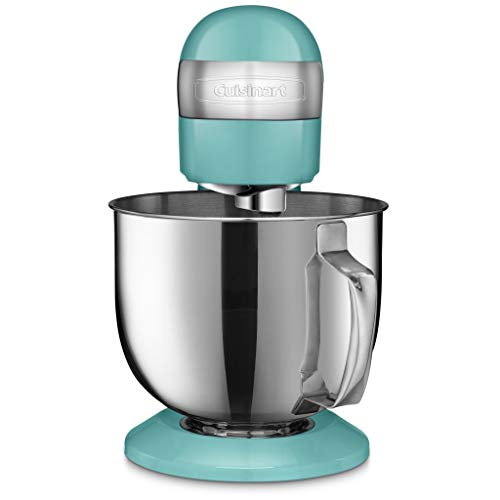
Cuisinart Stand Mixer, Periwinkle Blue
Badge: Best Step-Up (Not a Mini)
Label first: this is not a mini mixer. It is Cuisinart’s 5.5-quart stand mixer — 12 speeds, a stainless bowl, whisk, paddle, dough hook, and a splash guard with a pour spout — and it earns its place in this guide as the honest step-up for readers whose ‘small jobs’ turned out to be bread dough, double batches, and cakes that need hands-free creaming while they work elsewhere in the recipe. Judged as that machine, it is complete and capable, in a periwinkle blue that makes the counter commitment cheerful.
Judged as a mini, it fails every test in the introduction — it does not live in a drawer, start in seconds, or wash in a minute. Buy it when your batch sizes, not your storage, are the binding constraint, and buy it knowing the hand mixers above remain the right tool for the small jobs it will now be spared.
Strengths
- Hands-free mixing for doughs and batches no hand mixer should attempt
- A full attachment set: whisk, paddle, and dough hook
- Twelve speeds span folding to whipping with headroom
Trade-offs
- It is a counter appliance, not a mini — footprint and weight included
- Overkill, in every dimension, for egg whites and small batters
- A colour finish that anchors a kitchen’s palette
Key specs from the listing
- Speeds: 12
- Bowl: 5.5 quart stainless steel
- Attachments: Chef’s whisk, mixing paddle, dough hook
- Extras: Splash guard with pour spout
- Colour: Periwinkle Blue
Best for: Bakers whose small jobs have become batch jobs and dough / Not suited for: Anyone shopping for a drawer-sized mini mixer
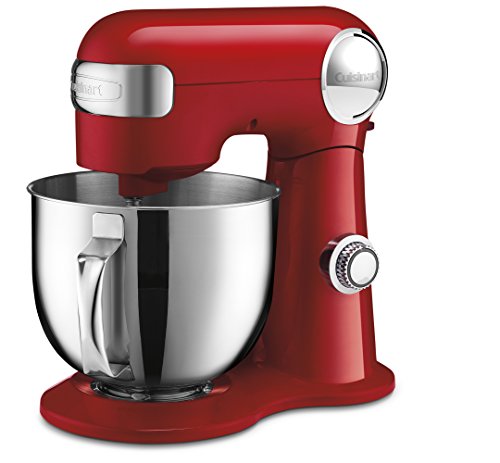
Cuisinart Stand Mixer, Ruby Red
Badge: Best Step-Up in Red (Not a Mini)
The Ruby Red SM-50R is the Periwinkle Blue pick’s platform sibling — same 12 speeds, same 5.5-quart stainless bowl, same whisk, paddle, dough hook, and splash guard — in the finish that has anchored red kitchens for a generation. Its review repeats the essential honesty: a superb step-up stand mixer, and no kind of mini. Readers choosing between the two Cuisinarts are choosing a colour and nothing else, and should spend their deliberation there rather than hunting for phantom specification differences.
For the mini shopper who scrolled this far out of curiosity, let the pair of them serve as the guide’s closing marker: this is where the mini category ends. Everything above this line fits in a drawer and starts in seconds. Everything from here needs a counter, a commitment, and a batch size to justify it — which some kitchens genuinely have, and should buy for proudly, under the right keyword.
Strengths
- The same complete step-up platform as its blue sibling
- Hands-free dough and batch capacity
- A finish with genuine counter presence
Trade-offs
- Not a mini, in size, weight, or storage
- A duplicate decision if the blue version is already in your kitchen
- Its capacity invites batches your household may not eat
Key specs from the listing
- Speeds: 12
- Bowl: 5.5 quart stainless steel
- Attachments: Chef’s whisk, mixing paddle, dough hook
- Extras: Splash guard with pour spout
- Colour: Ruby Red
- Model: SM-50R
Best for: Batch bakers wanting the step-up platform in a bold finish / Not suited for: Mini shoppers — see the four hand mixers above
Comparison Table
Format is the headline column: hand mixers are the minis, stand mixers are the step-ups, and the table refuses to blur them.
| Pick | Badge | Format | Standout trait | Link |
|---|---|---|---|---|
| Hamilton Beach 6-Speed Hand Mixer | Best Overall | 6-speed hand mixer | 250-watt motor, QuickBurst and a bowl rest | Check on Amazon |
| KitchenAid 5-Speed Hand Mixer, Empire Red | Best Classic Mini | 5-speed hand mixer | Turbo Beaters and a lockable swivel cord, in Empire Red | Check on Amazon |
| LILPARTNER Hand Mixer | Most Versatile Mini | 7-speed hand mixer | Seven speeds and five stainless accessories | Check on Amazon |
| KitchenAid 5-Speed Hand Mixer, Contour Silver | Best Understated Mini | 5-speed hand mixer | The KHM512 in Contour Silver | Check on Amazon |
| Cuisinart Stand Mixer, Periwinkle Blue | Best Step-Up (Not a Mini) | 5.5-quart stand mixer | 12 speeds, whisk, paddle, dough hook and splash guard | Check on Amazon |
| Cuisinart Stand Mixer, Ruby Red | Best Step-Up in Red (Not a Mini) | 5.5-quart stand mixer | The SM-50 platform in Ruby Red | Check on Amazon |
How to Choose a Mini Mixer
Inventory your real mixing jobs for one month. Most households discover a pattern: eggs and cream weekly, a batter or two, sauces and dressings, perhaps a small cake — and dough rarely, or never. That inventory, honestly kept, chooses the category for you. Hand mixers cover the entire common pattern at a fraction of the storage; stand mixers earn their counter only when dough and double batches recur. Buying for the imagined bakery instead of the observed month is the category’s most expensive habit.
Then optimise for friction, because mini tools live on it. Time the full cycle in your head: retrieve, attach, mix, wash, store. Snap-on cases, bowl rests, easy-release beaters, and dishwasher-safe parts each shave that cycle, and a mixer whose cycle is three minutes gets used ten times more than one whose cycle is ten. Speed counts and wattage decide individual jobs; friction decides whether the jobs happen at all. Our Best Mini Sound Mixers guide reaches the same conclusion from live-sound work: the reachable tool wins.
Match attachments to ambitions, and store them as a set. A whisk widens a mini into cream and meringue territory; dough hooks widen it towards small loaves, within motor reason. But every accessory without a home becomes drawer friction, which taxes the whole category. The kits that keep their pieces in one case or pouch preserve the mini promise; loose accessory collections quietly revoke it.
Finally, recognise the step-up moment when it genuinely arrives: you are doubling recipes and splitting them across two hand-mixer sessions, kneading weekly, or creaming butter and sugar while your hands are needed elsewhere. That is the stand mixer’s brief — including the two honestly labelled picks at the end of this guide — and buying it then is wisdom. Buying it before then is furniture. Readers at exactly that crossroads should compare the deeper stand-mixer field in our Best Mini Stand Mixers guide before committing the counter space.
How to Get Stand-Mixer Results from a Mini Hand Mixer
Technique closes most of the gap between a hand mixer and its bigger relatives. These habits are written for small batches, which is the mini’s home ground.
- Bring ingredients to room temperature. Cold butter and eggs resist small mixers disproportionately; thirty minutes on the counter is free power.
- Start low, with beaters in the mixture. Every speed increase should follow the mixture loosening, never precede it — that order prevents both spray and strain.
- Move the mixer, not just the mixture. Work the bowl in slow circuits, tilting to reach the edges; a hand mixer’s coverage is the operator’s path.
- Use the bowl rest for additions. Pause on the bowl’s edge, add ingredients to the side, and resume low — the rhythm that keeps small batters even.
- Whip in a deep, narrow bowl. Cream and egg whites climb better with less surface area, and a mini whisk or beaters reach a higher proportion of the volume.
- Stop at the recipe’s visual cue, not the timer. Small batches finish faster than big-batch timings suggest; glossy, ribboned, and peaked are instructions your eyes execute.
Know the two jobs to decline gracefully: heavy bread dough in quantity, and double or triple batches. Both are step-up work, and forcing a mini through them shortens its life while producing worse results than the right tool. Declining them is not a limitation of the mini — it is the category working as designed.
Troubleshooting
Problem: mixture climbs the beaters and stalls progress → the bowl is too wide or the speed too high for the stage; move to a deeper, narrower bowl, drop a speed, and work in circuits so the mixture folds instead of climbing.
Problem: egg whites refuse to peak → a trace of fat is the usual culprit; start with a scrupulously clean, dry bowl and beaters, separate eggs cold, and whip at room temperature with no yolk contamination.
Problem: flour clouds out of the bowl at every addition → additions are landing all at once at speed; add in thirds, fold each in at the lowest speed before the next, and let the bowl rest hold the mixer while you measure.
The Drawer Test: Storage as a Specification
Mini mixers should be bought with a tape measure. The honest storage audit comes first: which drawer, how deep, shared with what, and can the mixer live there with its attachments attached or cased? A hand mixer that fits its intended drawer, cord and all, will be used constantly. One that requires a cupboard reshuffle per use has already failed the category, whatever its speeds. The snap-on cases in this guide exist because manufacturers know the drawer is the real showroom.
Apply the same audit to the step-ups before admiring them: a stand mixer needs a permanent counter home or a lifting habit nobody sustains. Readers whose audit fails both categories are not without options — they are the market for the smallest hand mixers here, used with the technique section’s habits, which cover the overwhelming majority of home mixing without storing anything larger than a shoebox.
Small-Batch Baking: Where Minis Quietly Win
Recipe culture assumes stand-mixer scale, but a growing share of home baking is small: the half-batch of cookies, the single-layer cake, the six muffins. Mini mixers are not merely adequate at that scale — they are better. A small batter in a 5.5-quart bowl barely reaches the paddle; the same batter under hand beaters is contacted completely, watched closely, and finished at the exact visual cue. Small-batch makers also wash up in a minute, which changes how often they bake at all.
Scaling down has two rules. Halve every ingredient by weight where possible, because volume measures halve badly for flour. And shorten mixing times by attention rather than arithmetic: small masses cream, fold, and whip faster, and overmixing — the small batch’s one real risk — arrives sooner. Judge by the cue, as the how-to section insists, and the mini becomes the precision instrument of the small-batch kitchen. The small-venue applications in our Best Mixers 6 Mic Inputs guide run on exactly this right-sizing logic.
Colour Variants and Duplicate Models: How to Read This Guide’s Pairs
This guide contains two deliberate pairs — the KitchenAid KHM512 in Empire Red and Contour Silver, and the Cuisinart stand mixer in Periwinkle Blue and Ruby Red — because the verified pool contains them and because buyers genuinely shop them as separate listings. The editorial rule applied is transparency: each pair shares one review logic, states the duplication in plain words, and directs the decision to finish, set contents, and kitchen fit, where it belongs.
The wider lesson travels beyond this page. Appliance ranges are full of sibling models whose differences are finishes, bundled accessories, or a single feature. Reading listings for the platform underneath — motor class, speed system, attachment pattern — collapses a confusing shelf into a few real choices, each with cosmetic variants. Shop the platform first and the colour last, and most ‘which model’ anxiety evaporates.
The One-Mixer Kitchen: A Manifesto for Small Tools
There is a coherent philosophy behind the mini mixer, and it deserves stating plainly: most kitchens are not small bakeries, and equipping them as if they were taxes every meal with storage, cleaning, and ceremony. The one-mixer kitchen keeps a single, drawer-sized tool that covers the overwhelming majority of real mixing — eggs, cream, batters, sauces, small cakes, shakes — and rents the exceptions, in the form of a friend’s stand mixer or a bakery’s loaf, without guilt. The counter stays clear for cooking, which is what counters are for.
The philosophy has a discipline: the one mixer must be good. A weak mini that stalls on a firm batter teaches its owner to stop baking, which is the opposite of the intent. That is why this guide ranks proven platforms and treats storage cases, bowl rests, and release buttons as first-class features — in a one-tool kitchen, the tool’s daily manners are its specification. Buy the mini once, buy it well, and let the drawer be the bakery.
Accessories That Earn Their Drawer Space
Accessory inflation is the mini category’s quiet failure mode: boxes that arrive with five attachments, three of which are never washed because they are never used. The audit that prevents it is job-based. A whisk earns its space the first time cream or meringue appears in your cooking — for most households, monthly. Dough hooks earn theirs only for households that genuinely make small doughs; for everyone else they are sculpture. Extra beaters earn theirs in busy kitchens where a clean spare beats a mid-recipe wash.
Store the survivors as a single object — the case, pouch, or box they will actually live in — and let the rest go to the donation box without sentimentality. A mini setup that fits one drawer corner, complete, is a system. A mini setup spread across three drawers is a scavenger hunt with a motor attached. The guides in this series repeat the principle because it generalises: capacity you cannot store is capacity you do not own.
Mini Mixers for Small Households and First Kitchens
The mini mixer’s natural home is the small household: one or two people, cooking in real quantities, for whom full-size recipes are a storage problem disguised as dinner. Half-batches are this kitchen’s native format, and they are precisely where hand mixers outperform their larger relatives — full contact with small volumes, visual control, and a wash-up measured in seconds. First kitchens benefit doubly, because the mini’s price and footprint leave budget and space for the knives, pans, and boards that daily cooking uses even more.
Building a first kitchen around small, excellent tools also teaches the right habits early: mise en place, because a hand mixer needs its ingredients ready; temperature discipline, because small tools reward room-temperature ingredients; and finishing by eye, because small batches announce their cues clearly. Those habits transfer intact to any larger kitchen the cook later inhabits — which cannot be said of habits formed around a machine that did everything behind a splash guard.
When Mini Is Not Enough: An Honest Field Guide to the Boundary
This guide has praised the mini category at length, so it owes the boundary a full paragraph of its own. A mini mixer is the wrong tool when the recipe’s mass physically overwhelms it: a double batch of cookie dough with cold butter, a stiff bread dough in quantity, a wedding cake’s worth of batter. It is the wrong tool when the cook’s hands are the constraint — arthritis, an injury, a recipe whose other stages need both hands at the mixing moment. And it is the wrong tool when frequency turns minutes into hours: the daily baker’s stand mixer pays for itself in wrists.
Recognising the boundary is a compliment to both categories, not a defeat for either. The healthiest kitchens this guide can imagine own the question rather than a side: a mini for the eighty percent, a clear-eyed step-up when the twenty percent becomes weekly, and no purchases made from category loyalty. The two Cuisinart stand mixers reviewed above wait at exactly that boundary, labelled and ready — which is where this guide leaves them, and where honest buying guides should leave every product: at the point where the reader’s real life, not the keyword, makes the decision.
Mini Mixers in Tiny Kitchens, Dorms, and Caravans
The mini mixer’s most devoted households are the ones whose kitchens are measured in steps rather than metres: studio flats, dorm rooms, caravans, boats, and the spare-room kitchenettes of multigenerational homes. In those spaces the category’s virtues compound — a drawer is a real storage strategy, a three-minute cleanup is the difference between baking and not baking, and a tool that runs from any socket without a counter-clearing ceremony fits a life lived in one room. The hand mixers in this guide were ranked for exactly that reader, whether or not they knew it.
Compact living adds one selection pressure the standard kitchen does not: noise travels. A mixer used at midnight in a studio is a household event in a way the same mixer in a detached kitchen is not. Calm, well-mannered motors — the quality this guide praised in the classic picks — are a courtesy feature in small spaces, and worth weighting alongside speeds and attachments when the walls are thin and the neighbours are close.
Baking Ratios for One: Halving Recipes Without Tears
The mini mixer’s native recipe is the half-recipe, and halving has rules that spare tears. Weigh dry ingredients where possible, because a half of a cup measure is a different error than half of a gram weight. Halve the egg by beating a whole egg and using half by weight or spoon — the leftover half is tomorrow’s omelette enrichment, not waste. Keep leavening honest: baking powder and soda halve proportionally, but their effect concentrates in small batters, so err a fraction under rather than over and note the result.
Pan maths follows: a halved batter wants a loaf pan or a small round tin, filled to the same depth the original recipe intended, because depth — not volume — sets the baking time’s neighbourhood. Check early and by the cue. Small-batch baking fails mostly by being baked on the big recipe’s clock, in the big recipe’s tin, by a cook who halved everything except their attention to scale. The mini mixer started the job at the right size; finish it the same way.
Whipping Cream and Egg Whites: The Mini’s Party Tricks
Two jobs justify a mini mixer’s existence in kitchens that rarely bake: whipped cream and egg whites, the twin pillars of effortless dessert. Cream wants a cold bowl, a cold whisk or beaters, and a stop at soft peaks for serving or firm peaks for piping — a window measured in seconds at the end, which is why the mini’s instant start and stop beat a stand mixer’s ceremony for a single bowl. Sweeten late, when the cream has body, so the sugar dissolves into structure rather than into the liquid phase.
Egg whites want the opposite environment — room temperature, scrupulously grease-free, a bowl with no plastic residue of past butter — and the same instant control at the peak, because overwhipped whites turn grainy faster than any other mixture in the repertoire. Both jobs take under three minutes with the picks in this guide and transform bought desserts, coffees, and breakfasts out of proportion to their effort. A mini mixer bought for these two tricks alone, used weekly, has already repaid its drawer.
Motor Manners: Noise, Heat, and the Longevity of Small Tools
Small motors live closer to their limits than large ones, and their longevity is a user behaviour. Heat is the ledger: a hand mixer run continuously against resistance accumulates it, so the technique sections’ habits — room-temperature ingredients, correct speeds, pauses at the bowl rest — are also cooling intervals that extend the tool’s life. A mixer that smells hot is giving information, not attitude: stop, let it rest, and reconsider the load, because the next stage of that conversation is a shortened lifespan.
Noise is the other manner worth reading. A healthy mini has a consistent note per speed; a new rattle, a hunting pitch, or a speed that surges unloaded is an early symptom worth addressing while the tool is under whatever cover it carries. Kept clean, rested under load, and stored without its cord kinked at the entry point — the classic small-appliance failure — a good hand mixer serves for many years. The category’s economy depends on that lifespan, and the lifespan depends on these manners.
The Gift Question: Mini Mixers for New Households
A quality hand mixer is one of the few kitchen gifts that is almost never wrong: it suits the new household that has nothing, the small household that has no room, and the established household whose ancient mixer predates its occupants. The gifting logic follows this guide’s ranking — the leading all-rounder for the unknown kitchen, the classic in a finish for the known one, the full kit for the household starting from an empty drawer — with the storage case valued doubly in a gift, because it lets the present arrive as a complete, self-storing object rather than as the start of a drawer problem.
Pair the gift with the one thing manufacturers cannot include: a recipe card with the giver’s own calibrated small-batch favourite, ratios proven in a real kitchen. That card converts an appliance into an inheritance, and it costs a pen. Gift-givers who follow the calibration philosophy running through this whole catalogue — proven ratios, honestly bounded tools, storage treated as a specification — tend to give the presents that are still in weekly use a decade later, which is the only metric of gifting that matters.
Common Buying Mistakes
- Buying a stand mixer for a storage problem. If space is the constraint, the step-ups in this guide are the opposite of the answer.
- Counting speeds instead of testing the cycle. Retrieval, cleanup, and storage decide mini satisfaction; speeds decide single jobs.
- Scattering the attachments. A mini whose whisk lives in another drawer is a mini that no longer whips; store the set as one object.
- Forcing dough and double batches. The step-up moment is real — recognise it and change tools instead of straining the mini.
- Ignoring the bowl. Deep and narrow beats wide and shallow for nearly every mini job; the wrong bowl makes a good mixer look weak.
- Choosing between colour siblings on imagined specs. Pairs like the KHM512 finishes are one platform — decide on finish and move on.
Final Recommendation
For the brief this keyword actually describes — small jobs, small kitchens, fast starts — the leading hand mixer at the top of this list is the purchase most households will use daily. Start with the Hamilton Beach 6-Speed Hand Mixer if you want the safest all-round choice in this list.
Take the LILPARTNER if your small jobs are the most varied, a KitchenAid if calm classic behaviour matters most, and a Cuisinart stand mixer only when your batches have honestly outgrown the drawer. If your priorities lean the other way, the KitchenAid 5-Speed Hand Mixer, Empire Red and the LILPARTNER Hand Mixer cover the two most common alternative briefs in this guide.
Whichever you choose, give it the mini treatment: a real drawer home, attachments stored as a set, and ingredients at room temperature so its modest power is never wasted. A mini mixer kept that way stops being the small option and becomes, for most of what kitchens actually mix, simply the right one. Readers whose next question is the counter-standing version of this decision will find it answered in depth in our Best Mini Stand Mixers guide.
Frequently Asked Questions
What counts as a mini mixer?
In practice, a hand mixer: a one-hand, drawer-stored tool for small jobs like eggs, cream, batters, and sauces. Compact stand mixers occupy the category’s upper edge, but a 5.5-quart stand mixer is a counter appliance — this guide includes two as clearly labelled step-up picks rather than pretending they are mini.
Can a mini hand mixer replace a stand mixer?
For the common pattern of home mixing — small batches, no heavy dough — yes, and it will be used more often because it starts faster and washes in a minute. For weekly bread dough, double batches, and hands-free creaming during other work, no: that is the step-up brief, and forcing a mini through it shortens the tool’s life.
How many speeds does a mini mixer need?
Five to seven covers the whole small-job range, from folding to whipping. More valuable than the count is the quality of the lowest speed — gentle enough to combine without spray — and a burst function for final pockets, as on the leading Hamilton Beach pick.
Which pick is best for whipped cream and egg whites?
The LILPARTNER, for its whisk attachments and seven speeds, or either KitchenAid for calm, proven whisking-adjacent work with beaters. Use a deep, narrow, scrupulously clean bowl, and stop at the visual peak — small volumes whip fast and overwhip faster.
Are the two KitchenAid and two Cuisinart picks different mixers?
Within each pair, no — they are the same platform in different finishes: the KHM512 in Empire Red and Contour Silver, and the Cuisinart SM-50 stand mixer in Periwinkle Blue and Ruby Red. The guide reviews them transparently as variants; choose on finish and kitchen fit.
When should I step up to a stand mixer?
When the evidence accumulates: weekly dough, recipes routinely doubled, batches split across two hand-mixer sessions, or creaming tasks that need your hands elsewhere. At that point the stand mixers at the end of this guide — and the wider field in the linked stand-mixer guide — become the correct purchase rather than an indulgence.


