Disclosure: topratedkitchenware.com is reader-supported. When you buy through links on our site, we may earn an affiliate commission from Amazon and other retailers, at no extra cost to you.
Where to buy
If you are shopping for the best mixers baiking, the six models below are the shortlist this guide is built around. Prices and availability change often on Amazon, so use the links to check the current listing before you buy. Orders are placed on Amazon, and listings there carry the full manufacturer detail for each model.
- Best Overall: Cuisinart 6-Piece 9-Speed Hand Mixer with Storage Case (Brushed Chrome) — Check on Amazon
- Proctor Silex Easy Mix 5-Speed Hand Mixer with Bowl Rest — Check on Amazon
- Cuisinart Stand Mixer 5.5 Quart (White Linen) — Check on Amazon
- Cuisinart Stand Mixer 5.5 Quart (Onyx) — Check on Amazon
- Cuisinart Stand Mixer 5.5 Quart (Periwinkle Blue) — Check on Amazon
- Cuisinart Stand Mixer 5.5 Quart (Ruby Red) — Check on Amazon
Read the full guide ↓
Yes, the keyword really is spelled that way — and if you searched for the best mixers baiking, you almost certainly meant baking: the cakes, cookies, breads and frostings that a good mixer turns from arm-ache into pleasure. This guide takes the baking brief seriously even if the spelling wandered, because baking is the most demanding everyday work a mixer does. It asks for gentleness and violence in the same recipe — folding flour without knocking the air out, then whipping cream to stiff peaks; creaming butter and sugar to pale fluff, then pulling a dough together without burning out the motor. A mixer that bakes well is a mixer with range, and range is what the six picks below were judged on.
The list holds both families of baking mixer, because real kitchens do. Two are hand mixers — the drawer-friendly tools that handle the majority of home baking with minimal fuss and minimal storage. Four are the same Cuisinart stand mixer in four finishes, and this guide will be honest about that from the start: the stand mixer is one machine wearing four colours, included in each colour because that is how shoppers meet it, and because a stand mixer lives on the counter where colour is a daily fact. Its reviews concentrate on the stand-mixer baking experience — the 5.5 quart bowl, the paddle, whisk and dough hook — and say plainly that the finishes bake identically.
Everything here is research-led from verified listings: speeds, bowl sizes and included tools are reported from the listings, prices are left to Amazon for you to check on the day, and no laboratory bake-off is pretended. If your kitchen shopping extends beyond the mixer itself, the retail landscape in our guide to Best Mixers Bed Bath And Beyond covers the stores where machines like these are browsed in person.
Key Takeaways
- Baking tests a mixer’s range: gentle folding, hard creaming, fast whipping and patient dough work in a single afternoon.
- The Cuisinart HM-90BCS hand mixer takes Best Overall — 9 speeds, a 220W motor, SmoothStart and a 6-piece set with storage case.
- The four stand mixers here are one Cuisinart machine in four finishes: 12 speeds, a 5.5 quart bowl, whisk, paddle and dough hook — buy on colour.
- The Proctor Silex is the small-kitchen pick: compact, lightweight, with a bowl rest that keeps drips in the bowl.
- Stand mixers earn their counter space with dough and big batches; hand mixers win the weekly reality of batters, frostings and cream.
- Choose by your baking census — dough frequency and batch size decide the family; speeds and storage decide the model.
In this guide
Quick Picks
Six picks, two families, one honest duplication: four finishes of a single stand mixer, each badged by finish, alongside two hand mixers badged by role. The detailed reviews keep the duplication explicit.
| Pick | Badge | Why it earns its place |
|---|---|---|
| Cuisinart 6-Piece 9-Speed Hand Mixer with Storage Case (Brushed Chrome) | Best Overall | A 6-piece, 9-speed hand mixer set with a 220W motor, SmoothStart and a snap-on case — the most complete hand-mixer package here. |
| Proctor Silex Easy Mix 5-Speed Hand Mixer with Bowl Rest | Best for Small Kitchens | A compact, lightweight 5-speed mixer with a bowl rest, for small kitchens and simple, satisfying bakes. |
| Cuisinart Stand Mixer 5.5 Quart (White Linen) | Best Stand Mixer | The stand-mixer pick in White Linen: 12 speeds, 5.5 quart stainless bowl, whisk, paddle, dough hook and splash guard. |
| Cuisinart Stand Mixer 5.5 Quart (Onyx) | Best Stand Mixer in Black | The identical stand mixer in Onyx — the finish for dark, modern counters; performance matches the white pick exactly. |
| Cuisinart Stand Mixer 5.5 Quart (Periwinkle Blue) | Best Colour Choice | The identical stand mixer in Periwinkle Blue, for kitchens that treat the counter as a colour decision too. |
| Cuisinart Stand Mixer 5.5 Quart (Ruby Red) | Best Statement Finish | The identical stand mixer in Ruby Red — the statement finish, with the same 12 speeds and 5.5 quart bowl beneath it. |
How These Picks Were Chosen
This guide is research-led. We compared verified listings across the hand and stand mixer market through a single lens — baking — and filtered for the qualities a baker feels: a speed range wide enough to fold and to whip, the right tools in the box (paddle or beaters for batters, a whisk for air, a hook for dough), bowl capacity matched to real batch sizes, and starts gentle enough not to snow the kitchen in flour. Listing claims are described as listing claims; we ran no laboratory bake-off, and where we judge — for instance, that a splash guard earns its keep at the flour stage — we present it as kitchen reasoning.
Two structural decisions deserve disclosure. First, both mixer families are included because baking households genuinely split between them, and a guide that crowned one family for everyone would mislead both. Second, the Cuisinart stand mixer appears in four finishes, deliberately and transparently. Shoppers meet all four listings; pretending three do not exist helps nobody, and the reviews repeat, in each case, that the machine beneath the colour is the same — so the stand-mixer decision becomes two honest steps: choose the machine, then choose the finish you want to look at every day.
A final filter was storage and stamina. Baking is seasonal in bursts — the holiday weekend that runs a mixer for six hours is the real specification — so we favoured machines whose listings describe complete kits that store as units and motors specified for the heavy end of home work. The community kitchens and bake-sale productions described in our notes on Best Mixers Churches run exactly that duty cycle, and the picks below were chosen to survive it.
Best Mixers Baiking — the six picks in detail
Each review covers what the mixer is, how it behaves across the baking repertoire, who it suits, and one honest limitation. The four stand-mixer reviews describe the same machine in different finishes and say so. Specs come only from the verified listings — check the latest price on Amazon before you buy.

Cuisinart 6-Piece 9-Speed Hand Mixer with Storage Case (Brushed Chrome)
Badge: Best Overall
Strengths
- 9 speeds span folding to whipping in one tool
- 220W motor and 6-piece set cover the full hand-mixer rotation
- SmoothStart keeps flour in the bowl at startup
Trade-offs
- Brushed chrome collects fingerprints between bakes
- A hand mixer still asks you to hold it through long mixes
- Case adds a little drawer bulk
Key specs from the listing: 9 speeds; 220W motor; SmoothStart anti-splatter technology; snap-on storage case; brushed chrome; 6-piece set; model HM-90BCS.
The Cuisinart HM-90BCS takes Best Overall because it is the most complete hand mixer a baker can buy from this list. The 6-piece set, the 9-speed range and the 220W motor describe a machine specified for the full rotation: SmoothStart eases into flour without the dust cloud, the middle speeds cream butter and sugar with patience, and the top of the range whips cream and egg whites with real enthusiasm. The snap-on storage case then does the quiet, crucial work of keeping the kit together in a drawer, so the machine is a unit you grab, not a scavenger hunt you assemble.
Its limitations are those of its family and finish. A hand mixer, however good, is held — and through a long cookie production your arm is part of the machine in a way a stand mixer never asks. Brushed chrome, meanwhile, is a fingerprint ledger between polishes. Neither point dents its standing for the majority of baking households, whose work is batters, frostings, creams and light doughs in single batches. For that repertoire, this is the hand mixer we would put in the drawer first, and the one against which the others here are measured.
Best for: most baking households wanting the complete hand-mixer set / Not suited for: marathon baking days where holding a mixer tires the arm

Proctor Silex Easy Mix 5-Speed Hand Mixer with Bowl Rest
Badge: Best for Small Kitchens
Strengths
- Bowl rest parks the mixer on the bowl rim, drips inward
- Compact and lightweight — kind to small kitchens and tired arms
- 5 speeds cover the honest core of home baking
Trade-offs
- 215 watts peak power is the modest figure here
- No dough-first design — heavy dough belongs to the stand mixers
- Beater-focused set with no storage case in the listing
Key specs from the listing: 5 speeds; bowl rest; compact and lightweight; 215 watts of peak power; black finish; model 62511.
The Proctor Silex Easy Mix is the small-kitchen pick, and its virtues are the unglamorous ones that decide whether a mixer gets used on a Tuesday. It is compact and lightweight, its 5 speeds cover the honest core of baking — stir, mix, beat, whip and a gear in reserve — and its bowl rest is a small stroke of genius: the mixer stands on the rim of the bowl, beaters dripping inward, while you add eggs, answer the door or scrape down. In a tiny kitchen, where the mixer’s home is a crowded drawer and its stage is a square foot of counter, that tidiness is a feature with daily interest.
The limits are power and ambition. At 215 watts of peak power it is the modest figure in this guide, and heavy, stiff doughs are simply not its brief — the stand mixers below exist for that dough. Its set is beater-focused, with no case in the listing. Judge it as the machine it is: an affordable, friendly tool for cakes, creams, batters and mashed potatoes, in the kitchens — first flats, dorm-adjacent rentals, the student houses of Best Mixers College life — where space and simplicity outrank horsepower. For those bakers, it is not the budget compromise; it is the right size of right.
Best for: small kitchens, first flats and simple, frequent bakes / Not suited for: heavy dough or large stiff batches

Cuisinart Stand Mixer 5.5 Quart (White Linen)
Badge: Best Stand Mixer
Strengths
- 12 speeds is the widest range in this guide
- 5.5 quart stainless bowl swallows family batches
- Whisk, paddle and dough hook all included, with a splash guard
Trade-offs
- Counter space and weight are the standing-mixer tax
- White Linen shows every splash of a baking day
- Premium tier within this list
Key specs from the listing: 12 speeds; 5.5 quart stainless steel bowl; chef’s whisk, mixing paddle and dough hook; splash guard with pour spout; White Linen; model SM-50NAS.
The stand mixer picks begin with White Linen, and the machine beneath the finish is the baking heavyweight of this guide. Twelve speeds give it the widest range here — a genuinely slow stir for folding, a genuinely fast whip for meringue — and the 5.5 quart stainless steel bowl takes family batches and double recipes without brimming. The tool set is the full stand-mixer rotation: a mixing paddle for batters and creaming, a chef’s whisk for air, a dough hook for bread, and a splash guard with a pour spout that tames the flour stage and lets ingredients join mid-mix. This is hands-free baking: the machine works while your hands do the next job.
The costs are the family costs. A stand mixer is a counter commitment — weight, footprint and a permanent address — and it sits in the premium tier of this list. White Linen, specifically, will record every encounter with cocoa and turmeric. But for the household that bakes weekly, kneads dough, doubles batches and hosts the big baking days, this machine is not an indulgence; it is the difference between baking as effort and baking as routine. Choose this finish if your kitchen runs light and neutral — the machine underneath is identical in every colour that follows.
Best for: weekly bakers and dough makers who want hands-free power in a light finish / Not suited for: kitchens with no counter to spare
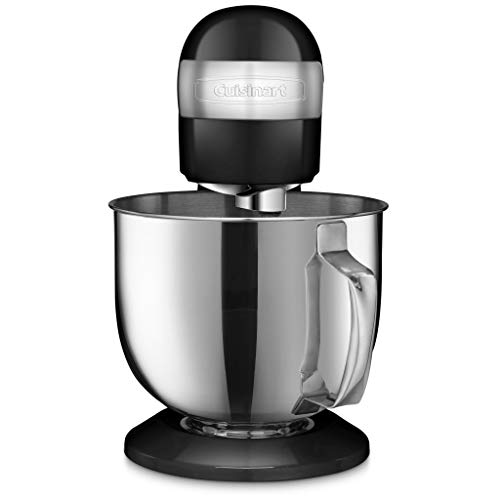
Cuisinart Stand Mixer 5.5 Quart (Onyx)
Badge: Best Stand Mixer in Black
Strengths
- Identical 12-speed, 5.5 quart platform to the White Linen pick
- Onyx finish suits dark and modern kitchens
- Full tool set included: whisk, paddle, dough hook, splash guard
Trade-offs
- No performance difference from the other finishes — none
- Dark finish shows flour dust at a glance
- Same counter-space commitment as any stand mixer
Key specs from the listing: 12 speeds; 5.5 quart stainless steel bowl; chef’s whisk, mixing paddle and dough hook; splash guard with pour spout; Onyx; model SM-50BK.
The Onyx version of the Cuisinart stand mixer is, as promised, the same machine: 12 speeds, the 5.5 quart stainless bowl, the paddle, whisk and dough hook, the splash guard with its pour spout. Its baking is the White Linen review’s baking, word for word in performance — the slow stir, the fast whip, the dough hook pulling a batch together while you line the tins. Nothing in this paragraph is a criticism; it is the guide keeping its promise that colour is the only variable in this family, so that your decision can be the honest, pleasant one it should be.
Onyx’s own trade-offs are purely presentational: a dark finish shows flour dust the moment it lands — and in a baking kitchen it lands daily — while hiding the darker splashes that mark the white version. It suits the modern, dark-accented kitchen the way White Linen suits the bright one. If you have decided on this stand mixer and your counters run dark, this is your finish; if you are still deciding on the machine, ignore the colour question entirely until the family-and-model decision is made, because no finish in this guide bakes a better cake than another.
Best for: the same stand-mixer brief in a dark, modern kitchen / Not suited for: anyone expecting it to bake differently from White Linen — it does not
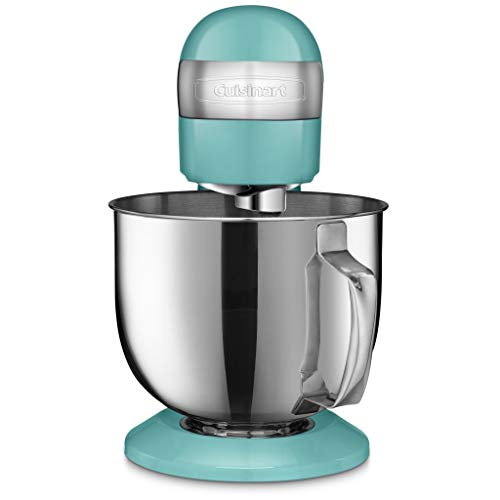
Cuisinart Stand Mixer 5.5 Quart (Periwinkle Blue)
Badge: Best Colour Choice
Strengths
- Identical stand-mixer hardware to the other finishes
- Periwinkle Blue is a genuinely distinctive counter colour
- Same 5.5 quart bowl and three tools included
Trade-offs
- No performance difference from the other finishes
- A distinctive colour is a long commitment on a daily appliance
- Same premium tier as its siblings
Key specs from the listing: 12 speeds; 5.5 quart stainless steel bowl; chef’s whisk, mixing paddle and dough hook; splash guard with pour spout; Periwinkle Blue; model SM-50TQNAS.
Periwinkle Blue is the finish for the baker who believes a machine that lives in view should earn its view. The hardware, for the third time and by design, is the Cuisinart stand platform entire: 12 speeds, 5.5 quart stainless steel bowl, chef’s whisk, mixing paddle, dough hook, splash guard with pour spout. Its dough hook does not know it is blue; its whisk whips exactly as its Onyx sibling’s does. We belabour the point because guides that dress colour variants as different products waste shoppers’ money and trust, and this one declines to.
The honest consideration is commitment. Periwinkle is a distinctive, cheerful colour, and a stand mixer is a decade-scale appliance; the finish you find delightful in the listing photographs will preside over a thousand breakfasts. Choose it because your kitchen genuinely loves colour — many do, and bake happily under its presidency for years — not as a whim between two safer shades. Performance will never give you cause to regret the machine; only taste can change, and taste is the one specification no guide can check for you.
Best for: colour-led kitchens committed to the stand-mixer life / Not suited for: the indecisive — a decade is a long time to second-guess a colour
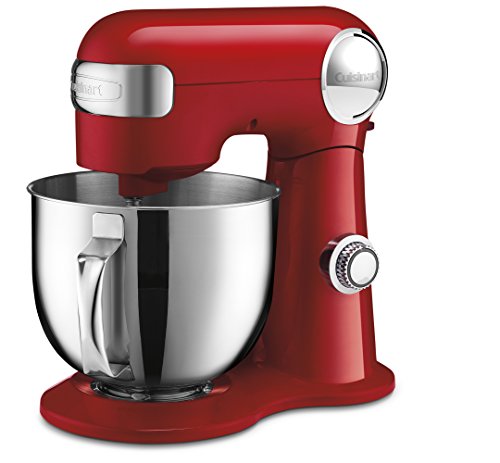
Cuisinart Stand Mixer 5.5 Quart (Ruby Red)
Badge: Best Statement Finish
Strengths
- Identical stand-mixer hardware to the other finishes
- Ruby Red is the classic statement finish for a counter appliance
- Same 12 speeds and full tool set included
Trade-offs
- No performance difference from the other finishes
- Red is the finish a kitchen must commit to, not sample
- Same footprint and tier as its siblings
Key specs from the listing: 12 speeds; 5.5 quart stainless steel bowl; chef’s whisk, mixing paddle and dough hook; splash guard with pour spout; Ruby Red; model SM-50R.
Ruby Red closes the stand-mixer family with the classic statement finish — the colour that has signified a serious baking kitchen on counters for generations. Beneath it, the by-now-familiar completeness: 12 speeds from stir to whip, the 5.5 quart stainless bowl for family batches, the paddle, the chef’s whisk and the dough hook, the splash guard with pour spout standing sentry over the flour stage. A red stand mixer is also, quietly, the most gifted and most registered-for appliance in this entire guide, which tells you something true about how bakers feel about the machine it colours.
Its trade-offs are the family’s — counter commitment, premium tier — plus red’s own: it is the least camouflageable object a kitchen can host, and it will anchor the room’s palette whether you plan around it or not. For the baker who wants exactly that anchor, there is nothing else to decide: the machine is proven by its three siblings above, the finish is the personality. And if you have read all four stand reviews and still cannot choose, that is the guide’s final hint — the finishes are equal, so pick the one that makes you smile, and go and bake something.
Best for: bakers who want the classic statement appliance on the counter / Not suited for: minimalist kitchens that hide every appliance they own
Comparison Table
The table below compares the six picks on family, capacity or format, and included tools. The four stand mixers share their row values because they share everything but finish — the table keeps that visible rather than disguising it.
| Pick | Format | Key features | Stands out for | Listing |
|---|---|---|---|---|
| Cuisinart 6-Piece 9-Speed Hand Mixer with Storage Case (Brushed Chrome) | Hand mixer, 9 speeds | 6-piece set, 220W, storage case | The complete drawer-sized baker | Check on Amazon |
| Proctor Silex Easy Mix 5-Speed Hand Mixer with Bowl Rest | Hand mixer, 5 speeds | Beaters, bowl rest, compact body | Small kitchens, simple bakes | Check on Amazon |
| Cuisinart Stand Mixer 5.5 Quart (White Linen) | Stand mixer, 12 speeds | 5.5 qt bowl, paddle, whisk, hook, guard | Hands-free baking, White Linen | Check on Amazon |
| Cuisinart Stand Mixer 5.5 Quart (Onyx) | Stand mixer, 12 speeds | 5.5 qt bowl, paddle, whisk, hook, guard | The same machine in Onyx | Check on Amazon |
| Cuisinart Stand Mixer 5.5 Quart (Periwinkle Blue) | Stand mixer, 12 speeds | 5.5 qt bowl, paddle, whisk, hook, guard | The same machine in Periwinkle Blue | Check on Amazon |
| Cuisinart Stand Mixer 5.5 Quart (Ruby Red) | Stand mixer, 12 speeds | 5.5 qt bowl, paddle, whisk, hook, guard | The same machine in Ruby Red | Check on Amazon |
How to Choose the Best Mixers Baiking — for Baking, Properly
Begin with the census, because baking households differ more than mixer catalogues admit. List what you actually bake across a season: the ratio of batters to doughs, the batch sizes at your biggest baking day, and whether your hands are free or busy while mixing. Dough weekly and double batches point at the stand mixer — its hook, its 5.5 quart bowl and its hands-free running are built for exactly that census. Cakes, frostings, creams and the occasional cookie batch point at the hand mixer, which will do all of it from a drawer. Most households, counted honestly, are hand-mixer households with stand-mixer fantasies; the census is how you tell which one you are.
Next, read the speed range as a baking range. The low end is where baking is won: a start slow enough to fold flour without a dust cloud or a deflated batter — the quality Cuisinart’s SmoothStart is named for, and the stand mixer’s lowest gears provide. The high end is for air: whipped cream, egg whites, meringue. The middle is creaming country, where butter and sugar want minutes of steady, unhurried work. A 5-speed machine covers this map adequately; 9 and 12 speeds draw it in finer detail, which experienced bakers feel in delicate work and new bakers grow into.
Then match the tools to the map. Paddle or beaters for batters and creaming, whisk for air, hook for dough — and check they are in the box, not in a separate catalogue. The stand picks here include all three plus a splash guard; the hand picks divide between the Cuisinart’s complete 6-piece set and the Proctor Silex’s beater-focused simplicity. A missing hook discovered on bread day is this category’s signature disappointment, and it is entirely preventable at the listing stage, including when shopping the department-store ranges covered in Best Mixers Bed Bath And Beyond.
Finally, price the whole commitment, not the machine. A stand mixer buys a decade of baking and rents a square of counter for all of it; a hand mixer buys flexibility and asks a drawer. Finishes, in the stand family here, are free decisions — the four colours bake identically — so spend your deliberation where differences live: family, capacity, tools and storage. Get those right and the mixer disappears into the baking, which is where every tool in this guide is trying to end up.
One last consideration is noise, honestly stated. Mixers are not quiet, and dough work at low speed is a different sound from a whisk at full tilt — a household with sleeping children, thin walls or a dawn baking habit should weigh where and when the machine will run. Hand mixers are brief and local in their noise; stand mixers run longer, unattended, and their sound becomes the kitchen’s weather for ten minutes at a time. Neither is a reason to avoid a family — bakers have risen early for centuries — but the household that plans its baking hours around its life, rather than discovering the conflict at 6 a.m. on a Sunday, keeps both the baking and the peace.
How to Bake With a Mixer: The Core Techniques
Machines do not bake; bakers bake, and the mixer is their strongest arm. The techniques below are the ones that separate a well-used mixer from a merely owned one, across both families in this guide: temperature discipline, the order of additions, and knowing which speed and tool each stage of a recipe is quietly asking for. Master these and the modest Proctor Silex will out-bake a neglected stand mixer every Saturday of the year.
- Bring butter and eggs to room temperature before creaming or batter work — a mixer cannot fix cold butter, only distribute the problem. Room-temperature ingredients cream faster, trap more air and emulsify smoothly.
- Cream butter and sugar longer than feels necessary, at a steady middle speed, until the mixture is visibly paler and fluffier; this is where a cake’s lightness is actually manufactured.
- Add eggs one at a time, mixing each in fully before the next, and add a spoonful of the recipe’s flour with the last eggs if the mixture threatens to curdle.
- Add dry ingredients in two or three stages, alternating with the liquid, and drop to the lowest speed — or the slow start — for each addition. Flour mixed slowly stays in the bowl and keeps the batter tender.
- Stop the moment streaks disappear. Overmixing after the flour goes in develops gluten and toughens cakes; the last few folds are better done by hand with a spatula, scraping the bowl’s bottom and sides.
- For dough, switch to the hook, keep speeds low, and let the dough tell you when it is ready: smooth, elastic and pulling cleanly from the bowl’s sides. For cream and whites, use the whisk, a clean bowl, and stop the instant peaks hold their shape.
One habit protects both the baking and the machine: clean as you finish, not as you remember. Batter left to dry in a paddle’s corners or a beater’s centre sets like cement, and dried residue in sockets is how attachments stop seating properly. A minute in warm soapy water at the end of the bake is the cheapest maintenance in the kitchen — and it leaves the mixer ready for the next idea, which in a baking household is never far away. The high-volume version of that discipline, for bake sales and celebration seasons, is the routine the community bakers of Best Mixers Churches swear by: wash between batches, not between days.
Finally, learn your own machine’s dialect. Speed numbers are not standardised across brands — one mixer’s third gear is another’s fifth — so the recipes’ words (slow, medium, fast) must be translated into your dial by experience. The first month with any pick in this guide is that translation course: note which setting creams without splashing, which whips without overrunning, and write it inside the recipe you used. By the second month the machine will feel less like an appliance and more like what it is — an extension of the baker who bothered to learn it.
Store the notebook with the mixer, not with the cookbooks — the notes belong to the machine’s settings as much as to the recipes, and the next baker to use the kitchen, whether that is you in December or someone you are teaching, inherits the translation whole instead of relearning it at the cost of a flat cake.
Troubleshooting
Problem: Butter and sugar will not cream to a pale fluff → the butter was too cold or the creaming too short. Next time, room-temperature butter and several patient minutes at middle speed. This time, keep mixing — warmth from the work itself will eventually bring the mixture round.
Problem: The batter curdles when the eggs go in → the eggs were cold or added too fast. Add a spoonful of the measured flour with each remaining egg, mix each addition in fully, and warm cold eggs in their shells in warm water for ten minutes before the next bake.
Problem: Flour erupts over the kitchen at every addition → start each addition at the lowest speed, add dry ingredients in smaller stages, and use the splash guard on a stand mixer or a deeper bowl with a hand mixer. The eruption is a speed problem, not a recipe problem.
Hand Mixer or Stand Mixer: The Baker’s Fork in the Road
Every baking household eventually faces the fork this guide is built around, and the honest answer is that both roads are right — for different censuses. The hand mixer’s case is weekly reality: cakes, frostings, whipped cream, mashed potatoes and light cookie doughs, done from a drawer, washed in a minute, at a fraction of the stand mixer’s price tier and none of its counter rent. For the majority of baking households, the hand mixer is not the compromise candidate; it is the correct tool, and the Cuisinart at the top of this list is its fullest expression.
The stand mixer’s case is weight of work: dough that would strain a hand mixer’s motor and its owner’s arm, batches doubled for a crowd, creaming that runs hands-free while the baker lines tins and melts chocolate. If your census holds those entries weekly, the stand mixer repays its counter space every month. Many mature baking kitchens own both — the stand for Saturday’s production, the hand mixer for Tuesday’s frosting — and if that is your destination, buy the hand mixer first; it will teach you your own census, which is the knowledge the stand purchase needs. Bar professionals face a cousin of this decision with a different liquid entirely, as Best Mixers Bar explores — the right tool is always the one matched to the work actually done.
Reading a Baking Recipe Like a Mixer Manual
Recipes speak a compressed language, and fluent bakers translate it into tool, speed and time without thinking. Cream means paddle or beaters, middle speed, minutes — until pale. Fold means the lowest speed for seconds, or better, a spatula and no machine at all. Whip means whisk, high speed, and a watchful eye, because the distance between soft peaks and grainy regret is under a minute. Knead means the hook, low speed, and patience measured in dough texture rather than clock time. Learning this translation is worth more than any single upgrade in this guide, because it applies to every mixer you will ever own.
The second translation is scale. A recipe written for a standard batch behaves differently doubled: creaming takes longer, flour additions need smaller stages, and a bowl that was generous becomes exact. The 5.5 quart stand bowl in this guide exists for that arithmetic, and the hand-mixer baker’s answer is two honest batches rather than one heroic one. Baking rewards the cook who respects capacity — of the bowl, of the motor, of the afternoon — and punishes, with a reliability that borders on comedy, the one who treats every limit as a suggestion.
The Supporting Cast: Bowls, Scales and the Tools Around the Mixer
A mixer does not bake alone, and the bakers who get the most from the machines in this guide surround them with a small, deliberate supporting cast. A deep mixing bowl is the hand-mixer baker’s splash guard and stage in one; a kitchen scale quietly replaces cup measures and makes recipes repeatable in a way volume never achieves; a flexible spatula owns the last folds and the bowl’s curved geography that no beater fully reaches. None of these is glamorous, and together they are worth more to your baking than the difference between any two picks in this list.
The stand-mixer baker’s cast differs slightly: a second bowl for the machine ends the wash-between-stages pause on production days, and a pouring shield habit — actually using the splash guard the listing includes — keeps the flour stage civilised. Both families share the deepest supporting tool of all, which is a notebook: speeds, times and small betrayals recorded per recipe, so the machine’s settings become knowledge instead of rediscovery. Baking improves by iteration, and iteration needs notes. The mixer provides the arm; the cast provides the memory.
Common Buying Mistakes
The first baking mistake is buying the family before the census: a stand mixer for a household that frosts six cakes a year, or a hand mixer for a household kneading dough every Friday. Count your real baking for one season — or reconstruct it honestly — and let the count, not the catalogue photograph, choose the family.
Second, do not pay for a finish believing it is a model. Four picks in this guide are one stand mixer in four colours, and the market is full of the same pattern wearing different badges of difference. Choose the machine on speeds, bowl and tools; then choose the colour with a free heart and a clear eye.
Third, shoppers chase speed counts and ignore the low end. Baking’s delicate work — folding, starting flour, combining without toughening — happens at the bottom of the range, and a mixer whose lowest speed is still frantic will dust your kitchen and deflate your batters regardless of how many speeds sit above it. Slow starts and gentle first gears are baking features; read for them.
Fourth, avoid the heroic batch. Doubling a stiff dough in a hand mixer, or brimming a bowl to its rim, strains motors, defeats tools and produces worse baking than two calm batches. Capacity is a specification, and the bakers who respect it are the ones whose mixers — and cakes — last.
Finally, do not let the mixer do the learning for you. Technique — temperatures, order, restraint at the flour stage — decides more bakes than hardware does, and a modest mixer in skilled hands out-bakes a flagship in careless ones. Buy the machine your census justifies, then invest the real effort where this guide’s how-to section points: in the baker, not the badge.
Final Recommendation
The baking brief sorts the six picks into a short answer for most households and a clear alternative for the dough-committed.
Start with the Cuisinart 6-Piece 9-Speed Hand Mixer with Storage Case (Brushed Chrome) if you want the safest all-round choice from this list. Its 9 speeds, 220W motor, SmoothStart and complete 6-piece set with a case make it the hand mixer that covers the widest baking repertoire from a drawer — the recommendation for the majority of readers, and the machine we would buy first in a new kitchen.
If that first choice does not fit your setup, the Cuisinart Stand Mixer 5.5 Quart (White Linen) is the alternative we would look at next. It is the answer when the census says dough, doubles and hands-free production: 12 speeds, a 5.5 quart bowl and the full paddle-whisk-hook rotation, in whichever of its four finishes suits your counter — White Linen here, its siblings identical beneath their colours. If your baking is weekly and weighty, start with the stand mixer; if it is joyful and occasional, the hand mixer above will serve you for years without asking for a square of counter in return.
Frequently Asked Questions
Is “baiking” just a misspelling of baking?
Yes — the search term is a common typo, and this guide treats it as the baking brief it plainly is: mixers judged on batters, creaming, whipping and dough. Everything here is written for baking in the ordinary, flour-dusted sense.
Which is better for baking, a hand mixer or a stand mixer?
It depends on your census. Hand mixers handle most home baking — cakes, frostings, creams, light doughs — with drawer storage and easy cleaning. Stand mixers win for frequent dough, large or doubled batches and hands-free mixing. Weekly dough is the clearest signal to choose the stand.
Are the four Cuisinart stand mixers in this guide different machines?
No — they are one machine in four finishes: White Linen, Onyx, Periwinkle Blue and Ruby Red. All share 12 speeds, the 5.5 quart stainless bowl, whisk, paddle, dough hook and splash guard. Choose the finish you want to live with; the baking is identical.
How many speeds does a baking mixer need?
Five covers the core: stir, mix, cream, beat, whip. Wider ranges — 9 or 12 speeds — add a gentler low end for folding and flour, which delicate baking appreciates. The bottom of the range matters more to bakers than the top.
Can a hand mixer knead bread dough?
Light, small, soft doughs, briefly and at low speed — cautiously. Regular or stiff dough belongs to a stand mixer with a dough hook; forcing a hand mixer through heavy dough strains its motor and your arm, and shortens both tempers and lifespans.
What size bowl do I need for family baking?
The 5.5 quart stand bowl in this guide handles family batches and most doubled recipes comfortably. Hand-mixer bakers should pair their machine with a deep mixing bowl of similar generosity — depth controls splatter and gives mixtures room to move.


