Disclosure: topratedkitchenware.com is reader-supported. When you buy through links on our site, we may earn an affiliate commission from Amazon and other retailers, at no extra cost to you.
Where to buy
For the best mixers excluding kitchenaid in any spelling, this is the short list: a premium Cuisinart hand mixer, the Cuisinart SM-50 stand mixer in four finishes, and a featherweight Proctor Silex — six picks, zero appearances by the excluded brand. Links for each pick are below; the reviews are honest about the fact that four of them share one excellent platform.
- Cuisinart 9-Speed Hand Mixer with Storage Case (HM-90BCS, Brushed Chrome) — Best Hand Mixer Alternative · Check on Amazon
- Cuisinart Precision Master 5.5-Quart Stand Mixer (SM-50, White Linen) — Best Stand Mixer Alternative
- Cuisinart Precision Master 5.5-Quart Stand Mixer (SM-50, Onyx) — Best Stand Mixer in Black
- Cuisinart Precision Master 5.5-Quart Stand Mixer (SM-50, Periwinkle Blue) — Most Distinctive Finish
- Cuisinart Precision Master 5.5-Quart Stand Mixer (SM-50, Ruby Red) — Best Statement Finish
- Proctor Silex Easy Mix 5-Speed Hand Mixer (62511) — Best Budget Alternative
Read the full guide ↓ for strengths, trade-offs, and who each option actually suits.
Type the famous brand as one word and you get the same shopping problem as typing it as two: the best mixers excluding kitchenaid need to prove that life outside the default is not a compromise. This guide answers with a lineup that leans into what the alternatives do best. Cuisinart dominates it, fairly — its nine-speed hand mixer out-controls the default brand’s hand mixers, and its SM-50 stand mixer is the most complete like-for-like stand alternative in this category — joined by a Proctor Silex that serves the light end of baking with total honesty.
You will notice something unusual below, and we will not hide it: four of the six picks are the same stand mixer in four colors. That is not padding. The SM-50’s colorways are separate listings that shoppers genuinely choose between, a stand mixer is a decade-long counter commitment where color is a real decision, and any guide that invented performance differences between White Linen and Onyx would be lying to you. So this guide does the opposite — it reviews the platform once with full rigor, then treats each finish as the distinct ownership choice it actually is.
If your exclusion comes with a spending ceiling, cross-check the capped-budget thinking in Best Mixers For 100 Bucks; if it comes from a specific grievance with the default brand, the two-word companion guide at Best Mixers Excluding Kitchen Aid argues the same case from the value end. Here, the emphasis is platform and finish: pick the machine, then pick the color you will enjoy looking at for ten years.
Key Takeaways
- Cuisinart is the center of gravity for brand-excluders: the widest speed ranges in both hand and stand categories here.
- Four picks share the SM-50 stand platform — 12 speeds, 5.5-quart bowl, full attachment trio — in White Linen, Onyx, Periwinkle Blue, and Ruby Red.
- Color is a legitimate deciding factor for a counter appliance you will keep for a decade; performance between the finishes is identical.
- The HM-90BCS hand mixer beats the default brand where it counts for switchers: nine speeds, SmoothStart, and a complete cased kit.
- The Proctor Silex covers the light end honestly — small jobs, small kitchens, no dough heroics.
- What you give up by excluding the default is accessory breadth, not mixing quality.
In this guide
Quick Picks
One premium hand mixer, one great stand platform in four finishes, and one lightweight — badges stay consistent into the detailed reviews.
| Pick | Badge | Why it made the list | Check |
|---|---|---|---|
| Cuisinart 9-Speed Hand Mixer with Storage Case (HM-90BCS, Brushed Chrome) | Best Hand Mixer Alternative | Nine speeds and SmoothStart make it the most controlled hand-mixer alternative to the default brand | Check on Amazon |
| Cuisinart Precision Master 5.5-Quart Stand Mixer (SM-50, White Linen) | Best Stand Mixer Alternative | The full SM-50 stand platform in a bright finish that suits light, classic kitchens | Check on Amazon |
| Cuisinart Precision Master 5.5-Quart Stand Mixer (SM-50, Onyx) | Best Stand Mixer in Black | The same stand platform in Onyx, the finish that disappears into modern black-and-steel kitchens | Check on Amazon |
| Cuisinart Precision Master 5.5-Quart Stand Mixer (SM-50, Periwinkle Blue) | Most Distinctive Finish | The same stand platform in Periwinkle Blue, for kitchens that want the mixer to be part of the decor | Check on Amazon |
| Cuisinart Precision Master 5.5-Quart Stand Mixer (SM-50, Ruby Red) | Best Statement Finish | The same stand platform in Ruby Red, the bold classic statement finish | Check on Amazon |
| Proctor Silex Easy Mix 5-Speed Hand Mixer (62511) | Best Budget Alternative | A light five-speed hand mixer for shoppers whose exclusion is really about keeping things simple and small | Check on Amazon |
How These Picks Were Chosen
This list was built by comparing the strongest non-default platforms on manufacturer specifications — speed ranges, bowl capacity, included attachments, guards and storage — and on the long-term ownership patterns for each family. Because the stand category matters so much to brand switchers, the SM-50 platform was evaluated as a platform first: its 12 speeds, 5.5-quart stainless bowl, whisk-paddle-hook trio, and splash guard with pour spout were judged against what stand-mixer buyers actually do, from bread dough to double cookie batches.
The colorway decision deserves its own sentence of method: we include all four finishes because they are distinct listings that real shoppers compare, and we describe them as one machine in four colors, because that is the truth. A guide’s job is to make the real decision easier — here, platform first, finish second — not to manufacture fake variety.
As with all our guides, this is research-led rather than a claim of simultaneous bench testing, and fast-moving figures like prices are deliberately omitted. The engineering facts that decide your decade with the machine are stable, and those are what we ranked.
The 6 Best Mixers Excluding Kitchenaid Worth Your Money

Cuisinart 9-Speed Hand Mixer with Storage Case (HM-90BCS, Brushed Chrome)
Badge: Best Hand Mixer Alternative
Strengths
- 220 W motor with nine speeds and SmoothStart for controlled, splatter-free starts
- Six-piece set with snap-on case, so beaters, whisk, hooks, and spatula store together
- Brushed chrome finish resists fingerprints better than glossy alternatives
Trade-offs
- Closely related to the HM-90S, so owners of that model gain little by switching
- The cased unit is bulky for small drawers
- Sits in the upper tier for a hand mixer, which casual bakers may not need
| Speeds | 9 speeds with SmoothStart |
|---|---|
| Motor | 220 W |
| Set | 6-piece set with snap-on storage case |
| Color | Brushed Chrome |
Think of the HM-90BCS as the HM-90 formula in its dress clothes: a 220 W motor, nine speeds, SmoothStart anti-splatter ramping, and a six-piece accessory set, all wrapped in brushed chrome with a snap-on storage case. The chrome is not just cosmetic. It wipes clean without showing every fingerprint, which matters for a tool that lives through buttercream sessions.
The six-piece set is the practical difference from the white HM-90S listing: you get the full attachment family plus the case, so whipping, beating, and light dough work are all covered from day one. Mixing behavior is classic Cuisinart — a true low speed that folds without flinging, a strong midrange for creaming, and enough top-end pace for meringue. The case keeps everything in one footprint in the cupboard. If you are choosing between the two Cuisinart nine-speed models in this guide, decide on finish and the exact bundle in front of you; the mixing experience itself is essentially the same, and both are among the most complete hand-mixer kits you can buy.
Searchers who type the brand as one word — kitchenaid — usually arrive with the same intent as the two-word searchers, and this pick answers it in hand-mixer form: more speeds than the default offers, a soft-start the default lacks, and a case the default does not include. If your exclusion is about features rather than feelings, start here.
The six-piece completeness matters for switchers: you will not spend the first month discovering which attachment is sold separately. Everything the nine speeds can do, they can do from the first bake.
Best for: Feature-led switchers who want maximum hand-mixer control / Not suited for: bakers who need stand-mixer capacity for dough

Cuisinart Precision Master 5.5-Quart Stand Mixer (SM-50, White Linen)
Badge: Best Stand Mixer Alternative
Strengths
- A true stand mixer: 12 speeds and a 5.5-quart stainless bowl for hands-free mixing and real dough
- Full attachment trio included — chef’s whisk, mixing paddle, and dough hook — plus a splash guard with pour spout
- Planetary-style coverage and a tilt head make additions and bowl access easy
Trade-offs
- Takes permanent counter or cupboard space that hand mixers do not
- Heavier to move and clean around than any hand mixer here
- The four SM-50 colors in this guide are the same machine, so pick by finish, not by imagined performance gaps
| Speeds | 12 speeds |
|---|---|
| Bowl | 5.5-quart stainless steel bowl |
| Attachments | Chef’s whisk, mixing paddle, dough hook |
| Guard | Splash guard with pour spout |
| Color | White Linen |
The SM-50 in White Linen is the step up from hand mixing altogether. A stand mixer changes the work itself: the 5.5-quart stainless bowl sits locked on the base, the head drives the attachment in a wide orbit that sweeps the bowl, and your hands are free to add ingredients, scrape, or simply step back while dough kneads. Twelve speeds run from a gentle fold to a vigorous whip, and the included trio — chef’s whisk, flat mixing paddle, and dough hook — covers the full baking repertoire, with a splash guard and pour spout to keep flour and liquids where they belong.
This is the right tool for the jobs hand mixers should not attempt: bread and pizza doughs, double batches of cookies, big buttercream projects, and long whips that would tire an arm. The honest costs are space and weight. It wants a permanent home on the counter or a strong cupboard shelf, and it is overkill for a single small batter. The color is purely a kitchen-matching decision; every SM-50 in this guide mixes identically. If your baking has outgrown hand mixing, this is the natural landing spot — and if it has not, the hand mixers above remain the smarter spend.
White Linen is the chameleon finish: bright in a white kitchen, clean in a colorful one, and the easiest of the four colorways to match to rental and resale realities. If this stand mixer will move houses with you, white is the low-regret choice.
As the first full presentation of the platform in this guide, be clear about what you are buying: a 12-speed, 5.5-quart stand mixer that kneads, whips, and mixes hands-free, with the guard and spout that keep flour starts civilized. The color is the wrapper; the platform is the purchase.
Best for: Stand-mixer buyers who want the safest, brightest finish / Not suited for: kitchens with no counter or cupboard room
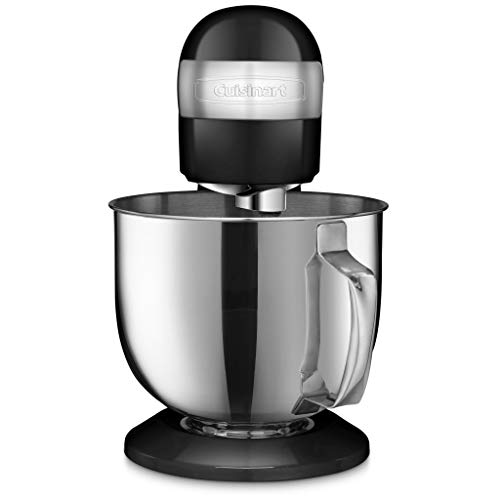
Cuisinart Precision Master 5.5-Quart Stand Mixer (SM-50, Onyx)
Badge: Best Stand Mixer in Black
Strengths
- A true stand mixer: 12 speeds and a 5.5-quart stainless bowl for hands-free mixing and real dough
- Full attachment trio included — chef’s whisk, mixing paddle, and dough hook — plus a splash guard with pour spout
- Planetary-style coverage and a tilt head make additions and bowl access easy
Trade-offs
- Takes permanent counter or cupboard space that hand mixers do not
- Heavier to move and clean around than any hand mixer here
- The four SM-50 colors in this guide are the same machine, so pick by finish, not by imagined performance gaps
| Speeds | 12 speeds |
|---|---|
| Bowl | 5.5-quart stainless steel bowl |
| Attachments | Chef’s whisk, mixing paddle, dough hook |
| Guard | Splash guard with pour spout |
| Color | Onyx |
The SM-50 in Onyx is the step up from hand mixing altogether. A stand mixer changes the work itself: the 5.5-quart stainless bowl sits locked on the base, the head drives the attachment in a wide orbit that sweeps the bowl, and your hands are free to add ingredients, scrape, or simply step back while dough kneads. Twelve speeds run from a gentle fold to a vigorous whip, and the included trio — chef’s whisk, flat mixing paddle, and dough hook — covers the full baking repertoire, with a splash guard and pour spout to keep flour and liquids where they belong.
This is the right tool for the jobs hand mixers should not attempt: bread and pizza doughs, double batches of cookies, big buttercream projects, and long whips that would tire an arm. The honest costs are space and weight. It wants a permanent home on the counter or a strong cupboard shelf, and it is overkill for a single small batter. The color is purely a kitchen-matching decision; every SM-50 in this guide mixes identically. If your baking has outgrown hand mixing, this is the natural landing spot — and if it has not, the hand mixers above remain the smarter spend.
Onyx is the finish for the black-appliance kitchen and for bakers who want the machine to recede rather than perform. It shows splashes honestly and flour dust less than the dark-glass look suggests, and it pairs with the widest range of modern hardware finishes.
Repeating the platform verdict is unnecessary — it is the same mixer as White Linen — but one ownership note belongs to Onyx specifically: dark finishes reward a quick wipe-down habit, because dried batter shows pale against black. Ten seconds with a damp cloth after baking keeps it looking like the premium object it is.
Best for: Modern black-and-steel kitchens / Not suited for: anyone expecting different performance from the white version
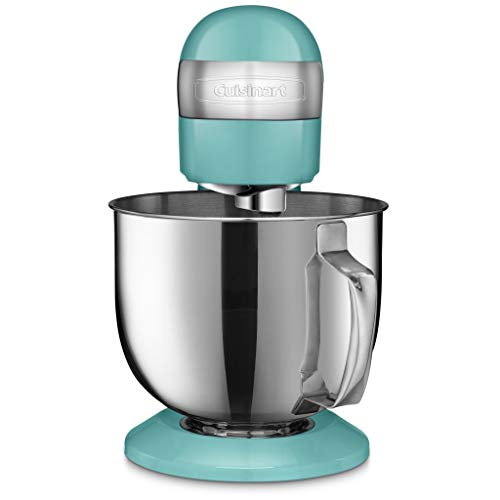
Cuisinart Precision Master 5.5-Quart Stand Mixer (SM-50, Periwinkle Blue)
Badge: Most Distinctive Finish
Strengths
- A true stand mixer: 12 speeds and a 5.5-quart stainless bowl for hands-free mixing and real dough
- Full attachment trio included — chef’s whisk, mixing paddle, and dough hook — plus a splash guard with pour spout
- Planetary-style coverage and a tilt head make additions and bowl access easy
Trade-offs
- Takes permanent counter or cupboard space that hand mixers do not
- Heavier to move and clean around than any hand mixer here
- The four SM-50 colors in this guide are the same machine, so pick by finish, not by imagined performance gaps
| Speeds | 12 speeds |
|---|---|
| Bowl | 5.5-quart stainless steel bowl |
| Attachments | Chef’s whisk, mixing paddle, dough hook |
| Guard | Splash guard with pour spout |
| Color | Periwinkle Blue |
Periwinkle Blue is the colorway for kitchens that treat appliances as part of the room’s personality rather than equipment to hide. The soft blue sits comfortably in coastal, cottage, and light modern kitchens, and it photographs beautifully — a real consideration for bakers who share their bakes. Under the color, everything is the familiar SM-50: 12 speeds, the 5.5-quart stainless bowl, whisk, paddle, dough hook, and the splash guard with its pour spout.
Because stand mixers live on counters for a decade, color is not a trivial decision, and Periwinkle makes a specific bet: that a gentle, distinctive color will keep pleasing you longer than a safe neutral you never notice. It is also the finish most likely to be chosen as a gift, precisely because it feels personal rather than default. If the platform is right for your baking — and the platform sections of this guide argue it is, for dough and batch bakers — then Periwinkle is the version for the cook who wants the machine to be seen.
A Periwinkle stand mixer is a decade-long decor commitment, so choose it the way you would choose a painted cabinet color: because you love it, not because it is safe. Bakers who light up at the color in the listing are exactly the buyers who report loving it years later.
If you are torn between Periwinkle and a neutral, consider where the mixer will live. On an open counter in a light kitchen, Periwinkle sings. In a dark, formal kitchen, it can look lost. The platform forgives any choice; the room should make it.
Best for: Light, personal, decor-forward kitchens / Not suited for: buyers who prefer appliances that disappear
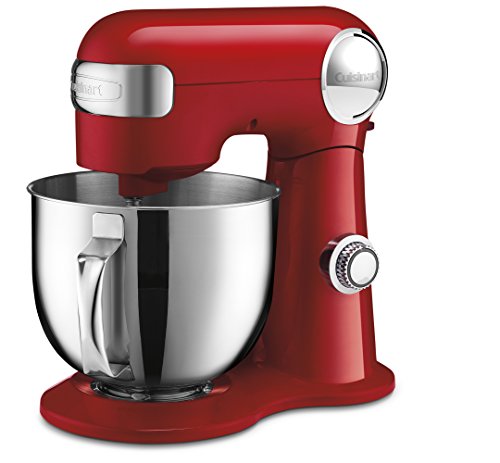
Cuisinart Precision Master 5.5-Quart Stand Mixer (SM-50, Ruby Red)
Badge: Best Statement Finish
Strengths
- A true stand mixer: 12 speeds and a 5.5-quart stainless bowl for hands-free mixing and real dough
- Full attachment trio included — chef’s whisk, mixing paddle, and dough hook — plus a splash guard with pour spout
- Planetary-style coverage and a tilt head make additions and bowl access easy
Trade-offs
- Takes permanent counter or cupboard space that hand mixers do not
- Heavier to move and clean around than any hand mixer here
- The four SM-50 colors in this guide are the same machine, so pick by finish, not by imagined performance gaps
| Speeds | 12 speeds |
|---|---|
| Bowl | 5.5-quart stainless steel bowl |
| Attachments | Chef’s whisk, mixing paddle, dough hook |
| Guard | Splash guard with pour spout |
| Color | Ruby Red |
Ruby Red is the boldest statement in the SM-50 family: a deep, warm red that anchors a counter the way the excluded brand’s famous red anchors its own. There is a gentle irony in choosing it — you leave the default brand behind and still get the classic red stand mixer presence, this time on a 12-speed platform with a 5.5-quart bowl, the full attachment trio, and a splash guard with pour spout.
Red finishes carry one practical note: they show flour dust cheerfully and hide very little, so Ruby owners wipe the machine down after baking days — a ten-second habit that keeps the color rich. In return, this is the colorway with the strongest gift and celebration energy, and the one most likely to become the kitchen’s visual center. The mixing, as with every SM-50 here, is identical: planetary-style coverage, a tilt head for easy access, and speeds from a fold to a whip. Choose Ruby for the room, keep it for the platform.
Ruby Red carries a wink for brand-excluders: the most famous mixer color in the world, on somebody else’s machine. Beyond the joke, red is the warmest, most celebratory finish here, and it suits traditional and retro kitchens the way Onyx suits modern ones.
It is also the strongest gift finish in the lineup — wedding-registry red, holiday red — with the same 12-speed substance underneath. If the recipient bakes seriously, the color delights and the platform delivers. Few purchases manage both.
Best for: Traditional kitchens and gift buyers / Not suited for: anyone who dislikes wiping flour dust off a dark-warm finish

Proctor Silex Easy Mix 5-Speed Hand Mixer (62511)
Badge: Best Budget Alternative
Strengths
- Compact and lightweight, so it is easy on the arm during longer whipping jobs
- Bowl rest feature keeps drips in the bowl instead of on the counter
- Simple five-speed control that anyone can use without a learning curve
Trade-offs
- 215 watts of peak power is the modest end of this group, so thick doughs are off the menu
- Basic beater set only, with no whisk or dough hooks in the box
- Black plastic design is purely functional
| Speeds | 5 speeds |
|---|---|
| Power | 215 watts peak power |
| Feature | Bowl rest |
| Color | Black |
The Proctor Silex Easy Mix is the minimalist entry in this guide: five speeds, a compact black body, 215 watts of peak power, and a bowl rest. It makes no attempt to be a status object, and that is its charm. It is light — genuinely light — which matters more than spec sheets admit when you are holding a mixer over a bowl of cream for several minutes, and its small footprint disappears into a drawer that the cased kits would dominate.
Within its lane it is a capable mixer: pancake and cake batters, boxed mixes, frostings, whipped cream, scrambled-egg prep, and mashed potatoes all come out fine. The lane has edges, though. Stiff cookie dough makes it work hard, and bread dough is simply not its job. The beater set is basic, with no whisk or hooks, so plan on it as a batter-and-cream tool. For small households, occasional bakers, RV and cabin kitchens, and anyone who values light and simple over powerful and featured, it is the honest, easy choice in this lineup.
Every exclusion guide needs its reality check, and the Proctor Silex is this one: if your actual mixing life is weekly batters and the occasional whip, the famous brand was never the point — a light, simple five-speed mixer was. This is the pick for the one-word searchers whose real query was “something good that is not that.”
Keep it in its lane — no stiff doughs, no marathon batches — and it will quietly out-serve machines three times its ambition in small kitchens, second homes, and dorm-adjacent setups.
Best for: Light daily mixing in small spaces / Not suited for: dough work and large batches
Comparison Table
| Pick | Badge | Standout trait | Watch out for | Check |
|---|---|---|---|---|
| Cuisinart 9-Speed Hand Mixer with Storage Case (HM-90BCS, Brushed Chrome) | Best Hand Mixer Alternative | 220 W motor with nine speeds and SmoothStart for controlled, splatter-free starts | Closely related to the HM-90S, so owners of that model gain little by switching | Check on Amazon |
| Cuisinart Precision Master 5.5-Quart Stand Mixer (SM-50, White Linen) | Best Stand Mixer Alternative | A true stand mixer: 12 speeds and a 5.5-quart stainless bowl for hands-free mixing and real dough | Takes permanent counter or cupboard space that hand mixers do not | Check on Amazon |
| Cuisinart Precision Master 5.5-Quart Stand Mixer (SM-50, Onyx) | Best Stand Mixer in Black | A true stand mixer: 12 speeds and a 5.5-quart stainless bowl for hands-free mixing and real dough | Takes permanent counter or cupboard space that hand mixers do not | Check on Amazon |
| Cuisinart Precision Master 5.5-Quart Stand Mixer (SM-50, Periwinkle Blue) | Most Distinctive Finish | A true stand mixer: 12 speeds and a 5.5-quart stainless bowl for hands-free mixing and real dough | Takes permanent counter or cupboard space that hand mixers do not | Check on Amazon |
| Cuisinart Precision Master 5.5-Quart Stand Mixer (SM-50, Ruby Red) | Best Statement Finish | A true stand mixer: 12 speeds and a 5.5-quart stainless bowl for hands-free mixing and real dough | Takes permanent counter or cupboard space that hand mixers do not | Check on Amazon |
| Proctor Silex Easy Mix 5-Speed Hand Mixer (62511) | Best Budget Alternative | Compact and lightweight, so it is easy on the arm during longer whipping jobs | 215 watts of peak power is the modest end of this group, so thick doughs are off the menu | Check on Amazon |
How to Choose When You Are Excluding Kitchenaid: Platform First, Finish Second
Decide the category with your recipe file, not your feelings about a logo. List the last ten things you mixed. If doughs, double batches, or long kneads appear, you are a stand-mixer buyer and the SM-50 section of this guide is your home. If the list is batters, frostings, whipped cream, and mashed work, a hand mixer covers you completely and the HM-90BCS is the strongest alternative here. If the list is short and light, the Proctor Silex is the honest answer and everything else is ambition.
For stand mixers, read the bowl before the motor. A 5.5-quart bowl is the sweet spot for home bakers: large enough for double batches and family doughs, small enough to whip a modest amount of cream without the whisk skating over it. Check the attachment trio — whisk, paddle, dough hook — and the splash guard, because flour-heavy starts without a guard redecorate kitchens. Twelve speeds sound like plenty because they are; what matters is that the lowest is a true gentle stir.
Then, and only then, choose the finish like you mean it. White Linen is the safe traveler, happy in any kitchen and kind at resale. Onyx suits black-and-steel modern rooms and hides its working life best with a wipe-down habit. Periwinkle Blue is the personal, decor-led choice for light kitchens. Ruby Red is the warm classic, giftable and bold. There is no wrong answer, only a mismatch between a color and the room it will live in for ten years — so choose for the room you have, not the one in a magazine.
For hand mixers, the switcher’s checklist is control and completeness: a soft start for flour, enough speeds to feel real steps between them, a whisk and hooks in the box, and a case that keeps the kit one object. The HM-90BCS checks every box, which is why it leads this guide’s hand-mixer side.
Finally, keep perspective on the exclusion itself. It is a starting filter, not a life sentence — the goal is a mixer matched to your baking, and the wider category context in Best Mixers Fees and Best Mixers Fir Run shows how many shapes that match can take. Buy the platform your recipes describe, in the finish your kitchen deserves.
How to Run a Stand Mixer Like You Mean It: Technique and Troubleshooting
Stand mixing rewards a calm first minute. Lock the bowl, lower the head until it seats, fit the splash guard for anything involving flour, and start at the lowest speed. Add dry ingredients in stages through the pour spout rather than dumping the full measure at once. The machine will gather the mixture into itself; your job is patience, then a single scrape-down once the mass has formed, because even planetary-style action leaves a thin layer at the bowl’s bottom curve.
For doughs, respect the gathering phase. Begin on the lowest speeds with the hook until the flour is incorporated and a shaggy mass forms, then step up one or two speeds for the knead itself. Watch the dough, not the clock: you are looking for a smooth, elastic ball that cleans the bowl sides. If the dough climbs the hook, stop, push it down, and restart — climbing is a signal, not a failure.
For whipping, the rules invert: cold bowl, cold cream, whisk fitted, and a confident climb to the higher speeds once the cream thickens past the splashy stage. Stand mixers whip hands-free, which tempts bakers to wander off — resist for the final minute, because the distance between soft peaks and over-whipped is short and the machine will not stop itself.
Hand-mixer technique, for the two hand picks here, mirrors the stand rules at smaller scale: gentle starts, speed staging, one scrape, stop at the visual cue. The HM-90BCS’s SmoothStart makes the first rule easy; the Proctor Silex asks you to supply the gentleness yourself with a hand stir before switching on.
One setup habit separates satisfied switchers from frustrated ones: run the new machine empty for a few seconds at each speed before its first recipe. You will learn its sound, feel how the steps are spaced, and notice anything that rattles while the stakes are zero. Every platform has its own acoustic signature, and knowing your machine’s normal is what lets you spot the abnormal early, while a return or a warranty conversation is still easy. Store the machine with its attachments together and its manual nearby, and the platform will feel like yours within a week.
Troubleshooting. Problem: flour puffs out despite the guard → too much dry ingredient added at once, or the speed started too high; add in stages at the lowest setting. Problem: the whisk barely touches a small amount of cream in the big bowl → the batch is below the bowl’s comfortable minimum; whip small amounts with a hand mixer instead, or double the batch and freeze the extra. Problem: dough strains and the head rocks → the batch is too large or too stiff for one load; split it and knead in two rounds.
Four Colors, One Machine: An Honest Word About Colorway Listings
Shoppers deserve to know how the mixer market actually works: established platforms are sold in multiple finishes, each with its own listing, its own availability swings, and its own following. Guides that review each color as a different machine are manufacturing content. Guides that ignore the colorways entirely are ignoring the actual decision in front of the buyer, who must, in fact, pick one.
This guide’s position is the honest middle: the platform gets one rigorous assessment, and each finish gets a truthful account of what living with that color is like — the kitchens it suits, the upkeep it asks, the gifts it flatters. If that approach leaves you better able to choose, it has done more for you than a dozen invented performance claims ever could.
The Decade Test: Choosing a Mixer You Will Still Like in Ten Years
Stand mixers are among the longest-lived appliances in a kitchen, which changes how you should buy one. Features you will use weekly — the guard, the bowl size, the low-speed gentleness — compound over a decade. Finishes compound too: a color that delights you becomes part of the kitchen’s identity, while a color chosen carelessly becomes background irritation you stop seeing but never chose.
Apply the decade test to every pick here. The HM-90BCS passes it on completeness — nothing to outgrow. The SM-50 passes it on capacity — few home bakers outgrow 5.5 quarts and 12 speeds. The Proctor Silex passes a different decade test: it is so light and simple that it remains useful as a second mixer forever. Even the party-drink corner of the category, covered in Best Mixers For A Marg Machine, obeys the same rule — buy for the life you will actually live with the thing.
What Switchers Most Often Get Wrong in the First Month
The pattern is consistent: new owners of an alternative platform judge it by the old brand’s speed numbers, find the steps in different places, and conclude the machine is wrong — when in fact the translation is behavioral. Low is low, whip is whip, whatever the dial says. Give any new mixer three real recipes before judging it, and judge by the bowl’s results, not the dial’s numerals.
The second mistake is neglecting the scrape. Alternative platforms shape their bowls and beaters slightly differently, and the first bakes reveal where your new machine leaves its thin unmixed layer. Learn that spot once — usually the bottom curve — build the scrape into your routine, and the platform will reward you with the even mixing you bought it for.
Attachments and Spares on an Alternative Platform: What to Check Before You Buy
The one area where the excluded brand genuinely outmuscles every rival is the sheer breadth of its attachment catalog, accumulated over decades. Switching platforms means doing a five-minute audit before purchase, not after: confirm the core trio you will use weekly is in the box — for the SM-50 that is the whisk, paddle, and dough hook, and for the HM-90BCS the beaters, whisk, and hooks — and then check that any specialty item you already rely on, such as a second bowl or a specific beater style, exists for your new platform.
For the overwhelming majority of home bakers, that audit ends the concern: the core attachments cover cakes, cookies, doughs, creams, and frostings completely, and spares for established alternative brands are normal retail items rather than treasure hunts. The bakers who should pause are the ones deeply invested in a previous ecosystem — a drawer of brand-specific attachments is a real switching cost, and honesty about it beats discovering it mid-recipe. Everyone else can switch freely, and this guide’s picks were chosen to make the landing soft: complete boxes, standard attachments, nothing exotic required.
Common Buying Mistakes
Mistake one: treating the four SM-50 finishes as four different mixers and comparison-shopping them against each other for weeks. They are one machine. Decide the platform in an afternoon, then pick the color in a minute, and go bake.
Mistake two: buying a stand mixer for hand-mixer work. If your real life is small batters and whipped cream, a 5.5-quart stand mixer is a beautiful burden. The category decision matters more than the brand decision you started with.
Mistake three: choosing a bold finish for a kitchen you are about to sell or a rental you will leave. White Linen exists for a reason. Bold colors are for kitchens you plan to keep — and for gifts, where the boldness is the point.
Mistake four: assuming exclusion means starting over completely. Your bowls, your recipes, your techniques, and most of your habits transfer intact. Only the logo changes — and, if you choose from this guide, the speed range improves. Readers who enjoy this kind of clear-eyed comparison will find the same spirit in Best Mixers For 151 for the drinks cabinet.
Final Recommendation
The final recommendation splits honestly by category, because this guide contains two. For hand-mixer switchers, buy the Cuisinart HM-90BCS: nine speeds, SmoothStart, the complete cased kit — the most capable non-default hand mixer here. For stand-mixer switchers, buy the SM-50 platform and let the room decide the finish: White Linen for safety, Onyx for modern kitchens, Periwinkle for personality, Ruby Red for warmth.
And if your baking life is genuinely light, let the Proctor Silex be the recommendation instead, without a shred of embarrassment. The best mixer excluding the famous brand is not a single product — it is the moment your choice stops being about the brand at all, and starts being about your recipes, your batches, and your kitchen. This guide’s six picks are the shortest honest path to that moment.
Start with the Cuisinart 9-Speed Hand Mixer with Storage Case (HM-90BCS, Brushed Chrome) if you want the safest all-round choice, or the Cuisinart Precision Master 5.5-Quart Stand Mixer (SM-50, White Linen) if its badge matches your kitchen better.
Related guides
Frequently Asked Questions
Is excluding kitchenaid spelled with one word or two a different search?
It is the same intent — shoppers ruling out the KitchenAid brand — typed the way the brand often appears in casual writing. This guide treats it identically to the two-word version and answers it with the strongest alternative platforms, led by Cuisinart.
Are the four Cuisinart stand mixers in this guide really the same machine?
Yes. White Linen, Onyx, Periwinkle Blue, and Ruby Red are finishes of the same SM-50 platform: 12 speeds, 5.5-quart stainless bowl, whisk, paddle, dough hook, and splash guard with pour spout. We list them separately because they are sold as separate listings and the color decision is real — but the mixing performance is identical.
What size stand mixer bowl do most home bakers need?
A 5.5-quart bowl, like the SM-50’s, is the versatile middle: it handles double batches and family-size doughs while still whipping reasonable amounts of cream. Much larger bowls struggle with small quantities; much smaller ones cap your batch ambitions.
Does Cuisinart make a good alternative to the default stand mixer brand?
On specifications and ownership patterns, yes — the SM-50 offers a wide 12-speed range, a generous bowl, the full attachment trio, and a splash guard with a pour spout. It is the stand alternative this guide recommends, in whichever finish suits your kitchen.
Should I buy a hand mixer or a stand mixer if I bake twice a month?
Twice-a-month baking that is mostly cakes, cookies, and frostings points to a complete hand mixer like the HM-90BCS — easier storage, faster cleanup, full capability for that repertoire. Add bread or pizza dough to that routine and the stand mixer earns its counter space.
How do I care for a colored stand mixer finish?
Wipe it down after flour-heavy or splashy sessions with a damp cloth, dry it to prevent water spots on darker finishes, and avoid abrasive pads that can dull any finish over time. The stainless bowl and attachments handle normal washing; the colored body just wants gentleness.
Is it worth switching brands if my current mixer still works?
Only if it frustrates you in ways this guide names — too few speeds, missing attachments, no storage, or a category mismatch like kneading dough with a hand mixer. A working mixer that suits your baking is not made obsolete by a logo debate. Switch when the machine, not the marketing, gives you a reason.


