Disclosure: topratedkitchenware.com is reader-supported. When you buy through links on our site, we may earn an affiliate commission from Amazon and other retailers, at no extra cost to you.
Where to buy
If you are shopping for the best mixers for bread douhg — yes, that spelling turns up in search boxes constantly, and it means exactly what you think: bread dough — the six hand mixers below are the shortlist this guide is built around. Every one of them is a handheld electric mixer rather than a stand mixer, and this guide is honest about what that means for dough from the first page to the last. Prices and availability change often on Amazon, so use the links to check the current listing before you buy.
- Best Overall: LILPARTNER Hand Mixer Electric, 7-Speed, Light Pink — Check on Amazon
- Best for Soft and Enriched Doughs: Hamilton Beach 6-Speed Electric Hand Mixer, White (62682G) — Check on Amazon
- Best Compact Pick: KitchenAid 5 Ultra Power Speed Hand Mixer, Empire Red (KHM512) — Check on Amazon
- Best for Small Kitchens: KitchenAid 5 Ultra Power Speed Hand Mixer, Contour Silver (KHM512) — Check on Amazon
- Best Speed Control: Cuisinart Power Advantage Plus 9-Speed Hand Mixer, White (HM-90S) — Check on Amazon
- Best Value Set: WEPSEN 5-Speed Electric Hand Mixer with Mixing Bowls Set — Check on Amazon
Read the full guide below ↓
Searching for the best mixers for bread douhg usually means one of two things. Either you bake small, soft loaves — brioche, dinner rolls, milk bread, a single batch of cinnamon-roll dough — and you want a machine to take over the sticky first minutes of mixing, or you have seen hand mixers described as dough-capable and you want to know whether that claim survives contact with a real bread recipe. This guide answers both versions of the question honestly. Hand mixers do not knead the way a stand mixer with a dough hook kneads. What the better ones can do, used with the rest-and-fold method described later in this guide, is bring a small, relatively soft dough together, develop it part of the way, and save your arms the worst of the work — provided you respect the batch ceiling and let time and folds do the rest.
That honesty shapes the whole shortlist. The headline pick is the one model in this group whose verified listing explicitly names dough among its jobs and backs it with a five-piece stainless accessory set. Around it sit five well-known hand mixers from Hamilton Beach, KitchenAid, Cuisinart and WEPSEN that handle the early, wet stages of dough work well and then hand over to folds and rests. We will tell you plainly, in every single review, where each machine’s dough ability ends. If your baking life is large, stiff, lean loaves — baguettes, big sourdough boules, double batches — skip to the buying guide, because the correct answer for you is a different class of machine, and this guide explains how to recognise that before you spend anything. Readers comparing approaches may also want our guide to the Best Mixers For Bread Making, which covers the same question from the stand-mixer side.
Key Takeaways
- All six picks are hand mixers. They suit small, soft, enriched doughs — not large or stiff lean doughs.
- The LILPARTNER 7-speed is the only pick whose verified listing explicitly names dough work and includes five stainless steel accessories.
- The method matters more than the motor: mix to a shaggy mass, rest, then fold. The mixer replaces the messy first stage, not the whole knead.
- Keep hand-mixer dough batches small — one modest loaf at a time — and stop if the motor labours or the body grows hot.
- Nine speeds (Cuisinart) and a burst button (Hamilton Beach) are control features; for dough, the lowest speeds do nearly all the work.
- If you regularly bake stiff doughs or double batches, a stand mixer with a dough hook is the right tool; this guide’s buying section explains the dividing line in full, with the hydration numbers that predict which side of it any given recipe falls on.
In this guide
Quick Picks
| Pick | Badge | Format | Speeds | Why it is here |
|---|---|---|---|---|
| LILPARTNER Hand Mixer Electric, Light Pink | Best Overall | Hand mixer | 7 | Listing explicitly covers whipping dough, cream and cake; five stainless accessories |
| Hamilton Beach 6-Speed Hand Mixer (62682G) | Best for Soft and Enriched Doughs | Hand mixer | 6 | 250 watt motor, QuickBurst button and a bowl-rest feature for pausing mid-batch |
| KitchenAid 5 Ultra Power Speed Hand Mixer, Empire Red | Best Compact Pick | Hand mixer | 5 | Turbo Beaters, lockable swivel cord and dishwasher-safe beaters in a small footprint |
| KitchenAid 5 Ultra Power Speed Hand Mixer, Contour Silver | Best for Small Kitchens | Hand mixer | 5 | The same KHM512 platform in a neutral finish that disappears into a drawer |
| Cuisinart Power Advantage Plus 9-Speed Hand Mixer (HM-90S) | Best Speed Control | Hand mixer | 9 | Nine speeds with SmoothStart anti-splatter and a snap-on storage case |
| WEPSEN 5-Speed Hand Mixer with Bowls Set | Best Value Set | Hand mixer + bowls | 5 | Bundled stainless nesting bowls, measuring cups and spoons for a starter kitchen |
How These Picks Were Chosen
This is a research-led guide. We compared verified listings for hand mixers whose attachments, speed ranges and motor descriptions could plausibly serve small-batch bread dough work, and we read each listing for what it actually confirms rather than what its marketing implies. Only specifications stated in the verified listing — speeds, wattage where given, named attachments, storage and cord features — are used anywhere in this article. Where a listing does not confirm a dough-specific attachment, we say so in the review instead of assuming one exists.
We also weighted the things that decide whether hand-mixer dough work succeeds in a real kitchen: a genuinely slow first speed so flour stays in the bowl, enough speeds to creep up as the dough tightens, a body shape you can hold against resistance for several minutes, and attachments that rinse or go in the dishwasher, because dough residue hardens like cement. Colour variants of the same platform are treated as what they are — the same machine in a different finish — and the reviews say so openly. We did not bake with these machines for this guide, and nothing below pretends otherwise; the judgements are based on verified specifications, the known physics of dough, and the long public record of how each of these models is used.
The 6 Best Mixers for Bread Douhg, Reviewed

LILPARTNER Hand Mixer Electric, 7-Speed, Light Pink
Badge: Best Overall
Strengths
- Its verified listing explicitly names whipping dough alongside cream and cake — the only pick here that claims dough as a job.
- Five stainless steel accessories give you more than a single pair of beaters to work with across dough stages.
- Seven speeds provide a genuinely low starting gear for bringing flour and liquid together without a flour cloud.
Trade-offs
- It is still a hand mixer: stiff, lean dough in any quantity will strain it, and batch size stays small.
- The light pink finish will not suit every kitchen, and there is no alternative colour in this listing.
- Accessories are dishwasher safe per the listing, but dough dries hard — rinse promptly anyway.
Mini spec box
- Format: electric hand mixer
- Speeds: 7
- Accessories: 5 stainless steel accessories
- Listing-named jobs: whipping dough, cream, cake
- Attachments: dishwasher safe
- Colour: Light Pink
If one machine in this group earns the headline for bread dough, it is this one, for a simple reason: its listing says the word dough. The five-piece stainless accessory set is built around the jobs the listing names — dough, cream and cake — which makes it the most honestly matched pick for a reader whose mixing life is small loaves, enriched doughs and the occasional cake. In practice you would use it the way this guide recommends for every hand mixer: start on the lowest speed with the bowl tilted slightly, pull the flour in from the edges, and stop the moment the dough forms a single shaggy mass. From there, rests and folds finish what the motor started, and the dough comes out smooth without the motor ever fighting a fully tightened ball of gluten.
The honest limitation is the same one that applies to the whole category, only slightly softened: this is a small-batch tool. A single loaf of milk bread, a pan of dinner rolls, a batch of brioche buns — those are its home territory. A big, lean, low-hydration dough will make it labour, and pushing through that sound is how small motors die. Treat the seven speeds as finesse rather than force, keep batches modest, and this is the most dough-forward hand mixer in the guide.
Best for: bakers of small, soft and enriched doughs who want the one hand mixer here that names dough in its listing / Not suited for: large or stiff lean loaves, or double batches of anything

Hamilton Beach 6-Speed Electric Hand Mixer, White (62682G)
Badge: Best for Soft and Enriched Doughs
Strengths
- A 250 watt motor is a real, stated figure — many hand mixers in this class hide behind peak-power language.
- The QuickBurst button gives a short extra push for pulling the last dry flour into a wet dough.
- The bowl-rest feature lets you park the mixer on the bowl rim during rests instead of laying it on the counter.
Trade-offs
- The listing names traditional beaters; it does not confirm dough hooks, so stiff dough work is out of scope.
- Six speeds is plenty, but the jump between low gears matters for dough and is less fine than the Cuisinart’s nine.
- The snap-on case stores the beaters, yet the mixer itself still needs drawer or cupboard room.
Mini spec box
- Format: electric hand mixer
- Speeds: 6, plus QuickBurst
- Motor: 250 watts
- Attachments named in listing: traditional beaters
- Features: bowl rest, snap-on storage case
- Colour: White
Hamilton Beach’s 62682G is the workhorse temperament in this group: a stated 250 watt motor, a burst button for stubborn pockets of flour, and a bowl rest that turns out to matter more for dough than for anything else. Dough work with a hand mixer is a rhythm of mix, rest, fold, rest — and during every rest, this mixer sits hooked over the bowl rim, dripping into the bowl instead of across your counter. That small design decision makes the whole method tidier, and tidiness is half the battle with sticky doughs.
Use it for the wet stages: combining, bringing together, and the first minute or two of development on soft doughs like focaccia batter-dough, pizza dough for one or two bases at high hydration, and enriched doughs where butter keeps everything supple. Its honest limitation is attachment-based — the listing confirms traditional beaters only — so the moment a dough becomes stiff enough to climb the beaters and fight back, your job is to stop, cover the bowl, and let folds take over. Bakers who also make celebration bakes will find the same machine covered from a different angle in our Best Mixers For Cake guide.
Best for: soft, wet and enriched doughs in single batches, and bakers who like the mix-rest-fold rhythm / Not suited for: stiff lean doughs or anyone expecting confirmed dough hooks in the box
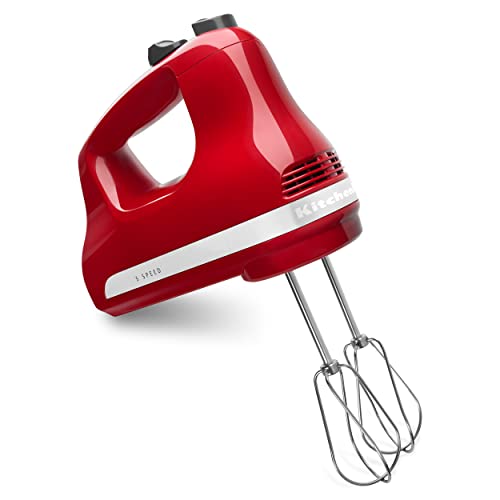
KitchenAid 5 Ultra Power Speed Hand Mixer, Empire Red (KHM512)
Badge: Best Compact Pick
Strengths
- Turbo Beaters are designed to push through mixtures without the clogging that stalls plain beaters in thick batters.
- The lockable swivel cord moves the cable out of the bowl and locks to the side you prefer.
- Beaters release with a single button and go in the dishwasher — vital when the mixture is dough.
Trade-offs
- Five speeds is the narrowest range here alongside the WEPSEN, and the lowest gear is the one that matters most.
- No dough hooks are named in the listing; dough work is limited to soft, small, early-stage mixing.
- Empire Red is a statement colour — wonderful or wrong depending on your kitchen.
Mini spec box
- Format: electric hand mixer
- Speeds: 5
- Attachments named in listing: Turbo Beaters
- Features: lockable swivel cord, easy-release button, dishwasher-safe beaters
- Colour: Empire Red
The KHM512 is the mixer for the baker whose dough life is occasional and whose kitchen storage is tight. It lives in a drawer, comes out for a single batch of rolls or a small enriched loaf, and earns its place through control rather than power: the swivel cord genuinely helps when you are circling a bowl of sticky dough, because the cable stops dragging through the mixture, and the one-button beater release means you are never prising dough-caked beaters out with your fingers.
Be honest with it and it will serve you well. Turbo Beaters handle the combining stage of soft doughs cleanly, and their open design sheds dough better than traditional beaters when you lift them out. But there are no dough hooks in this listing, and five speeds on a compact motor define a clear ceiling: small batches, soft doughs, early stages only. Within that ceiling it is a pleasure; beyond it, you are asking a compact tool to do a stand mixer’s job.
Best for: occasional bakers with small kitchens making small, soft batches / Not suited for: frequent bread baking, stiff doughs, or batches beyond a single small loaf

KitchenAid 5 Ultra Power Speed Hand Mixer, Contour Silver (KHM512)
Badge: Best for Small Kitchens
Strengths
- The same proven KHM512 platform as the red model — Turbo Beaters, swivel cord, one-button release.
- Contour Silver is the finish that vanishes into modern kitchens and rental flats alike.
- Dishwasher-safe beaters keep dough-day cleanup to a rinse and a rack.
Trade-offs
- Identical dough ceiling to its red sibling: no dough hooks named, small soft batches only.
- Buying this and the red one would be buying the same machine twice — pick a colour, not both.
- Five speeds give less low-end finesse than the nine-speed Cuisinart for flour incorporation.
Mini spec box
- Format: electric hand mixer
- Speeds: 5
- Attachments named in listing: Turbo Beaters
- Features: lockable swivel cord, easy-release button, dishwasher-safe beaters
- Colour: Contour Silver
We list this separately because the assignment pool does, and because colour is a legitimate reason to choose between otherwise identical machines — but we will not pretend it is a different mixer. Everything said about the Empire Red KHM512 applies here word for word: a compact, tidy, drawer-friendly hand mixer whose Turbo Beaters cope gracefully with the wet stages of small dough batches and whose dough ceiling is set by the absence of hooks and the modesty of a five-speed compact motor.
Where the silver finish earns its own paragraph is in shared and small kitchens. It reads as a neutral appliance rather than a statement, it shows flour dust less theatrically than a dark colour and less starkly than pure white, and it is the version most likely to be left out on a counter without visually arguing with everything around it. If your dough baking is a weekend habit rather than a daily practice, and your storage is one crowded drawer, this is the version of the platform we would put in it.
Best for: small and shared kitchens wanting the KHM512 platform in a neutral finish / Not suited for: anyone who already owns the red KHM512, or bakers needing dough hooks

Cuisinart Power Advantage Plus 9-Speed Hand Mixer, White (HM-90S)
Badge: Best Speed Control
Strengths
- Nine speeds — the widest range here — means a truly gentle first gear for flour and fine steps as dough tightens.
- SmoothStart anti-splatter technology ramps the motor up slowly, which is exactly what a bowl of flour and water needs.
- The snap-on storage case keeps the mixer and its attachments together, dough-day parts included.
Trade-offs
- The listing describes it as a cake mixer and names a beater; it does not confirm dough hooks.
- Nine speeds is control, not torque — the dough ceiling of the category still applies in full.
- White shows every splash of a cocoa or turmeric dough until you wipe it down.
Mini spec box
- Format: electric hand mixer
- Speeds: 9
- Features: SmoothStart anti-splatter, snap-on storage case
- Listing positioning: cake mixer, hand held mixer
- Colour: White
If the LILPARTNER wins this guide on dough intent, the Cuisinart wins it on dough technique. Bread dough with a hand mixer fails in the first ten seconds more often than anywhere else: you switch on, the beaters bite dry flour, and half of it leaves the bowl. SmoothStart exists for precisely that moment — the motor eases in instead of lunging — and with nine speeds you can stay in the gentle gears for the whole combining stage, stepping up one click at a time as the mass comes together. For wet, slack doughs and batters on the bread spectrum, like focaccia and batter breads, that control is worth more than raw wattage.
The limitation to respect is that control is not the same as kneading power. The listing positions this as a cake mixer with a beater, and no dough hook is confirmed, so treat it as the finest early-stage dough tool in the group rather than a kneading machine. Pair it with the rest-and-fold method and small batches, and its nine speeds make the whole process calmer than any other pick here manages.
Best for: bakers of wet doughs and batter breads who value a gentle, splash-free start / Not suited for: stiff doughs, or buyers who need a confirmed dough hook in the box

WEPSEN 5-Speed Electric Hand Mixer with Mixing Bowls Set
Badge: Best Value Set
Strengths
- The bundle includes four large stainless steel nesting bowls — and dough work genuinely needs more than one bowl.
- Measuring cups and spoons are included, which matters for bread, where ratios decide everything.
- Whisks and a beater cover the wet stages of dough plus the rest of a baking day.
Trade-offs
- Five speeds and a bundle-first design make it the lightest-duty dough tool in this guide.
- No dough-specific attachment is named in the listing; dough work is combining-stage only.
- Bundle value depends on needing the bowls — if your kitchen is already equipped, you are paying for duplicates.
Mini spec box
- Format: electric hand mixer with bowl set
- Speeds: 5
- Included: 4 large stainless steel nesting bowls, measuring cups and spoons
- Attachments named in listing: whisks, beater
The WEPSEN set makes its case on the equipment around the mixer rather than the mixer itself — and for bread, that case is stronger than it first looks. The rest-and-fold method needs a bowl for mixing, a bowl for resting, and ideally a third for the preferment or the flour you weighed out early. Four large stainless nesting bowls cover all of that, they are light enough to handle with floury hands, and stainless does not hold the smell of last week’s garlic dough. Add measuring cups and spoons for the baker who does not yet own a scale routine, and the set equips a beginner’s whole dough workflow in one box.
Keep expectations for the mixer itself modest. Five speeds, whisks and a beater, and no dough attachment named in the listing place it firmly at the combining end of dough work — which, to be fair, is where this entire guide says hand mixers belong. As a starter kit for someone setting up a first baking kitchen, it is the most complete purchase here; as a dough machine for an equipped baker, it is the first one to outgrow.
Best for: new bakers equipping a first kitchen who want bowls and measures in the same box / Not suited for: equipped bakers, or any dough stiffer than a soft enriched batch
Comparison Table
| Pick | Speeds | Motor (as listed) | Attachments named in listing | Dough role | Link |
|---|---|---|---|---|---|
| LILPARTNER 7-Speed | 7 | Not stated | 5 stainless accessories | Dough named in listing; small batches | Check on Amazon |
| Hamilton Beach 62682G | 6 + QuickBurst | 250 watts | Traditional beaters | Soft dough combining; bowl rest for rests | Check on Amazon |
| KitchenAid KHM512, Empire Red | 5 | Not stated | Turbo Beaters | Small soft batches, early stages | Check on Amazon |
| KitchenAid KHM512, Contour Silver | 5 | Not stated | Turbo Beaters | Small soft batches, early stages | Check on Amazon |
| Cuisinart HM-90S | 9 | Not stated | Beater (as listed) | Wet doughs; gentlest flour incorporation | Check on Amazon |
| WEPSEN 5-Speed Set | 5 | Not stated | Whisks, beater | Combining stage; bowls support the method | Check on Amazon |
How to Choose the Best Mixers for Bread Douhg Work in a Real Kitchen
Start with the dividing line, because it decides whether this entire category is right for you. Dough divides into two families. Soft, wet and enriched doughs — focaccia, milk bread, brioche, dinner rolls, cinnamon rolls, high-hydration pizza dough — spend their early life as sticky masses that need combining more than kneading. Stiff, lean doughs — baguette, bagel, low-hydration sandwich loaves, big sourdough batches — become elastic resistance almost immediately and need a hook, a bowl that stays put, and a motor mounted in a frame. Hand mixers serve the first family, in small batches, at the combining stage. They do not serve the second family, and no speed count or wattage figure on a hand mixer changes that.
Within the category, judge four things. First, the lowest speed: dough work begins in flour, and a first gear that is truly slow — helped by a soft-start feature like the Cuisinart’s SmoothStart — keeps the flour in the bowl and the dough workable. Second, attachments as actually listed: a listing that names dough, like the LILPARTNER’s, is making a claim the others are not; beaters-only listings should be read as combining tools. Third, motor honesty: a stated wattage, like the Hamilton Beach’s 250 watts, tells you more than silence, and any figure should be read as a ceiling for small batches, not an invitation to double them. Fourth, the pause features — a bowl rest, a storage case, dishwasher-safe beaters — because dough work is stop-start by nature, and the machine that parks neatly and cleans easily is the one you will keep using.
Weight and grip deserve a sentence of their own, because dough work is the one mixing job where you hold the machine against resistance for minutes at a time. A mixer that feels light during a thirty-second whipped-cream test can feel very different at minute three of a dough that is pulling back. Compact models like the KitchenAid pair suit smaller hands and shorter sessions; the trade-off for that lightness is the smaller motor that defines their batch ceiling. If your hands tire easily, plan shorter mixing bursts with more rests — the rest-and-fold method already builds those rests in, which is one more reason it pairs so well with this entire category of machine.
Finally, size the batch before you size the mixer. One small loaf, one pan of rolls, one pizza base or two: that is the hand-mixer envelope. If your standard bake is two loaves, or your household eats bagels weekly, the honest purchase is a stand mixer with a dough hook, and the money for a hand mixer is better saved toward it. Many bakers own both — the stand mixer for dough days, the hand mixer for everything else — which is why the hand mixers here are also judged as general baking tools throughout this guide.
How to Mix Bread Dough with a Hand Mixer: The Rest-and-Fold Method
The method below is how every pick in this guide should be used for dough. It replaces continuous kneading with short mixing bursts and timed rests, letting hydration and gluten development do the heavy lifting.
- Combine dry ingredients in a large, deep bowl — depth matters, because beaters throw mixture upward.
- Add the liquid, and mix on the lowest speed for one to two minutes, moving the mixer slowly around the bowl until no dry flour remains.
- Stop. Cover the bowl and rest the dough for twenty to thirty minutes. This rest — the autolyse — hydrates the flour and starts gluten development with no effort from the motor.
- Mix again on a low speed for one minute. The dough will already feel smoother and more elastic.
- Turn the dough onto a lightly floured surface, or work in the bowl with wet hands: stretch one side up and fold it over. Rotate and repeat eight to ten times.
- Rest again, covered, for twenty to thirty minutes, then repeat the folds. Two or three fold rounds across the rise replace a full knead for most soft doughs.
- Shape, proof and bake as your recipe directs. Clean the beaters immediately — dried dough is dramatically harder to remove than fresh dough.
Troubleshooting. Problem: the dough climbs the beaters and wraps around them → the dough is getting too stiff for beaters; stop, rest it, and switch to folds by hand. Problem: the motor smells hot or the body is warm → the batch is too big or too stiff; split the batch, add rests, and never push through a straining sound. Problem: flour erupts out of the bowl at switch-on → start slower, tilt the bowl, add liquid in two pours, and choose a deeper bowl next time.
Soft Doughs a Hand Mixer Handles Well — and Stiff Doughs It Does Not
It helps to name names. In the hand-mixer-friendly camp: focaccia and other high-hydration flatbreads, where the dough is closer to a thick batter; Japanese-style milk bread and soft sandwich doughs at moderate batch sizes; brioche and enriched roll doughs, where butter and eggs keep the mass supple (add the butter gradually, in pieces, once the dough has come together); and sweet doughs for cinnamon rolls and sticky buns. In the leave-it-to-a-stand-mixer camp: bagel dough, which is famously stiff; pretzel dough; low-hydration lean loaves; and any recipe you routinely double. Knowing which camp your favourite recipe lives in is the single most useful piece of self-knowledge in this purchase — more useful than any specification in this guide.
A Note on the Word “Mixer”
One clarification, because search results blur it constantly: the word mixer also belongs to drinks. Readers who landed here while planning a bar shelf may be looking for the Best Mixers For Brown Rum or the Best Mixers For Butterscotch Schnapps — sodas, juices and syrups that pair with spirits — or even the Best Mixers For Bushmills and the Best Mixers For Burnetts. Those are beverage guides about what goes in the glass at the bar. Everything in this article is about the electric machine that goes in the bowl, and the two meanings never meet except in a search box.
Hydration, Flour and Batch Size: The Dough Math That Decides Success
Bakers talk about hydration — the weight of water relative to the weight of flour, expressed as a percentage — and it is the single number that predicts whether a hand mixer will cope. A dough at seventy percent hydration or above is slack and sticky; it clings, stretches and combines willingly, and a hand mixer’s beaters can move through it. A dough down near fifty-five percent, like bagel or pretzel dough, is a firm mass that pushes back against everything, and beaters simply ride over it or strain against it. When you read a recipe, do this tiny calculation before you reach for the mixer: if the water weighs roughly two-thirds or more of the flour weight, the dough is in hand-mixer territory at the combining stage; below that, plan on hand work or a stand mixer from the start.
Flour choice moves the line too. Strong bread flour absorbs more water and develops a tougher gluten network earlier, which means the dough tightens sooner and the mixer’s easy window closes faster. Soft all-purpose flour stays forgiving for longer. Wholemeal flour sits in between for absorption but its bran cuts gluten strands, so wholemeal doughs often feel slack while developing less strength — folds matter more and mixer time matters less. Enrichments shift things again: eggs add liquid and tenderness, sugar softens, and butter, added gradually after the dough has come together, keeps an enriched dough supple enough for a hand mixer to stay useful well into the mixing stage. This is why brioche, which sounds advanced, is often kinder to a hand mixer than a plain lean loaf that sounds simple.
Batch size is the third variable, and it multiplies the other two. The same recipe that behaves beautifully at a single-loaf scale becomes a fight when doubled, because the beaters must move twice the mass through the same small arc while the dough’s resistance climbs as it develops. A practical rule for every pick in this guide: if the recipe’s flour fits the one-small-loaf pattern you already bake, proceed; if you have scaled it up for guests, split it into two combining rounds and unite the dough for the folds, or move the whole bake to a stand mixer. Splitting sounds like a chore and is actually faster than nursing an overloaded motor through a batch it is resenting.
What a Hand Mixer Does to Your Baking Beyond Dough
Almost nobody buys a hand mixer for dough alone, and the picks here earn their drawer space across the rest of a baking week. The same machines that combine a focaccia dough on Saturday cream butter and sugar for cookies on Sunday, whip cream for a pavilion of desserts, beat eggs for sponge cakes, and mash soft ingredients for dips and fillings. The Cuisinart’s nine speeds and SmoothStart make it the natural cake-day pick — which is why it anchors our Best Mixers For Cake coverage as well — while the KitchenAid pair’s dishwasher-safe Turbo Beaters make them the lowest-effort everyday tools in the group. Judged purely as dough machines, every pick here carries an asterisk; judged as the one mixer a small kitchen actually owns, the asterisk shrinks, because dough is one job among many and the combining stage is the part of that job most worth mechanising.
That dual role should shape which pick you choose. If dough is a weekly ritual and cakes are rare, weight the LILPARTNER’s dough-named listing and accessory set most heavily. If dough is the occasional adventure inside a general baking life, weight speed control, cleanup and storage — the Cuisinart’s case, the KitchenAid’s swivel cord, the Hamilton Beach’s bowl rest — because those are the features you will touch every single week. Either way, you are buying a generalist that moonlights in dough, and this guide’s scores make sense only when read that way.
Common Buying Mistakes
The first mistake is buying a hand mixer to knead stiff dough and discovering the ceiling on the first bagel day — read the dividing line in the buying guide and place your recipes honestly. The second is reading a speed count as power: nine speeds is control, five speeds is not weakness, and neither figure tells you the motor will knead. The third is assuming attachments that the listing does not name; if dough hooks matter to you, buy a listing that confirms them. The fourth is doubling a dough recipe in a hand mixer because it worked once at single size — dough resistance does not scale politely, and motors fail on the ambitious batch, not the modest one. The fifth is neglecting cleanup: beaters left to dry with dough on them become a soaking project, while a thirty-second rinse at the sink keeps them effortless. The sixth is buying two colour variants of the same platform, as this very pool tempts you to do with the KHM512 — choose the finish you like and spend the difference on flour.
Final Recommendation
For most readers who typed some version of best mixers for bread douhg into a search box, the LILPARTNER 7-Speed Hand Mixer is the first choice: it is the pick whose listing names dough, its accessory set is the broadest here, and its seven speeds cover the gentle gears dough work lives in. If your doughs are wet and splash-prone and you value a calm start over everything, choose the Cuisinart HM-90S instead and let SmoothStart earn its keep. Bakers of soft doughs who bake often will appreciate the Hamilton Beach’s bowl rest; new bakers should look at the WEPSEN set’s bowls. And if your honest recipe list is stiff, lean and doubled, take this guide’s advice at full strength: save toward a stand mixer with a dough hook, and let a hand mixer be the second machine, not the only one.
Related guides
Frequently Asked Questions
Can a hand mixer really knead bread dough?
Not in the way a stand mixer kneads. A hand mixer can combine a small, soft dough and develop it part of the way, especially with the rest-and-fold method in this guide, where rests and hand folds complete the development. For stiff or large doughs, a hand mixer is the wrong tool and forcing it risks the motor.
What size batch can these mixers handle for dough?
One small loaf, one pan of rolls, or one or two pizza bases at a time is the sensible envelope. If a recipe’s flour quantity makes a full-size loaf and a half, split it or choose a stand mixer. When the motor begins to labour or the dough climbs the beaters and fights back, the batch is telling you it is too much.
Do any of these picks include dough hooks?
Only where the verified listing says so. The LILPARTNER’s listing names dough among its jobs and includes five stainless accessories; the Hamilton Beach 62682G, both KitchenAid KHM512 models, the Cuisinart HM-90S and the WEPSEN set name beaters or whisks rather than dough hooks, and this guide treats them accordingly — as combining tools for dough, not kneading tools.
Why does the lowest speed matter so much for dough?
Because dough begins as loose flour and liquid. A fast start throws flour out of the bowl and can splash liquid everywhere, while a slow first gear — ideally with a soft-start ramp like Cuisinart’s SmoothStart — pulls the ingredients together calmly. Nearly all hand-mixer dough work happens in the lowest two or three gears.
Is a hand mixer worth it if I already bake bread by hand?
For the sticky first stage, yes. Hand mixing a wet dough means dough glued to your hands and the bowl for the first several minutes; a hand mixer takes that stage over and leaves you the pleasant part — folds during the rise. Bakers who enjoy full hand-kneading of stiff doughs gain less, which is another way of saying the answer depends on your doughs.
Should I buy a hand mixer or save for a stand mixer if I bake bread weekly?
It depends on which breads fill your week. If they are soft, enriched and small — rolls, milk bread, focaccia, sweet doughs — a hand mixer from this guide plus the rest-and-fold method will serve you for years, and the money saved buys a lot of flour. If they are lean, stiff or doubled, a hand mixer will frustrate you weekly and a stand mixer with a dough hook is the purchase to save for. Many serious home bakers end up owning both, using the stand mixer on dough days and the hand mixer for everything else; if you must choose one first, choose for the doughs you actually bake, not the ones you admire.
How do I clean dough off beaters?
Rinse them immediately under warm water and the dough comes away easily. If dough has dried on, soak the beaters in warm water for fifteen minutes and it will soften and release. The KitchenAid and LILPARTNER attachments in this guide are listed as dishwasher safe, which makes the whole question simpler still.


