Disclosure: topratedkitchenware.com is reader-supported. When you buy through links on our site, we may earn an affiliate commission from Amazon and other retailers, at no extra cost to you.
Where to buy
If you are shopping for the best mixers for cake, the six hand mixers below are the shortlist this guide is built around. Cake is the job hand mixers were born for — creaming butter and sugar, folding flour without a dust storm, whipping egg whites and cream — and every pick here is a handheld electric mixer chosen for some facet of that work. Prices and availability change often on Amazon, so use the links to check the current listing before you buy.
- Best Overall: Cuisinart Power Advantage Plus 9-Speed Hand Mixer, White (HM-90S) — Check on Amazon
- Most Versatile: Hamilton Beach 6-Speed Electric Hand Mixer with Easy Clean Beaters (62636J) — Check on Amazon
- Best Premium Hand Mixer: Cuisinart 9-Speed Electric Hand Mixer with Storage Case, Brushed Chrome (HM-90BCS) — Check on Amazon
- Best Compact Pick: KitchenAid 5 Ultra Power Speed Hand Mixer, Black Matte (KHM512) — Check on Amazon
- Best Value Set: WEPSEN 5-Speed Electric Hand Mixer with Mixing Bowls Set — Check on Amazon
- Best Budget Pick: Proctor Silex Easy Mix 5-Speed Electric Hand Mixer, Black (62511) — Check on Amazon
Read the full guide below for the detailed reviews, the comparison table and the technique sections ↓
Finding the best mixers for cake is really about finding the machine that handles cake’s four distinct jobs without failing any of them. Job one is creaming: beating butter and sugar into a pale, aerated foundation, which is where a cake’s rise truly begins and where an underpowered mixer quietly costs you height. Job two is incorporating: adding eggs one at a time and flour in additions, at speeds gentle enough not to undo the aeration or develop the flour’s gluten into toughness. Job three is whipping: egg whites and cream need speed, clean beaters and a bowl strategy. Job four is everything around the bake — frostings that must be silky, glazes that must pour, and the cleanup that decides whether you bake again next week or quietly stop.
The six picks divide those jobs among themselves in genuinely different ways. The two Cuisinarts bring nine speeds and a soft-start feature that exists precisely for flour; one of them is positioned in its own listing as a cake mixer, full stop. The Hamilton Beach brings the broadest attachment set — beaters, a whisk and even dough hooks for the enriched doughs that border cake territory. The KitchenAid brings compact, cord-managed tidiness. The WEPSEN bundles the bowls a cake baker actually needs, and the Proctor Silex strips the whole idea down to a light, simple, bowl-resting tool for small bakes. Read the reviews with your own cake repertoire in mind — the layer-cake baker, the cupcake baker and the frosting-first baker will each find a different winner here, and this guide will tell you which one you are.
Key Takeaways
- All six picks are hand mixers, and cake is their home territory — no category mismatch to manage, only preferences to weigh.
- The Cuisinart HM-90S leads on control: nine speeds and SmoothStart anti-splatter for flour work, with a listing that names cake mixing directly.
- Creaming quality is the hidden spec: a mixer that creams butter and sugar thoroughly builds a taller, finer cake than one that merely stirs them.
- The Hamilton Beach 62636J is the versatility pick — beaters, whisk and dough hooks cover cakes, creams and enriched doughs in one case.
- Bowls matter for cake: the WEPSEN set’s four nesting bowls solve the multi-component problem (batter, whites, frosting) in one purchase.
- For very large or multi-layer production baking, a stand mixer still wins on capacity — the buying guide explains the threshold honestly, and the workflow section shows exactly where a hand mixer stops being a compromise and starts being the sensible tool.
In this guide
Quick Picks
| Pick | Badge | Speeds | Attachments named in listing | Cake role |
|---|---|---|---|---|
| Cuisinart Power Advantage Plus 9-Speed (HM-90S) | Best Overall | 9 | Beater (as listed) | Finest speed control for creaming and flour incorporation |
| Hamilton Beach 6-Speed Hand Mixer (62636J) | Most Versatile | 6 | Easy clean beaters, traditional beaters, dough hooks, whisk | One machine for batter, whipped cream and enriched doughs |
| Cuisinart 9-Speed Hand Mixer (HM-90BCS) | Best Premium Hand Mixer | 9 | 6-piece set | 220 W motor, SmoothStart and a case in brushed chrome |
| KitchenAid KHM512, Black Matte | Best Compact Pick | 5 | Turbo Beaters | Drawer-sized creaming with a cord that stays out of the bowl |
| WEPSEN 5-Speed Hand Mixer Set | Best Value Set | 5 | Whisks, beater | Bowls and measures bundled for multi-component cakes |
| Proctor Silex Easy Mix 5-Speed | Best Budget Pick | 5 | Beaters (format) | Lightweight, bowl-rest simplicity for small and occasional bakes |
How These Picks Were Chosen
This is a research-led guide built from verified listings. We read each listing for what it confirms — speed counts, stated wattage, named attachments, start and storage features — and we use only those confirmed facts in the spec boxes and reviews. Where a listing is silent, the review says so rather than filling the gap with assumptions. That discipline matters for cake in particular, because cake performance turns on details like a genuinely gentle first speed and a soft start, which marketing language loves to blur.
We weighted the picks by the four cake jobs named in the introduction: creaming power and patience, incorporation control, whipping ability, and the surrounding practicalities of storage and cleanup. We also kept batch realism in view — a hand mixer serves single and double-layer cakes, cupcake batches and frostings beautifully, and this guide says plainly where the stand-mixer threshold lies for bakers producing beyond that scale. We did not bake with these machines for this guide and claim no hands-on testing; the judgements rest on verified specifications and on the settled mechanics of cake making, which are consistent about what each stage of a batter actually needs.
One scope note: this shortlist is the hand-mixer shelf. Stand mixers appear in the buying guide as the alternative for production-scale baking, discussed honestly, but they are not among the six picks — the assignment here was the drawer-sized machines most home cake bakers actually buy, store and reach for.
The 6 Best Mixers for Cake, Reviewed

Cuisinart Power Advantage Plus 9-Speed Hand Mixer, White (HM-90S)
Badge: Best Overall
Strengths
- Its listing names it a cake mixer outright — the category’s job is its stated identity.
- Nine speeds give the finest control here for both patient creaming and gentle flour folding.
- SmoothStart anti-splatter ramps the motor in softly, ending the flour-cloud start that plagues cake making.
Trade-offs
- The listing names a beater rather than a whisk, so egg-white specialists should note the attachment wording.
- Nine speeds reward a baker who enjoys control; a set-and-forget baker may use three of them.
- The white finish shows cocoa and turmeric splashes until wiped down.
Mini spec box
- Format: electric hand mixer
- Speeds: 9
- Features: SmoothStart anti-splatter, snap-on storage case
- Listing positioning: cake mixer, hand held mixer
- Colour: White
Cake making is a game of speeds, and the HM-90S is the only pick here that gives you nine of them with a soft start. Watch what that buys across a single layer cake. Creaming begins at a middle speed and stays there for minutes while butter and sugar lighten — patience a coarse speed dial makes hard to hold. Eggs go in one at a time at a lower gear. Flour arrives in three additions at the lowest speed of all, where SmoothStart means the first touch of the beaters does not launch a white cloud across the kitchen. Then frosting, at whatever speed its consistency demands. A nine-speed machine with a gentle ramp is not a luxury in this sequence; it is the difference between a batter that keeps its air and one that loses it at every transition.
The honest limitation is attachment wording: the listing names a beater and calls the machine a cake mixer and hand held mixer, without enumerating a whisk. Beaters whip cream and egg whites serviceably — bakers did it for decades — but a reader whose cake life is angel food and chiffon should weigh the Hamilton Beach’s confirmed whisk. For the mainstream of butter cakes, sponge cakes, cupcakes and frostings, the HM-90S is the most capable and controlled hand mixer in this guide, and it takes the top badge on that basis.
Best for: layer-cake and cupcake bakers who value speed control and splash-free flour work / Not suited for: bakers who need a confirmed whisk attachment above all else
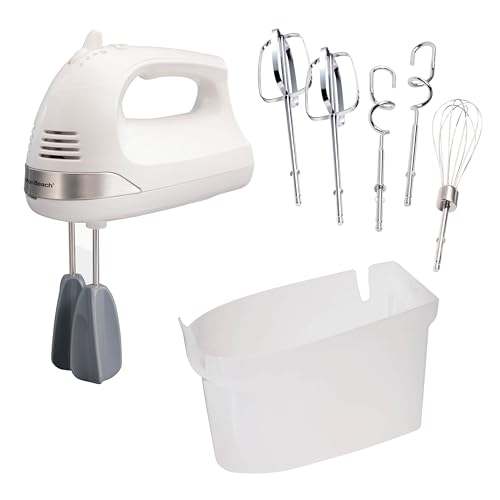
Hamilton Beach 6-Speed Electric Hand Mixer with Easy Clean Beaters (62636J)
Badge: Most Versatile
Strengths
- The broadest confirmed attachment set here: easy clean beaters, traditional beaters, dough hooks and a whisk.
- A stated 275 watt motor — the strongest confirmed power figure in this guide.
- The snap-on case keeps the whole cake-and-dough toolkit in one place.
Trade-offs
- Six speeds means coarser steps than the Cuisinarts’ nine, especially at the gentle end.
- No soft-start feature is named in the listing, so flour additions need a slower hand on the dial.
- The versatility is wasted if you truly only ever make one kind of cake.
Mini spec box
- Format: electric hand mixer
- Speeds: 6
- Motor: 275 watts
- Attachments named in listing: easy clean beaters, traditional beaters, dough hooks, whisk
- Storage: snap-on storage case
- Colour: White
If the Cuisinart wins on finesse, the Hamilton Beach wins on range. Its listing confirms the full toolkit: two styles of beater for batters of different densities, a whisk for the egg whites and creams that chiffon and angel cakes depend on, and dough hooks that carry the same machine into enriched doughs — babka, brioche-based celebration bakes, and the sweet breads that sit on cake’s border. A stated 275 watt motor backs the set with the group’s strongest confirmed power figure, which shows up in creaming: thick butter at the cool end of room temperature is where lesser motors bog down and this class of machine earns its keep.
The trade-off is the speed dial. Six speeds is entirely workable — generations of cakes were made with fewer — but the steps are wider, and without a named soft-start you manage flour additions with technique: beaters in the batter before you switch on, bowl tilted, speed low. Bakers who bake widely, from whipped-cream cakes to enriched celebration loaves, will find this the hardest pick to outgrow. It is also a core machine in our Best Mixers For Cake Business guide, where that range starts to pay rent.
Best for: wide-ranging bakers who want one cased toolkit for cakes, creams and enriched doughs / Not suited for: bakers who prize the finest low-speed control over attachment range

Cuisinart 9-Speed Electric Hand Mixer with Storage Case, Brushed Chrome (HM-90BCS)
Badge: Best Premium Hand Mixer
Strengths
- A stated 220 W motor pairs with nine speeds and SmoothStart — the most complete confirmed spec sheet among the hand mixers here.
- The six-piece set and snap-on case make it a self-contained baking kit.
- Brushed chrome is the finish that suits a counter-kept machine in a serious kitchen.
Trade-offs
- The listing calls the set six-piece without enumerating each piece, so attachment-by-attachment confirmation is thinner than the Hamilton Beach’s.
- It overlaps heavily with its white sibling, the HM-90S — most buyers need one Cuisinart, not both.
- Premium positioning means it asks more of a budget than the Proctor Silex end of this guide.
Mini spec box
- Format: electric hand mixer
- Speeds: 9
- Motor: 220 W
- Features: SmoothStart anti-splatter technology, snap-on storage case
- Set: 6-piece
- Colour: Brushed Chrome
The HM-90BCS is the connoisseur’s version of the Cuisinart formula: the same nine speeds and SmoothStart that lead this guide, a stated 220 W motor, a six-piece set in a snap-on case, and a brushed chrome finish that looks deliberate on a counter rather than stored out of sight. For cake work, its virtues are the family virtues — a ramped start for flour, fine low gears for folding, patient middle speeds for creaming — with the added confidence of a wattage figure printed in the listing rather than left to imagination.
Choose it over the white HM-90S when the finish and the fuller set matter to you, or when it is simply the one available; do not buy both, because their cake-making abilities are siblings, not complements. Its limitation is the shared Cuisinart one — no enumerated whisk in the listing — and a premium position in a category where the budget pick below still makes a perfectly good birthday cake. What the premium buys is control, presentation and the feeling of a tool bought once and kept.
Best for: committed home bakers who want the fullest Cuisinart spec in a counter-worthy finish / Not suited for: buyers already owning the HM-90S, or strict budgets

KitchenAid 5 Ultra Power Speed Hand Mixer, Black Matte (KHM512)
Badge: Best Compact Pick
Strengths
- Turbo Beaters keep thick batters moving without clogging — a real creaming-stage advantage.
- The lockable swivel cord stays out of the batter and locks to the side you work from.
- One-button release and dishwasher-safe beaters make frosting-day cleanup nearly effortless.
Trade-offs
- Five speeds is a coarser dial for the flour-folding stage than the Cuisinarts offer.
- No whisk is named in the listing; whipping relies on the Turbo Beaters.
- Black matte shows flour and icing sugar at a glance between cleans.
Mini spec box
- Format: electric hand mixer
- Speeds: 5
- Attachments named in listing: Turbo Beaters
- Features: lockable swivel cord, easy-release button, dishwasher-safe beaters
- Colour: Black Matte
The KHM512 is the cake mixer for the tidy, compact kitchen. Its case rests on three small excellences that compound across a bake: Turbo Beaters that do not pack with batter at the creaming stage, a swivel cord that locks out of the bowl instead of trailing through your frosting, and a one-button release that drops the beaters into the sink or dishwasher without a frosting-covered wrestling match. In a small kitchen, where the mixer lives in a drawer and the counter hosts one bowl at a time, those details are not garnish — they are the user experience.
Its cake ceiling is set by its dial and its attachment list. Five speeds cover creaming, beating and whipping adequately, but the fine low-end steps for folding flour belong to the Cuisinarts, and egg-white specialists get beaters rather than a named whisk. For the mainstream repertoire — butter cakes, snack cakes, cupcakes, brownies and frostings in single batches — it is a thoroughly satisfying machine that asks very little of your space or your patience.
Best for: small kitchens and tidy bakers making single-batch cakes and frostings / Not suited for: high-volume or whisk-critical baking

WEPSEN 5-Speed Electric Hand Mixer with Mixing Bowls Set
Badge: Best Value Set
Strengths
- Four large stainless nesting bowls are included — layer cakes need a bowl per component.
- Whisks are named in the listing, covering whipped cream and egg whites properly.
- Measuring cups and spoons complete a starter cake kit in one box.
Trade-offs
- Five speeds and a bundle-first design make it the lightest-duty creaming tool here.
- Equipped kitchens will duplicate bowls and measures they already own.
- No storage case or soft-start feature is named in the listing.
Mini spec box
- Format: electric hand mixer with bowl set
- Speeds: 5
- Included: 4 large stainless steel nesting bowls, measuring cups and spoons
- Attachments named in listing: whisks, beater
A layer cake is a logistics problem disguised as a dessert: batter in one bowl, whipped whites in a second, frosting in a third, and crumbs, syrups and fillings competing for a fourth. The WEPSEN set is the only pick that ships the logistics with the machine. Four large stainless nesting bowls mean each component gets its own vessel and the whole fleet stores in one bowl’s footprint; the whisks named in the listing handle the whites and creams; the measuring cups and spoons cover the baker still building a kit. For a first serious cake — the birthday cake that starts a habit — this is the most enabling purchase in the guide.
The mixer itself is the modest element: five speeds, no named soft start, no case. It creams and beats competently at single-batch scale, and its limits appear only when batters get large or ambitions get layered beyond two tiers. Buy it as the kit it is, and it will carry a beginner further than a fancier mixer arriving in an unequipped kitchen.
Best for: new cake bakers equipping a kitchen and anyone short on bowls / Not suited for: equipped bakers or large multi-tier production

Proctor Silex Easy Mix 5-Speed Electric Hand Mixer, Black (62511)
Badge: Best Budget Pick
Strengths
- Compact and lightweight — the easiest machine here to hold through a long creaming stage.
- The bowl-rest feature parks the mixer on the bowl rim between additions, keeping counters clean.
- 215 watts of peak power is a stated figure, honest about its light-duty class.
Trade-offs
- Peak power language signals a light-duty motor; big, cold-butter creaming jobs will test it.
- Five speeds and no named soft start, whisk or case — the spec sheet is deliberately minimal.
- Not the pick for frequent bakers; it is built for occasional, smaller bakes.
Mini spec box
- Format: electric hand mixer
- Speeds: 5
- Motor: 215 watts of peak power (as listed)
- Features: bowl rest, compact and lightweight design
- Colour: Black
The Proctor Silex Easy Mix understands its customer precisely: someone who bakes a cake now and then — a birthday, a bake sale, a Sunday sponge — and wants a light, simple machine that lives in a drawer and asks nothing. Its two thoughtful touches are weight and rest. Lightweight matters more in cake making than in most mixing, because creaming is a minutes-long hold, and a heavy mixer turns it into an endurance event. The bowl rest matters because cake making is stop-start — add an egg, scrape, add flour, scrape — and parking the mixer on the bowl rim keeps every drip in the bowl and the counter clean.
Read its listing honestly and its limits are printed there: 215 watts of peak power is light-duty language, and there is no soft start, whisk or case to discover later. Within its intended life — small cakes, single batches, occasional frosting — it is a sensible, likeable tool. The frequent baker should climb this guide toward the Cuisinarts or the Hamilton Beach and let the Proctor Silex serve the kitchens it was designed for.
Best for: occasional bakers, small cakes, and anyone who prizes a light machine / Not suited for: frequent baking, large batches, or cold-butter creaming marathons
Comparison Table
| Pick | Speeds | Motor (as listed) | Soft start | Whisk confirmed | Link |
|---|---|---|---|---|---|
| Cuisinart HM-90S | 9 | Not stated | Yes — SmoothStart | Not named | Check on Amazon |
| Hamilton Beach 62636J | 6 | 275 watts | Not named | Yes | Check on Amazon |
| Cuisinart HM-90BCS | 9 | 220 W | Yes — SmoothStart | Not enumerated | Check on Amazon |
| KitchenAid KHM512 | 5 | Not stated | Not named | No — Turbo Beaters | Check on Amazon |
| WEPSEN 5-Speed Set | 5 | Not stated | Not named | Yes | Check on Amazon |
| Proctor Silex 62511 | 5 | 215 watts peak | Not named | Not named | Check on Amazon |
How to Choose the Best Mixers for Cake: Creaming, Control and Capacity
Choose first by your dominant cake. Butter cakes and layer cakes live or die at the creaming stage and at flour incorporation, so they reward speed control and a soft start — the Cuisinart pair’s home ground. Foam cakes — sponge, chiffon, angel food — live or die at the whisk, so they reward a confirmed whisk attachment: the Hamilton Beach or the WEPSEN. Frosting-heavy baking rewards whatever you find easiest to hold and clean, because frosting is frequent, sticky work. And enriched, cake-adjacent doughs reward the Hamilton Beach’s hooks. Most bakers are a blend, which is why the guide’s top two picks are a control specialist and a versatility specialist rather than two of a kind.
Choose second by batch reality. A hand mixer handles the standard home repertoire — cakes mixed in one bowl, in one batch, for one occasion — without strain. The threshold where a stand mixer takes over is repetition and scale: multiple layers for one event, weekly celebration cakes, or any move toward selling, which is the territory our Best Mixers For Cake Business guide treats in full. Below that threshold, a stand mixer is mostly counter jewellery; above it, a hand mixer becomes the bottleneck in your kitchen.
Choose third by the features you will touch every bake: a cord that behaves (KitchenAid’s swivel), a case that keeps attachments findable (both Cuisinarts, the Hamilton Beach), dishwasher-safe beaters (KitchenAid, and the LILPARTNER in our wider mixer coverage), and a weight your hand enjoys holding (Proctor Silex). Cake making is repetitive in the best way, and small ergonomic mercies compound across hundreds of bakes.
Choose fourth, if you like, by what the machine does to your kitchen’s rhythm. A cased mixer that stores as one object gets put away and taken out without friction, which quietly raises how often you bake. A mixer that lives in a drawer among utensils gets excavated, which quietly lowers it. Neither effect appears on a spec sheet, and both are real; the bakers who bake most are usually the ones whose tools are easiest to start with, and cake — a food of occasions and whims — rewards the low-friction kitchen more than almost any other cooking.
How to Mix a Cake with a Hand Mixer, Stage by Stage
- Bring butter and eggs to room temperature. Cold butter creams badly in any machine, and no mixer specification compensates for it.
- Cream butter and sugar at a steady middle speed for several minutes, until the mixture is visibly paler and fluffier. Scrape the bowl halfway. This stage builds the cake’s air — do not rush it.
- Add eggs one at a time at a lower speed, mixing until each disappears before the next. If the mixture threatens to curdle, a spoonful of the measured flour steadies it.
- Add flour in two or three additions, alternating with liquid if the recipe uses it, at the lowest speed — or with SmoothStart doing the gentleness for you — mixing only until each addition vanishes. Overmixing here is where tenderness goes to die.
- For whipped components, use a clean bowl and clean beaters or whisk: grease is the enemy of egg-white foam, and a wipe with a cut lemon or a little vinegar is cheap insurance.
- Scrape, fold the last streaks by hand with a spatula, and get the batter into the prepared pan promptly — the air you built is perishable.
- Wash beaters immediately. Dried batter and frosting harden into a chore; fresh ones rinse in seconds.
Troubleshooting. Problem: the cake rose unevenly and domed hard → the batter was likely overmixed after the flour went in, or creaming was uneven; mix less at the flour stage and scrape more at the creaming stage. Problem: flour erupts at every addition → start with the beaters already in the batter, add smaller amounts, tilt the bowl, and prefer a soft-start machine next purchase. Problem: egg whites will not peak → a trace of fat on bowl or beaters is the usual culprit; rewash with hot soapy water, dry thoroughly, and start again with fresh whites if the batch is truly greased.
Cake Styles and the Mixer Features Each One Rewards
Butter cakes reward creaming patience and low-end control. Pound cakes, dense and butter-rich, reward honest motor strength at the creaming stage — the Hamilton Beach’s stated wattage and the Cuisinart HM-90BCS’s stated 220 W are the figures to weigh. Sponge cakes reward a fast, clean whip and a gentle fold; chiffon and angel food reward the whisk most of all. Cupcakes reward whatever makes small-batch work quick and cleanup quicker — the KitchenAid and Proctor Silex both live happily in cupcake territory. Frostings reward a machine you can hold in one hand while the other turns the bowl, and a beater release that does not require a clean hand to operate. Reading your own repertoire against this map is the fastest route through this guide: most bakers discover they are really shopping for two features, and the pick that owns both is usually obvious by the end of the reviews.
One more style deserves its own sentence, because it is quietly the most common cake in home kitchens: the snack cake — the single-layer, mixed-in-one-bowl, frosted-in-the-pan cake that appears on weeknights. Snack cakes forgive almost everything, which makes them the natural home of this guide’s simpler picks; a five-speed machine, a single bowl and ten unhurried minutes are the entire requirement. If your cake life is mostly snack cakes with the occasional birthday layer cake, weight your choice toward ease of storage and cleanup rather than toward the top of this guide, and spend the difference on good cocoa and vanilla, which a snack cake shows off more honestly than any other bake.
A Note on the Word “Mixer”
The word does double duty in search results. If you were actually planning drinks — a Best Mixers For Cake Vodka pairing, the Best Mixers For Calypso Rum or the Best Mixers For Captain Morgan and its Best Mixers For Captain Morgan Spiced Rum variant — those are beverage guides about what goes into the glass. This article covers electric machines for batter, and the only captain here is whoever is holding the mixer.
Frosting, Fillings and Finishing: The Mixer’s Second Shift
A cake mixer’s day does not end when the batter goes into the oven, and for many bakers the second shift is the one that decides the purchase. Buttercream wants several minutes of steady beating to turn dense and sweet into light and spreadable, and it punishes a mixer that cannot hold a middle speed patiently. Cream cheese frosting wants the opposite discipline — low speeds and restraint, because an overbeaten cream cheese frosting turns slack and weepy. Whipped ganache wants a whisk’s air; simple glazes want barely a stir. A hand mixer moves between all of these in one hand while the other rotates the bowl, which is precisely the working posture frosting assumes, and it is why even bakers who own stand mixers often frost with a hand mixer pulled from the drawer.
Two practical consequences follow. First, beater release and cleanup, treated as minor features in the reviews above, are actually frosting features: you will eject and wash beaters between batter and frosting, sometimes twice in one bake, and the KitchenAid’s one-button release and dishwasher-safe beaters earn their keep exactly there. Second, bowl strategy returns: frosting made in the same bowl as the batter, without a full wash in between, carries crumbs and colour into the finish. The WEPSEN set’s spare bowls and every other pick’s easy cleanup are, in effect, frosting infrastructure. When you compare the picks, imagine the whole bake — batter, bake, frost, finish — and choose the machine whose handling you like at the end of that sequence, tired and floury, not just at the start.
The Layer-Cake Workflow: One Hand Mixer, One Whole Bake
It is worth walking through a full layer cake with a single hand mixer, because the workflow reveals where each pick’s features actually fire. You begin by creaming — minutes at a middle speed, where the Hamilton Beach’s stated power and the Cuisinarts’ control both show their worth, and where the Proctor Silex’s lightness spares your arm. Eggs go in one by one; a swivel cord, as on the KitchenAid, keeps the cable out of the bowl at exactly the moment your other hand holds the egg bowl. Flour goes in low and slow; SmoothStart, if you have it, turns the dustiest step into a non-event. While the layers bake, the mixer rests — ideally on a bowl rest or back in its case, not lying in a puddle of batter. Then the second shift: frosting, beaten in a fresh bowl, with the beaters washed and dried in between. Assembly is hand work. Cleanup is one set of beaters, one or two bowls, and a machine that wipes down in seconds.
Notice what never appears in that workflow: a moment where the hand mixer is simply incapable. The stand mixer’s advantages — walking away during creaming, doubling without thought — are conveniences of scale and attention, not gates to quality at this batch size. That is the honest summary of the entire hand-mixer-for-cake category, and it is why this guide can recommend its budget pick without a wink: at one cake, made attentively, every machine here can produce a result indistinguishable in the eating. Choose on handling, control and the features your repertoire uses most, and bake with confidence.
How to Read a Hand Mixer Listing Like a Baker
Listings reward a particular reading order, and cake bakers should learn it because it is the order this guide used to build the shortlist. Read attachments first, and read them literally: a named whisk is a whisk, a named beater is a beater, and a set described by count alone — six-piece, five accessories — is a promise to enumerate elsewhere, so check the listing’s full detail before assuming any particular tool is inside. Read speeds second, and ask the cake question of them: not how high does it go, but how low, and how many steps live in the bottom half of the dial where flour work happens. Read wattage third and carefully: a plain watt figure and a peak-power figure are different species of claim, and the peak figure describes a moment the motor can touch rather than a pace it can hold — fine for light-duty machines that say so, like the Proctor Silex, but not comparable one-to-one with a continuous rating.
Read the small features last and take them seriously, because in cake making the small features are the experience: a soft start decides your flour stage, a storage case decides whether your attachments survive the drawer, a swivel cord decides whether the cable frosts itself, a bowl rest decides where the drips go, and a one-button release decides how the cleanup feels at the end of a long bake. A listing that confirms several of these, in writing, is a listing from a maker who understands the job. That is as close to a universal rule as this category offers, and it is why the reviews above quote listing language so precisely instead of paraphrasing it into mush.
Common Buying Mistakes
Mistake one: buying by top speed. Cake work lives at the bottom and middle of the dial; a gentle first gear is worth more than a dramatic ninth. Mistake two: ignoring the soft-start question and spending a year apologising to your kitchen walls for flour. Mistake three: assuming a whisk is in the box when the listing does not name one — read attachments literally, as this guide does. Mistake four: overbuying for imaginary scale; the baker of one cake a month does not need the premium tier, and the Proctor Silex exists to prove it. Mistake five: underbuying for real scale — if celebration cakes are a weekly event, the hand-mixer ceiling is real and a stand mixer is the honest answer. Mistake six: letting batter dry on beaters, which turns the easiest cleanup in baking into the hardest. Mistake seven: creaming with cold butter straight from the fridge and blaming the mixer for a dense crumb — no pick in this guide, or any guide, can aerate butter that has not softened first.
Final Recommendation
For most cake bakers, the Cuisinart HM-90S is the first choice: nine speeds, SmoothStart, and a listing that calls it a cake mixer outright make it the most controlled hand mixer here for creaming and flour work. If your repertoire runs wider — whipped-cream cakes, enriched doughs, a whisk you can point to in the listing — choose the Hamilton Beach 62636J instead. Beginners should consider the WEPSEN set’s bowls, small kitchens the KitchenAid, and occasional bakers the Proctor Silex, which may be all the cake mixer a happy kitchen ever needs.
Frequently Asked Questions
Is a hand mixer or a stand mixer better for cake?
For the standard home repertoire — single-batch layer cakes, cupcakes, sponges and frostings — a hand mixer is entirely sufficient and far easier to store and clean. A stand mixer earns its counter space when batches multiply: several layers at once, weekly production, or selling. The dividing line is repetition and scale, not cake quality at home batch sizes.
Why does my cake come out dense even with a good mixer?
Density is usually technique, not machinery: butter too cold to cream properly, creaming cut short, eggs added too fast, or flour overmixed after it goes in. The stage-by-stage method in this guide addresses each cause in order. A mixer with fine low speeds and a soft start helps at the flour stage, but the creaming patience is yours to supply.
Can I whip egg whites with beaters instead of a whisk?
Yes — bakers did so for generations, and every pick here can do it with clean equipment and a little more time. A whisk attachment incorporates air faster and is the better tool for foam cakes made often, which is why this guide flags which listings actually confirm one: the Hamilton Beach and the WEPSEN.
What speed should I cream butter and sugar at?
A steady middle speed, held for several minutes until the mixture pales and fluffs. Too slow and the stage takes forever; too fast and you fling sugar, warm the butter with friction and build large, unstable air pockets. Scrape the bowl down once halfway through — the unmixed ring at the bottom is where dense streaks in the finished cake are born.
How do I stop flour from flying everywhere?
Add flour in small additions, start with the beaters already resting in the batter, tilt the bowl slightly toward the beaters, and use the lowest speed until each addition disappears. A soft-start feature like Cuisinart’s SmoothStart automates the gentlest part of that technique, which is why both Cuisinarts score so well for cake in this guide.
Can these mixers handle a double batch of cake batter?
Mostly, no — and they should not be asked to. A doubled butter-cake batter is a heavy, deep mass that a hand mixer’s beaters must be dragged through, and the creaming stage that precedes it doubles in difficulty along with the volume. The better home workflow is two sequential single batches, which also bake more evenly as two cakes than as one giant one. Bakers who routinely need double batches are describing stand-mixer work, and this guide’s buying section says so plainly.
What is the difference between the two Cuisinart picks?
Less than their listings suggest. Both are nine-speed Cuisinart hand mixers with SmoothStart and a snap-on storage case. The HM-90BCS adds a stated 220 W motor figure, a described six-piece set and a brushed chrome finish; the HM-90S comes in white and is positioned in its listing as a cake mixer. Their cake-making performance is sibling-close — choose by finish, by which spec details you want confirmed in writing, and by availability, not by expecting a different class of machine.
Is the WEPSEN bowl set actually useful, or a gimmick?
Useful, for a specific and common situation: multi-component cakes in a kitchen short on bowls. Batter, whipped whites and frosting each want their own bowl, and the set’s four stainless bowls nest into one footprint afterwards. If your kitchen already owns a fleet of bowls, the value fades and the mixers above it in this guide are better places to spend.


