Disclosure: topratedkitchenware.com is reader-supported. When you buy through links on our site, we may earn an affiliate commission from Amazon and other retailers, at no extra cost to you.
Where to buy
If you are shopping for the best mixers for home baking, the six hand mixers below are the shortlist this guide is built around. Home baking is a breadth sport — cakes one weekend, cookies the next, a small dough or a tray of muffins in between — and every pick here is a handheld electric mixer assessed across that whole repertoire, at home batch sizes, for home kitchens and home storage. Prices and availability change often on Amazon, so use the links to check the current listing before you buy.
- Best Overall: Cuisinart Power Advantage Plus 9-Speed Hand Mixer, White (HM-90S) — Check on Amazon
- Most Versatile: Hamilton Beach 6-Speed Electric Hand Mixer with Easy Clean Beaters (62636J) — Check on Amazon
- Best Premium Hand Mixer: Cuisinart 9-Speed Electric Hand Mixer with Storage Case, Brushed Chrome (HM-90BCS) — Check on Amazon
- Best Compact Pick: KitchenAid 5 Ultra Power Speed Hand Mixer, Black Matte (KHM512) — Check on Amazon
- Best Starter Set: WEPSEN 5-Speed Electric Hand Mixer with Mixing Bowls Set — Check on Amazon
- Best Budget Pick: Proctor Silex Easy Mix 5-Speed Electric Hand Mixer, Black (62511) — Check on Amazon
Read the full guide below for the detailed reviews, the comparison table, the home-baking technique sections and the advice on seasons, children, ecosystems and keeping a mixer for a decade ↓
The best mixers for home baking are not the best mixers for any single bake — they are the mixers that serve the whole, gloriously inconsistent life of a home baker. Home baking is a birthday cake in March, a cookie phase in April, muffins because the bananas turned, a small enriched dough at a holiday, brownies on a whim and a frosting experiment that may or may not be repeated. It happens at home scale, in bursts of enthusiasm separated by ordinary weeks, in kitchens where the mixer shares a drawer with the potato masher. The machine that wins this life is not the most powerful or the most specialised; it is the one that is always ready, adequate-to-excellent at everything, easy to clean on a Sunday night, and priced and sized like the hobby it serves.
This shortlist grades six hand mixers by that standard. The Cuisinart HM-90S leads on control — nine speeds and a soft start cover every batter a home baker meets. The Hamilton Beach 62636J follows with the broadest attachment set in the pool, whisk and dough hooks included, for the baker whose repertoire keeps expanding. The brushed-chrome Cuisinart HM-90BCS is the premium version of the leader’s virtues. The KitchenAid KHM512 is the compact daily tool. The WEPSEN set equips a beginner’s whole kitchen in one box, and the Proctor Silex keeps the honest budget end of the shelf honest. The buying guide will also tell you, plainly, when home baking outgrows this entire category and a stand mixer becomes the right next chapter — because for some bakers it does, and a good guide says so.
Key Takeaways
- Home baking rewards breadth and readiness over specialisation: one versatile hand mixer serves the whole repertoire at home scale.
- The Cuisinart HM-90S leads on control — nine speeds, SmoothStart, and a listing that names cake mixing directly.
- The Hamilton Beach 62636J is the repertoire-expander: beaters, whisk and dough hooks in one cased set.
- Storage and cleanup decide long-term satisfaction — cased mixers and dishwasher-safe beaters get used for years.
- Beginners should weigh the WEPSEN set’s bowls and measures as heavily as the mixer itself.
- The stand-mixer threshold is real but specific: weekly bread, doubled batches, or selling. Below it, these picks are the right size of tool.
- Audit the ecosystem before upgrading the machine: a second bowl and a kitchen scale improve more home bakes than a model change does.
In this guide
Quick Picks
| Pick | Badge | Speeds | Attachments named in listing | Home baking role |
|---|---|---|---|---|
| Cuisinart Power Advantage Plus 9-Speed (HM-90S) | Best Overall | 9 | Beater (as listed) | Control for every batter in the repertoire |
| Hamilton Beach 6-Speed Hand Mixer (62636J) | Most Versatile | 6 | Easy clean beaters, traditional beaters, dough hooks, whisk | Cakes, creams and small doughs in one case |
| Cuisinart 9-Speed Hand Mixer (HM-90BCS) | Best Premium Hand Mixer | 9 | 6-piece set | Leader’s control with a stated motor and chrome finish |
| KitchenAid KHM512, Black Matte | Best Compact Pick | 5 | Turbo Beaters | Drawer-sized daily baking with easy cleanup |
| WEPSEN 5-Speed Hand Mixer Set | Best Starter Set | 5 | Whisks, beater | Whole starter kitchen: bowls and measures included |
| Proctor Silex Easy Mix 5-Speed | Best Budget Pick | 5 | Beaters (format) | Light, simple, bowl-rest ease for occasional baking |
How These Picks Were Chosen
This guide is research-led and built from verified listings. Every specification used — speeds, stated wattage, named attachments, storage and start features — comes from the listing itself, and where a listing is silent, the review says so. The weighting is this keyword’s own: breadth across the home repertoire first, then readiness (storage, deployment, cleanup), then the ceiling questions — batch size and dough ambition — where this guide is deliberately honest about the hand-mixer format’s limits.
All six picks are hand mixers, because the assignment for this guide was the drawer-sized shelf where most home baking actually happens; stand mixers are discussed in the buying guide as the graduation step, with the signals that announce it. The two Cuisinarts are distinct models with overlapping virtues, and the reviews treat them as such — siblings, not duplicates. We claim no hands-on testing; the assessments rest on verified specifications and on the settled, uncontroversial mechanics of home baking.
The 6 Best Mixers for Home Baking, Reviewed

Cuisinart Power Advantage Plus 9-Speed Hand Mixer, White (HM-90S)
Badge: Best Overall
Strengths
- Nine speeds and SmoothStart cover the whole home repertoire, from flour-gentle batters to whipped cream, without a splash.
- Its listing names it a cake mixer — the centre of the home baking repertoire is its stated home.
- The snap-on case keeps the machine ready as one object, bake after bake, year after year.
Trade-offs
- The listing names a beater rather than a whisk; the whisk-led baker should note the Hamilton Beach below.
- It is a hand mixer: doubled batches and stiff doughs belong to another format.
- White shows a baking life until wiped.
Mini spec box
- Format: electric hand mixer
- Speeds: 9
- Features: SmoothStart anti-splatter, snap-on storage case
- Listing positioning: cake mixer, hand held mixer
- Colour: White
Home baking’s defining trait is variety at modest scale, and the HM-90S is variety’s machine. Its nine speeds are not a brag but a map of the repertoire: the bottom gears for folding flour into a sponge and for the dry stages of a crumble, the middle for creaming and batters, the top for cream and egg whites — each reachable in fine steps, each startable without the flour eruption that SmoothStart exists to prevent. A home baker who buys this machine stops thinking about the mixer, which is the highest praise a generalist tool can earn: it simply answers, whatever the recipe asks.
The case compounds the virtue across years. Home baking is intermittent, and intermittent tools die of disorganisation — attachments lost, machines buried — more often than of wear. The Cuisinart lives as one cased object, deploys in seconds after a month in the cupboard, and returns to its case clean. Its ceiling is the format’s ceiling, stated in the buying guide; within the repertoire it was built for, it is the most complete hand mixer in this pool.
Best for: home bakers who bake widely and often, and want one controlled machine for all of it / Not suited for: weekly bread at scale, or bakers who need a confirmed whisk above all
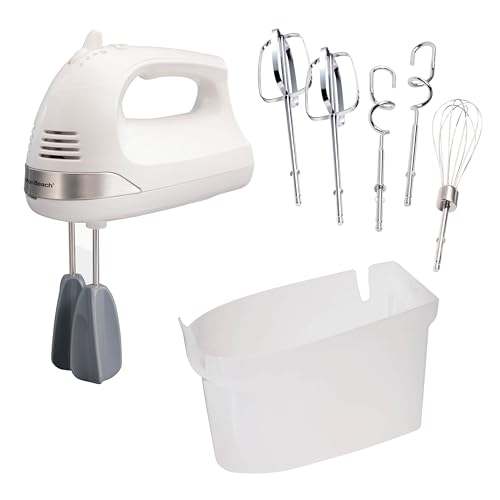
Hamilton Beach 6-Speed Electric Hand Mixer with Easy Clean Beaters (62636J)
Badge: Most Versatile
Strengths
- The fullest confirmed attachment set here: two beater styles, a whisk and dough hooks — the whole home repertoire in one case.
- A stated 275 watt motor, the strongest confirmed figure in the pool.
- The snap-on case keeps the expanding toolkit organised as the repertoire grows.
Trade-offs
- Six speeds is a coarser dial than the Cuisinarts’ nine at the gentle end.
- No soft-start feature is named in the listing.
- Home bakers who never touch dough or whipped work will not use half the case.
Mini spec box
- Format: electric hand mixer
- Speeds: 6
- Motor: 275 watts
- Attachments named in listing: easy clean beaters, traditional beaters, dough hooks, whisk
- Storage: snap-on storage case
- Colour: White
Every home baker knows the moment the repertoire expands: the cake baker tries a brioche, the cookie baker discovers meringues, and suddenly the question is whether the mixer can follow. The 62636J is built for that moment. Its listing confirms the full journey — beaters for the batters, a whisk for the whipped end of the repertoire, dough hooks for the small enriched doughs that mark a home baker’s graduation — driven by the pool’s strongest stated motor and stored as one cased kit. It is the pick least likely to be outgrown by curiosity, which is the way home bakers actually outgrow things.
The trades are the familiar ones: a six-speed dial where the leader offers nine, and no named soft start, so flour starts are technique. Bakers whose repertoire is settled and cake-centred may prefer the Cuisinart’s finesse; bakers still exploring — which is to say, most home bakers in their first years — will find this machine waiting at every new recipe with the right attachment already in the case.
Best for: bakers whose repertoire is growing into doughs and whipped work / Not suited for: settled cake-only bakers who prize the finest speed control

Cuisinart 9-Speed Electric Hand Mixer with Storage Case, Brushed Chrome (HM-90BCS)
Badge: Best Premium Hand Mixer
Strengths
- Nine speeds, SmoothStart and a stated 220 W motor — the leader’s control with its power in writing.
- The six-piece set in a snap-on case makes a complete, giftable, storable baking kit.
- Brushed chrome suits a counter-kept machine in a design-conscious kitchen.
Trade-offs
- The six-piece set is described by count in the listing rather than enumerated piece by piece.
- It overlaps the HM-90S heavily; most kitchens need one Cuisinart, chosen by finish and set.
- Premium positioning in a category whose budget end still bakes a fine cake.
Mini spec box
- Format: electric hand mixer
- Speeds: 9
- Motor: 220 W
- Features: SmoothStart anti-splatter technology, snap-on storage case
- Set: 6-piece
- Colour: Brushed Chrome
The HM-90BCS is the HM-90S’s formula at full dress: the same nine-speed, soft-start control that leads this guide, a motor figure stated in the listing, a six-piece set in its case, and a finish that turns a stored tool into a kept-out appliance. For home baking, the practical differences from its white sibling are the set and the stated wattage; the experiential difference is that a machine which looks at home on the counter gets used like a resident rather than a visitor, and home baking — opportunistic, mood-driven — rewards resident tools.
Choose it when the finish and fuller set speak to you, or when you are buying once, generously, for a kitchen you intend to bake in for a decade. Do not buy it alongside the HM-90S; they are siblings with the same talents, and the money is better spent on the second bowl, the good scale and the ingredients that turn a well-equipped kitchen into a baking one.
Best for: committed home bakers buying once, well, for the long term / Not suited for: owners of the HM-90S, or strict budgets

KitchenAid 5 Ultra Power Speed Hand Mixer, Black Matte (KHM512)
Badge: Best Compact Pick
Strengths
- Turbo Beaters handle the repertoire’s thick batters without clogging.
- The lockable swivel cord and one-button release make it the tidiest daily baker in the pool.
- Dishwasher-safe beaters close every bake with a rinse-and-rack cleanup.
Trade-offs
- Five speeds is a coarser vocabulary for the repertoire’s delicate ends.
- No whisk or dough hooks are named in the listing; its baking range is beater-led.
- Black matte shows flour at maximum contrast.
Mini spec box
- Format: electric hand mixer
- Speeds: 5
- Attachments named in listing: Turbo Beaters
- Features: lockable swivel cord, easy-release button, dishwasher-safe beaters
- Colour: Black Matte
The KHM512 is home baking’s daily driver: the machine for the weeknight muffins, the quick banana bread, the small cake for no reason. Its virtues are the virtues of frequency — a cord that locks out of the batter, beaters that eject with a button and wash in the dishwasher, a body that lives in a drawer and deploys in seconds. A home baker who bakes in small batches often will touch this machine more in a month than a grander tool in a season, and the baking life is mostly made of exactly those touches.
Its range is beater-led and its dial is five speeds, so the repertoire’s extremes — a whisked sponge at one end, a small dough at the other — are served adequately rather than specially. Bakers who live at those extremes should climb to the Hamilton Beach’s attachments or the Cuisinarts’ control. Bakers who live in the delicious middle will find the KHM512 close to perfect.
Best for: frequent small-batch bakers in compact kitchens / Not suited for: dough work, whisk-led baking, or large batches

WEPSEN 5-Speed Electric Hand Mixer with Mixing Bowls Set
Badge: Best Starter Set
Strengths
- Four large stainless nesting bowls and measuring tools are included — a beginner’s entire mixing infrastructure.
- Whisks are named in the listing, covering the whipped end of a starter repertoire.
- The set removes every equipment excuse between a new baker and their first dozen recipes.
Trade-offs
- The lightest-duty mixer here; growing bakers will upgrade the machine while keeping the bowls.
- Equipped kitchens duplicate the bundled bowls and measures.
- No case or soft start is named.
Mini spec box
- Format: electric hand mixer with bowl set
- Speeds: 5
- Included: 4 large stainless steel nesting bowls, measuring cups and spoons
- Attachments named in listing: whisks, beater
Home baking begins with a kitchen, not a machine, and the WEPSEN set is the only pick that sells the kitchen. A new baker needs bowls in plurality — batter here, dry goods there, the frosting waiting in a third — and measures that make recipes repeatable; this set ships both with a competent five-speed mixer whose whisks and beater cover the starter repertoire from muffins to meringues. The first year of a baking life is about attempts, and this box makes attempts easy, which is the most valuable thing a starter purchase can do.
Its ceiling is the lightest in the guide, and the honest forecast is that a baker who catches the bug will one day upgrade the mixer — and keep the bowls, which nest into a cupboard corner and serve for a decade. As a first purchase, or a gift that actually equips, it has no rival in this pool.
Best for: new home bakers and gift-buyers equipping a first baking kitchen / Not suited for: equipped bakers or heavy, frequent loads

Proctor Silex Easy Mix 5-Speed Electric Hand Mixer, Black (62511)
Badge: Best Budget Pick
Strengths
- Compact and lightweight — the easiest hold in the pool for a long creaming stage.
- The bowl-rest feature suits baking’s stop-start rhythm of additions and scrapes.
- Its light-duty positioning is stated honestly in its own listing’s peak-power language.
Trade-offs
- 215 watts of peak power marks a light-duty machine for occasional, smaller bakes.
- No case, whisk or soft start is named — the specification is deliberately minimal.
- Frequent bakers will outgrow it; that is its design, not its defect.
Mini spec box
- Format: electric hand mixer
- Speeds: 5
- Motor: 215 watts of peak power (as listed)
- Features: bowl rest, compact and lightweight design
- Colour: Black
Not every home baker bakes weekly, and the Proctor Silex is the honest machine for the rest: the birthday cake, the holiday cookies, the occasional brownie tray. It is light in the hand — a genuine mercy during creaming — it parks on the bowl rim between the additions and scrapes that structure every bake, and it stores in a drawer without ceremony. Its listing’s peak-power language tells you plainly that it is a light-duty tool, and a guide should honour that honesty by matching it to light-duty lives rather than apologising for it.
Within that life it is entirely sufficient: the occasional baker’s cakes will not know the difference, and the money saved against the premium picks buys a year of good butter and vanilla. The frequent baker should buy up the guide; the occasional baker should buy this, bake happily, and ignore anyone who suggests the hobby requires more.
Best for: occasional home bakers and small, simple bakes / Not suited for: frequent baking or large batches
Comparison Table
| Pick | Speeds | Motor (as listed) | Whisk / hooks confirmed | Home baking strength | Link |
|---|---|---|---|---|---|
| Cuisinart HM-90S | 9 | Not stated | Not named | Control across the repertoire | Check on Amazon |
| Hamilton Beach 62636J | 6 | 275 watts | Both | Attachment range for a growing repertoire | Check on Amazon |
| Cuisinart HM-90BCS | 9 | 220 W | Set not enumerated | Premium control and presentation | Check on Amazon |
| KitchenAid KHM512 | 5 | Not stated | No | Compact daily baking, easy cleanup | Check on Amazon |
| WEPSEN 5-Speed Set | 5 | Not stated | Whisks named | Starter kitchen in a box | Check on Amazon |
| Proctor Silex 62511 | 5 | 215 watts peak | Not named | Light, simple, occasional baking | Check on Amazon |
How to Choose the Best Mixers for Home Baking: Breadth, Readiness and the Graduation Question
Choose breadth first. List the last ten things you baked — or honestly intend to — and check them against the pick’s confirmed attachments and speeds. A repertoire of cakes, cookies and muffins is beater work, and every pick here passes. Add whipped sponges and meringues and the whisk question matters: the Hamilton Beach confirms one, the WEPSEN names whisks, the Cuisinarts and KitchenAid ask their beaters to serve. Add small enriched doughs and only the Hamilton Beach’s confirmed hooks answer. The list you write is the specification; buy the machine that covers your list, not the list you admire in other people’s kitchens.
Choose readiness second, because home baking is opportunistic. The bake happens when the mood and the bananas align, and the machine that is cased, complete and clean gets used while the machine in pieces gets postponed. Readiness is also why weight and grip deserve a thought: a home baker holds a hand mixer through creaming stages and frosting sessions, and the machine that feels balanced in the hand at minute four is the one whose owner volunteers to bake the next cake too. That is why this guide keeps returning to cases, dishwasher-safe beaters and one-button releases: over a decade of Sundays, readiness is worth more than a speed or two, and the baker who doubts it should count how many of their bakes began as a whim that a ready machine caught and a buried one would have missed. Choose the graduation question last, and answer it honestly: a stand mixer becomes the right purchase when bread becomes weekly, batches become doubled, or baking becomes selling. Until one of those is true, the hand mixers in this guide are not a compromise on the way to the real thing — they are the right-sized tool, and the money difference is ingredients, which is the input home baking actually runs on.
How to Run a Home Baking Session, Start to Finish
- Read the recipe fully before the mixer leaves its case, and set out every ingredient, weighed or measured, in the order the recipe will ask for them. Home baking’s failures are mostly logistics wearing a disguise.
- Bring butter and eggs to room temperature for creaming-based recipes; no mixer in this guide can aerate cold butter, and none should ever be asked to try.
- Cream at a steady middle speed, scrape once halfway, and give the stage its minutes — it is where cakes get their height, and rushing it is the one economy no ingredient can repay.
- Add eggs gradually, flour gently: lowest speed, beaters settled deep in the batter, mixing only until each addition disappears from sight.
- Use the machine’s pause-friendly features — bowl rest, case, a free hand — to scrape, rotate the bowl and check the mixture rather than simply mixing longer out of uncertainty.
- Whipped components go in clean bowls with clean attachments; a trace of fat is the difference between peaks and soup, and the bowl that held the frosting must never be the bowl asked to hold the meringue.
- Clean as the bake finishes: attachments rinsed or racked while the oven does the last of the work, so the session ends with a cake and a tidy kitchen, not a sink of regrets waiting for the morning.
Troubleshooting. Problem: cakes keep coming out dense → audit the creaming stage and the butter temperature before blaming any machine; those two variables explain most density in home baking. Problem: flour erupts at the flour stage → start lower, start buried, add in smaller additions, and prefer a soft-start machine at replacement time. Problem: the mixer labours and warms on a favourite recipe → the batch has outgrown the format; split it, or read the graduation section above with fresh eyes.
The Home Baker’s Year: How the Repertoire Rotates
Home baking has seasons, and a good generalist mixer is really four seasonal tools in one body. Spring is cakes and sponges — creaming control and gentle flour work, the Cuisinarts’ home ground. Summer is whipped things and no-bake assemblies — creams, mousses, chilled desserts where the whisk end of the repertoire and fast cleanup matter most. Autumn is cookies and spiced batters, thick mixtures that reward the Hamilton Beach’s stated power and the KitchenAid’s clog-resistant beaters. Winter is the enriched season — small doughs, celebration bakes, frostings at volume for gifts — where attachment range and honest batch discipline decide the day. A mixer chosen against the whole year, rather than against this month’s enthusiasm, is a mixer that never has an off-season in a cupboard. When you compare the six picks, run them mentally through all four seasons of your own baking; the right one usually announces itself by October.
The seasons also explain why breadth beats brilliance in this category. A specialist machine — the perfect dough tool, the perfect whisk — spends three seasons as the second-best option in its own kitchen, while the generalist is never worse than good and frequently exactly right. Home bakers do not need a machine that wins a season; they need one that never loses one, and that is the standard this guide’s podium was built to meet.
A Note on the Word “Mixer”
The word keeps other company too. Readers setting up a Best Mixers For Home Bar will find the beverage sense of it, as will those checking the Best Mixers For Honey Whiskey or the Best Mixers For Honey Jack; readers equipping a Best Mixers For Home Recording setup or a Best Mixers For Home Studio will find the audio sense. This guide is firmly in the kitchen: the only mixing here is measured in cups, not channels.
The Supporting Cast: Bowls, Scales and the Second Spatula
A home baker’s mixer performs inside an ecosystem, and a few inexpensive companions multiply any pick in this guide more than an upgrade within it would. A second large bowl is the first: batters rest in one while whites whip in the other, and the whole choreography of a layer cake stops being a washing-up relay. A simple kitchen scale is the second: home baking’s repeatability problem is usually a measuring problem, and weighed flour behaves the same in January and July in a way scooped flour never does. A flexible spatula that truly scrapes is the third, because every mixer in this guide leaves a ring of unmixed batter at the bowl’s edge, and the baker who scrapes once, halfway, gets stand-mixer evenness from a hand tool.
None of this is upselling; it is sequencing. The WEPSEN set builds the bowl part of the ecosystem into the purchase, which is why it keeps winning the beginner argument. Established bakers should audit the ecosystem before upgrading the machine: in kitchen after kitchen, the limiting factor turns out to be the missing second bowl, not the five-speed dial, and the cheapest performance upgrade in home baking is very often a bowl.
Baking with Children: The Mixer as a Teaching Tool
For many households, home baking is also how children enter the kitchen, and the hand mixer is usually their first powered tool — which makes its teachability a real selection criterion. The forgiving traits are the ones this guide has praised for other reasons: a gentle or soft start that does not punish a first switch-on, speeds that change in steps rather than lunges, a body light enough for smaller hands with an adult’s hand over theirs, and attachments that eject without a struggle. By those measures the soft-starting Cuisinarts and the compact KitchenAid are the family-friendly picks, while every machine in the pool shares the same non-negotiable rules: beaters in the bowl before power, hair and sleeves away, and an adult owning the plug.
The deeper point is that a mixer a child can use safely is a mixer that builds a baker. The first cake a young cook creams themselves — with a machine that behaves predictably and forgives their timing — is the one that turns helping into hobby, and households routinely report that the mixer bought for the adults ends its career as the machine the children learned on, which is a service record no specification sheet predicts. Households choosing for that future are choosing well when they weight control and gentleness over raw capability, exactly as this guide’s podium does.
Keeping a Hand Mixer for a Decade: Care That Compounds
Home baking’s intermittent rhythm is kind to machines in one way — low total hours — and cruel in another: long rests with residue on the attachments, storage in damp or dusty corners, cords kinked in drawers. The decade-long mixer is the one cleaned before it is stored, every time, because batter dried in a beater’s wires through a month’s rest becomes the scrubbing that bends wires and strains ejectors. It is the one stored as a unit — case if it has one, a single drawer corner if it does not — so its attachments are never borrowed into other duties and lost. And it is the one rested during heavy work rather than forced, because small motors remember heat the way joints remember weather.
None of this care is burdensome; it is a thirty-second rinse, a wipe, a case snapped shut. But it is the difference between the mixer bought once for a baking life and the mixer bought three times for the same life, and it is why this guide treats cleanup and storage features as headline specifications rather than footnotes. Read the podium again with that lens and it rearranges itself into a longevity ranking as much as a performance one — which, for a hobby measured in decades, is the ranking that counts. In home baking, longevity is a feature you operate, not a feature you buy — the picks above simply make operating it easy.
Common Buying Mistakes
Mistake one: buying for a single bake — the bread phase, the wedding cake, the ambitious holiday project — instead of for the repertoire’s whole year. Mistake two: overbuying into stand-mixer scale for a hobby that bakes twice a month, and resenting the footprint ever after, every time the machine has to be worked around to reach the kettle. Mistake three: underbuying for a repertoire that has already graduated — weekly dough and doubled batches will not be negotiated with, and a light-duty machine asked to live that life will answer in heat and strain. Mistake four: ignoring storage and cleanup, the features that decide whether a hobby machine is still in service in year five — or retired in year two with its beaters in three different drawers. Mistake five: assuming attachments the listing does not name; in this guide, only the Hamilton Beach’s whisk and hooks are confirmed in writing, and that fact should steer dough-and-whisk bakers accordingly rather than hopefully. Mistake six: buying both Cuisinarts as if their overlap were a difference. Mistake seven: blaming the mixer for a missing second bowl, a scooped-flour habit or butter from the fridge — the ecosystem and the technique around the machine decide more bakes than the machine does, and they are cheaper to fix. Mistake eight: storing the mixer dirty “just this once,” monthly, for years, and then concluding that hand mixers do not last. Mistake nine: reading this guide’s podium as a ranking of worth rather than of fit — the Proctor Silex in an occasional baker’s drawer outperforms, for that baker, the premium pick gathering dust in a kitchen that bakes twice a year.
Final Recommendation
For most home bakers, the Cuisinart HM-90S is the first choice: nine speeds, a soft start and a case make it the most complete, ready and controlled hand mixer for the whole repertoire. If your baking is expanding into doughs and whipped work, choose the Hamilton Beach 62636J and its confirmed attachments instead. New bakers take the WEPSEN set, compact kitchens take the KitchenAid, occasional bakers take the Proctor Silex without a shred of apology — and bakers who have genuinely graduated take this guide’s blessing to the stand-mixer shelf, hand mixer retained for everything else.
One final encouragement, because home baking is a hobby that thrives on it: the best mixer for your baking is the one that gets you baking this weekend, with the ingredients already in the house, at the scale your kitchen already supports, for the people already at your table. Every pick in this guide clears that bar, at every level of commitment the hobby honestly comes in. Choose the one whose strengths match your repertoire’s centre of gravity, keep it clean and cased and within reach, and let the repertoire — not the catalogue, and not anyone else’s kitchen — decide if and when anything grander is ever needed.
Related guides
Frequently Asked Questions
Is a hand mixer enough for home baking?
For the great majority of it, yes: cakes, cookies, muffins, brownies, frostings, whipped creams and small enriched doughs are all hand-mixer work at home batch sizes, and the picks in this guide cover them with room to spare. The hand mixer is not the budget substitute in this story; for the repertoire as most households actually bake it, it is the proportionate, sufficient and most-used tool. The exceptions are specific — weekly bread at scale, doubled batches, commercial ambitions — and the buying guide names them so you can recognise whether they are actually yours.
When should a home baker buy a stand mixer?
When one of three signals becomes routine: bread or dough most weeks, recipes regularly doubled, or baking for sale. Those are capacity and duty signals, and they tend to arrive clearly rather than subtly — usually announced by the hand mixer labouring on a beloved recipe, or by a queue of batters forming on a baking day. Until then, a stand mixer mostly buys counter occupation, and the hand mixer remains the proportionate tool.
What attachments does a home baker actually need?
Beaters first — they carry the repertoire’s centre, from creaming to batters to frostings. A whisk second, for the whipped end: sponges, meringues, creams. Dough hooks third, for the baker expanding into small enriched doughs. Only the Hamilton Beach in this pool confirms all three in its listing, which is why repertoire breadth keeps pointing at it; bakers whose list stops at beaters are well served by every pick here, and bakers unsure of their list should buy for the beaters and let the repertoire reveal itself over a year of weekends.
How important is a storage case, really?
More than it looks. Home baking is intermittent, and intermittent equipment survives on organisation: a cased mixer deploys complete in seconds after weeks away, while loose attachments migrate and vanish — into the utensil drawer, the back of the cupboard, the box of things nobody remembers packing. Over years, the case is frequently the difference between the mixer you still use and the mixer you replaced because you could not find its beaters on the morning of a birthday.
Can these mixers handle a whole Christmas baking season?
Yes, with batch discipline: single batches mixed in sequence, rests between heavy jobs, and the freezer used as the capacity multiplier — doughs and finished bakes frozen ahead spread the season’s work across weeks. The season punishes doubled batches and cold butter, not hand mixers as a class, and the bakers who sail through it are the ones who started in November, not the ones with the biggest machine.
What size batches suit these hand mixers?
The standard home repertoire as written: cakes and cookie batches from ordinary cookbooks, mixed once, in one bowl, without doubling, in the pans those recipes were tested in. That envelope covers the overwhelming majority of home baking as it is actually practised. When a recipe must be doubled for an occasion, mix two sequential batches rather than one heroic one — the cakes will be more even, the leavening will time correctly for both, and the mixer will not be asked to work outside the format it was built for.
How do I know if my repertoire needs a whisk?
Look at your last season of baking, honestly rather than aspirationally. If sponges, meringues, whipped creams or mousses appear regularly, a whisk earns its place — and in this pool that means the Hamilton Beach’s confirmed whisk or the WEPSEN’s named whisks, since beaters whip adequately but more slowly. If those recipes are annual events, beaters will serve, and the whisk should not drive the purchase.
What is the best first bake to learn a new mixer on?
A familiar cake — the one you have made often enough to judge blind. A new machine changes one variable at a time only if the recipe is a constant: you will learn its creaming pace, its flour-stage manners and its cleanup character in a single bake, against a result you can compare with memory. Save the new recipe for the second bake, when the machine is no longer a stranger and its quirks have become part of your hands’ knowledge.
How long should a home baker expect a hand mixer to last?
A decade is a reasonable horizon for the established names in this guide under home baking’s rhythm — intermittent use, honest loads, attachments cleaned before storage, and a cord that is looped rather than yanked from the wall a thousand times. The machines that fail early in home kitchens usually fail from the abuses this guide keeps naming: doubled batches forced through a straining motor, residue left to harden through long rests, attachments dropped and bent on tile, or attachments lost and improvised around until the machine is retired for disorganisation rather than breakdown.
Which pick is best as a gift for a new baker?
The WEPSEN set, because it equips rather than merely tools: mixer, whisks, four bowls and measuring tools in one box means the recipient can bake the same day, with nothing left to borrow, improvise or postpone. For a new baker who already has a kitchen, the Cuisinart HM-90S in its case is the generous, long-term choice — the kind of gift that is still being thanked, bake by bake, years later.


