Disclosure: topratedkitchenware.com is reader-supported. When you buy through links on our site, we may earn an affiliate commission from Amazon and other retailers, at no extra cost to you.
Where to Buy
If you are shopping for best non toxic slow cookers, the shortlist below is the whole guide in miniature: every pick with its badge, linked where a verified listing supports it. Prose-only archetype slots carry no purchase link, for the reasons their reviews explain. Read the full guide below for the material disclosures and the reasoning behind each slot.
- Crock-Pot Oval Manual Slow Cooker, 7-Quart — Best Overall
- Crock-Pot Programmable Slow Cooker with MyTime, 7-Quart — Best Programmable
- Aroma Housewares ARC-150SB Digital Multicooker, 20-Cup Cooked — Best Multitasker
- Compact Manual Stoneware Slow Cooker (Prose-Only Archetype) — Best for Small Households (prose-only, no purchase link)
- Divided-Insert Stoneware Slow Cooker (Prose-Only Archetype) — Best for Entertaining (prose-only, no purchase link)
- Stoneware Slow Cooker with Hinged Lid (Prose-Only Archetype) — Best for Serving (prose-only, no purchase link)
Read the full guide ↓
Shopping for the best non toxic slow cookers starts with a single question: what touches your food for the next eight hours? A slow cooker is a long-contact appliance — a stew does not kiss the cooking surface and leave, it lives against it all day. That is why this guide is organised around insert materials first and features second. The short answer the research keeps returning to is glazed stoneware: a ceramic cooking surface with no nonstick coating to wear, scratch or age out, which is why the dedicated stoneware models below anchor the list.
One honesty note before the picks. The verified product pool for this guide mixed true slow cookers with rice cookers that have no slow-cook function at all. Those rice cookers have not been dressed up as slow cookers here: three slots in this guide are clearly labelled prose-only archetypes describing what to look for, with no purchase link attached. What is linked below is linked because its verified listing genuinely supports slow cooking — and where a linked model’s food-contact material is not confirmed by its listing, the review says so in plain words.
Key Takeaways
- Glazed stoneware is the reference cooking surface for this category: ceramic, coating-free on the food side, and proven over decades of use.
- Two of the three linked picks are dedicated stoneware slow cookers; the third is a digital multicooker whose verified title includes a slow-cook function but does not state its inner-pot material.
- Three slots are prose-only archetypes, because the verified pool’s remaining products were rice cookers with no slow-cook function — we describe the right product instead of linking the wrong one.
- Size by household: compact formats for one or two people, 6 to 7 quarts for families, 8 quarts only for crowds and batch cooking.
- Programmability is a schedule feature, not a cooking-quality feature — buy it if your workdays run long, skip it if someone is home.
In this guide
Quick Picks
| Pick | Badge | Why It Earns Its Place | Check |
|---|---|---|---|
| Crock-Pot Oval Manual Slow Cooker, 7-Quart | Best Overall | The food cooks in removable oval stoneware, so the cooking surface itself carries no nonstick coating to wear out or scratch through. | Check on Amazon |
| Crock-Pot Programmable Slow Cooker with MyTime, 7-Quart | Best Programmable | MyTime technology adjusts the cooking cycle to the mealtime you set, which attacks the classic slow-cooker problem of food overcooking when your day runs long. | Check on Amazon |
| Aroma Housewares ARC-150SB Digital Multicooker, 20-Cup Cooked | Best Multitasker | Three appliances in one footprint: the verified listing covers rice cooking, slow cooking and steaming in a single digital unit. | Check on Amazon |
| Compact Manual Stoneware Slow Cooker (Prose-Only Archetype) | Best for Small Households | A small stoneware crock matches one- or two-person portions, so food sits at a sensible depth instead of spreading thin across an oversized pot. | Prose-only |
| Divided-Insert Stoneware Slow Cooker (Prose-Only Archetype) | Best for Entertaining | A divided stoneware insert cooks a main and a side — or two sauces — in one appliance on one counter footprint. | Prose-only |
| Stoneware Slow Cooker with Hinged Lid (Prose-Only Archetype) | Best for Serving | A hinged lid opens and stays up for serving, which solves the eternal buffet problem of where to put a wet, steaming lid. | Prose-only |
How These Picks Were Chosen
These picks were chosen by comparing verified product listings across the slow-cooker pool: capacity, cooking-insert material as stated in the listing, control type, lid design and cleanup claims. The filter for this particular guide was applied in a strict order. First, the product had to genuinely slow-cook — a dedicated slow cooker, or a multicooker whose verified title names a slow-cook function. Second, the food-contact surface story had to be statable honestly from the listing itself. Products failing the first test were excluded outright, however good they may be at cooking rice.
This is a research-led guide, not a hands-on lab test, and it does not pretend otherwise. Where a listing is silent about a material, the review below says “not stated” rather than filling the gap with an assumption — because for readers shopping on material concerns, an honest unknown is more useful than a confident guess. Prices and popularity figures were deliberately excluded from the comparison, since both change constantly and neither tells you what your dinner will touch.
The 6 Best Non Toxic Slow Cookers in Detail

Crock-Pot Oval Manual Slow Cooker, 7-Quart
Badge: Best Overall
Strengths
- The food cooks in removable oval stoneware, so the cooking surface itself carries no nonstick coating to wear out or scratch through.
- The control set is as simple as this category gets: High, Low and Warm on a manual dial, with nothing electronic to program wrong.
- The oval 7-quart shape swallows whole roasts, a whole chicken or a double batch of chili without forcing you to cut food down to fit.
Trade-offs
- There is no timer and no automatic switch to Warm, so a recipe that finishes while you are out keeps cooking until you get home.
- Stoneware is heavy even before food goes in, and a full 7-quart crock is a two-handed lift to the sink.
- The manual dial gives you no way to fine-tune in-between temperatures for delicate recipes.
Key specs (from the verified listing):
- Capacity: 7-quart
- Serves: 8+ people
- Settings: High, Low and Warm
- Cooking insert: Removable oval stoneware
- Exterior: Stainless steel
This is the slow cooker in its original, uncomplicated form: a stainless steel housing, a heavy oval stoneware crock and a dial. Stoneware is a glazed ceramic material, which is exactly why it anchors so many lower-tox shortlists — the surface that touches your food for six or eight hours at a time is ceramic rather than a coated metal pan. Heat-up is gentle and even, the crock doubles as a serving dish, and when dinner is over the insert lifts out for washing. There are no presets to learn and no display to fail; the skill this cooker asks of you is timing, because you, not a chip, decide when Low becomes Warm.
For the non-toxic brief specifically, this manual Crock-Pot is the cleanest answer in the pool: the entire cooking environment is the stoneware crock and a lid, the controls cannot tempt you into modes that change the surface story, and there is no coated sauté pan hiding inside the workflow. It is the pick for shoppers whose material question outranks every other question — the ones who would rather manage a timer themselves than wonder what their food cooked in.
Best for: shoppers who want the classic stoneware cooking surface with zero electronic complexity / Not suited for: cooks who need a timer or automatic Warm while they are out all day

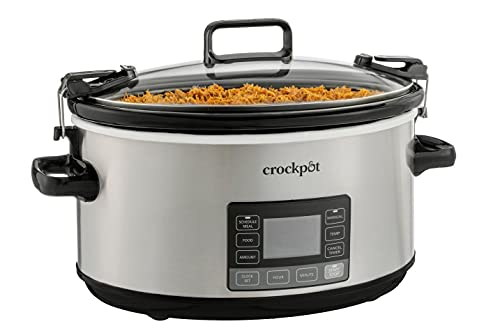
Crock-Pot Programmable Slow Cooker with MyTime, 7-Quart
Badge: Best Programmable
Strengths
- MyTime technology adjusts the cooking cycle to the mealtime you set, which attacks the classic slow-cooker problem of food overcooking when your day runs long.
- The Cook & Carry locking lid clamps down for transport, so a finished pot of soup can actually travel to a potluck without riding in a towel-lined box.
- You still get a stoneware cooking insert at a full 7-quart size, so programmability does not cost you capacity or change the cooking surface.
Trade-offs
- Programmable electronics add a failure point a manual dial never has, and the control panel takes a few uses to learn.
- The locking lid and its gasket need a careful wash after every saucy cook, or yesterday’s chili perfumes tomorrow’s oatmeal-adjacent mistake.
- At 7 quarts with a locking lid assembly, this is one of the bulkier footprints in this guide for a small counter.
Key specs (from the verified listing):
- Capacity: 7-quart
- Serves: 9+ people
- Technology: MyTime adjusts cooking to your schedule
- Lid: Cook & Carry locking lid
- Exterior: Stainless steel
Take the classic 7-quart stoneware formula and add a brain. The MyTime system is the headline: instead of a fixed countdown that flips to Warm whenever it ends, it adjusts the cooking profile around the serving time you enter, which is a genuinely useful answer to the most common slow-cooker complaint — dinner that was perfect at five and tired by seven. The locking Cook & Carry lid is the second practical win, sealing the crock for transport in a way a loose glass lid never can. Underneath the electronics, the cooking itself is still stoneware-based, low and slow.
The MyTime model answers the objection that stoneware slow cooking belongs to people with predictable lives. Its cooking surface keeps the stoneware story intact while the scheduling technology absorbs the unpredictability — you set the mealtime, the cooker adjusts, and the food still spends its day in a ceramic crock rather than a coated insert. For households balancing material preferences against two jobs and a commute, this is the compromise that does not feel like one.
Best for: busy households that want stoneware cooking plus mealtime scheduling and a travel-ready locking lid / Not suited for: minimalists who distrust control panels and want a dial

Aroma Housewares ARC-150SB Digital Multicooker, 20-Cup Cooked
Badge: Best Multitasker
Strengths
- Three appliances in one footprint: the verified listing covers rice cooking, slow cooking and steaming in a single digital unit.
- The 20-cup cooked capacity is family-and-gathering scale, far beyond what the compact cookers in this guide can hold.
- Digital controls give you set-and-leave convenience across all three functions instead of a single-purpose dial.
Trade-offs
- The verified title confirms a stainless steel exterior, not the material of the inner cooking pot, so anyone strict about food-contact surfaces should confirm the pot material with the manufacturer before buying.
- A multi-function unit this large is a poor fit for small daily batches; the big pot wants to be filled.
- Slow cooking here is one function among three, so it lacks the deep, single-purpose simplicity of a dedicated stoneware crock.
Key specs (from the verified listing):
- Capacity: 20-cup cooked (10-cup uncooked)
- Functions: Rice cooker, slow cooker and food steamer
- Controls: Digital
- Exterior: Stainless steel (SS) exterior
The ARC-150SB is Aroma’s big digital multitasker: a 20-cup cooked capacity with rice cooking, slow cooking and steaming under one stainless steel shell. For a household that slow-cooks in the same week it steams vegetables and cooks rice for a crowd, one appliance doing all three is a real counter-space argument. The honest caveat belongs up front: the verified listing specifies the exterior material, not the inner pot’s, so the food-contact question needs a manufacturer check if that is your deciding factor. As a slow cooker it trades the stoneware tradition for digital flexibility and sheer volume.
This Aroma earns its slot on a functional technicality that matters: its verified title explicitly lists slow cooking among its functions, which the pool’s pure rice cookers cannot claim. Treat it as the multitasker’s route into slow cooking rather than the purist’s. The disclosure bears repeating in the review itself: the listing confirms a stainless steel exterior and digital controls, and does not state the inner pot material — so if the food-contact surface is your deciding factor, this model asks you to do one more piece of homework than the stoneware picks above.
Best for: multitaskers who want slow cooking alongside big-batch rice and steaming in one digital unit / Not suited for: material purists who need the inner-pot surface confirmed before buying
Compact Manual Stoneware Slow Cooker (Prose-Only Archetype)
Badge: Best for Small Households
Strengths
- A small stoneware crock matches one- or two-person portions, so food sits at a sensible depth instead of spreading thin across an oversized pot.
- Glazed stoneware is the cooking surface this archetype exists for: no nonstick coating on the food-contact side.
- Manual controls keep the price tier low and the operation obvious.
Trade-offs
- No timer or programmability is typical at this level; you manage the switch to Warm yourself.
- Small capacity is a hard ceiling for batch cooking or entertaining.
- Archetype guidance cannot promise a specific model’s fit and finish — check the individual listing before buying.
Archetype checklist (features to verify on any listing):
- Archetype size class: Small-format stoneware slow cooker
- Cooking surface: Glazed stoneware insert (the defining feature of this archetype)
- Controls: Manual dial, High / Low / Warm
This slot is deliberately prose-only. The verified pool for this guide did not include a compact stoneware slow cooker we could link with confidence, so rather than point you at a rice cooker wearing the wrong label, this archetype describes what to search for: a small-format slow cooker whose insert is glazed stoneware, with a simple High / Low / Warm dial. In this size class the stoneware surface, portion-appropriate depth and dead-simple controls matter more than any program menu. Use the spec points here as a checklist against any listing you find.
In the context of this guide, the compact archetype matters because material-conscious shoppers in small households are the worst served by the mainstream market, which concentrates its stoneware range at family sizes. A small stoneware crock keeps the surface story intact at a portion size that actually cooks properly for one or two people — and a properly filled small crock will out-cook a large crock running a quarter full every time.
Best for: one- and two-person households wanting a stoneware surface at the right portion size / Not suited for: anyone cooking for guests or batching for the freezer
Prose-only archetype: no purchase link is attached to this slot, so you can shop the description against any retailer and verify the material claims yourself.
Divided-Insert Stoneware Slow Cooker (Prose-Only Archetype)
Badge: Best for Entertaining
Strengths
- A divided stoneware insert cooks a main and a side — or two sauces — in one appliance on one counter footprint.
- The cooking surface stays glazed stoneware, keeping the material story consistent with the rest of this guide.
- For entertaining, two warm dishes holding in one unit beats juggling a second appliance.
Trade-offs
- Each compartment is small, so this format serves sides and sauces better than a family main.
- Divided inserts are a niche format; replacement inserts can be hard to source later.
- This is archetype guidance, not a verified product — confirm insert material on any specific listing.
Archetype checklist (features to verify on any listing):
- Archetype format: Stoneware slow cooker with a divided or double insert
- Cooking surface: Glazed stoneware
- Best use: Two dishes at two stages in one cook
Also prose-only, this archetype covers the divided-insert stoneware slow cooker: one heating base, a stoneware insert split into two compartments. It is a genuinely useful format for dips, sauces and two-part meals, and it keeps the food in contact with glazed stoneware rather than coated metal. The verified pool offered no linkable example, so we describe the format honestly instead of attaching a link to a product that does something else. Judge any candidate by insert material first, compartment size second, and controls last.
The divided-insert archetype serves the entertaining case this guide’s linked picks handle least well: two warm dishes, one appliance, no coated anything. Dips, sauces and sides are exactly the foods that sit longest at serving temperature, which makes the stoneware surface more relevant here, not less — a cheese dip held warm for three hours is a long-contact food by any definition.
Best for: hosts serving two warm dips, sauces or sides from one appliance / Not suited for: families needing one large main dish per cook
Prose-only archetype: no purchase link is attached to this slot, so you can shop the description against any retailer and verify the material claims yourself.
Stoneware Slow Cooker with Hinged Lid (Prose-Only Archetype)
Badge: Best for Serving
Strengths
- A hinged lid opens and stays up for serving, which solves the eternal buffet problem of where to put a wet, steaming lid.
- The cooking surface remains glazed stoneware, consistent with the material standard of this guide.
- For hosts, serving from the cooker keeps food at serving temperature through the whole event.
Trade-offs
- The hinge mechanism adds a cleaning crevice that a plain loose lid does not have.
- This is a serving-focused format; it does not add cooking capability over a standard crock.
- Archetype guidance only — no hinged-lid model was verified in this article’s pool.
Archetype checklist (features to verify on any listing):
- Archetype format: Stoneware slow cooker with counter-hinged lid
- Cooking surface: Glazed stoneware insert
- Best use: Serving straight from the cooker at gatherings
The third prose-only archetype in this guide covers the hinged-lid stoneware slow cooker, a serving-oriented variant where the lid stays attached and flips up for buffet-style access. The verified pool contained no linkable example, so the slot stays unlinked on principle. If you entertain often, the format is worth hunting for with the same checklist as the rest of this guide: glazed stoneware insert first, honest capacity second, and the hinge treated as a serving convenience rather than a cooking feature.
The hinged-lid archetype rounds out the serving picture: at a buffet, the lid is opened dozens of times, handled with wet hands and set down on counters — a plain lid is a small recurring hazard and mess. Keeping the lid attached and the stoneware story unchanged makes this the host’s variant of the same material-first philosophy that runs through the whole guide.
Best for: buffet and potluck hosts who serve straight from the cooker / Not suited for: cooks shopping for advanced programmability
Prose-only archetype: no purchase link is attached to this slot, so you can shop the description against any retailer and verify the material claims yourself.
Related reading: our guide to Best Nontoxic Rice Cookers takes the neighbouring question in the same depth.
Finally, our guide to Best Oil To Season Infared Cookers With is worth a look for readers still choosing between formats.
Comparison Table
| Pick | Badge | Capacity / Format | Cooking Surface / Construction | Check |
|---|---|---|---|---|
| Crock-Pot Oval Manual Slow Cooker, 7-Quart | Best Overall | 7-quart | Removable oval stoneware | Check on Amazon |
| Crock-Pot Programmable Slow Cooker with MyTime, 7-Quart | Best Programmable | 7-quart | 9+ people | Check on Amazon |
| Aroma Housewares ARC-150SB Digital Multicooker, 20-Cup Cooked | Best Multitasker | 20-cup cooked (10-cup uncooked) | Rice cooker, slow cooker and food steamer | Check on Amazon |
| Compact Manual Stoneware Slow Cooker (Prose-Only Archetype) | Best for Small Households | Small-format stoneware slow cooker | Small-format stoneware slow cooker | Prose-only |
| Divided-Insert Stoneware Slow Cooker (Prose-Only Archetype) | Best for Entertaining | Stoneware slow cooker with a divided or double insert | Stoneware slow cooker with a divided or double insert | Prose-only |
| Stoneware Slow Cooker with Hinged Lid (Prose-Only Archetype) | Best for Serving | Stoneware slow cooker with counter-hinged lid | Stoneware slow cooker with counter-hinged lid | Prose-only |
How to Choose a Slow Cooker That Fits Your Kitchen
Start with the cooking surface, because it is the decision this category turns on. A slow cooker holds food at temperature for hours, so the insert material gets more contact time with your dinner than any pan you own. Glazed stoneware is the traditional answer and the one most lower-tox shoppers land on: it is a ceramic surface, it tolerates decades of use, and it does not depend on a thin coating staying intact. Coated metal inserts exist in multi-function machines and cook perfectly well, but the coating is a wear item. Decide which side of that trade you are on before you look at a single control panel.
Size by people, then by leftovers. A useful rule is roughly a quart of capacity per person for a main dish, plus a margin if you batch-cook. Two people who cook fresh most nights live happily in the compact classes. A family of four lands at 6 quarts. The 7- and 8-quart models earn their counter space when you cook roasts, double batches for the freezer, or feed a crowd — and they punish small batches, because a shallow layer of food in a huge crock cooks faster and dries sooner than the recipe expects. Buy for your typical Tuesday, not your biggest holiday.
Manual versus programmable is a lifestyle question. A manual dial is cheaper, simpler and effectively immortal, but it cooks until you turn it off. A programmable model with a timer and an automatic Warm shift forgives a long commute. Scheduling systems that adjust the cook to a target mealtime forgive even more. If your workdays are predictable and someone is home, manual is honestly enough. If your days routinely run long, programmability is not a luxury feature — it is the difference between dinner and a dried-out apology.
Lids, weight and cleanup decide long-term satisfaction. A glass lid lets you check without lifting and losing heat. A locking lid matters only if the cooker will travel. Weight matters every single week: a full stoneware crock is heavy, and dishwasher-safe inserts and lids turn cleanup from a project into a non-event. Finally, measure your cabinet or counter before ordering — the big oval models are wider than most people picture.
Readers comparing across the category may also find our guide to Best Nontoxic Rice Cookers And Steamer useful before deciding.
How to Use, Clean and Maintain a Slow Cooker
Setting up well is most of slow cooking. Fill the crock between half and two-thirds full for the most predictable results: less and food can scorch at the edges, more and a full crock can bubble against the lid and cook unevenly. Dense vegetables and root vegetables go at the bottom, closest to the heat; meat sits on top of them so its juices season everything below. Resist lifting the lid to check — every peek dumps the accumulated heat and can add a meaningful stretch to the cooking time. Season assertively, because long gentle cooking softens spice impact, and add delicate herbs, dairy and quick-cooking vegetables near the end rather than at the start.
Cleaning stoneware the right way keeps it alive for decades. Let the crock cool before it meets water; plunging a hot stoneware insert into a cold sink is how thermal-shock cracks happen. Most everyday residue releases with a warm soak and a soft sponge. Baked-on rings respond to a paste of baking soda and patience rather than metal scouring. If your insert is dishwasher-safe, the machine can do the work, though hand-washing keeps glazes looking better over the years. Dry the heating base with a wipe only — it never goes in water.
Maintenance is mostly inspection. Check the cord for damage, look at the crock for crazing or chips before a long unattended cook, and make sure the lid sits flat without rocking. A cooker that heats unevenly, cycles oddly or shows a cracked insert should be retired from unattended duty. Store the crock with the lid ajar or a cloth between lid and rim so yesterday’s stew does not perfume the cabinet.
Troubleshooting
Problem: Food is still undercooked at the end of the recipe time. → Check the fill level first (an overfilled crock cooks slowly), confirm the lid sat sealed the whole time, and remember that every lid lift costs heat; add time in 30-minute blocks on Low rather than blasting on High at the end.
Problem: Everything comes out watery and bland. → Long cooking releases vegetable and meat juices that never evaporate under a lid. Reduce added liquid next time, remove the lid for the final stretch to let the sauce reduce, or stir in a small slurry near the end to body it up.
Problem: Food overcooks or dries out on workdays. → Your cooker is finishing long before you get home. Drop to a model with a timer and automatic Warm, choose recipes written for longer windows, or start with colder ingredients so the ramp-up is gentler.
What “Non Toxic” Can and Cannot Mean for a Slow Cooker
The phrase “non toxic” is a shopping shorthand, not a regulated certification, and it is worth being precise about what shoppers usually mean by it. The concern is almost always the food-contact surface: traditional nonstick coatings are the thing being avoided, whether from worries about coating wear, high-heat behaviour or simply a preference for inert materials. Against that concern, glazed stoneware and other ceramics are the category’s long-standing answer — the surface is the material, all the way through, so there is nothing thin to wear off.
What the shorthand cannot promise is a chemical audit of an entire appliance. Housings, lids, gaskets and exterior finishes are separate materials with separate considerations, and no honest guide can certify a whole product from a listing. The practical approach this guide takes is to rank what can be verified: the cooking surface first, stated plainly per model, with unknowns labelled as unknowns. Readers who want deeper assurance on a specific model should ask the manufacturer directly about the insert and lid materials — and a maker who answers clearly is telling you something good about themselves.
Stoneware, Coated Metal and the Honest Middle Ground
Stoneware’s virtues are boring in the best way: it heats gently, holds temperature steadily, shrugs off decades of sauces, and goes from cooker to table without embarrassment. Its costs are weight and fragility — it is pottery, and it wants to be treated like pottery around sinks and cold water. Coated metal inserts are lighter, heat faster and suit multi-function machines that must also sauté or steam under pressure of a menu’s promises; their surface is a finish with a lifespan, maintained by gentle utensils and honest expectations.
The middle ground is occupied by ceramic-coated and ceramic inserts, which appear in this guide’s archetype slots: easier release than bare surfaces, no conventional nonstick layer, and gradual ageing rather than sudden failure. None of these surfaces makes dinner taste different. The choice is about maintenance style, lifespan expectations and which material story you want in your kitchen for the next decade — which is exactly why this guide states each linked model’s surface facts and lets you decide with open eyes.
Getting More from Your Slow Cooker: Timing, Texture and Leftovers
Low and High are not two temperatures so much as two timelines. Both settings aim at the same gentle simmer; High simply gets there faster. That is why recipes convert imperfectly — a dish written for eight hours on Low is rarely the same dish in four on High, because some transformations, like collagen melting out of a tough cut, are time-dependent rather than temperature-dependent. When a recipe matters, cook it as written the first time and adjust from evidence, not from arithmetic.
Texture is managed at the margins. Slow cooking softens everything it touches, which is glorious for braises and fatal for anything meant to stay distinct. Potatoes hold up better than pasta, which should almost always be cooked separately and combined at serving. Grains like barley can go in from the start; rice swells and thickens a soup into a porridge if it rides the whole cook, so add it late or cook it apart. Dairy splits and dulls over long heat — stir it in at the end, off the boil, and it stays silky.
Browning is the flavour cheat code. The crock cannot brown, full stop: moist heat below boiling never triggers the reactions that make seared meat taste like itself. A hard sear in a pan before loading, or even just browning the onions and tomato paste for a stew, adds a depth the long cook then distributes through the whole pot. It costs one pan and ten minutes. For weeknight cooking you may skip it; for a dish you care about, it is the highest-value step in the entire recipe.
Leftovers are where slow cookers quietly pay rent. A big crock turns one cooking session into several meals, and most braises and soups genuinely improve overnight as flavours marry in the refrigerator. Cool leftovers promptly, refrigerate them in shallow containers rather than in the deep crock itself, and reheat them thoroughly. The stoneware insert can go from fridge back to serving duty beautifully for a gentle reheat, but let it lose its chill on the counter briefly first — thermal shock is as unkind to cold crocks meeting high heat as to hot ones meeting cold water.
A small note on beans and safety. Dried beans are one of slow cooking’s great economies, with one established caution: kidney beans and their relatives should be boiled vigorously on the stovetop for a stretch before slow cooking, because the gentle crock may not reach the temperature that neutralises a natural toxin they carry raw. Canned beans sidestep the issue entirely. It is a thirty-second piece of knowledge that belongs in every slow-cooker household.
Finally, learn your own cooker’s personality. Two cookers at the same setting can run noticeably differently — one eager, one lazy — and recipe times are written for an imaginary average. The first few cooks in a new machine are calibration: note when dishes actually finish, whether your Low runs hot, and how full you tend to load. After that, the timings in your head belong to your cooker, and the recipes start landing on time.
For the adjacent format, see our guide to Best Nontoxic Rice Cookers With Stainless Steel Inner Pots, which applies the same verified-listing standard.
A note on lids and heat. Slow cookers lose a surprising share of their working heat through a poorly seated lid. When you shop, the lid should sit flat with no rocking and no visible gaps; in use, a rim of condensation around the seal is the sign things are right. If a recipe matters, weigh the lid down with nothing fancier than its own fit — and keep it closed.
Where the cooker lives matters. These appliances vent steam for hours, so a spot under low cabinets will drip condensation back onto the counter and swell the cabinet bottom over time. Give the cooker open air above it, a heat-safe surface under it, and enough cord reach that it never has to sit at the counter’s edge with a full, heavy crock.
On adapting family recipes. Most handed-down slow-cooker recipes assume the 5- to 6-quart generation of crocks. In a 7- or 8-quart model the same recipe spreads thinner and finishes sooner; in a compact model it may not fit at all. Scale liquid conservatively — enclosed cooking keeps almost all of it — and check a new size pairing early the first time, until you know how your cooker and your recipe get along.
Serving from the crock is a feature, not a shortcut. Stoneware inserts are designed to hold heat at the table, which is why they anchor so many buffet and holiday setups. A cooker that travels from base to table in one vessel saves a transfer, a serving dish and a washing-up cycle. If you entertain, weigh that serving life as heavily as the cooking specs — it is half the appliance’s working hours in a sociable household.
What to do with a cooker that runs hot or cold. If every recipe finishes early and dry, your cooker runs hot: favour the fuller end of its fill range, choose recipes with more liquid, and lean on the Warm setting sooner. If dishes lag, check the lid seal and your fill level before blaming the machine. Knowing which way your unit leans is worth more than any single feature on the box.
Common Buying Mistakes
Buying capacity for the biggest day of the year. An 8-quart cooker bought for one holiday spends fifty weeks making small batches cook badly. Size for the weekly routine and borrow or batch in two runs for the rare crowd.
Ignoring the insert material until after checkout. In this category the cooking surface is the purchase. Shoppers who care about coatings and then buy on timer features alone end up returning the machine they meant to love.
Lifting the lid to check progress. It feels harmless and costs real heat every time. Trust the timer, look through the glass, and open once at the end.
Putting a hot stoneware crock into cold water. Thermal shock cracks inserts. Cool first, then soak warm.
Assuming programmable means forgettable forever. Even with a timer and Warm, food safety has limits: a finished cook should shift to Warm and be served or refrigerated within a sensible window, not held all evening and all night.
Our guide to Best Nuwave Cookers covers the closest alternative category, if your shortlist widens.
Final Recommendation
If you buy one cooker from this guide, buy the manual stoneware Crock-Pot: it is the material answer and the simple answer in the same appliance, and it will still be cooking when today’s electronics are antiques. Choose the MyTime programmable model instead if your schedule is the real problem — the stoneware stays, the timing stress goes. Take the Aroma multicooker only if counter space forces consolidation and you have confirmed its pot material to your own satisfaction. And if your household is small, do not force a family-size crock to pretend otherwise: shop the compact stoneware archetype with the checklist in its review, and you will end up with the right cooker even though this guide could not link it for you.
For the Crock-Pot Oval Manual Slow Cooker, 7-Quart, you can Check on Amazon. For the Crock-Pot Programmable Slow Cooker with MyTime, 7-Quart, you can Check on Amazon. For the Aroma Housewares ARC-150SB Digital Multicooker, 20-Cup Cooked, you can Check on Amazon.
We apply the same honesty rules in our guide to Best Of Old Pressure Cookers, if that format is also on your table.
Frequently Asked Questions
Is stoneware really the lower-tox choice for slow cooking?
For most shoppers, yes, and it is the simplest reasoning in this guide: glazed stoneware is a ceramic surface, so the food-contact layer is not a coating that can wear, scratch or age out. It is also the traditional material for the category, which means the widest choice of sizes and prices. The trade-offs are weight and fragility rather than surface chemistry.
Can I leave a slow cooker running while I am at work?
That is the use case the category was built around, with two conditions: the cooker should be in good condition with an undamaged cord and insert, and the recipe window should match your absence. Programmable models that switch to Warm, or adjust cooking to a set mealtime, widen the safe and tasty window considerably. Place the cooker on a heat-safe surface with clearance around it, as you would any heating appliance.
What size slow cooker does a family of four need?
Six quarts is the reliable answer for a family of four cooking mains: a whole chicken fits, a batch of soup fits, and leftovers are modest. Step up to 7 or 8 quarts if you regularly cook for guests, double-batch for the freezer, or braise very large cuts. Step down only if most meals are for one or two people.
Why does my slow cooker food taste blander than the stovetop version?
Three reasons compound: liquid never evaporates under the lid so flavours dilute, long heat softens spices, and browning — which builds deep flavour — does not happen in a crock. Brown meat and bloom spices in a pan first when a recipe matters, season a little more boldly than instinct suggests, and finish with something fresh and acidic at serving time.
Are programmable models worth it over a manual dial?
If someone is home to flip the switch, often not — a manual cooker is simpler and can last decades. If your schedule is unpredictable, programmability pays for itself in saved dinners: a timer with automatic Warm prevents the overcooked-by-seven problem, and mealtime-adjusting systems prevent it more gracefully still.
How long will a stoneware crock last?
Treated gently — cooled before washing, kept out of thermal shock, not dropped — a stoneware insert can serve for decades. The usual causes of death are cracks from temperature shock and chips from sink impacts, not wear from cooking. The heating base and its controls typically decide the appliance’s lifespan long before the crock does.


