Disclosure: topratedkitchenware.com is reader-supported. When you buy through links on our site, we may earn an affiliate commission from Amazon and other retailers, at no extra cost to you.
Where to buy
All six picks in this guide to best coffee pot makers are listed on Amazon, where you can check the latest price on Amazon, confirm the exact variant and colour, and read the current listing details before ordering. Listings, bundles and stock change, so match the full model name on the listing to the pick reviewed below.
- Best for Hot and Iced: BLACK+DECKER CaféCraft 12-Cup Thermal Coffee Maker — Check on Amazon
- Cuisinart 12-Cup PerfecTemp Thermal Coffee Maker (White) — Check on Amazon
- BUNN Speed Brew Platinum Thermal Coffee Maker CSB3T — Check on Amazon
- Hamilton Beach FlexBrew Advanced 5-in-1 Coffee Maker — Check on Amazon
- KRUPS 12-Cup Programmable Thermal Carafe Coffee Maker — Check on Amazon
- Cuisinart 10-Cup Thermal Classic Coffeemaker DCC-1170BKNAS — Check on Amazon
Read the full guide ↓
Best coffee pot makers is the plain-spoken version of a question millions of households ask: which machine should make the morning pot? This guide answers with six verified drip coffee makers, chosen for the variety of households that ask it — a hot-and-iced BLACK+DECKER, a flexible white Cuisinart with a small-batch setting, BUNN’s speed machine, Hamilton Beach’s FlexBrew that unites drip and single-serve in one body, a three-strength KRUPS, and Cuisinart’s right-sized 10-cup Thermal Classic. Every pick brews a proper pot into a thermal carafe; they differ in rhythm, capacity and diplomacy, which is to say in everything that decides whether a household loves its machine in year two.
A note on what ‘coffee pot maker’ means in this guide: the drip machine and its pot, bought as one system. That excludes espresso machines, pod-only brewers and pour-over kit — not because they are lesser, but because the household asking this question wants a pot of coffee with the morning’s least possible friction. Readers whose household is split between pot drinkers and pod drinkers should read the FlexBrew review first; it exists for exactly that treaty. Those exploring the wider single-serve border will find related ground in Best Coffee Single Makers.
All six picks were verified against their listings on 2026-11-20, and the guide reports only what those listings support. The recommendations are organised by household rhythm, because in this category rhythm — not specification — is destiny.
Key Takeaways
- The FlexBrew is the split household’s answer: a 12-cup thermal drip side plus a single-serve side for pods or grounds, one footprint.
- The BUNN CSB3T brews a pot fastest by keeping water always ready — the on-demand household’s machine.
- The white Cuisinart’s 1-4 cup setting makes it the variable household’s pick: small pots brewed properly, full pots when needed.
- The KRUPS gives three brew strengths and full programmability; the CaféCraft adds iced coffee to the household repertoire.
- The 10-cup Cuisinart Thermal Classic is the right-sized recommendation for smaller households that brew by the pot.
In this guide
Quick Picks
Six pot makers for six household rhythms: mixed, fast, variable, programmable, two-season and right-sized.
- Best for Hot and Iced — BLACK+DECKER CaféCraft 12-Cup Thermal Coffee Maker: Hot and iced from one programmable 12-cup thermal machine — the two-season household pick. Check on Amazon
- Best for Variable Households — Cuisinart 12-Cup PerfecTemp Thermal Coffee Maker (White): 1-4 cup setting, Brew Pause and strength control in a white thermal Cuisinart. Check on Amazon
- Fastest Brew — BUNN Speed Brew Platinum Thermal Coffee Maker CSB3T: BUNN speed: an always-ready 10-cup thermal brewer for on-demand mornings. Check on Amazon
- Best for Mixed Households — Hamilton Beach FlexBrew Advanced 5-in-1 Coffee Maker: The treaty machine: 12-cup thermal drip plus pods-or-grounds single serve, 60 oz removable reservoir. Check on Amazon
- Best for Strength Control — KRUPS 12-Cup Programmable Thermal Carafe Coffee Maker: Three strengths and 24-hour programming around a double-wall thermal carafe. Check on Amazon
- Best Right-Sized Pot — Cuisinart 10-Cup Thermal Classic Coffeemaker DCC-1170BKNAS: The Thermal Classic in 10 cups: Cuisinart’s lean, right-sized pot maker in black. Check on Amazon
How These Picks Were Chosen
Each pick was cross-checked against its marketplace listing on 2026-11-20 — ASIN, title, capacity, carafe type, modes and controls — and admitted as a genuine drip pot maker with a thermal carafe and a household rhythm it serves distinctively. The FlexBrew’s dual format, the BUNN’s speed architecture and the Cuisinart’s small-batch setting are all stated in their verified titles; nothing in the reviews exceeds what the listings support, and capacities are reported exactly as listed.
The guide is research-led and claims no hands-on testing. Its contribution is the household-rhythm frame: in a category where most machines brew adequately, the differences that persist into year two are rhythm fit, capacity fit and the carafe’s holding quality. Readers comparing brewing formats beyond the pot will find the neighbouring territory in Best Coffee Press Makers, where the manual methods make their own case.
The 6 Best Picks for best coffee pot makers

BLACK+DECKER CaféCraft 12-Cup Thermal Coffee Maker
Badge: Best for Hot and Iced
Strengths
- Hot and iced modes in one machine covers the two ways households actually drink coffee across a year
- Thermal carafe keeps the hot batch hot without a plate, and suits iced prep by starting from a proper brew
- Programmable scheduling keeps the morning routine automatic
Trade-offs
- A dual-mode machine splits its design attention — purists after one perfect hot cup may prefer a specialist
- Thermal carafe care and pouring quirks apply as with all metal carafes here
- Newer line, so its long-term record is still being written
Key specs (from the verified listing)
- Capacity: 12 cups
- Carafe: thermal (per model name)
- Modes: hot and iced coffee (per listing)
- Controls: programmable
- Line: CaféCraft
The BLACK+DECKER CaféCraft thermal coffee maker is the two-season machine in this guide: a programmable 12-cup drip brewer with a thermal carafe that brews both hot and iced coffee. That dual brief matches how households actually live — hot pots through the winter, iced coffee through the summer, one machine on the counter all year. The thermal carafe serves both modes well: it holds the morning’s hot brew without a warming plate stewing it, and a hot-brewed batch destined for ice starts from a properly extracted pot rather than a lukewarm one. Programmability keeps weekday mornings on rails. The honest trade-off is specialisation: a machine that does two jobs well rarely does either with the single-mindedness of a dedicated unit, and coffee purists optimising purely for the hottest, most precise hot cup should look at the Cuisinart or BUNN in this guide. For a household that genuinely drinks both, the CaféCraft’s versatility is the point.
Under the lens of best coffee pot makers, the question for this machine is whether its carafe and brewing brief match how your household actually drinks coffee. Its design spends its budget on the pot drinker’s priorities — a proper brew, held hot by insulation — and that focus is what separates the machines in this guide from the glass-and-hotplate default. If your mornings involve a pot brewed once and drunk over hours, this is the shape of machine that serves them.
Best for: Households that switch between hot coffee and iced coffee across the year and want one programmable machine / Not suited for: Hot-coffee purists who want a single-purpose brewer optimised for one job

Cuisinart 12-Cup PerfecTemp Thermal Coffee Maker (White)
Badge: Best for Variable Households
Strengths
- 1-4 cup setting is the small-batch feature most 12-cup machines fake — it adjusts the brew for partial pots
- Brew Pause lets you pour a cup mid-brew without the drip-and-dash mess
- Thermal carafe plus PerfecTemp brewing covers both heat jobs: brewing hot and staying hot
Trade-offs
- White finish shows coffee splashes and counter stains more than dark finishes
- Full-featured controls mean a small learning curve versus one-button machines
- Premium-tier positioning within this guide’s drip machines
Key specs (from the verified listing)
- Capacity: 12 cups
- Carafe: PerfecTemp thermal carafe (per listing)
- Settings: 1-4 cup setting, Brew Strength control, Brew Pause
- Controls: programmable
- Finish: Stainless Steel / White
This white Cuisinart 12-cup machine is the flexible household brewer of the guide: a programmable PerfecTemp thermal carafe machine with Brew Strength control, a Brew Pause for the impatient first cup, and — the feature that earns its keep — a dedicated 1-4 cup setting. Small batches are where big drip machines usually fail quietly, running water through too fast and under-extracting; a setting designed for partial pots is the difference between a good small brew and a watery apology. The thermal carafe then holds a full pot properly hot for the mornings when the whole household is home. The white and stainless finish suits bright kitchens and shows every splash, which is either a cleaning prompt or an annoyance depending on your temperament. For households whose pot size genuinely varies day to day — two cups on Tuesday, twelve on Sunday — this is the most adaptable machine in the guide.
For shoppers focused on best coffee pot makers, this pick’s case rests on the two heats of drip coffee: brewing hot enough to extract properly, and holding hot without stewing. Its listing addresses both directly, which is rarer than it should be in this category. Judge it against your household’s rhythm — pot size, timing, how long the last cup sits — and it will either clearly fit or clearly not, which is exactly what a good buying guide should make easy.
Best for: Households that brew both small weekday pots and full weekend pots and want both done properly / Not suited for: One-button minimalists, or anyone who always brews the same full pot

BUNN Speed Brew Platinum Thermal Coffee Maker CSB3T
Badge: Fastest Brew
Strengths
- Speed is the franchise: BUNN’s always-ready hot-water design brews a full pot far faster than conventional machines
- Commercial coffee heritage — BUNN builds for diners and offices, and the home line inherits the brief
- Stainless thermal carafe keeps the fast-brewed pot hot without a plate
Trade-offs
- The always-hot reservoir design means the machine is designed to stay plugged in and ready
- 10 cups is slightly less than the 12-cup rivals here
- The brief is speed and reliability, not programmable scheduling theatre — check the listing for the control set
Key specs (from the verified listing)
- Capacity: 10 cups
- Carafe: thermal (per model name)
- Line: Speed Brew Platinum
- Model: 55200 CSB3T
- Finish: Stainless Steel / Black
- Brand: BUNN (commercial coffee heritage)
The BUNN CSB3T Speed Brew Platinum is the machine for people who measure coffee makers in minutes: BUNN’s home line borrows the commercial trick of keeping water hot and ready, so a full 10-cup pot brews in a fraction of the time a conventional machine needs to heat from cold. That speed changes behaviour — coffee becomes something you brew on demand, fresh, rather than a pot made in bulk and left to age. The stainless thermal carafe completes the brief by holding the pot hot without a warming plate. BUNN’s commercial heritage shows in the priorities: reliability and throughput over feature lists. The trade-offs follow from the design — it is meant to stay plugged in and ready, capacity is 10 cups rather than 12, and buyers who love programming a brew the night before should confirm the control set on the listing suits them. For impatient households and offices, nothing else in this guide is playing the same game.
Read against best coffee pot makers, this machine is best understood as an answer to a specific household pattern rather than a universal winner. Its capacity, controls and carafe suit one kind of morning; a different pattern is better served by a sibling pick in this guide. That is not a weakness — drip coffee is a daily ritual, and the right ritual fit is worth more than the longest feature list.
Best for: Speed-first households and home offices that brew on demand and hate waiting for a pot / Not suited for: Buyers who want the largest capacity, or a machine that sits unplugged between uses
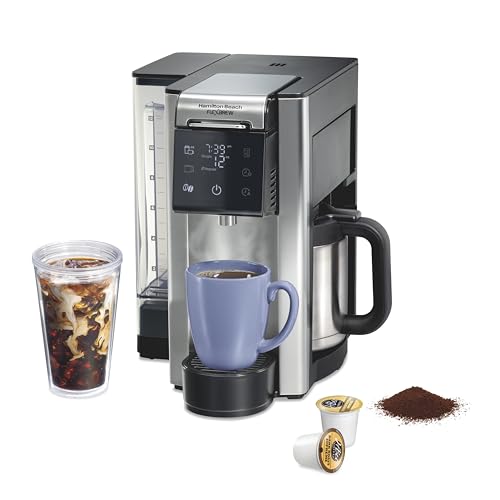
Hamilton Beach FlexBrew Advanced 5-in-1 Coffee Maker
Badge: Best for Mixed Households
Strengths
- Two machines in one footprint: a 12-cup thermal drip brewer and a single-serve side for pods or grounds
- Removable 60 oz reservoir is the easiest fill-and-clean arrangement in this guide
- Hot and iced on both sides covers the widest drink range here
Trade-offs
- A 5-in-1 machine is the most complex device in this guide — more modes, more to learn, more to clean
- Single-serve pod brewing will never match a fresh drip pot for a committed drip drinker
- Counter footprint grows with the dual format
Key specs (from the verified listing)
- Capacity: 12-cup thermal drip side
- Format: 5-in-1 drip and single serve
- Modes: hot and iced
- Brewing: pods and grounds (per listing)
- Reservoir: removable 60 oz reservoir
- Controls: programmable drip side
The Hamilton Beach FlexBrew Advanced is the peace treaty for divided households: one machine with a 12-cup thermal programmable drip side for the pot drinkers, and a single-serve side that takes pods or grounds for the one-cup-at-a-time crowd, with hot and iced modes across the system. The removable 60 oz reservoir is the detail owners will appreciate daily — carry it to the tap, fill it properly, click it back — instead of pouring water into a fixed tank with a measuring jug and hope. The thermal carafe keeps the drip side honest to this guide’s brief: a metal carafe, no warming plate, coffee that stays hot without cooking. Complexity is the price of the treaty: more modes mean more cleaning paths and a learning curve the one-button machines do not impose. For a household genuinely split between pots and pods, it replaces two machines with one and earns its counter space.
Under the lens of best coffee pot makers, the question for this machine is whether its carafe and brewing brief match how your household actually drinks coffee. Its design spends its budget on the pot drinker’s priorities — a proper brew, held hot by insulation — and that focus is what separates the machines in this guide from the glass-and-hotplate default. If your mornings involve a pot brewed once and drunk over hours, this is the shape of machine that serves them.
Best for: Mixed households where some drink drip pots and others drink single-serve pods or grounds / Not suited for: Purists who want one brewing method done with maximum simplicity

KRUPS 12-Cup Programmable Thermal Carafe Coffee Maker
Badge: Best for Strength Control
Strengths
- Three brew strengths is finer control than the usual regular/bold pair
- 24-hour programmability covers the full schedule-ahead routine
- Double-wall thermal carafe with no warming plate is the purest expression of this guide’s brief
Trade-offs
- KRUPS support and parts presence varies by region compared with the biggest US brands
- Thermal carafe pouring and cleaning habits apply as with all metal carafes
- Feature-rich controls reward owners who read the manual once
Key specs (from the verified listing)
- Capacity: 12 cups
- Carafe: double-wall thermal carafe
- Heat retention: keeps coffee hot for hours (per listing)
- Controls: 24-hour programmable, 3 brew strengths
- Design: no warming plate
The KRUPS 12-cup thermal machine is the control enthusiast’s drip brewer: 24-hour programmability, three brew strengths instead of the usual two, and a double-wall thermal carafe explicitly designed to keep coffee hot for hours with no warming plate at all. That last point is the philosophy of this guide in one product decision — heat retention by insulation, never by cooking. Three strengths sounds like a small thing until a household contains both a mild-morning drinker and a bold-or-nothing drinker; the middle setting ends arguments. KRUPS brings a European design sensibility to the brief, with the one caveat that its parts and support footprint is thinner in some regions than the giant US brands. For a household that will use the programmability and the strength range rather than admire them, this is one of the most complete thermal-carafe packages in the guide.
For shoppers focused on best coffee pot makers, this pick’s case rests on the two heats of drip coffee: brewing hot enough to extract properly, and holding hot without stewing. Its listing addresses both directly, which is rarer than it should be in this category. Judge it against your household’s rhythm — pot size, timing, how long the last cup sits — and it will either clearly fit or clearly not, which is exactly what a good buying guide should make easy.
Best for: Households with mixed strength preferences that brew ahead on a schedule / Not suited for: Buyers who want the deepest local parts network, or one-button simplicity

Cuisinart 10-Cup Thermal Classic Coffeemaker DCC-1170BKNAS
Badge: Best Right-Sized Pot
Strengths
- 10-cup size is the right-sized pot for many households — less brewed-and-wasted coffee
- Cuisinart build and the Thermal Classic line’s straightforward brief: program it, brew, keep hot
- Black finish is the low-maintenance cosmetic choice
Trade-offs
- Two cups less than the 12-cup rivals — bigger households will brew twice
- A more classic, simpler brief than the feature-stacked Cuisinart 12-cup in this guide
- Thermal carafe care applies as with the rest of the category
Key specs (from the verified listing)
- Capacity: 10 cups
- Carafe: thermal (per model name)
- Controls: programmable
- Line: Thermal Classic
- Model: DCC-1170BKNAS
- Finish: Black
The Cuisinart DCC-1170BKNAS Thermal Classic is the right-sized Cuisinart: a programmable 10-cup machine with a thermal carafe, in black, without the feature stack of its 12-cup sibling. Ten cups is a quietly sensible capacity — it matches what many households actually drink in a morning, which means less coffee brewed to be thrown away and a carafe that gets emptied while it is still at its best. The brief is classic in the deliberate sense: set the programme the night before, wake to a brewed pot, and let the thermal carafe hold it hot without a plate. Buyers cross-shopping within this guide should see it as the simpler, smaller Cuisinart option — the 12-cup PerfecTemp model adds capacity and small-batch settings, this one keeps the routine lean. For one- and two-coffee-drinker households that still brew by the pot, it is the proportionate choice.
Read against best coffee pot makers, this machine is best understood as an answer to a specific household pattern rather than a universal winner. Its capacity, controls and carafe suit one kind of morning; a different pattern is better served by a sibling pick in this guide. That is not a weakness — drip coffee is a daily ritual, and the right ritual fit is worth more than the longest feature list.
Best for: Smaller households that brew by the pot and want Cuisinart’s thermal format in a 10-cup size / Not suited for: Large households that will regularly want a 12-cup pot
Comparison Table
Six rhythms, six machines. Capacity and standout trait are the quick sort; the reviews supply the reasoning.
| Pick | Format | Capacity | Standout trait | Link |
|---|---|---|---|---|
| BLACK+DECKER CaféCraft 12-Cup Thermal Coffee Maker | Countertop | 12 cups | Hot and iced modes | Check on Amazon |
| Cuisinart 12-Cup PerfecTemp Thermal Coffee Maker (White) | Countertop | 12 cups | True 1-4 cup setting | Check on Amazon |
| BUNN Speed Brew Platinum Thermal Coffee Maker CSB3T | Countertop | 10 cups | Always-ready speed brewing | Check on Amazon |
| Hamilton Beach FlexBrew Advanced 5-in-1 Coffee Maker | Countertop | 12-cup thermal drip side | Drip + single-serve in one | Check on Amazon |
| KRUPS 12-Cup Programmable Thermal Carafe Coffee Maker | Countertop | 12 cups | 3 strengths, 24-hour programme | Check on Amazon |
| Cuisinart 10-Cup Thermal Classic Coffeemaker DCC-1170BKNAS | Countertop | 10 cups | Right-sized 10-cup classic | Check on Amazon |
How to Choose a Coffee Pot Maker for Your Household
Begin with the household census, because pot makers are bought per household, not per person. How many coffee drinkers, drinking how much, on what schedule, with what disagreements? A single-rhythm household — everyone up at seven, everyone drinking the same pot — is served by almost anything here, and should choose on carafe quality and simplicity: the Thermal Classic or the KRUPS. Every complication in the census maps to a machine in this pool: staggered schedules to programmability or BUNN speed, variable pot sizes to the white Cuisinart, split formats to the FlexBrew, seasonal iced drinking to the CaféCraft.
Capacity follows the census with arithmetic rather than aspiration. A ‘cup’ in drip listings is a small measure, and a household’s real consumption is best counted in mugs: roughly two listing-cups per generous mug. Two drinkers with two mugs each is an eight-cup morning — inside a 10-cup machine with headroom, straining a smaller one, wasting a 12-cup machine’s extra only if it is brewed and discarded. Brew what you drink; the thermal carafe rewards a right-sized pot by emptying while the coffee is still at its best.
Then weigh the two heats, as this programme’s coffee guides consistently advise: brewing heat, which decides extraction quality, and holding heat, which decides the last cup. Every pick here holds by insulation in a thermal carafe — the category’s modern default for good reason. Brewing heat differentiates more quietly, through the machines’ stated systems and temperature briefs. Black-coffee households should weight it; milky-coffee households can weight rhythm and capacity instead and lose nothing they will taste.
End with the counter and the sink. The FlexBrew’s dual format is the pool’s largest commitment of counter space and cleaning paths; the Thermal Classic is the leanest. Reservoirs matter daily: the FlexBrew’s removable 60 oz reservoir is the easiest fill in the pool, while fixed tanks ask for a jug and a steady hand. These mundane interfaces — filling, pouring, washing — are touched twice a day for years, and they deserve a full vote in the decision. The reservoir-first comparison continues in Best Coffee Makers With Removable Water Reservoir for households that rank it top.
How to Brew a Better Pot: The Household Routine
The pot maker’s daily routine rewards three habits. First, fresh inputs: coffee bought in sensible quantities, stored airtight, and measured consistently — the machine cannot average out stale beans, and consistency of dose is what makes a household’s preferred strength setting meaningful. Second, water discipline: fill the reservoir with fresh water for each brew rather than topping up yesterday’s, and descale on schedule for your water’s hardness, because scale quietly steals the brew temperature the whole category is built on.
Third, carafe discipline: pre-warm a thermal carafe with a hot rinse on cold mornings, keep its lid closed between pours, and wash it weekly with a brush so invisible oils never season the steel. Brew Pause features — the white Cuisinart lists one — are for the single impatient cup, not a pouring style; let the pot finish before the household descends, and the last cup will justify the wait. A finished pot, held in a closed thermal carafe, is good for the whole morning; treat that window as the pot’s life and brew the next one fresh rather than nursing the old.
For the pool’s special citizens, two adaptations. FlexBrew households should keep the two sides’ cleaning separate in their minds — the drip side’s carafe routine and the single-serve side’s pod disposal are different rituals sharing one reservoir. BUNN households should embrace the always-ready design: the machine is meant to stay plugged in, and its speed is the reward for that small standing commitment. Every machine in this pool has a rhythm it was designed for; the routine above is how a household moves into it.
Troubleshooting
- Problem: the pot tastes weaker than last month → scale is stealing brew temperature or the dose has drifted; descale the machine and re-measure the coffee dose deliberately for a week.
- Problem: coffee overflows the filter basket → too fine a grind or too much coffee for the basket; coarsen slightly, dose to the maker’s measure, and never tamp a drip basket.
- Problem: the first cup is strong and the last is thin → the pot was poured during brewing, before the full cycle homogenised it; wait for the cycle to finish, then give the carafe one gentle swirl before pouring.
The Split Household and the Treaty Machine
The most common modern coffee conflict is not strength but format: one partner drinks pots, the other drinks pods; one wants a carafe on the table, the other wants a single cup at an unrelated hour. Households used to solve this with two machines and a crowded counter. The FlexBrew’s presence in this pool marks the market’s answer — one body, a 12-cup thermal drip side and a single-serve side taking pods or grounds, fed by a removable 60 oz reservoir. It is the only pick here that ends the format war rather than refereeing it.
Treaties have costs, and the guide states them in the review: the pool’s largest footprint and its most complex cleaning. The question for a split household is whether the war’s daily friction exceeds the treaty’s — and for genuinely split households it usually does, within the first month. United households, meanwhile, should not buy the treaty out of novelty: a single-format machine does one job with fewer paths to clean, and simplicity compounds daily. Know which household you are.
Speed as a Household Philosophy
The BUNN’s always-ready design embodies a philosophy worth examining beyond its own review: that coffee should be brewed at the moment of wanting, in the quantity of the wanting. Scheduled programmability — the rest of this pool’s rhythm — embodies the opposite philosophy: coffee as a prepared environment, waiting when you wake. Neither is superior; they suit different relationships with the morning. Programmed households tend to keep fixed hours and drink together; on-demand households keep irregular hours and drink individually, and for them a fast full pot on request beats a scheduled pot going stale.
The interesting households are the mixed ones — scheduled weekdays, chaotic weekends — and for them the pool offers a genuine choice rather than a compromise: a programmable machine used on demand at weekends (accepting the heat-up wait), or the BUNN used as the household’s metronome (accepting its always-on design). This guide’s advice is to choose by the weekday, because there are five of them, and let the weekend adapt. Rhythm decisions, like capacity decisions, should be made by the majority of your mornings.
Iced Coffee at Home: The CaféCraft’s Second Season
Iced coffee is the fastest way a pot maker’s job description expands, and it deserves more than the passing mention most guides give it. The naive method — yesterday’s hot pot, refrigerated, poured over ice — produces a drink that tastes like a memory. The designed method, which the CaféCraft lists as a mode, brews with dilution in mind: a concentrated hot brew that meets ice and lands at drinking strength, with the thermal carafe keeping the un-iced remainder honest for the household’s hot drinkers. One machine, two temperatures of drinker, no second appliance colonising the counter.
Households in warm climates, or with teenagers, or with an afternoon-coffee culture, will find the iced mode moves from novelty to routine within a month of summer. Households in the opposite situation should discount it accordingly and let the pool’s other rhythms lead. As with every section of this guide, the advice is census-based: count the iced drinks your household actually drank last summer, and let that number — not the feature’s charm — cast the vote.
Second Pots and Small Pots: The Mid-Morning Question
Every pot household eventually faces the mid-morning question: the first pot is gone, two people want one more cup each, and a full second pot would be waste. The pool answers it three ways, and the answers are a tidy summary of its range. The white Cuisinart’s 1-4 cup setting brews the small pot properly, as a designed act. The BUNN brews a fresh full pot so quickly that the waste question shrinks — though the honest household still brews only what it drinks. The FlexBrew’s single-serve side simply dissolves the question: one cup, one drinker, no pot at all.
Notice that each answer belongs to a different household philosophy — design, speed, format — and that the household which asks the mid-morning question daily should let its preferred answer steer the main purchase. Occasional questions deserve improvised answers; daily questions deserve machines. That principle, applied across this guide’s sections, is the closest thing to a universal rule the category offers.
The Pot as Household Infrastructure
A coffee pot maker is infrastructure in a way few appliances are: it sets the morning’s first timestamp, anchors the kitchen’s geography, and its failure is noticed before breakfast rather than during it. Infrastructure thinking changes how you buy. Reliability and serviceability outrank novelty; the reservoir you fill half-asleep outranks the programme you set once; the carafe that survives the household’s clumsiest member outranks the one with the prettiest silhouette. This pool was assembled with that hierarchy in mind, which is why its picks come from manufacturers with parts catalogues and why the reviews keep returning to filling, pouring and washing.
Infrastructure also deserves a succession plan. Know the machine’s wear points — carafe lids, reservoir seals, the showerhead that wants an occasional wipe — and know that its maker’s parts channel exists before you need it. Keep the model number with the household documents. When a part eventually wears, a household with a plan is inconvenienced for days; a household without one is shopping for a whole machine under breakfast pressure, which is how bad second purchases happen.
Bought this way — rhythm first, capacity honestly, interfaces weighted, succession planned — a pot maker stops being a product and becomes what it secretly always was: the household’s first utility of the day. The six machines in this pool can all hold that office. The reviews above exist to help you elect the right one.
One last piece of infrastructure thinking concerns the coffee itself, because a pot maker is only as good as its supply chain. Households that love their machine tend to standardise a house coffee — a bean and a dose that the machine’s strength setting was tuned around — and then experiment at the edges rather than reinventing every bag. Standardisation sounds unromantic and is in fact how cafés achieve consistency; the home version simply means your Tuesday pot tastes like your Monday pot, and a new bag becomes an event rather than a variable. The machine you choose from this pool will hold up its end of that arrangement for years; the house coffee is your end of it.
And when the machine’s first year closes, do the infrastructure review: descale it, wash the carafe properly, check the lid and reservoir seals, and note honestly whether the household’s rhythm has drifted from the census you bought for. Households change — a baby, a job shift, a teenager converted to coffee — and the right response to drift is sometimes a setting, sometimes a second small machine, and only rarely a replacement. The pot maker you chose well will absorb most drift on its own; the review exists so that you notice the rest before it becomes a daily irritation.
Infrastructure, finally, is allowed to be a pleasure. The first pot of a cold morning, brewed by a machine that fits the household like a glove, is one of domestic life’s reliable small ceremonies — and it is built, unglamorously, out of every decision this guide has walked through: the right rhythm, the honest capacity, the clean carafe, the descaled boiler. Ceremonies that rest on good infrastructure do not need luck. That is the deepest reason to buy a pot maker carefully, and the note on which this guide is happy to end.
Common Buying Mistakes
Pot-maker purchases go wrong in familiar, avoidable ways:
- Buying for the guest pot. Size for the weekday census; a second brew handles the party better than a year of wasted coffee.
- Solving a format split with a single-format machine. If the household is genuinely split between pots and pods, the treaty machine exists — use it.
- Ignoring the fill interface. You will fill the reservoir half-asleep for years; a removable reservoir or an easy pour is a daily feature, not a detail.
- Pouring mid-brew as a habit. Brew Pause is for emergencies; habitual mid-brew pouring unbalances every pot.
- Letting scale set the flavour. Descale on schedule — brew temperature is the category’s foundation, and scale undermines it silently.
Final Recommendation
Elect by household. Mixed-format households: the FlexBrew, and peace in our time. On-demand households: the BUNN, and a pot at the speed of wanting. Variable households: the white Cuisinart, whose small-batch setting respects Tuesday as much as Sunday. Two-season households: the CaféCraft. Strength-divided households: the KRUPS. And the straightforward pot household — the majority, and the one this keyword literally names — should take the Cuisinart Thermal Classic in 10 cups or step to a 12-cup sibling pick if the census demands it, confident that the simple brief is the one most mornings actually have. Start with the first pick above — Check on Amazon — and only step sideways if its stated limits are the ones your household would hit daily.
Every machine here will brew a good pot tomorrow. The right one will still be brewing the right pot, in the right amount, at the right moment, in year three. That is the whole election, and your household’s rhythm is the only ballot that counts.
Whichever pick you choose, buy it as the start of a routine rather than as a gadget: the households that love their purchase a year later are the ones whose format matched their mornings from day one. Check on Amazon when you are ready to order.
Related guides
Frequently Asked Questions
What is the difference between a coffee pot maker and a single-serve machine?
A pot maker brews a carafe — multiple cups in one cycle, shared across a morning. A single-serve machine brews one cup at a time, often from pods. Households divide along that line, which is why this pool includes the FlexBrew: a 12-cup thermal drip side and a single-serve side in one machine for households that need both.
How many cups does a household of two actually need?
Count in mugs, not listing cups: a generous mug is roughly two listing-cups, so two drinkers with two mugs each brew about eight cups a morning. That fits a 10-cup machine like the Thermal Classic beautifully. Households that regularly brew for guests or drink three mugs each should take a 12-cup pick and enjoy the headroom.
Is a thermal carafe better than a glass carafe with a warming plate?
For flavour across a morning, yes: insulation holds heat without cooking the coffee, while a plate keeps coffee hot by steadily degrading it. Thermal carafes are also more durable and portable. Glass keeps one advantage — visible coffee level — and this guide’s pool accepts that trade on every pick.
Which pick is best for a home office?
The BUNN, if your hours are irregular: its always-ready design brews a pot on demand faster than scheduled machines can respond, and the thermal carafe then lives on the desk untethered. If your office hours are fixed, a programmable pick — the KRUPS or CaféCraft — with the carafe carried to the desk achieves the same result on a schedule.
Can these machines brew iced coffee?
One pick is built for it: the BLACK+DECKER CaféCraft lists hot and iced modes in its verified title, and the FlexBrew also lists iced capability. Any drip machine can brew a strong pot over ice informally, but a designed iced mode proportions the brew for dilution, which is the difference between iced coffee and cold disappointment.
How long does a pot stay good in a thermal carafe?
A full morning is the honest window: the carafe holds temperature for hours — the KRUPS listing describes its double-wall carafe keeping coffee hot for hours — and flavour is at its best in the first part of that window. Brew the quantity the morning will drink, keep the lid closed, and make a fresh small pot rather than resurrecting an old one.


