Disclosure: topratedkitchenware.com is reader-supported. When you buy through links on our site, we may earn an affiliate commission from Amazon and other retailers, at no extra cost to you.
Where to buy
The six machines below are the verified picks for this guide to the best cone coffee makers — drip machines in the cone-filter tradition, where the tapered basket shapes how water moves through the grounds. Each name links to its Amazon listing so you can check the latest price on Amazon and confirm the current configuration, including basket and filter details, before you decide.
- SECPOEDR Grind and Brew Coffee Maker with Built-In Grinder
- Gevi 10-Cup Grind & Brew Coffee Maker
- BLACK+DECKER 12-Cup Thermal Programmable Coffee Maker
- Cuisinart PerfecTemp 12-Cup Thermal Drip Coffee Maker
- BLACK+DECKER CaféCraft 12-Cup Thermal Coffee Maker
- Cuisinart 12-Cup PerfecTemp Thermal Carafe Coffee Maker
Start with our top pick: Check on Amazon for the current listing. Read the full guide ↓ for the reasoning, the honest limitations, and the checks that matter.
Shoppers hunting for the best cone coffee makers are usually chasing extraction quality, whether or not they use that word. The cone — a tapered filter basket, narrower at the bottom than the top — changes how water behaves: the deeper bed of grounds slows the drawdown, the tapered walls push water through the centre of the bed, and the result, with the right grind, is a more complete and even extraction than a wide, shallow basket tends to give. It is the same geometry the pour-over world settled on, translated into a machine.
One honesty note applies to this whole category: basket geometry is a listing detail, and where a verified listing title does not state the basket shape, this guide does not invent it — each review sticks to the specifications the verified listing actually states, and the buying guide explains how to confirm basket shape on the listing before you buy.
This guide ranks six verified drip machines for the cone-seeking buyer, judging them on the things that decide whether the cone advantage shows up in the cup: saturation design, brewing temperature, strength control, grind freshness, and carafe format. You will also find the practical layer — how grind size interacts with a cone bed, how to keep drawdown in the happy zone, and the mistakes that turn a cone basket’s advantages into overflow and bitterness. Readers comparing the neighbouring terminology will find Best Cone Style Coffee Makers and Best Conical Drip Coffee Makers cover the same family from slightly different angles.
Key Takeaways
- A cone basket’s deeper, tapered bed slows drawdown and can extract more evenly than a wide flat bed.
- Grind size matters more in a cone: too fine chokes the drawdown, too coarse races through.
- Saturation design and brewing temperature decide whether the cone advantage reaches the cup.
- Confirm basket and filter shape on the current listing before buying — this guide never invents that spec.
- Thermal carafes protect the more delicate flavour a good cone extraction produces.
In this guide
Quick Picks
| Pick | Badge | Why it is here | Listing |
|---|---|---|---|
| SECPOEDR Grind and Brew | Best for Fresh Grounds | Fresh-ground cone brewing on a programmable timer | Check on Amazon |
| Gevi 10-Cup Grind & Brew | Most Modern | Grind-and-brew with touch controls and a reusable filter | Check on Amazon |
| BLACK+DECKER 12-Cup Thermal CM2046S | Best Overall | VORTEX showerhead saturation over the grounds bed | Check on Amazon |
| Cuisinart PerfecTemp DCC-3400NAS | Best for Full Extraction | PerfecTemp hotter brewing for fuller cone extraction | Check on Amazon |
| BLACK+DECKER CaféCraft 12-Cup | Most Versatile | Hot and iced versatility in a 12-cup thermal format | Check on Amazon |
| Cuisinart 12-Cup PerfecTemp (White) | Best for Small Batches | 1-4 cup setting that keeps small cone batches honest | Check on Amazon |
How These Picks Were Chosen
This guide is research-led. We compared the verified listings available for this guide, read the manufacturer specifications published in those listings, and weighed the features that change daily results for this product type: capacity, carafe format, brewing temperature and saturation design, strength control, programming, and how much cleaning the machine asks for. Every linked pick below comes from that verified pool, with its Amazon listing checked on 2026-11-20, and only those verified products carry links and images in this article.
We want to be plain about the limits of that method. This is not a hands-on laboratory test, and we do not claim it is. We did not brew side-by-side pots under instrumented conditions for this guide. What research can do well is compare verified specifications, spot which features are real and which are decoration, and match machines to the households they actually fit. Where a specification was not present in the verified listing data, we left it out rather than guessing, and where a pick has a genuine weakness we say so in its review.
The badges were assigned after the comparison, not before. Best Overall goes to the machine we would point the widest range of readers to. The other badges name the specific job each machine does best, because in a mature category like drip coffee the second-best machine for everyone is often the best machine for someone. Price played no part in the ranking as a printed number, because prices move; we considered each machine’s tier qualitatively, and every pick’s listing invites you to check the latest price on Amazon before deciding.
The 6 Best Cone Coffee Makers in This Year’s Verified Pool

SECPOEDR Grind and Brew Coffee Maker with Built-In Grinder
Badge: Best for Fresh Grounds
Strengths
- Built-in grinder means whole beans go in and fresh-ground coffee comes out
- Programmable brewing pairs with the grinder for a true night-before setup
- 2-hour keep warm function suits households that drink across the morning
Trade-offs
- Grinder adds noise to early-morning brewing
- More parts to clean than a grounds-only machine
- Keep-warm holding will change flavour over the full two hours, as with any held coffee
Key specs: Capacity: 10 cups; Grinder: Built-in; Programming: Programmable; Keep warm: 2-hour keep warm function; Finish: Stainless steel.
Grind-and-brew machines exist for one reason: coffee tastes better when the beans are ground moments before water hits them, and most people will not run a separate grinder at dawn. This SECPOEDR builds the grinder into a programmable 10-cup machine, so the night-before routine is beans in, timer set, and fresh-ground coffee in the morning without extra counter equipment. The 2-hour keep warm function suits slower mornings. The honest limitations come with the format: grinding is loud, the grinder chamber needs regular cleaning to stop old grounds flavouring new pots, and coffee held warm for the full window will not taste like the first cup. For freshness-first households, those are fair trades.
In a cone basket, grind freshness and grind evenness are amplified — the deep bed exposes stale or dusty grounds quickly. The SECPOEDR’s built-in grinder, run moments before brewing on a programmable timer, gives the cone the input it performs best with.
Best for: whole-bean buyers who want fresh-ground cone pots on a schedule / Not suited for: households that will not keep a grinder chamber clean

Gevi 10-Cup Grind & Brew Coffee Maker
Badge: Most Modern
Strengths
- Built-in grinder plus touch-screen programmable controls in one all-in-one unit
- Reusable filter cuts paper-filter restocking
- Glass carafe makes the remaining level visible at a glance
Trade-offs
- Glass carafe on a warm plate changes flavour faster than a thermal carafe over long holds
- Grinder adds noise and cleaning steps
- Touch controls are less glove- and wet-hand-friendly than physical dials
Key specs: Capacity: 10 cups; Grinder: Built-in; Controls: Touch screen, programmable brew; Carafe: Glass; Warm plate: 90-minute warm plate; Tank: 1.5L; Filter: Reusable filter included.
The Gevi takes the grind-and-brew idea and gives it a modern control surface: a touch screen, programmable brewing, a built-in grinder, and a 1.5L tank feeding a 10-cup glass carafe. The reusable filter is a small but real running-cost and waste advantage, and the glass carafe lets you see exactly how much is left, which thermal carafes never do. The 90-minute warm plate keeps coffee hot for the standard morning window. The honest limitation is that a warm plate is a flavour compromise over time, and a touch panel is not everyone’s preference with wet hands at dawn. Buyers who want the all-in-one format with contemporary controls will find this the most complete expression of it here.
The Gevi brings the same fresh-grind logic to cone brewing with a touch-screen interface and a reusable filter — worth noting because cone drinkers often prefer the cleaner cup and lower waste of a reusable filter over paper, a preference this machine builds in.
Best for: modern kitchens wanting grind-and-brew with a reusable filter / Not suited for: slow drinkers who need thermal holding
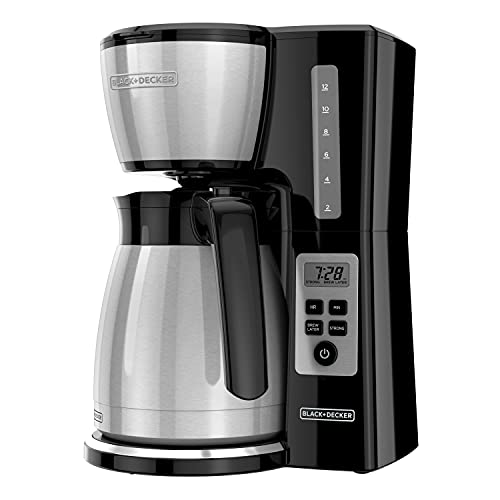
BLACK+DECKER 12-Cup Thermal Programmable Coffee Maker
Badge: Best Overall
Strengths
- VORTEX Technology is designed to saturate the grounds evenly, which is where extraction is won or lost
- Brew strength control lets you adjust the pot to the coffee you bought
- 12-cup thermal format serves a crowd without a warming plate
Trade-offs
- No built-in grinder
- Thermal carafe hides the remaining level
- Showerhead evenness still depends on a level bed of grounds, so sloppy scooping can undo it
Key specs: Capacity: 12 cups; Carafe: Thermal; Programming: Programmable, with brew strength control; Showerhead: VORTEX Technology water dispersion; Finish: Black and steel; Model: CM2046S.
The CM2046S hangs its case on one word in its name: VORTEX, BLACK+DECKER’s name for a showerhead designed to spread water evenly across the grounds instead of drilling a hole through the middle of the bed. Even saturation is the quiet difference between a balanced pot and a sour, under-extracted one, so this is a meaningful feature rather than decoration. Add brew strength control and a 12-cup thermal carafe and you get a family-size machine aimed squarely at better everyday extraction. The honest limitation is that no showerhead fully compensates for uneven scooping or wildly inconsistent grind, and there is no grinder on board. For households that brew full pots daily, the priorities here are the right ones.
A cone bed only extracts evenly if the water arrives evenly, and the CM2046S is the pick whose headline engineering — the VORTEX showerhead — is aimed at exactly that arrival. Paired with strength control and a thermal carafe, it is the most complete cone-brewing package in this pool.
Best for: cone drinkers who prioritise even saturation above all / Not suited for: buyers wanting a built-in grinder

Cuisinart PerfecTemp 12-Cup Thermal Drip Coffee Maker
Badge: Best for Full Extraction
Strengths
- PerfecTemp hotter brewing targets the temperature range where extraction tastes sweet rather than sour
- Brew Strength control adjusts the pot without changing your coffee-to-water ratio math
- Double-wall stainless thermal carafe protects flavour across the morning
Trade-offs
- No built-in grinder
- Silver finish shows fingerprints more than matte black
- Hotter brewing rewards fresh coffee but will expose stale beans honestly
Key specs: Capacity: 12 cups; Carafe: Double-wall stainless steel thermal; Brewing: PerfecTemp hotter brewing; Controls: Brew Strength control; Finish: Silver; Model: DCC-3400NAS.
PerfecTemp is Cuisinart’s answer to the most common drip complaint: coffee that tastes thin and sour because the water never got properly hot. This 12-cup model brews hotter by design, pairs that with Brew Strength control, and lands the coffee in a double-wall stainless thermal carafe so the temperature work is not undone by a scorching plate. It is a coherent package aimed at flavour first. The honest limitation is that hotter, more complete extraction is an honest mirror: fresh, well-stored beans taste better, and stale beans taste more obviously stale. There is also no grinder, so freshness of grind is your job or your coffee bag’s. For drinkers who blame their machine for sour pots, this is the most direct fix in the group.
The PerfecTemp’s hotter brewing suits cone geometry particularly well: a deep bed needs properly hot water at the top of the bed to finish extracting by the bottom. Drinkers who find drip coffee sour — the classic under-extraction complaint — should start here.
Best for: drinkers bothered by sour, thin drip coffee / Not suited for: buyers on the tightest budgets in this category

BLACK+DECKER CaféCraft 12-Cup Thermal Coffee Maker
Badge: Most Versatile
Strengths
- Brews both hot pots and iced coffee, covering summer without a second method
- 12-cup thermal carafe suits families and small gatherings
- Programmable start covers the weekday routine
Trade-offs
- No built-in grinder
- Iced results depend on brewing over ice correctly, which takes one careful read of the directions
- Thermal carafe hides how much coffee remains
Key specs: Capacity: 12 cups; Carafe: Thermal; Programming: Programmable; Modes: Hot and iced coffee.
The CaféCraft is the seasonal all-rounder of this group: a programmable 12-cup thermal machine in winter and an iced-coffee maker when the weather turns. That dual role matters more than it sounds, because iced coffee made by chilling yesterday’s hot pot tastes tired, while coffee brewed for ice tastes bright. The thermal carafe keeps hot pots in good shape across a morning, and programming covers weekday starts. The honest limitation is that the iced mode rewards following the fill-to-the-ice method properly the first few times, and there is no grinder for buyers chasing maximum freshness. Households whose coffee habits change with the seasons get the most from this pick.
The CaféCraft’s hot-and-iced range makes it the seasonal pick for cone households: full thermal pots in winter, coffee brewed for ice in summer. Cone extraction brewed strong over ice holds up better than weak drip diluted by melting ice, which is the practical link between the geometry and the glass.
Best for: households whose coffee habits change with the seasons / Not suited for: buyers wanting a built-in grinder

Cuisinart 12-Cup PerfecTemp Thermal Carafe Coffee Maker
Badge: Best for Small Batches
Strengths
- 1-4 cup setting brews small pots properly instead of leaving them weak and under-extracted
- Brew Pause lets you pour a first cup before the pot finishes
- Brew Strength control plus PerfecTemp thermal format covers both ends of household demand
Trade-offs
- No built-in grinder
- White finish needs a wipe-down routine to stay bright near a stove
- Full feature set means a slightly longer first read of the manual
Key specs: Capacity: 12 cups; Carafe: Thermal (PerfecTemp); Small batch: 1-4 cup setting; Controls: Brew Strength control, Brew Pause; Finish: Stainless steel and white.
Most 12-cup machines quietly punish small households: brew four cups in a big basket and the water races through too little coffee, leaving a weak pot. This Cuisinart answers with a dedicated 1-4 cup setting, which is why it earns its place even beside its PerfecTemp sibling in this guide. Brew Pause covers the impatient first cup, Brew Strength control adjusts flavour, and the thermal carafe keeps the rest of the pot in shape. The honest limitation is cosmetic and practical: the white finish looks sharp but asks for regular wiping in a busy kitchen, and there is no grinder. Couples who occasionally host a crowd get a machine honest about both jobs.
Small batches are where cone baskets can misbehave — too little coffee in a deep bed channels and under-extracts. This Cuisinart’s dedicated 1-4 cup setting is the direct answer, slowing the brew for small pots so a two-mug morning still tastes like the machine’s best work.
Best for: couples and small households that brew small pots often / Not suited for: households that only ever brew full pots
Comparison Table
| Pick | Capacity | Carafe / Format | Standout feature | Listing |
|---|---|---|---|---|
| SECPOEDR Grind and Brew | 10 cups | Drip coffeemaker | Fresh-ground cone brewing on a programmable timer | Check on Amazon |
| Gevi 10-Cup Grind & Brew | 10 cups | Glass | Grind-and-brew with touch controls and a reusable filter | Check on Amazon |
| BLACK+DECKER 12-Cup Thermal CM2046S | 12 cups | Thermal | VORTEX showerhead saturation over the grounds bed | Check on Amazon |
| Cuisinart PerfecTemp DCC-3400NAS | 12 cups | Double-wall stainless steel thermal | PerfecTemp hotter brewing for fuller cone extraction | Check on Amazon |
| BLACK+DECKER CaféCraft 12-Cup | 12 cups | Thermal | Hot and iced versatility in a 12-cup thermal format | Check on Amazon |
| Cuisinart 12-Cup PerfecTemp (White) | 12 cups | Thermal (PerfecTemp) | 1-4 cup setting that keeps small cone batches honest | Check on Amazon |
How to Choose the Right Drip Coffee Maker
Start with honest capacity math. A coffee maker’s cup is a small unit, roughly five ounces, not the mug in your hand. A 10-cup machine makes about 50 ounces, which is four generous mugs; a 12-cup machine makes about 60 ounces, or five mugs. Count the mugs your household actually drinks before noon, add one for the guest or the second round, and buy that size. Oversized machines brew small pots badly unless they carry a dedicated small-batch setting, and undersized machines make you brew twice, which nobody does happily at dawn.
Choose the carafe before the features. Thermal carafes hold coffee with insulation, so the last cup tastes close to the first, but you cannot see how much is left and they reward a hot-water pre-warm. Glass carafes show the level at a glance and sit on warming plates that keep coffee hot at the cost of slowly cooking it. If your household finishes a pot within the hour, glass is fine and cheaper to replace. If a pot stretches across a morning, thermal is the flavour-preserving choice, and it is why thermal models dominate this guide.
Temperature and saturation decide the taste more than the badge count. Coffee extracts best in hot water, and it extracts evenly only when the water is spread across the whole bed of grounds. Machines that advertise hotter brewing or engineered showerheads are addressing the two variables that most often make home drip taste sour or hollow. Strength controls are the third useful lever: they let you adjust a pot to the coffee you bought instead of re-measuring ratios every time a new bag arrives.
Decide how you feel about grinding. A built-in grinder delivers the single biggest freshness upgrade available to a drip drinker, because ground coffee stales in hours while whole beans hold for weeks. The cost is noise, a chamber to clean, and one more mechanism in the machine. Households that buy pre-ground coffee for convenience should skip grind-and-brew entirely and put the money toward a better brewer; households that buy whole beans anyway should seriously consider it.
Programming is worth having if your mornings are predictable. A 24-hour programmable start sounds like a small thing until the first week of waking to a finished pot. It matters less for households where someone is always awake first and happy to press a button. Small-batch settings, brew pause, and removable reservoirs are the other practical features: each removes a specific daily friction rather than adding a line to a feature list.
Finally, think about the sink, not the counter. Every machine here needs descaling, carafe washing, and basket rinsing. Removable reservoirs, dishwasher-friendly carafes where the listing allows, and reusable filters all change the weekly effort. The machine you will keep clean is the machine that will keep making good coffee in year three.
How to Brew, Clean, and Look After a Drip Coffee Maker
Setting up for the first pot. Wash the carafe, lid, and filter basket in warm soapy water before first use, then run one full cycle of plain water through the machine to rinse the internal path. Place the machine so the reservoir is easy to fill and the steam from brewing is not trapped under a cabinet. If your model has a clock and programmable start, set them now, while the manual is open, rather than at midnight before the first workday.
The daily brew, step by step. Fill the reservoir with fresh cold water to the line for the number of cups you actually want. Add the filter and coffee: a reliable starting ratio is one to two tablespoons of ground coffee per six ounces of water, adjusted to taste over the first week. For a thermal carafe, swirl hot water through it for a minute first and empty it; a pre-warmed carafe can be the difference between a hot last cup and a lukewarm one. Start the brew, and resist lifting the carafe mid-cycle unless your machine has a brew-pause feature, because early cups are disproportionately strong and the pot’s balance depends on the full cycle finishing.
Grind and storage basics. Medium grind is the drip standard; too fine over-extracts into bitterness and can overflow the basket, too coarse under-extracts into sourness. Store beans or grounds in an airtight container away from heat and light, and buy in quantities your household finishes while the coffee is still lively. If your machine grinds, empty and brush the grinder chamber regularly, because old grounds clinging to the chamber will flavour every new pot.
Cleaning rhythm. Rinse the carafe and basket daily; coffee oils go rancid and will season the machine in the worst way. Wash removable parts weekly. Descale on the schedule your water hardness demands: mineral scale insulates the heating element, brewing temperature falls, and the coffee quietly turns sour weeks before the machine complains. Use the descaling method the manufacturer specifies, run rinse cycles afterwards, and treat a slowdown in brew time as the early warning it is.
Troubleshooting
Problem: the coffee tastes sour and weak → check the grind first (too coarse), then the ratio (too little coffee), then descale, because a scaled machine brews too cool and under-extracts exactly this way.
Problem: the basket overflows or grounds reach the carafe → the grind is likely too fine, the basket was overfilled, or a collapsed paper filter blocked drainage; reduce the dose slightly and make sure the filter sits flat before brewing.
Problem: the last cups from a thermal carafe are lukewarm → pre-warm the carafe with hot water before brewing, keep the lid fully closed between pours, and brew the size of pot your household finishes within the carafe’s strong window.
Why Cone Geometry Changes the Cup
Picture the two basket shapes side by side. A flat-bottom basket spreads the grounds in a wide, shallow layer; water finds the path of least resistance, often the edges, and parts of the bed can be barely touched while others are overworked. A cone concentrates the grounds into a deeper, narrower bed. Water entering at the top must travel a longer path through more coffee, and the tapered walls discourage the edge-bypass that flattens flat-bed extraction. The result, managed well, is a cup with more sweetness and clarity — the reason manual pour-over drippers are cones almost without exception.
Managed badly, the same geometry punishes. A deeper bed is closer to its overflow limit, so a too-fine grind or an overfilled basket shows up as a stalled, overflowing brew rather than a merely strong one. This is why cone machines reward the basics — level scooping, a grind matched to the basket, and doses within the basket’s comfort — more than flat machines do. The wider family discussion continues in Best Consumer Coffee Makers for readers comparing beyond the cone category.
Grind Size and Drawdown: Running a Cone Basket Well
Drawdown — the time water takes to pass through the bed — is the cone brewer’s dashboard. Too fast, and the coffee tastes thin and sour because the water never extracted enough; too slow, and it tastes bitter and heavy, with overflow risk at the extreme. Grind size is the control: one step finer slows the drawdown and deepens extraction, one step coarser does the opposite. Change it in small steps across several pots, not in leaps, and keep the dose constant while you learn, so you can taste what the grind change actually did.
Freshness interacts with drawdown too. Freshly ground coffee releases gas when wet, briefly slowing the water’s passage; stale grounds let water race. This is another reason the grind-and-brew picks sit high in this guide: they stabilise the variable cone brewing is most sensitive to. For the neighbouring shape discussion, Best Consumer Quiet Coffee Makers covers the quieter end of the category, and Best Consumer Reports Coffee Makers the review-led angle.
Water, Freshness, and the Cone: The Two Inputs Nobody Sees
A cone basket amplifies two inputs that buyers rarely think about. The first is water. Coffee is almost entirely water, and water heavy with mineral or treatment flavours will print those flavours through a thorough extraction more clearly than through a weak one. If your tap water tastes fine in a glass, it is fine in the machine. If it does not, filtered water is the cheapest flavour upgrade available to a cone drinker — cheaper than any machine change, and immediately audible in the cup. The second input is the coffee’s age since roasting and grinding. A cone’s deeper extraction pulls the woody, flat notes out of stale coffee just as efficiently as it pulls sweetness out of fresh coffee. Buy smaller bags more often, store them airtight away from the stove’s heat, and let the grind-and-brew picks in this guide remove the grinding-age variable entirely.
There is a third invisible input: the machine’s own cleanliness. Coffee oils coat the basket, the showerhead, and the carafe, and they oxidise. In a cone machine, where extraction is efficient, yesterday’s oil film is efficiently extracted into today’s pot. The daily rinse in this guide’s how-to section is not hygiene theatre; it is flavour maintenance, and cone drinkers who skip it often conclude, wrongly, that their machine has declined.
Choosing Your Cone Path: Three Buyer Profiles
The first profile is the upgrader: drinking drip for years, increasingly bothered by sour or hollow pots, ready for the geometry change. Their pick is the saturation-and-temperature end of this guide — the BLACK+DECKER CM2046S or the Cuisinart PerfecTemp — because their complaint is extraction itself. The second profile is the fresh-grind convert, who has tasted what grinding moments before brewing does and wants it without a dawn ritual. Their pick is a grind-and-brew machine, the SECPOEDR or the Gevi, accepting the cleaning and the noise as the price of the freshest input. The third profile is the small household with big standards: two mugs on weekdays, a tableful on Sundays. Their pick is the Cuisinart with the 1-4 cup setting, because their defining problem is batch-size honesty, and it is the only problem in this guide that a setting genuinely solves.
Notice what none of the profiles needed: the longest feature list. Cone brewing is a focused discipline, and the right machine is the one whose strengths point at your actual complaint. Name the complaint first — sour pots, stale taste, weak small batches, slow mornings — and this guide’s badges will walk you to the right pick faster than any specification table.
Cone Brewing Across the Seasons and the Clock
A cone machine’s year has seasons. In winter, the thermal picks carry the household: a full cone pot at breakfast, held properly, covers the slow weekend morning without a second brew. In summer, the CaféCraft’s iced mode changes the geometry’s job: the cone’s thorough extraction, brewed at iced strength, produces a concentrate-like pot that stands up to a glass of ice instead of surrendering to it. Households that have only ever chilled leftover hot coffee owe themselves one properly brewed iced pot before judging the method.
The clock matters too. Cone extraction is at its best in the machine’s first years, before scale and oil quietly tax its temperature and its shower. The households that report their cone machine “still makes coffee like the day it arrived” are, without exception, the ones running the boring rhythm: rinse daily, wash weekly, descale on the calendar. There is no premium version of that rhythm to buy. It is the same five minutes, and it is the difference between a machine that justifies the geometry for a decade and one that gets replaced in three years by a disappointed owner who concludes, wrongly, that cone brewing was a fad.
That is the honest closing note for this category: the cone is not magic, it is leverage. It multiplies whatever you put into it — fresh coffee, level scoops, clean parts, hot water — and it multiplies neglect by the same factor. Choose the pick above that matches your habits, keep the rhythm, and the leverage works for you every morning.
The Cone Owner’s Maintenance Calendar
Daily, the rhythm is ninety seconds: dump the grounds, rinse the basket, rinse the carafe, leave the lid open to dry. Weekly, it is ten minutes: wash the carafe and basket with soap, wipe the showerhead area, and empty and brush the grinder chamber if your pick grinds. Monthly, it is one decision: check the calendar against your water hardness and descale when due, not when symptoms appear, because by the time a cone machine brews noticeably slowly its temperature has been sagging for weeks and every pot in that window was quietly under-extracted. Seasonally, it is one inspection: filters stocked in the correct cone size, carafe seals and lids sound, and a critical first cup tasted with the descale date in mind.
Keep the calendar where the machine lives — a card inside the cupboard door beats an app nobody opens. The cone rewards this rhythm disproportionately, because its whole value proposition is extraction precision, and precision is exactly what scale, oil, and stale residue erode. Owners who keep the calendar describe their machines as consistent for years. Owners who do not describe the same machines as having “gone off” within eighteen months. The machines are identical. The calendars are not, and in cone brewing the calendar is a component of the machine whether the manufacturer lists it or not.
One More Decision: Where the Machine Lives
Cone machines ask for two small spatial favours. The first is headroom: baskets and carafes lift and slide, reservoirs fill, and steam rises, so measure the cabinet clearance before the machine arrives rather than discovering the conflict on the first morning. The second is distance from the stove: a cone machine kept beside a working hob collects a film of cooking grease on its showerhead and basket that no rinse schedule fully defeats, and that film is an extraction variable nobody chose. Give the machine its own stretch of counter, near the sink and the coffee storage, and the daily rhythm in this guide becomes the path of least resistance — which, in a kitchen at dawn, is the only path that gets walked.
The Cone and the Second Cup
There is a small test that predicts cone satisfaction better than any specification: the second cup. Brew a pot, drink the first cup fresh, then pour the second an hour later from the carafe. In a well-matched setup — thermal carafe, correct ratio, coffee that was fresh — the second cup is recognisably the same coffee, a little softer, still itself. In a mismatched setup it is a different, lesser drink, and the gap between the cups is the truest measure of what to fix first: the carafe if the flavour cooked, the ratio if both cups were thin, the coffee if both were dull from the start. Run the test in your first week with any pick from this guide, and let its result, not the internet, set your adjustment list.
A Last Word on Filters and Waste
Cone households go through filters at pot rate, and the waste question deserves a sentence of arithmetic rather than a gesture. A paper filter per pot is a small, compostable item — grounds and paper together go to compost or garden in many households — while a reusable filter trades that stream for wash water and a longer-lived object. The Gevi’s included reusable filter makes the experiment free for its owners; paper loyalists can compost and feel equally settled. What neither camp should do is reuse a paper filter or stretch a reusable one past its cleanable life: a fouled filter is an extraction variable, and in a cone basket, of all places, unchosen variables are the enemy.
Common Buying Mistakes
Buying capacity by the headline number. Shoppers compare 10-cup and 12-cup labels as if they were mug counts. They are not, and the mismatch is why big households end up brewing twice and small households end up with weak small pots. Do the mug math before you shop, and look for a small-batch setting if your household swings between two cups on weekdays and a crowd on weekends.
Paying for a grinder you will not clean. Grind-and-brew machines are wonderful for exactly as long as the grinder chamber stays clean. If you know your household will not brush out a chamber weekly, a grounds-only machine and a bag of good pre-ground coffee will honestly taste better by month two.
Ignoring the carafe question. Buyers compare features and forget the vessel the coffee lives in. A glass carafe on a plate punishes slow drinkers; a thermal carafe frustrates people who want to see the level. This one decision shapes every single morning with the machine, so make it deliberately.
Chasing feature counts instead of extraction basics. Hot water, even saturation, and a sensible ratio make coffee taste good. A long feature list built on a cool, uneven brew makes expensive bad coffee. Weight the basics first, then let features break ties.
Skipping descaling until the machine slows down. By the time a scaled machine brews noticeably slowly, it has been brewing too cool for weeks. Put descaling on a calendar rhythm matched to your water, not on a when-it-breaks rhythm.
Final Recommendation
Start with the BLACK+DECKER CM2046S: its saturation-first design gives a cone bed the even wetting it needs, with strength control and a thermal carafe completing the package. Choose the Cuisinart PerfecTemp DCC-3400NAS if sour, under-extracted pots are your complaint, the Cuisinart 12-Cup PerfecTemp with the 1-4 cup setting if small pots are your routine, and either grind-and-brew pick if freshness of grind is the variable you most want to control. Whichever you choose, confirm the basket and filter details on the current listing, then spend the first week dialling in grind — that week is where cone brewing pays you back.
Ready to decide? Start with the top pick and Check on Amazon to confirm the current configuration before you buy.
Still torn between the top two? Compare the runner-up directly and Check on Amazon for its current listing details.
Frequently Asked Questions
What is the difference between a cone basket and a flat-bottom basket?
Shape and bed depth. A cone is tapered and holds a deeper, narrower bed of grounds, so water travels a longer path and tends to extract more completely and evenly. A flat basket holds a wide, shallow bed that is more forgiving of sloppy dosing but more prone to uneven, edge-bypass extraction.
Do cone coffee makers need special filters?
They use cone-shaped filters sized to the basket, in paper or reusable form. Because filter fit affects drawdown, confirm the filter size and shape on the machine’s current listing before stocking up, and never fold a mismatched filter into service as a habit.
Why did my cone brewer overflow?
The usual causes are a grind that is too fine, an overfilled basket, or a filter that collapsed against the basket wall and blocked drainage. Reduce the dose slightly, step the grind one notch coarser, and seat the filter flat before brewing.
What grind suits a cone basket?
Medium is the starting point, then adjust by taste: sour and thin means extract more (a step finer or a little more coffee), bitter and heavy means extract less (a step coarser). Change one variable at a time across a few pots.
Are cone machines better than flat-bottom machines?
They have a higher ceiling for extraction quality and a lower tolerance for sloppy inputs. A careful user tastes the advantage; a careless user may prefer the flat basket’s forgiveness. This guide’s picks were chosen to make the careful path easy.
How do I confirm a machine really uses a cone basket before buying?
Check the current listing’s specifications and filter information — the filter shape is the giveaway, since cone machines take cone filters. This guide deliberately does not state basket shapes that the verified listings did not state.


