Disclosure: topratedkitchenware.com is reader-supported. When you buy through links on our site, we may earn an affiliate commission from Amazon and other retailers, at no extra cost to you.
Where to buy
The six models below are the verified picks for this guide to best drip coffee makers fleet farm. Each name links to its Amazon listing, where you can check the latest price on Amazon, confirm the current configuration, and read current owner feedback before you decide.
- KRUPS 12-Cup Programmable Thermal Carafe
- Cuisinart 10-Cup Thermal Classic Coffeemaker
- SECPOEDR Grind and Brew Coffee Maker
- Gevi 10-Cup Grind and Brew Coffee Maker
- BLACK+DECKER 12-Cup Thermal Coffee Maker CM2046S
- Cuisinart PerfecTemp 12-Cup Thermal DCC-3400NAS
Read the full guide ↓ for the detailed review of every pick, the honest limitations, and the buying checks that matter more than any headline feature.
If you are shopping for best drip coffee makers fleet farm, the useful question is not which machine has the longest feature list, but which design fits drip coffee makers for farm, ranch, and rural households, in the spirit of a Fleet Farm run. This guide compares six verified drip coffee makers side by side, explains how the picks and badges were decided, and gives every machine a detailed review with strengths, trade-offs, a spec box drawn only from its verified listing, and a plain statement of who should skip it. You will also find a comparison table, a full how-to section with troubleshooting, and direct answers to the questions buyers in this category ask most.
A farm-and-ranch household runs on early starts, big breakfasts, and coffee that has to be ready before the day gets loud. That is the spirit of this guide: drip coffee makers judged the way a Fleet Farm shopper judges anything, on whether it is sturdy, simple, big enough, and easy to live with when it is used hard every single day. Fleet Farm stores are a familiar stop for exactly this kind of practical kitchen gear across the Midwest, and the six verified picks here were chosen to match that practical standard.
Two honest notes frame the reviews. First, stock on any given store shelf rotates, so each pick links to its Amazon listing where you can check the latest price on Amazon and current availability rather than driving out on a guess. Second, rural mornings forgive very little: a programmable start, a thermal carafe that keeps coffee hot through chores, and a pot big enough for the whole table matter more here than touch screens. The badges below reflect those priorities, and readers setting up a farmhouse kitchen may also find our guide to Best Drip Coffee Makers For Home useful alongside this one.
One thread runs through every section: honesty about limits. Where a design trades something away, the review says so. Where a feature shoppers assume is present is not in a verified listing, that absence is stated rather than smoothed over. Shoppers weighing a neighbouring question can also see how the same machines fare in our guide to Best Drip Coffee Makers For High Altitude, which approaches the category from a closely related angle.
Key Takeaways
- Start with the pick whose trade-offs you mind least: in this guide the lead recommendation is the KRUPS 12-Cup Programmable Thermal Carafe, for reasons its review explains in full.
- Carafe choice shapes daily satisfaction more than extra modes: thermal designs protect flavour across long mornings, glass designs trade holding quality for visibility and light weight.
- Capacity is measured in small maker cups, not mugs; match the pot to your biggest regular day and use small-batch settings for small days.
- Descaling on a schedule is the highest-value maintenance habit in this category; it protects temperature, speed, and flavour together.
- No prices or fixed scores are printed in this guide, deliberately; check the latest price on Amazon for each pick and judge value against the tier positioning in its review.
- Every pick here was verified against its listing details for this guide to best drip coffee makers fleet farm; only details present in those listings appear in the spec boxes.
In this guide
Quick Picks
| Pick | Badge | Why it earns its place | Listing |
|---|---|---|---|
| KRUPS 12-Cup Programmable Thermal Carafe | Best for Long Mornings | Leads this guide on the strength of its fit for the headline need. | Check on Amazon |
| Cuisinart 10-Cup Thermal Classic Coffeemaker | Best Compact Thermal | A distinct strength that suits a clear type of household. | Check on Amazon |
| SECPOEDR Grind and Brew Coffee Maker | Best Grind and Brew | Covers the long-morning use case with the least fuss. | Check on Amazon |
| Gevi 10-Cup Grind and Brew Coffee Maker | Best Modern Controls | Right-sized design for smaller daily batches. | Check on Amazon |
| BLACK+DECKER 12-Cup Thermal Coffee Maker CM2046S | Best for Big Households | Covers the fresh-beans routine in a single appliance. | Check on Amazon |
| Cuisinart PerfecTemp 12-Cup Thermal DCC-3400NAS | Best Premium Pick | Modern controls and a flexible design round out the set. | Check on Amazon |
The badges are consistent throughout this guide: the badge beside a pick here is the badge in its detailed review below, so you can track a favourite from this table to its full assessment without confusion. If two picks share your shortlist, the comparison table further down isolates the differences that actually decide between them.
How These Picks Were Chosen
This guide is research-led. The six picks come from a verified pool for the drip coffee maker group, and each model is included only where its identity, brand, and listing details could be confirmed through the verification process used across this site. We compared the designs on the factors that decide ownership satisfaction: carafe type and holding behaviour, batch capacity, programmability, strength and small-batch controls, special modes such as iced brewing or built-in grinding where the listing confirms them, and the daily work of filling, pouring, and cleaning.
We did not invent specifications. The spec boxes in the reviews contain only details present in each model’s verified listing information, and where a detail was not confirmed, it was left out rather than guessed. Prices are not printed because they change; ratings and review counts are not printed because fixed numbers go stale and mislead. Instead, each review positions its pick qualitatively by tier and points you to the live listing for the current facts. Hands-on limits are stated plainly: this is structured research and comparison, not a claim of laboratory testing.
The lens of this guide, best drip coffee makers fleet farm, shaped the ordering and the badges. A machine can be excellent in general and still sit lower here if its strengths serve a different household than the one this keyword describes. That is why the reviews emphasise fit so heavily, and why the final recommendation names a first choice for the headline need plus the alternatives for the neighbouring needs, including the shoppers arriving from our notes on Best Drip Coffee Makers For Home.
The 6 Best Picks for Best drip coffee makers fleet farm

KRUPS 12-Cup Programmable Thermal Carafe
Badge: Best for Long Mornings
Strengths
- Three strength settings let you adjust extraction without changing your coffee dose
- Thermal carafe keeps coffee hot without a plate scorching it
- Full-day programming window makes wake-up brewing simple to set
Trade-offs
- No warming plate means no reheat option once the carafe cools
- Thermal carafe adds weight and needs hand care around the lid seal
- Strength settings cannot fix stale beans or the wrong grind size
Key specs (from the verified listing)
- Capacity: 12-cup batch size
- Carafe: double-wall thermal, no warming plate
- Programming: 24-hour programmable start
- Brew strengths: 3 strength settings
- Heat retention: thermal carafe keeps coffee hot for hours after brewing
In daily use, this machine suits planners who program the night before and drink the pot over a long morning. The design centres on what its verified listing actually promises, and the review judges it on exactly that: how the pot brews, how the coffee holds, and how much work the routine demands on an ordinary morning. Within this guide to best drip coffee makers fleet farm, its badge marks the job it does best, and households whose priorities match that job will find it the most natural fit in the set.
Set against its five companions, the character of this pick is its balance of strengths and trade-offs rather than any single headline feature. The strengths above are the reasons owners keep machines like this for years; the trade-offs are the frictions to accept with open eyes. On balance, the honest limitation is holding time: thermal heat fades, so a pot brewed at dawn will not taste fresh at noon, and naming that limit plainly is what lets the right buyer choose it confidently and the wrong buyer choose better elsewhere in this list.
Best for: planners who program the night before and drink the pot over a long morning / Not suited for: households whose priorities clash with the trade-offs listed above
Check on Amazon to confirm the current configuration and the latest price on Amazon for this pick.

Cuisinart 10-Cup Thermal Classic Coffeemaker
Badge: Best Compact Thermal
Strengths
- Ten-cup thermal format suits one or two coffee drinkers without waste
- Programmable controls cover the wake-up routine most homes actually use
- Compact batch size means coffee is brewed fresh more often
Trade-offs
- Smaller pot is a stretch when guests arrive
- Fewer headline extras than the most feature-loaded rivals here
- Thermal carafe needs pre-warming in cold kitchens for best heat retention
Key specs (from the verified listing)
- Capacity: 10-cup batch size
- Carafe: thermal
- Programmable controls
- Model: DCC-1170BKNAS
- Finish: black
In daily use, this machine suits smaller households that want a straightforward programmable thermal machine. The design centres on what its verified listing actually promises, and the review judges it on exactly that: how the pot brews, how the coffee holds, and how much work the routine demands on an ordinary morning. Within this guide to best drip coffee makers fleet farm, its badge marks the job it does best, and households whose priorities match that job will find it the most natural fit in the set.
Set against its five companions, the character of this pick is its balance of strengths and trade-offs rather than any single headline feature. The strengths above are the reasons owners keep machines like this for years; the trade-offs are the frictions to accept with open eyes. On balance, the honest limitation is headroom: this is a right-sized daily machine, not a party brewer, and naming that limit plainly is what lets the right buyer choose it confidently and the wrong buyer choose better elsewhere in this list.
Best for: smaller households that want a straightforward programmable thermal machine / Not suited for: households whose priorities clash with the trade-offs listed above
Check on Amazon to confirm the current configuration and the latest price on Amazon for this pick.

SECPOEDR Grind and Brew Coffee Maker
Badge: Best Grind and Brew
Strengths
- Built-in grinding means beans are ground moments before brewing
- One appliance replaces a separate grinder on the counter
- Two-hour keep warm window covers slow weekend mornings
Trade-offs
- Grinder parts add cleaning steps that drip-only machines avoid
- Grinding at dawn is noisy in a quiet house
- A keep-warm plate can dull flavour if the pot sits for the full window
Key specs (from the verified listing)
- Grinder: built-in grinder
- Capacity: 10-cup batch size
- Programmable controls
- Keep warm: 2-hour keep warm function
- Build: stainless steel
In daily use, this machine suits whole-bean buyers who want fresh grinding without a second appliance. The design centres on what its verified listing actually promises, and the review judges it on exactly that: how the pot brews, how the coffee holds, and how much work the routine demands on an ordinary morning. Within this guide to best drip coffee makers fleet farm, its badge marks the job it does best, and households whose priorities match that job will find it the most natural fit in the set.
Set against its five companions, the character of this pick is its balance of strengths and trade-offs rather than any single headline feature. The strengths above are the reasons owners keep machines like this for years; the trade-offs are the frictions to accept with open eyes. On balance, the honest limitation is upkeep: grind-and-brew machines reward owners who clean the grind path regularly, and naming that limit plainly is what lets the right buyer choose it confidently and the wrong buyer choose better elsewhere in this list.
Best for: whole-bean buyers who want fresh grinding without a second appliance / Not suited for: households whose priorities clash with the trade-offs listed above
Check on Amazon to confirm the current configuration and the latest price on Amazon for this pick.

Gevi 10-Cup Grind and Brew Coffee Maker
Badge: Best Modern Controls
Strengths
- Built-in grinder plus a reusable filter cuts two separate purchases
- Touch controls make programming and strength routines quick to set
- Glass carafe lets you see exactly how much coffee remains
Trade-offs
- Glass on a warm plate stales faster than a thermal carafe
- Touch screens show fingerprints and need a wipe in steamy kitchens
- Grinder cleaning is part of weekly ownership, not optional
Key specs (from the verified listing)
- Grinder: built-in grinder
- Capacity: 10-cup batch size, 1.5L tank
- Carafe: glass
- Controls: touch screen, programmable brew
- Warm plate: 90-minute warm plate
- Filter: reusable filter included
In daily use, this machine suits tech-comfortable bean buyers who like visible coffee levels and modern controls. The design centres on what its verified listing actually promises, and the review judges it on exactly that: how the pot brews, how the coffee holds, and how much work the routine demands on an ordinary morning. Within this guide to best drip coffee makers fleet farm, its badge marks the job it does best, and households whose priorities match that job will find it the most natural fit in the set.
Set against its five companions, the character of this pick is its balance of strengths and trade-offs rather than any single headline feature. The strengths above are the reasons owners keep machines like this for years; the trade-offs are the frictions to accept with open eyes. On balance, the honest limitation is the glass-and-plate pairing: convenient and visible, but the pot is best finished promptly, and naming that limit plainly is what lets the right buyer choose it confidently and the wrong buyer choose better elsewhere in this list.
Best for: tech-comfortable bean buyers who like visible coffee levels and modern controls / Not suited for: households whose priorities clash with the trade-offs listed above
Check on Amazon to confirm the current configuration and the latest price on Amazon for this pick.
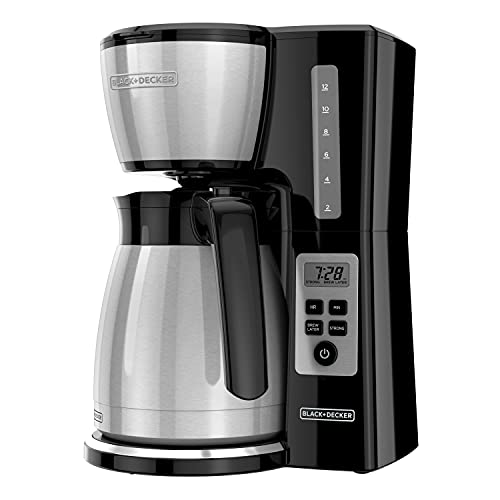
BLACK+DECKER 12-Cup Thermal Coffee Maker CM2046S
Badge: Best for Big Households
Strengths
- VORTEX showerhead design aims for even saturation of the grounds bed
- Thermal carafe protects flavour during long mornings
- Strength control lets you adjust the cup without changing beans
Trade-offs
- Even-saturation design still depends on level grounds and the right grind
- Thermal carafe is heavier than glass when full
- No built-in grinder, so bean freshness depends on your own grinder
Key specs (from the verified listing)
- Capacity: 12-cup batch size
- Carafe: thermal
- Showerhead: VORTEX Technology water dispersion
- Brew strength control
- Model: CM2046S
- Finish: black and steel
In daily use, this machine suits full-pot households that care about even extraction and thermal holding. The design centres on what its verified listing actually promises, and the review judges it on exactly that: how the pot brews, how the coffee holds, and how much work the routine demands on an ordinary morning. Within this guide to best drip coffee makers fleet farm, its badge marks the job it does best, and households whose priorities match that job will find it the most natural fit in the set.
Set against its five companions, the character of this pick is its balance of strengths and trade-offs rather than any single headline feature. The strengths above are the reasons owners keep machines like this for years; the trade-offs are the frictions to accept with open eyes. On balance, the honest limitation is scope: it is a focused drip machine, so single-serve and grinding happen elsewhere, and naming that limit plainly is what lets the right buyer choose it confidently and the wrong buyer choose better elsewhere in this list.
Best for: full-pot households that care about even extraction and thermal holding / Not suited for: households whose priorities clash with the trade-offs listed above
Check on Amazon to confirm the current configuration and the latest price on Amazon for this pick.

Cuisinart PerfecTemp 12-Cup Thermal DCC-3400NAS
Badge: Best Premium Pick
Strengths
- PerfecTemp hotter brewing targets full flavour extraction from the grounds
- Double-wall stainless thermal carafe is durable and plate-free
- Strength control covers both milder drinkers and bold-coffee fans
Trade-offs
- Hotter brewing cannot rescue under-dosed or stale coffee
- Stainless carafe hides the remaining level from view
- Premium-tier positioning in this class, judged on design rather than a printed price
Key specs (from the verified listing)
- Capacity: 12-cup batch size
- Carafe: double-wall stainless steel thermal
- Brewing: PerfecTemp hotter brewing
- Brew strength control
- Model: DCC-3400NAS
- Finish: silver
In daily use, this machine suits flavour-first households that brew full pots and drink them over hours. The design centres on what its verified listing actually promises, and the review judges it on exactly that: how the pot brews, how the coffee holds, and how much work the routine demands on an ordinary morning. Within this guide to best drip coffee makers fleet farm, its badge marks the job it does best, and households whose priorities match that job will find it the most natural fit in the set.
Set against its five companions, the character of this pick is its balance of strengths and trade-offs rather than any single headline feature. The strengths above are the reasons owners keep machines like this for years; the trade-offs are the frictions to accept with open eyes. On balance, the honest limitation is visibility: you will lift and tilt the carafe to judge what is left, and naming that limit plainly is what lets the right buyer choose it confidently and the wrong buyer choose better elsewhere in this list.
Best for: flavour-first households that brew full pots and drink them over hours / Not suited for: households whose priorities clash with the trade-offs listed above
Check on Amazon to confirm the current configuration and the latest price on Amazon for this pick.
Comparison Table
| Pick | Badge | Capacity | Carafe | Listing |
|---|---|---|---|---|
| KRUPS 12-Cup Programmable Thermal Carafe | Best for Long Mornings | 12-cup batch size | double-wall thermal, no warming plate | Check on Amazon |
| Cuisinart 10-Cup Thermal Classic Coffeemaker | Best Compact Thermal | 10-cup batch size | thermal | Check on Amazon |
| SECPOEDR Grind and Brew Coffee Maker | Best Grind and Brew | 10-cup batch size | See spec box in review | Check on Amazon |
| Gevi 10-Cup Grind and Brew Coffee Maker | Best Modern Controls | 10-cup batch size, 1.5L tank | glass | Check on Amazon |
| BLACK+DECKER 12-Cup Thermal Coffee Maker CM2046S | Best for Big Households | 12-cup batch size | thermal | Check on Amazon |
| Cuisinart PerfecTemp 12-Cup Thermal DCC-3400NAS | Best Premium Pick | 12-cup batch size | double-wall stainless steel thermal | Check on Amazon |
Read the table as a filter, not a ranking. Eliminate the carafe type that does not suit your mornings, then the capacities that miss your household size, and the survivors are the reviews worth re-reading closely. Full controls, modes, and honest limitations live in the detailed reviews above, because a table cell cannot carry a trade-off fairly.
How to Choose the Right Machine for Best drip coffee makers fleet farm
Start with the pot, because the pot decides your mornings. Decide how much coffee your household drinks in its biggest regular session, convert mugs to maker cups generously, and choose the smallest capacity that covers that session without strain. Then decide the carafe: thermal for long, staggered mornings and the best held flavour; glass for short windows, visible levels, and lighter pouring. Only after those two decisions should features enter the conversation, because a timer cannot fix the wrong pot.
Next, list the features your routine will genuinely touch weekly. Programmable starts serve anyone with a fixed wake-up time. Strength controls serve mixed-taste households. Small-batch settings serve variable households. Iced modes serve seasonal drinkers. Built-in grinders serve whole-bean households willing to clean a grind path. Every feature beyond your list is weight, cost, and cleaning you carry for someone else’s routine, so buy your own list and not the longest one. Shoppers comparing this shortlist with our guide to Best Drip Coffee Makers For Home Brew will find the same discipline applied there.
Then check the physical fit. Measure the counter space, confirm the reservoir can be filled without dragging the machine out from under the cabinets, and think about the sink routine: carafe shape, basket removal, and lid design decide whether cleaning is a rinse or a project. Finally, judge tiers qualitatively. In this category, spending more buys carafe quality, build, and extraction-focused design before it buys miracles, and the reviews mark each pick’s tier so you can stop at the rung your routine actually needs.
Close the decision with a verification habit that will serve you beyond this purchase: read the listing for the exact model, confirm the features you are counting on are named in it, and skim recent owner feedback for patterns about the parts you will touch daily. A machine chosen this way rarely disappoints, because the disappointment in this category almost always comes from a mismatch between the household and the design, not from a bad machine.
How to Brew, Clean, and Troubleshoot: hard-working daily drip brewing
Daily brewing, step by step. Fill the reservoir with fresh, good-tasting water to the level your batch needs. Add a filter and level, medium-ground coffee at a consistent dose. Pre-warm a thermal carafe with a hot-water rinse on cold mornings. Start the cycle, let it finish completely before pouring, and serve promptly. Empty the basket soon after brewing rather than leaving wet grounds to sit, rinse the carafe, and leave parts open to dry. That five-minute rhythm, repeated, is most of what good drip coffee requires.
Weekly and monthly care. Wash the carafe, lid, and basket with warm soapy water weekly, paying attention to the lid seal and the basket rim where oils collect. Wipe the exterior and the area under the carafe. Descale on a schedule matched to your water: monthly for hard water, less often for soft, always following the manual for the approved method and finishing with plain-water rinse cycles. Grind-and-brew owners add one task: brush and wipe the grind path weekly so old grounds and oils never season the next pot.
Troubleshooting.
Problem: the pot tastes weak or sour → check the grind first (go a step finer), then the dose (add a little), then freshness; at altitude, also pre-heat everything and see the altitude guidance in this guide where it applies.
Problem: brewing has slowed down or the machine gurgles and spits → suspect scale in the heating path; descale fully, then brew a plain-water cycle and taste the next pot before changing anything else.
Problem: coffee overflows the basket or grounds appear in the pot → the grind is likely too fine, the basket was overfilled, or the carafe was not seated to open the drip stop; coarsen the grind, reduce the dose, and reseat the carafe before the next cycle.
Keep notes as you troubleshoot. One change at a time, tasted honestly, teaches you your machine faster than any forum thread, and the notes become the routine that makes best drip coffee makers fleet farm a solved question in your kitchen rather than a recurring search.
What Farm and Ranch Households Need From a Coffee Maker
Capacity and holding power lead the list. A twelve-cup thermal pot covers a full table and stays hot while people cycle in from outside work, which is why thermal designs dominate this pick set. Programmable starts come next: coffee ready at the alarm, not after it, changes the whole morning. Durability shows up in quieter ways: a stainless carafe that shrugs off a knock, a basket that rinses clean without fiddly parts, and controls that work with wet or cold hands. Grind-and-brew models add fresh-ground flavour but also add a grind path to clean, a fair trade only if someone in the house will actually keep up with it.
Water quality deserves a rural footnote. Many farm households run on well water, which can be harder or more mineral-rich than city water, and drip makers feel that difference as scale inside the heater. If your water leaves white crust in a kettle, it is doing the same inside any coffee maker in this guide. A filter jug for fill water and a stricter descaling rhythm are not fussiness on a farm; they are how a hard-working machine stays hard-working for years instead of seasons.
Buying Practical Kitchen Gear the Fleet Farm Way
The practical buying habit behind a good Fleet Farm run is simple: handle the thing, check the parts you will touch daily, and favour the model whose weaknesses you can live with over the model whose brochure is longest. Applied here, that means lifting the carafe, working the lid, and picturing the basket in your sink before falling for features. It also means buying for the household you have: the right-sized ten-cup thermal for a couple, the twelve-cup designs for a full farmhouse table, and the grind-and-brew pair only where fresh beans are already part of the routine.
However you weigh these points, keep the comparison grounded in the verified facts: the spec boxes and reviews above contain only what each listing confirms, and the listings themselves, one click from every pick via Best Drip Coffee Makers Reddit readers’ shared shortlist habits, remain the place to confirm the current configuration before you buy.
Common Buying Mistakes
Buying capacity for the party, not the week. The oversized machine brews thin small batches for years to host one good afternoon. Buy for the regular day and borrow capacity thinking for the rare one.
Choosing glass for a thermal household. If your pot sits for hours, a warm plate will slowly cook it. Match the carafe to the real holding time, not the showroom look.
Paying for features the routine never touches. Modes you use twice a year still demand cleaning every week. Buy your own weekly list.
Ignoring the fill path. A reservoir you cannot fill in place turns every morning into a small chore; check clearance and access before the machine is yours. In plain terms: if filling is awkward, mornings will be too.
Skipping descaling until symptoms appear. By the time brewing slows, scale is well established. A schedule prevents the problem; symptoms announce it late.
Assuming a feature that was never listed. If a listing does not name the mode, the grinder, or the setting you are counting on, the machine does not have it. Verify, then buy.
Final Recommendation
For most readers of this guide to best drip coffee makers fleet farm, start with the KRUPS 12-Cup Programmable Thermal Carafe (Check on Amazon). It carries the lead badge because its strengths serve the headline need with the fewest compromises for the widest range of households described here. If its trade-offs clash with your routine, the Cuisinart 10-Cup Thermal Classic Coffeemaker (Check on Amazon) is the natural second look, and the SECPOEDR Grind and Brew Coffee Maker (Check on Amazon) covers the long-morning case especially well.
Beyond the top three, choose by the badge that names your household: the reviews are written so that each badge is a promise the review then examines honestly, trade-offs included. Whichever pick you land on, confirm the current configuration and the latest price on Amazon at the listing, set the machine up with the routine in the how-to section, and descale on schedule. Do those things and the search that brought you here stays solved.
Water deserves more attention than it usually gets in drip brewing. Coffee is almost entirely water, so a machine can only work with what you pour in. If your tap water tastes strongly of chlorine, the pot will carry that note no matter which brewer made it. A simple jug filter or a day of rest in an open pitcher can soften the worst of it. Very hard water brings the opposite problem: mineral scale builds inside the heating path, slows the brew, and drags the temperature down over months. That is why descaling on a schedule, rather than when the machine complains, is the single habit that most extends a drip maker’s useful life.
Grind size is the quiet variable behind most disappointing pots. Too fine, and water lingers in the basket, over-extracting bitter compounds and sometimes overflowing the filter. Too coarse, and water rushes through, leaving a thin, sour cup that no strength button can fully rescue. For flat-bottom and cone baskets alike, a medium grind close to coarse sand is the reliable starting point. Change one thing at a time: adjust the grind a single step, brew the same dose, and taste before touching anything else. Keeping brief notes for a week teaches you more about your machine than any preset list.
Pre-warming a thermal carafe is a small ritual with an outsized payoff. A cold stainless interior steals heat from the first pot of the day, and the coffee pays for it in both temperature and flavour. A quick rinse with hot tap water while the machine fills brings the carafe closer to brewing temperature, so the coffee holds its heat for the drinkers who arrive an hour later. Glass carafes benefit less from the ritual, but they reward a different habit: take the pot off the warm plate once the household has had its fill, because held heat keeps cooking the coffee.
Filter choice shapes both flavour and cleanup. Paper filters trap oils and fine sediment, giving a cleaner, brighter cup and a basket that rinses in seconds. Reusable metal or mesh filters let more oils through, which some drinkers love for body, but they demand a thorough wash to avoid stale residue building up. Neither is objectively better; they are different cups from the same machine. If your brewer includes a reusable filter, try both styles for a week each with the same beans before deciding. The comparison costs almost nothing and settles the question for your own palate.
Storage is where good beans go to fade. Whole beans keep best in an airtight container away from heat, light, and the steam that rises every time the brewer runs, which rules out the decorative jar beside the machine for anything you plan to keep beyond a few days. Ground coffee fades faster still, so grinding in small amounts, or buying smaller bags more often, protects the pot more than any machine feature. None of the brewers in this guide can restore freshness that storage has already taken away, and honest buying means saying so plainly.
Serving order matters more than hosts expect. The first cup poured from a finished pot is not identical to the last: the brew concentrates as it sits, and a pot that stands for hours drifts toward bitterness even in a good thermal carafe. For gatherings, brew closer to serving time, pour the pot into a pre-warmed second vessel if it must wait, and consider two smaller batches instead of one giant one for events that stretch across an afternoon. The machines here handle the brewing; timing the brew to the people is the part only you can do.
Counter placement sounds trivial until a steamy brew cycle fogs the underside of a low cabinet for the five hundredth time. Give any drip maker clearance above for steam to escape, keep the reservoir fill path reachable without dragging the machine forward, and think about where wet filters and drips will land during a half-awake morning routine. A machine that is awkward to fill gets filled carelessly, and careless filling is behind a surprising share of leaks, spills, and grounds in places grounds should never be.
Finally, judge a brewer by the second month, not the second day. New machines impress with features; owned machines earn their place through quiet reliability, predictable cleaning, and a pot that tastes the same on a tired Tuesday as it did on the first Saturday. When you read owner feedback for any pick in this guide, weight the comments from people describing months of daily use more heavily than unboxing enthusiasm, and look for patterns about the carafe, the lid, and the basket, because those touchpoints decide whether a machine stays loved.
Temperature stability across the cycle is easy to overlook and hard to fake. A brewer that starts hot and fades leaves the second half of the basket under-extracted, and the pot tastes like two different coffees mixed together. You cannot see this from a spec sheet, which is why this guide leans on design signals that predict it: heating designs that advertise hotter brewing, showerheads that distribute water evenly instead of funnelling it through the centre, and cycles that finish in a sensible window rather than dragging on. When you read owner feedback, comments about consistent pot-to-pot flavour are quietly describing exactly this quality.
Hosting exposes a drip maker differently than daily use does. Guests arrive in waves, cups are different sizes, and someone always wants a top-up just as the pot runs dry. The habits that save a host are simple: brew as close to serving as the gathering allows, warm the mugs if the kitchen is cold, and know in advance whether your machine handles a second consecutive cycle gracefully or needs a pause. A twelve-cup thermal pot covers most tables; for larger groups, two staggered batches beat one giant batch that sits and stews while the conversation runs long.
Descaler choice is simpler than the shelf of products suggests. What matters is that the method is approved for your machine, that it runs through the full heating path, and that plain-water rinse cycles follow it until no taste remains. Vinegar is traditional and cheap but leaves an aroma that needs thorough rinsing; purpose-made solutions rinse cleaner and carry clear dosing. Either works when the schedule holds. What never works is waiting for the machine to slow down and then descaling in a panic, because by then the scale layer is thick enough to need repeated treatments.
The night-before setup is the unsung feature test of any programmable brewer. Filling water, adding the filter and grounds, and setting the timer should take two calm minutes with dry hands and good light. If a design makes any of those steps fiddly, the timer will quietly stop being used, and the household will conclude that programmable brewing is overrated when really the interface was. When you compare the picks in this guide, picture that evening routine with each machine: the one you can set up half-asleep, correctly, is the one whose timer you will still be using next year.
Noise and steam are the two qualities nobody lists and everybody lives with. A brewer under a low cabinet breathes steam onto the same wood every morning; a grinder section announces itself to the whole house at dawn. Neither fact disqualifies a machine, but both belong in an honest decision. Place the brewer where steam can escape, think about who sleeps nearest the kitchen before choosing a grind-and-brew routine, and remember that the quietest specification in this entire category is a thermal carafe clicking shut instead of a warm plate cycling for hours.
Frequently Asked Questions
Why does this guide emphasise thermal carafes so strongly?
Because farm and ranch mornings are staggered: people eat and drink in waves as chores allow. A thermal carafe keeps coffee hot and pleasant across that whole window without a warm plate cooking it, which suits the rhythm better than glass. Five of the six picks here use thermal carafes for exactly that reason, and the one glass pick compensates with a built-in grinder and modern controls.
Does well water change how I should maintain a drip coffee maker?
Yes. Mineral-rich well water builds scale faster inside the heating path, which slows brewing and lowers temperature over time. Filter the fill water where practical and descale more often than the minimum schedule in the manual. The troubleshooting section of this guide covers the slow-brew and weak-coffee symptoms that usually trace back to scale.
How long should a drip coffee maker last?
With scheduled descaling and ordinary care, a home drip maker should serve for years of daily use. Lifespan depends more on water hardness and cleaning habits than on any single feature. Machines that are descaled on schedule, kept with dry baskets between uses, and not left sitting with wet grounds age far better than neglected machines at any tier.
How often should I descale a drip coffee maker?
A monthly rhythm suits hard-water homes, while softer water allows a longer interval; the honest rule is to descale on a schedule rather than waiting for slow brewing or off flavours. Follow the machine manual for the approved method, run plain-water rinse cycles afterwards, and treat descaling as heater maintenance, not deep cleaning theatre.
Can I brew a half pot in a full-size drip maker?
Yes, but do it deliberately. Use the small-batch setting if your machine lists one, keep the coffee-to-water ratio the same as a full pot, and spread the grounds evenly so the thinner bed still extracts properly. Several picks in this guide list small-batch or strength controls that make partial pots taste intentional rather than diluted.
What grind size works best for drip coffee makers?
A medium grind, close to coarse sand, is the reliable starting point for drip baskets. Too fine slows the flow and turns the pot bitter; too coarse rushes the water through and leaves the cup thin and sour. Adjust one step at a time, keep the dose constant, and taste before changing anything else.
Still weighing two picks? The fastest tiebreak is the carafe question, followed by capacity, followed by the feature your routine touches weekly. Readers comparing across this series can also see the neighbouring shortlist at Best Drip Coffee Makers Reddit Walmart, where the same verification standard applies.


