Disclosure: topratedkitchenware.com is reader-supported. When you buy through links on our site, we may earn an affiliate commission from Amazon and other retailers, at no extra cost to you.
Where to buy
The six machines below are the verified picks for this guide to the best drip coffee makers that blooming-minded buyers should consider. Each name links to its Amazon listing, where you can check the latest price on Amazon and confirm the exact configuration before you decide.
- Cuisinart 12-Cup Programmable PerfecTemp Thermal Carafe Coffee Maker
- BLACK+DECKER 12 Cup Thermal Programmable Coffee Maker CM2046S
- Cuisinart PerfecTemp 12-Cup Thermal Drip Coffee Maker
- BLACK+DECKER CaféCraft 12-Cup Thermal Coffee Maker
- Hamilton Beach Flexbrew Advanced 5-in-1 Drip and Single Serve Coffee Maker
- BUNN 55200 CSB3T Speed Brew Platinum Thermal Coffee Maker
Read the full guide ↓ for what blooming actually does, an honest statement of what these machines can and cannot claim about it, and the traits that decide whether a drip machine blooms your coffee well or barely at all.
The buyers searching for the best drip coffee makers that blooming improves already know something most coffee drinkers never learn: the first moments of a brew decide much of what follows. When hot water first meets fresh grounds, the coffee releases trapped gas and the bed swells — the bloom — and if the main pour arrives before that gas escapes, water channels around the still-degassing grounds and extraction turns uneven. Pour-over brewers manage this stage by hand, pausing after the first pour. Drip machine owners cannot pause a machine that does not offer the option, which is exactly why this keyword exists: buyers want to know which automatic machines handle the early wetting stage with some respect, and which ones simply flood the basket and hope.
Honesty first, because this topic invites exaggeration: none of the six verified machines in this guide claims a dedicated, named bloom or pre-infusion programme in its verified listing data, and this article will not pretend otherwise. What the machines do offer are the traits that determine how the bloom stage plays out in practice — showerhead distribution that wets the whole bed instead of one spot, brewing temperatures high enough for the bloom to happen vigorously, flow and strength controls that change how aggressively water arrives, and cycle designs that either allow the bed a moment to settle or prioritise speed over ceremony. The ranking below is built on those traits, stated openly, so you can see exactly what each pick does for the bloom and what it does not. Readers who want the temperature half of this story in depth will find Best Drip Coffee Makers That Brew Hotenough the natural next read, since a bloom with lukewarm water is barely a bloom at all.
Key Takeaways
- Blooming is the initial release of gas from fresh grounds when hot water first wets them; managing it supports even extraction for the rest of the brew.
- No pick in this verified pool claims a dedicated bloom programme in its listing data; the guide ranks machines on bloom-relevant traits instead — distribution, temperature, flow control, and cycle design — and says so openly.
- Even wetting is the most important bloom trait in a drip machine, which is why the showerhead design ranks near the top.
- Freshness is the bloom’s fuel: coffee roasted long ago has little gas left to release, so no machine feature can manufacture a dramatic bloom from stale grounds.
- Speed-first machines trade bloom time for pace; that trade is stated plainly in the relevant review rather than hidden.
- Check the latest price on Amazon for each pick, and judge bloom claims on any listing by design traits you can verify, not by vocabulary.
In this guide
Quick Picks
| Pick | Badge | Why it made the list | Listing |
|---|---|---|---|
| Cuisinart 12-Cup PerfecTemp Thermal | Best Overall for Bloom-Minded Brewing | Hotter brewing, strength control, and a 1-4 cup setting give the most control over the early extraction stage in this pool. | Check on Amazon |
| BLACK+DECKER CM2046S | Best for Even Wetting | VORTEX showerhead distribution wets the whole grounds bed, the single most bloom-relevant design trait here. | Check on Amazon |
| Cuisinart PerfecTemp DCC-3400NAS | Best for Hotter Brewing | PerfecTemp hotter water makes the bloom vigorous and supports extraction after it, with strength control to tune the result. | Check on Amazon |
| BLACK+DECKER CaféCraft Thermal | Most Versatile | A consistent 12-cup thermal programmable routine, hot or iced, for households that want the daily pot handled well. | Check on Amazon |
| Hamilton Beach Flexbrew Advanced | Best for Mixed Households | Full thermal pot or single serve, pods or grounds, so the bloom-minded pot shares a counter with everyone else’s habits. | Check on Amazon |
| BUNN Speed Brew Platinum Thermal | Best for Speed | The fast-cycle thermal brewer, included with its trade stated openly: pace is its priority, not a lingering bloom stage. | Check on Amazon |
The badges here describe bloom-relevant strengths, not bloom certifications. Best for Even Wetting is arguably the purest answer to the keyword, while Best Overall wins on the combination of heat, control, and holding. The speed pick sits last in this particular ranking not because it is a lesser machine — in a speed ranking it would lead — but because this keyword’s priority is the early brew stage, and honesty about that ordering is the point of the guide. One more reading tip: if you are comparing two picks and both seem plausible, choose by the trait your own spent grounds indict, using the simple bed-reading method described later in this guide, rather than by the length of either feature list. A cratered bed and a feature-rich machine with a single-stream inlet will still produce a cratered bed tomorrow; the trait that matches your diagnosed problem is the only specification that reliably changes the next pot.
How These Picks Were Chosen
The method started by defining what a drip machine can actually do about blooming, because vague enthusiasm helps nobody. Four traits were assessed from the verified data only: water distribution design, since even initial wetting is the precondition for a useful bloom; brewing temperature design, since gas release and extraction both depend on genuinely hot water; flow and strength controls, since they change how the brew proceeds after the first wetting; and cycle philosophy, since a machine engineered for maximum speed is making a different promise from one engineered for control. Only machines in the verified pool were linked or pictured, and no machine was credited with a pre-infusion programme, a temperature figure, or a bloom feature that its verified data does not name.
This is a research-led guide rather than a bench test, and it does not claim to have filmed grounds beds swelling under laboratory conditions. Its contribution is the framework: once you know the four traits, you can evaluate any machine’s bloom story for yourself, including the listings that use the word freely. A listing that says a machine blooms beautifully but describes a single-stream water inlet and no temperature design is telling you less than a listing that never uses the word but specifies a showerhead and hotter brewing. Readers comparing across the wider category can cross-check with Best Drip Coffee Makers With Grinder for the freshness side of the equation, because the freshest grounds — the ones with gas left to bloom — usually come from beans ground at home, whichever brewer they land in.
One further choice deserves explanation: the inclusion of an openly speed-first machine in a bloom guide. It is here because real households searching this keyword still contain people who need coffee fast, and because contrast clarifies. Its review states exactly what its design prioritises, so a reader can make the trade knowingly rather than discovering it. A guide that only lists machines flattering its keyword teaches less than one that shows the boundary of the category honestly.
The 6 Best Drip Coffee Makers That Handle the Bloom Stage Well

Cuisinart 12-Cup Programmable PerfecTemp Thermal Carafe Coffee Maker
Badge: Best Overall for Bloom-Minded Brewing
Strengths
- PerfecTemp hotter brewing gives the bloom the heat it needs to release gas vigorously instead of sluggishly.
- Brew Strength control lets you manage how the brew proceeds after the first wetting, the stage the bloom sets up.
- The 1-4 cup setting respects small beds of grounds, where uneven wetting does the most damage.
Trade-offs
- No dedicated bloom programme is claimed in its verified data; its case rests on heat and control traits, stated openly.
- Brew Pause can disturb the brew’s rhythm if the carafe is pulled repeatedly mid-cycle.
- Thermal carafe hides both the coffee level and any view of the process for curious owners.
Key specs: 12-cup capacity; PerfecTemp thermal carafe; 1-4 cup setting; Brew Strength control; Brew Pause; programmable; stainless steel and white.
This machine leads a bloom-focused list without owning a bloom button, and understanding why is understanding the topic. The bloom is a physical event driven by heat and wetting: water must be hot enough to drive gas out of fresh grounds quickly, and it must reach all the grounds while that is happening. PerfecTemp hotter brewing addresses the heat with a named design commitment. Strength control addresses what follows, letting the household slow or intensify the main extraction that the bloom prepares. The small-batch setting addresses the case where blooming matters most and fails most easily, the shallow bed of a partial pot, where a rushed standard cycle can leave half the grounds barely wetted.
In daily use this is also simply a complete thermal machine: programmable, full-size, and holding its output by insulation rather than a plate, so the carefully managed early brew is not undone by an hour of cooking afterwards. The honest limitation is the one this whole guide repeats: if you want a machine that advertises and automates a timed pre-infusion pause by name, this pool does not contain it, and you should shop the specialty end of the market with that exact phrase in hand. If you want the mainstream machine whose traits best support the bloom’s physics, this is the strongest answer here.
Best for: bloom-minded buyers wanting heat plus control in a mainstream thermal machine / Not suited for: buyers who require a named, timed pre-infusion programme
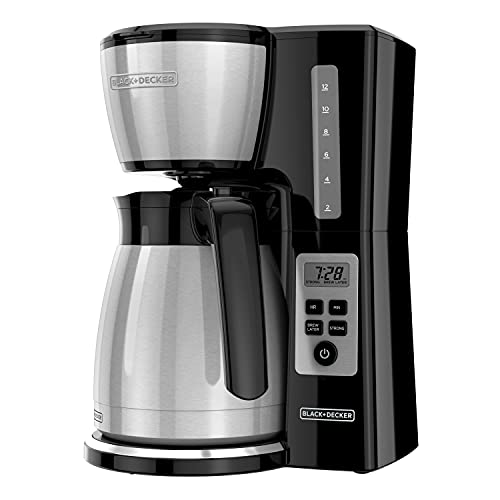
BLACK+DECKER 12 Cup Thermal Programmable Coffee Maker CM2046S
Badge: Best for Even Wetting
Strengths
- VORTEX showerhead spreads the first water across the whole bed, which is what a bloom needs to happen everywhere at once.
- Brew strength selection gives control over the extraction the bloom initiates.
- Twelve-cup thermal carafe protects the finished brew by insulation rather than applied heat.
Trade-offs
- No hotter-brewing design claim in its verified data, so its bloom case is distribution-led rather than heat-led.
- No named bloom programme, consistent with every pick in this pool.
- Thermal format carries the usual invisible coffee level.
Key specs: 12-cup capacity; thermal carafe; programmable; brew strength selection; VORTEX Technology; black/steel; model CM2046S.
If the bloom has a single mechanical precondition, it is this: all the grounds must get wet at roughly the same time. A bed where one crater is soaked and the edges stay dry does not bloom; it channels, and the dry grounds contribute almost nothing while the wet path over-extracts. The CM2046S earns second place in a bloom guide — ahead of machines with longer feature lists — because its VORTEX showerhead is a direct, named answer to that precondition. Water arrives distributed, the bed wets as a bed, and whatever gas the coffee has to release can release across the whole surface.
That makes this the most instructive pick in the guide for a buyer learning the topic: its headline trait is the one the physics asks for. The counterweight is temperature, where its verified data makes no hotter-brewing claim, so a household whose water runs genuinely cool will find the Cuisinarts’ heat story more relevant. Judge by your own machine’s failure mode. Mixed sour-bitter cups and visible dry patches in the spent bed point here; uniformly thin, sour cups point at heat, and therefore upward in this list.
Best for: buyers whose spent grounds show dry patches and uneven wetting / Not suited for: buyers whose core problem is brew temperature

Cuisinart PerfecTemp 12-Cup Thermal Drip Coffee Maker DCC-3400NAS
Badge: Best for Hotter Brewing
Strengths
- PerfecTemp hotter brewing drives a vigorous bloom and proper extraction after it.
- Brew Strength control tunes the main phase for different beans and roast levels.
- Double-wall stainless thermal carafe holds the result without degrading it on a plate.
Trade-offs
- No small-batch setting is named in its verified data, so partial pots need user care.
- No distribution system is named either; its bloom case is heat-led, the mirror of the pick above.
- Not a named pre-infusion machine, as with the whole pool.
Key specs: 12-cup capacity; double-wall stainless steel thermal carafe; PerfecTemp hotter brewing; Brew Strength control; silver finish; model DCC-3400NAS.
The DCC-3400NAS is the heat-led half of this guide’s central pairing. Where the BLACK+DECKER argues distribution, this Cuisinart argues temperature: PerfecTemp hotter brewing means the first water to touch the grounds arrives with the energy to drive gas out briskly, which is what separates a lively bloom from a damp shrug, and the same heat then carries the main extraction the bloom prepared. Strength control completes the picture by letting the household adjust the phase after wetting for beans that need a gentler or firmer hand.
It sits third rather than second only because, for the specific mechanics of blooming, wetting every ground is the precondition and heat is the amplifier — a distinction its sibling at the top of the list avoids by combining heat with the small-batch control that protects shallow beds. Full-pot households will feel no practical gap between the two Cuisinarts, and buyers whose current coffee is uniformly sour rather than patchy may reasonably promote this pick to first in their own ranking. The guide’s order is a framework, not a command, and this machine is the clearest example of why.
Best for: full-pot households whose coffee tastes uniformly under-extracted / Not suited for: small-batch brewers or distribution-first buyers

BLACK+DECKER CaféCraft 12-Cup Thermal Coffee Maker
Badge: Most Versatile
Strengths
- A consistent twelve-cup thermal programmable routine gives the bloom the same conditions every morning, and consistency is measurable progress.
- Hot and iced capability covers the household’s year in one machine.
- Thermal holding protects the brewed pot the bloom worked to set up.
Trade-offs
- No hotter-brewing or named distribution trait in its verified data, so its bloom case is the generalist one.
- Iced brewing follows different logic; the bloom discussion applies to its hot pots.
- No named bloom programme, like the rest of the pool.
Key specs: 12-cup capacity; thermal carafe; programmable; hot and iced brewing.
The CaféCraft’s contribution to a bloom conversation is repeatability. Extraction science at home is mostly the discipline of changing one variable at a time, and that discipline needs a machine whose behaviour is a constant rather than another variable. A programmable thermal twelve-cup machine that brews the same way every morning gives the owner a stable platform: adjust the dose, watch the bed, taste the difference, and actually learn what the bloom is doing with their beans. That educational value is real, and it is why a generalist machine belongs in this guide at all.
Its limits are equally clear. With neither a heat-led nor a distribution-led headline in its verified data, it cannot claim the specific bloom traits of the three picks above it, and a buyer whose single goal is maximising the early-brew stage should choose accordingly. Choose the CaféCraft when the household wants one dependable thermal machine for hot pots and iced coffee alike, and intends to improve the cup through beans, dose, and routine — the levers this machine leaves entirely in your hands.
Best for: households wanting a consistent thermal platform for hot and iced routines / Not suited for: buyers chasing specific bloom-stage design traits
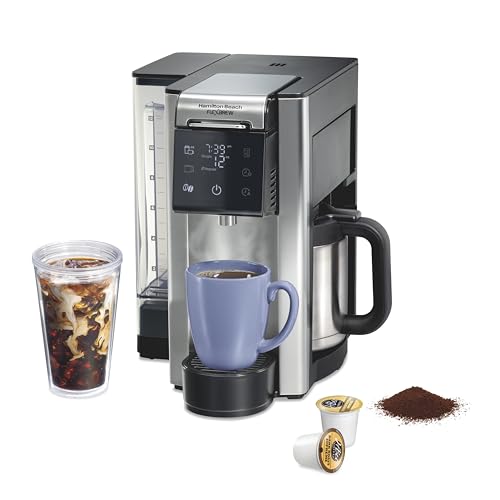
Hamilton Beach Flexbrew Advanced 5-in-1 Drip and Single Serve Coffee Maker
Badge: Best for Mixed Households
Strengths
- The drip side is a full twelve-cup thermal programmable brewer, so the bloom-minded pot is a real pot, not a token.
- Grounds brewing on both sides keeps fresh coffee — the bloom’s raw material — at the centre of the household’s options.
- A removable 60 oz reservoir makes the consistent filling that repeatable brewing needs genuinely easy.
Trade-offs
- No heat-led or distribution-led bloom trait is named in its verified data.
- Five functions mean more parts and more cleaning than any dedicated brewer here.
- Single-serve and pod brewing sit outside the bloom conversation entirely.
Key specs: 12-cup thermal drip side; single-serve for pods and grounds; hot and iced brewing; removable 60 oz reservoir; black finish.
Most households are not monasteries of extraction technique, and this pick exists for the realistic version of the keyword’s buyer: someone who cares about how the morning pot blooms and brews, living with people who want a pod at noon and iced coffee in July. The Flexbrew Advanced protects the pot drinker’s interests properly — a full-size thermal programmable drip side, brewing from grounds — while absorbing everyone else’s habits into the same footprint. Its large removable reservoir even serves the technique quietly, because consistent water filling is easier when the tank comes to the tap.
The bloom-specific honesty is that its verified data names no distribution system and no hotter-brewing design, so on the four traits this guide scores, it offers the platform rather than the specialism. If your household is unified in its habits, the picks above serve the keyword better. If your household is mixed, this is the machine that keeps the careful pot possible without exiling everyone else’s coffee to a second appliance, and that practical virtue outweighs a theoretical bloom edge you would never get to use in peace.
Best for: mixed households where one careful pot must coexist with pods and iced coffee / Not suited for: single-routine households focused purely on brew-stage traits

BUNN 55200 CSB3T Speed Brew Platinum Thermal Coffee Maker
Badge: Best for Speed
Strengths
- A fast brew cycle from the brand owners cite most for pace and longevity, in a proper thermal format.
- Hot water delivered decisively means the wetting stage is not lukewarm, even if it is brief.
- Ten-cup thermal carafe holds the result by insulation, protecting whatever the fast brew produced.
Trade-offs
- Speed is the design priority, and a fast cycle leaves the least room for a lingering bloom stage of any pick here — stated openly, because it is the honest core of this review.
- No strength or small-batch controls are named in its verified data.
- Feature-minimal next to the programmable picks above.
Key specs: 10-cup capacity; thermal carafe; stainless steel and black finish; Speed Brew design.
Every guide should contain one pick that defines its boundary, and this is that pick. The BUNN Speed Brew is an excellent machine by its own lights — fast, thermal, from the most durability-trusted name in this pool — and it is included here precisely so the bloom trade-off can be shown rather than asserted. A brewing cycle engineered to minimise total time necessarily spends its moments differently from one engineered around staged extraction: wetting happens, heat is genuinely there, but the unhurried pause in which a bloom fully develops is not what this design is selling. Owners who buy it for pace report satisfaction in exactly those terms.
So the verdict is conditional and clear. If your household’s mornings are a sprint and the bloom is a nice-to-have, this machine will serve you better than any other in the guide, and its thermal carafe still protects the result. If the bloom stage is the reason you are reading — if you buy fresh beans, watch the bed, and taste the difference the first minute makes — the picks above exist for you, and this one, honestly, does not. Knowing which of those buyers you are is worth more than any single specification in this article.
Best for: households that need a full thermal pot at maximum speed / Not suited for: bloom-focused brewers who want the early stage given time and control
Comparison Table
| Model | Capacity | Carafe / holding | Bloom-relevant trait | Listing |
|---|---|---|---|---|
| Cuisinart PerfecTemp Thermal (12-Cup) | 12-cup | Thermal carafe | Hotter brewing, strength control, 1-4 cup setting | Check on Amazon |
| BLACK+DECKER CM2046S | 12-cup | Thermal carafe | VORTEX showerhead even wetting | Check on Amazon |
| Cuisinart PerfecTemp DCC-3400NAS | 12-cup | Double-wall stainless thermal | Hotter brewing, strength control | Check on Amazon |
| BLACK+DECKER CaféCraft | 12-cup | Thermal carafe | Consistent programmable routine, hot and iced | Check on Amazon |
| Hamilton Beach Flexbrew Advanced | 12-cup plus single serve | Thermal carafe | Full grounds pot alongside pods and iced | Check on Amazon |
| BUNN Speed Brew Platinum | 10-cup | Thermal carafe | Fast, hot cycle; pace over bloom time | Check on Amazon |
How to Choose a Drip Coffee Maker for Better Blooming
Choose by failure mode, not by vocabulary. After your next pot on your current machine, look at the spent grounds before you throw them away. A bed with a deep central crater and pale, dry edges is telling you the water never spread: your problem is distribution, and the showerhead pick in this guide is your answer. A bed that looks evenly wet but produced a thin, sour cup is telling you the water or the contact was inadequate: your problem is heat or time, and the PerfecTemp picks are your answer. A bed that looks fine from coffee that has sat in a bag for months is telling you the bloom had no fuel: your problem is freshness, and the fix is beans and grinding habits before any machine, which is why the freshness discussion in Best Drip Coffee Makers Under $100 and its neighbouring guides pairs naturally with this one.
Then be honest about your household’s pace and composition. Bloom quality is worth paying attention to only if someone at home tastes the difference and the routine allows it: a machine chosen for staged, controlled brewing will irritate a household that needs coffee in minutes, and a speed machine will quietly disappoint a household that bought fresh beans to taste them properly. The BUNN’s presence at the foot of this ranking is the guide’s way of keeping that honesty structural. Finally, match the carafe to the morning, because the best-managed bloom in the world still ends in a pot that either sits in insulation or cooks on a plate; five of these six picks hold thermally, and slow households should keep it that way, a point the wider Best Drip Coffee Makers With Carafe research supports from the holding side just as this guide supports it from the brewing side.
How to Brew, Observe, and Troubleshoot the Bloom at Home
You cannot add a bloom programme to a machine that lacks one, but you can give the bloom stage its best conditions. Use coffee fresh enough to still hold gas, and grind close to brewing when you can, since ground coffee sheds its gas quickly. Level the grounds bed before brewing so water meets an even surface rather than a mound with a thin edge. Keep the machine descaled, because scale lowers brew temperature and a cool first wetting produces a weak bloom and a sour cup. Then observe: many baskets let you glimpse the early cycle, and a bed that swells and settles evenly is the visual signature of the stage working; a bed that erupts in one channel is distribution failing in real time.
Adjust in the order the physics suggests. Freshness first, because no setting creates gas that has already left the coffee. Distribution second, through bed levelling and, at purchase time, showerhead design. Temperature third, through descaling and, at purchase time, hotter-brewing designs. Strength settings last, to tune the main extraction once the early stage is healthy — using them to compensate for a failed bloom is like seasoning a dish to hide that it was undercooked. Keep a brief note of what you changed and what the cup did in response; three recorded pots will teach you your own machine’s personality more reliably than a month of unrecorded experimentation, and that record becomes the evidence base for any future purchase decision.
Problem: the grounds barely swell and the cup tastes flat → suspect stale coffee before the machine; buy fresher beans, store them sealed away from heat, and grind closer to brew time. Problem: the bed shows a crater with dry edges → the wetting is uneven; level the bed, check the filter is seated flat, and favour a showerhead design at replacement time. Problem: the cup is sour despite fresh coffee and an even bed → think temperature and contact; descale, then use a strength setting or a hotter-brewing pick rather than masking the fault with darker roasts.
What Blooming Can and Cannot Do for a Cup
A well-managed bloom supports even extraction, and even extraction is where balanced flavour lives, so the stage deserves its reputation among careful brewers. But proportion matters. Blooming cannot rescue stale beans, cannot correct a badly wrong dose, cannot raise a lukewarm machine’s temperature, and cannot make a pot held badly for hours taste fresh. It is one stage in a chain, and the chain’s other links — freshness, ratio, heat, distribution, holding — are all represented in this guide’s ranking because the keyword’s buyers are best served by the whole picture rather than by a single fashionable stage.
It is also worth knowing that the bloom is most dramatic with very fresh coffee, which creates a pleasant trap: the visible swelling is partly a freshness indicator, so chasing the visual for its own sake can mislead. Judge the stage by the cup it produces — sweetness, balance, the absence of that mixed sour-bitter signature — and let the theatre be a bonus. Buyers who keep that order straight will get more from any machine in this list, and will know exactly which trait to prioritise when they replace it. There is a modest satisfaction in that knowledge, too: an owner who can read a grounds bed owns a diagnostic skill that transfers to every brewer they will ever use, from a borrowed machine on holiday to whatever eventually replaces the current one years from now. Readers ready to explore the holding half of the chain can continue to Best Drip Coffee Makers Under $75 for orientation on how the mainstream tiers bundle these designs.
Freshness: The Raw Material the Bloom Is Made Of
Every bloom discussion eventually becomes a freshness discussion, because the gas that swells the bed is a property of the coffee, not the machine. Beans hold the most gas in the period shortly after roasting, then release it steadily through storage, and grinding accelerates the loss dramatically by exposing vastly more surface area. This is why the same machine can produce a lively, swelling bed from a fresh bag and a nearly still bed from a bag opened weeks ago, with no fault anywhere in the equipment. A buyer evaluating machines should therefore fix the coffee before judging the hardware: assess any pick in this guide with beans fresh enough to bloom, or you will rank machines by the performance of your pantry instead.
Storage is the lever most households control worst. Coffee kept in a warm spot near the machine, in a bag resealed loosely, or ground in large batches days ahead will surrender its gas long before brewing, and no showerhead can return it. The standards are simple: sealed, cool, away from light, bought in quantities the household finishes while the coffee is still lively, and ground as close to the brew as the routine allows. Households that grind at home hold an advantage here that no drip feature fully offsets, which is why freshness and grinding are treated as one topic across this site’s guides. The bloom, read correctly, is a freshness meter built into every pot — a bed that swells is telling you the coffee arrived alive, and a bed that does not is telling you to shop differently before you shop for machines at all.
Bloom Behaviour Across Batch Sizes and Roast Levels
Batch size changes the bloom’s physics in ways worth understanding before you judge a machine. A full pot’s deep bed holds water back, giving gas time to escape as the bed saturates from the top down; a small pot’s shallow bed lets water through quickly, so the same coffee can appear to bloom less simply because the stage is over sooner. This is the mechanical background to the leading pick’s small-batch setting and to the guide’s repeated advice: brew the batch size your machine handles gracefully, or choose a machine that explicitly handles yours. Households that alternate between a weekday small pot and a weekend full one are really shopping for two brewing situations, and the picks with batch-size or strength controls serve that duality best.
Roast level changes the picture from the coffee’s side. Roasting drives gas into the bean, and different roast levels hold and release it differently, while also extracting at different rates once the water arrives — which is why a strength setting that flatters one bag can push another into harshness, and why the bloom-minded owner adjusts in small steps when the beans change. None of this requires laboratory equipment: it requires the habit of noticing. Watch the bed when a new bag starts. Taste the first pot before adjusting anything. Change one variable, and notice again. The machines in this guide were ranked to reward exactly that habit, because their distinguishing traits — distribution, heat, control — are precisely the ones a noticing owner can feel working, pot after pot.
A Simple Home Test: Reading Your Current Machine’s Bloom Traits Before You Replace It
Before spending anything, a bloom-minded owner can learn which trait their current machine lacks, using one fresh bag of coffee and three consecutive pots. Brew the first pot exactly as usual and simply watch the early cycle if the basket allows it, then examine the spent bed: its shape is a map of the water’s behaviour. Brew the second pot with the bed carefully levelled and the dose measured rather than estimated; if the cup improves noticeably, your constraint was routine, not hardware, and the cheapest upgrade in this entire guide is a scoop and a habit. Brew the third pot after descaling, if the machine is due; if the cup sharpens and the bed swells more willingly, temperature was drifting and the machine you own may have more to give than you credited it with.
If, after those three pots, the bed still shows a crater with dry edges, the diagnosis is distribution, and the showerhead pick becomes your evidence-based first choice rather than a guess. If the bed wets evenly but the cup remains thin and sour with fresh coffee and a correct dose, the diagnosis is heat or contact, and the PerfecTemp picks lead your shortlist for a demonstrated reason. If every pot is honestly good and only the mornings are too slow, the diagnosis is pace, and the speed pick at the foot of this ranking becomes, for your household, the correct first choice wearing the wrong guide’s ordering. That is the deepest service a framework can do a buyer: it converts a vague dissatisfaction into a named variable, and a named variable into a short list of one or two machines. Run the test, name your variable, and the ranking in this article will rearrange itself around your kitchen — which is what it was built to do.
Common Buying Mistakes
- Believing a listing’s bloom vocabulary without checking for the traits that produce a bloom: distribution design, temperature design, and flow control.
- Expecting a dramatic bloom from stale, pre-ground coffee that has already released its gas on a shelf.
- Buying a speed-first machine for a freshness-focused routine, or a control-focused machine for a household in a hurry.
- Judging the bloom by how theatrical it looks instead of by the balance of the finished cup.
- Ignoring descaling until brew temperature falls, then blaming the beans for a weak bloom and a sour pot.
- Pulling the carafe repeatedly mid-brew to peek or pour, disrupting the very extraction stages the purchase was meant to protect.
Final Recommendation
For the buyer behind this keyword, the first choice is the Cuisinart 12-Cup Programmable PerfecTemp Thermal Carafe Coffee Maker, because heat, strength control, and small-batch handling together give the bloom stage the most support available in this pool. If your spent beds show uneven wetting, promote the BLACK+DECKER CM2046S and its showerhead to first place; if your pots are uniformly sour, the PerfecTemp DCC-3400NAS is the heat-led answer. Keep the guide’s disclosure in view throughout: none of these machines claims a dedicated bloom programme, so if that specific automation is your requirement, shop for it by name at the specialty end of the market — and use the trait framework here to verify that whatever you find deserves its own description.
Frequently Asked Questions
What is coffee blooming, in plain terms?
It is the first stage of brewing, when hot water wets fresh grounds and the coffee releases trapped gas, causing the bed to swell. Letting that gas escape before and during the main pour helps water reach the grounds evenly, which supports balanced extraction. Old coffee has little gas left, which is why freshness and blooming are inseparable topics.
Do any machines in this guide have a true bloom or pre-infusion mode?
None of the six verified listings names a dedicated bloom programme, and the guide does not claim one for them. Instead, the picks are ranked on the traits that govern the bloom stage in a drip machine — even wetting, hotter brewing, strength and batch-size control, and cycle design — with the speed-first pick’s opposite priority stated openly.
Why does the showerhead model rank so high for blooming?
Because a bloom can only happen where water actually arrives. A showerhead wets the whole bed at once, so the entire surface can release gas and extract together; a single-stream inlet leaves dry patches that never bloom and a channel that over-extracts. For this specific keyword, distribution is the most mechanical, verifiable trait on offer.
Can I improve blooming without buying a new machine?
Yes, partly. Fresher beans, grinding close to brew time, a level grounds bed, a properly seated filter, and a descaled machine all improve the early brew stage on equipment you already own. What you cannot retrofit is design: distribution hardware, heating design, and cycle programming are set at purchase, which is what the picks here are for.
Why is a fast machine ranked last in a blooming guide?
Because the ranking follows the keyword’s priority. A fast cycle is a legitimate design goal, and the BUNN is an excellent answer to a speed question, but pace leaves the least room for the unhurried early stage this keyword is about. Its review states the trade plainly so a speed-needing household can still choose it with open eyes.
Does blooming matter for small pots?
It matters more, not less. A shallow bed in a partial pot is the easiest to wet unevenly and the quickest to channel, which is why the leading pick’s 1-4 cup setting counts as a bloom-relevant feature in this guide. Small-batch households should weight batch-size handling alongside heat and distribution when choosing.
How can I tell whether my coffee is fresh enough to bloom?
The brew itself tells you. Fresh coffee swells visibly when the first water arrives and produces a lively, aromatic early stage; coffee past its best sits comparatively still and brews a flatter cup even on a capable machine. If a new, recently roasted bag blooms weakly on a descaled machine with an even bed, the constraint is the coffee’s storage or age rather than the hardware. Treat the bloom as a freshness report delivered with every pot, and let it guide your buying quantity and storage habits before it guides any machine purchase.


