Disclosure: topratedkitchenware.com is reader-supported. When you buy through links on our site, we may earn an affiliate commission from Amazon and other retailers, at no extra cost to you.
Where to buy
The six models below are the verified picks for this guide to the best drip coffee makers that brew hotenough — machines that genuinely brew hot enough. Each name links to its Amazon listing, where you can check the latest price on Amazon, confirm the current configuration, and read the newest owner feedback before you decide.
- BLACK+DECKER 12 Cup Thermal Programmable Coffee Maker (CM2046S)
- Cuisinart PerfecTemp 12-Cup Thermal Drip Coffee Maker (DCC-3400NAS)
- BLACK+DECKER CaféCraft 12-Cup Thermal Coffee Maker
- Cuisinart 12-Cup PerfecTemp Thermal Coffee Maker, White
- BUNN Speed Brew Platinum Thermal Coffee Maker (CSB3T)
- Hamilton Beach FlexBrew Advanced 5-in-1 Coffee Maker
If you only follow one link from this box, make it the Cuisinart PerfecTemp — Check on Amazon — because its brewing system is the one in this group that is explicitly built around hotter brewing. Read the full guide ↓ for the ranking logic, the honest limitations of every pick, and the checks that matter more than any headline claim.
Lukewarm coffee is the quiet failure mode of drip brewing, and it is exactly why so many people search for the best drip coffee makers that brew hotenough to taste like coffee should. A maker can have a big carafe, a tidy clock, and a long feature list, yet still disappoint every single morning if the water never gets properly hot during extraction or if the finished coffee sits losing heat on a weak warming plate. Heat is not a cosmetic detail. Water that is too cool under-extracts the grounds, leaving sour, thin, salty notes; coffee that cools quickly in the cup tastes flat long before the pot is finished. This guide treats temperature as the first buying criterion, not an afterthought, and every pick below earned its place because its design — thermal carafes, hotter-brewing systems, fast cycles, or some combination of those — gives the coffee a fair chance to arrive hot and stay hot.
You will find six verified models compared side by side, with the reasoning behind the order and the badges explained in plain language. Each pick gets a detailed review covering strengths, trade-offs, the specifications confirmed in its listing, and a blunt statement of who should skip it. Beyond the reviews, there is a comparison table, a full buying guide on what actually controls brew temperature, a practical how-to section on setup, brewing, cleaning, and troubleshooting, and answers to the questions hot-coffee hunters ask most. If your budget is the tighter constraint, our notes on Best Drip Coffee Makers Under $100 cover the same temperature questions from a price-first angle, and readers who mostly care about heat retention after brewing should also see Best Drip Coffee Makers With Insulated Carafe, where the carafe itself is the whole story.
Key Takeaways
- Temperature fails in two places: water that never gets hot enough during brewing, and coffee that loses heat afterwards. Good picks defend both.
- Every pick in this guide uses a thermal carafe rather than a glass carafe on a hot plate, so coffee is not slowly cooked while it waits.
- The two Cuisinart PerfecTemp models are the most direct answer to the question, because PerfecTemp is a brewing system designed around hotter brewing.
- Fast brew cycles, like the BUNN design here, protect heat in a different way: less time in contact with room air, less time waiting.
- Preheating the thermal carafe with hot water before brewing is the cheapest temperature upgrade available, and it works with every pick.
- Grind, ratio, and fresh water still matter. A hot maker cannot rescue stale beans or a badly skewed coffee-to-water ratio.
In this guide
Quick Picks
| Pick | Badge | Why it is here | Link |
|---|---|---|---|
| BLACK+DECKER 12 Cup Thermal Programmable Coffee Maker (CM2046S) | Best for Even Extraction | VORTEX showerhead design spreads water across the grounds while the thermal carafe holds the heat. | Check on Amazon |
| Cuisinart PerfecTemp 12-Cup Thermal Drip Coffee Maker (DCC-3400NAS) | Best Overall | PerfecTemp hotter brewing plus a double-wall stainless steel thermal carafe. | Check on Amazon |
| BLACK+DECKER CaféCraft 12-Cup Thermal Coffee Maker | Best for Hot and Iced | A 12-cup thermal machine that also handles iced coffee, for households split between the two. | Check on Amazon |
| Cuisinart 12-Cup PerfecTemp Thermal Coffee Maker, White | Best for Small Batches | PerfecTemp brewing with a dedicated 1-4 cup setting, so small pots are not an afterthought. | Check on Amazon |
| BUNN Speed Brew Platinum Thermal Coffee Maker (CSB3T) | Best for Speed | A 10-cup thermal design built around fast brewing, so the pot is done before it can cool. | Check on Amazon |
| Hamilton Beach FlexBrew Advanced 5-in-1 Coffee Maker | Most Versatile | Full 12-cup thermal drip on one side, single-serve pods and grounds on the other. | Check on Amazon |
How These Picks Were Chosen
This is a research-led guide, not a lab report, and it is written that way on purpose. The picks were chosen by comparing verified product listings, manufacturer descriptions of the brewing and carafe systems, and the recurring themes in owner feedback — especially the complaints, because temperature complaints follow a pattern. When owners say a machine brews lukewarm, the causes repeat: a heating element that cycles off too early, a showerhead that dribbles water unevenly so part of the bed never extracts, a glass carafe bleeding heat into the room, or a warming plate that keeps coffee warm-ish while stewing it. Models whose designs answer those specific failure points rose to the top of this list; models that are perfectly good drip makers but do nothing in particular about heat did not.
Three filters did most of the work. First, the carafe test: every pick here brews into a thermal carafe, because insulation is the single most reliable defence of serving temperature once brewing ends. Second, the brewing-system test: priority went to machines whose listings describe a deliberate approach to hot brewing — PerfecTemp hotter brewing on the two Cuisinart models, the VORTEX water-distribution system on the BLACK+DECKER CM2046S, and the speed-focused design of the BUNN, which limits the time brewed coffee spends exposed. Third, the everyday test: programmability, brew strength control, and batch-size flexibility, because a maker that only performs on one rigid routine gets replaced within a year. Where a specification is quoted in this guide, it comes from the verified listing data for that model; where a listing is silent, this guide is silent too, rather than inventing numbers.
One honesty note belongs here. Brew temperature is measured differently by different makers, at different points in the cycle, and listings rarely publish a directly comparable figure. So this guide does not crown a winner by a single degree. It ranks designs: systems built to brew hotter and carafes built to hold heat, combined with the habits in the how-to section, are what actually put a steaming cup in your hand. Readers comparing the wider field should also look at Best Drip Coffee Makers With Thermal Carafe, which ranks many of the same machines purely on carafe performance, and Best Drip Coffee Makers With Carafe for the glass-versus-thermal argument in full.
The 6 Best Drip Coffee Makers That Brew Hot Enough
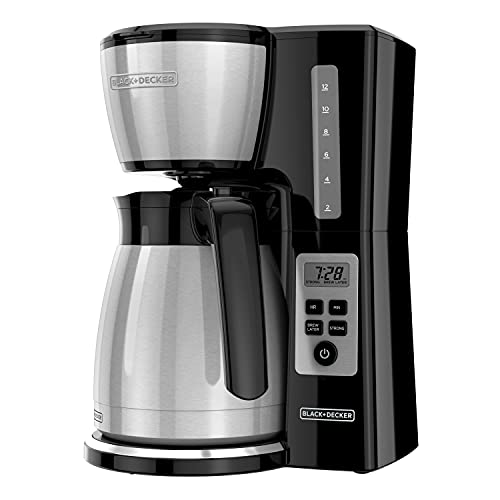
BLACK+DECKER 12 Cup Thermal Programmable Coffee Maker (CM2046S)
Badge: Best for Even Extraction
Strengths
- VORTEX Technology showerhead is designed to saturate the grounds evenly, which supports fuller extraction at temperature.
- 12-cup thermal carafe keeps brewed coffee hot without a flavour-stewing warming plate.
- Brew Strength control lets you slow the process down for a bolder cup on days you want it.
Trade-offs
- Even saturation helps extraction, but this is not a dedicated high-heat brewing system like the PerfecTemp models.
- The black and steel finish shows fingerprints and water spots readily.
- Thermal carafes pour more slowly than glass for some people, especially near the end of the pot.
Mini spec box
- Capacity: 12 cup
- Carafe: Thermal
- Controls: Programmable, Brew Strength control
- Showerhead: VORTEX Technology
- Finish: Black/Steel
- Model: CM2046S
Extraction and temperature are partners. Water can be perfectly hot and still produce a weak, sour pot if it channels through one corner of the grounds while the rest stay nearly dry. The CM2046S attacks that half of the problem: its VORTEX showerhead is built to distribute water across the whole bed of grounds, so the hot water actually meets all of the coffee. In daily terms, that means the last cup from the thermal carafe tastes like the same coffee as the first, rather than a thinner echo of it. The programmable timer and brew strength control make it an easy machine to live with — set it the night before, choose a stronger cycle when the beans are a lighter roast, and let the carafe do the heat-holding work afterwards.
The honest limitation is focus. If your single, overriding complaint is that your current maker brews lukewarm, the PerfecTemp models below aim at that complaint more directly. The BLACK+DECKER is the better all-rounder for households that want even extraction, a generous 12-cup thermal pot, and straightforward controls, and who will use the carafe-preheating habit described later in this guide to close any remaining temperature gap.
Best for: households that want even extraction and a big thermal pot / Not suited for: buyers whose only priority is the hottest possible brew system

Cuisinart PerfecTemp 12-Cup Thermal Drip Coffee Maker (DCC-3400NAS)
Badge: Best Overall
Strengths
- PerfecTemp technology is explicitly designed for hotter brewing, which is the heart of this entire guide.
- Double-wall stainless steel thermal carafe protects the heat the brewer worked to create.
- Brew Strength control gives a real choice between regular and bolder extraction.
Trade-offs
- It sits in a premium tier within this group, reflecting the brewing system and carafe.
- Stainless thermal carafes hide the coffee level, so you judge by cups poured, not by looking.
- The silver finish is handsome but shows every splash in a busy kitchen.
Mini spec box
- Capacity: 12-cup
- Carafe: Double-wall stainless steel thermal
- Brewing system: PerfecTemp hotter brewing
- Controls: Brew Strength control
- Finish: Silver
- Model: DCC-3400NAS
Start with the name, because here the name is the point. PerfecTemp is Cuisinart’s hotter-brewing approach, and for a shopper whose search began with lukewarm disappointment, a system designed around brew temperature is the most relevant feature any drip maker can offer. Hotter water through the grounds extracts more of what makes coffee taste like coffee — the sugars and aromatic compounds that cooler water leaves behind — which is why under-heated coffee so often tastes sour and thin at the same time. Pair that brewing system with a double-wall stainless steel thermal carafe and the whole heat chain is defended: hot in, hot held, and no warming plate slowly baking the last two cups into bitterness.
In everyday use, the brew strength control is the feature owners reach for most after the timer. It lets a household split the difference between someone who wants a gentle morning cup and someone who wants the pot to stand up to milk. The honest limitation is positioning rather than performance: this is a considered purchase in a premium tier of this group, and households that mostly brew for one person may be paying for 12-cup thermal capacity they rarely fill — the white PerfecTemp model below, with its small-batch setting, or the 10-cup options in this guide may fit better. For everyone else, this is the benchmark pick of the six.
Best for: anyone whose top complaint is lukewarm drip coffee / Not suited for: single-cup households that rarely brew a pot

BLACK+DECKER CaféCraft 12-Cup Thermal Coffee Maker
Badge: Best for Hot and Iced
Strengths
- Brews both hot and iced coffee, so one machine covers summer and winter routines.
- 12-cup thermal carafe keeps the hot side of that bargain hot without a warming plate.
- Programmable operation fits set-it-the-night-before households.
Trade-offs
- Iced capability is a bonus feature, not a heat feature — pure hot-coffee hunters may not need it.
- Like all thermal carafes, it rewards a quick rinse-and-preheat routine for best holding.
- Fewer brew-customisation details are published for this model than for the Cuisinart pair.
Mini spec box
- Capacity: 12-cup
- Carafe: Thermal
- Modes: Hot and iced coffee
- Controls: Programmable
- Brand line: CaféCraft
Split households are real: one person drinks hot coffee twelve months a year, the other switches to iced the moment the weather turns. The CaféCraft answers that split with a 12-cup thermal platform that brews hot coffee into an insulated carafe and also handles iced coffee when asked. For the purposes of this guide, the hot side is what counts, and it is properly built — a thermal carafe rather than glass on a plate, full-pot capacity, and programmable timing so the coffee is brewed fresh at waking rather than reheated. Iced brewing, done well, actually depends on the same virtue this guide cares about: strong, fully extracted hot coffee brewed over ice, which only works if the hot brew itself is right.
The honest limitation is that versatility is the headline here, not a specialised heating system. If nobody in your home ever drinks iced coffee, the feature earns you nothing, and one of the PerfecTemp models directs more of the design budget at your actual problem. If the split-household description sounds familiar, though, the CaféCraft is the pick that ends the two-machine argument, and its thermal carafe keeps it fully legitimate in a hot-coffee ranking.
Best for: households split between hot and iced coffee / Not suited for: hot-only drinkers who want a dedicated high-heat brewing system

Cuisinart 12-Cup PerfecTemp Thermal Coffee Maker, White
Badge: Best for Small Batches
Strengths
- Same PerfecTemp hotter-brewing family as the Best Overall pick.
- Dedicated 1-4 cup setting, so a small morning pot brews with adjusted flow rather than as a diluted full cycle.
- Brew Pause lets you pour a cup mid-cycle without dripping across the plate area.
Trade-offs
- The white finish needs more frequent wiping to look clean around coffee splashes.
- Full 12-cup capacity is there, but the machine’s special talent is the small end of the range.
- Also a premium-tier model within this group.
Mini spec box
- Capacity: 12-cup
- Carafe: PerfecTemp thermal carafe
- Brewing system: PerfecTemp
- Settings: 1-4 cup setting, Brew Strength Control, Brew Pause
- Finish: Stainless steel, white
Small batches are where many drip makers quietly fail the temperature test. Run four cups of water through a machine tuned for twelve and the cycle is short, the water spends less time at full heat, and the result can be a thin, lukewarm pot that gives drip coffee a bad name. This Cuisinart answers with a dedicated 1-4 cup setting alongside its PerfecTemp brewing system, which is exactly the combination a one- or two-person household should look for: hotter brewing as the foundation, and a small-batch mode that treats a half pot as a real brewing job rather than a shortcut. The thermal carafe then holds those few cups properly, so the second cup an hour later is still worth drinking.
Brew Pause and brew strength control round out a machine that suits deliberate coffee drinkers — people who notice the difference between a rushed cycle and a proper one. The honest limitation is mostly cosmetic and budgetary: white shows coffee stains more readily than black or steel, and the model sits in the group’s premium tier. Households that always brew full pots will use the 1-4 cup setting rarely; for them the silver DCC-3400NAS above is the cleaner recommendation. For mixed households — small pots on weekdays, full pots when guests arrive — this is arguably the smartest buy of the six.
Best for: small households that still want full-pot backup / Not suited for: buyers who always brew twelve cups and prefer a darker finish

BUNN Speed Brew Platinum Thermal Coffee Maker (CSB3T)
Badge: Best for Speed
Strengths
- Speed Brew design completes the pot quickly, limiting the time brewed coffee sits exposed to cooler air.
- Thermal carafe in stainless steel and black holds serving temperature without a hot plate.
- 10-cup capacity suits households that found 12-cup pots partly wasted.
Trade-offs
- Speed is the philosophy here; it offers less in the way of programmable scheduling theatre than rivals.
- 10 cups is the ceiling — big households will brew twice.
- The design language is functional rather than decorative.
Mini spec box
- Capacity: 10-cup
- Carafe: Thermal
- Design: Speed Brew Platinum
- Finish: Stainless steel, black
- Model: 55200 CSB3T
BUNN built its name in commercial settings, where coffee has to be brewed fast and served hot, and the Speed Brew Platinum carries that thinking into a 10-cup home machine. Speed is a legitimate temperature strategy: the less time a brew cycle takes, and the sooner the coffee is sealed inside a thermal carafe, the less heat escapes into the kitchen air. For impatient households — the ones who currently microwave yesterday’s mug or drink the pot within twenty minutes because it goes cold — a fast cycle into insulation solves the actual lived problem, not just the specification-sheet one. The stainless and black build also suits kitchens that prefer appliances to look like tools.
The trade-off is ceremony. Shoppers who love scheduling, strength menus, and small-batch modes will find the BUNN comparatively single-minded, and its 10-cup ceiling is a real limit for entertaining. It is also worth saying plainly that fast brewing only tastes right when the grind and ratio are right; the how-to section below covers the quick checks that keep a fast machine honest. Judged on the question this guide asks — will the cup be hot? — the BUNN’s answer is one of the most convincing here, delivered by pace rather than by a named heating system. Readers who want the same pace in a tighter price frame should compare Best Drip Coffee Makers Under $75, where mid-band thermal models compete closely.
Best for: impatient households that drink the pot quickly / Not suited for: feature collectors who want scheduling and strength menus
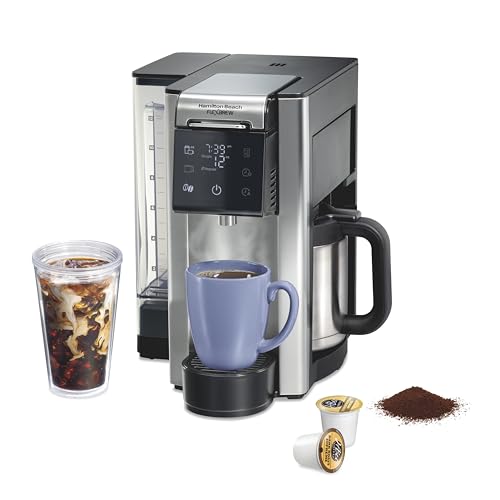
Hamilton Beach FlexBrew Advanced 5-in-1 Coffee Maker
Badge: Most Versatile
Strengths
- 5-in-1 design: full-pot drip, single-serve pods, and single-serve grounds in one machine.
- The drip side is a proper 12-cup thermal programmable brewer, not a token extra.
- Removable 60 oz reservoir is easy to fill and clean, which supports consistent brewing.
Trade-offs
- Two brewing systems mean more parts to clean and more counter footprint than a pure drip maker.
- Single-serve convenience can quietly raise your per-cup cost in pods if it becomes the default.
- Heat purists get a competent thermal drip side rather than a specialised hot-brewing system.
Mini spec box
- Configuration: 5-in-1 drip and single serve
- Drip capacity: 12-cup thermal, programmable
- Single serve: Pods and grounds, hot and iced
- Reservoir: Removable, 60 oz
- Finish: Black
The FlexBrew Advanced earns its place in a hot-coffee guide by being honest about how households actually drink. Some mornings need a full 12-cup thermal pot for a houseful of people; some afternoons need one quick cup that is actually hot and fresh rather than the dregs of the morning pot reheated. A hybrid machine serves both moments: the drip side brews into a thermal carafe that holds heat the way this guide recommends, and the single-serve side — pods or your own grounds — makes a fresh cup on demand instead of a microwaved one. The removable 60 oz reservoir is a small design decision with outsized daily value, because a reservoir you can carry to the sink gets filled with fresh water more often, and fresh water brews better.
The limitation is complexity. Two systems mean two cleaning routines, and the drip side, while genuinely good, is not a dedicated temperature specialist like the PerfecTemp models. There is also a discipline question: pods are convenient, and households that drift into pod-only use lose the cost and flavour advantages of pot brewing. Treat the FlexBrew as a thermal drip maker with a brilliant backup singer, and it is one of the most practical machines in this group. Shoppers who know pods are their main event should start instead at Best Drip Coffee Makers With Pod and work backwards to the pot.
Best for: mixed households that want a hot pot and a quick single cup / Not suited for: minimalists who want one simple system to clean
Comparison Table
| Model | Capacity | Carafe | Heat strategy | Standout feature | Link |
|---|---|---|---|---|---|
| BLACK+DECKER CM2046S | 12 cup | Thermal | Even VORTEX saturation + insulation | Brew Strength control | Check on Amazon |
| Cuisinart PerfecTemp DCC-3400NAS | 12-cup | Double-wall stainless thermal | PerfecTemp hotter brewing | Brew Strength control | Check on Amazon |
| BLACK+DECKER CaféCraft | 12-cup | Thermal | Insulated carafe, programmable timing | Hot and iced brewing | Check on Amazon |
| Cuisinart PerfecTemp, White | 12-cup | Thermal | PerfecTemp brewing, small-batch mode | 1-4 cup setting, Brew Pause | Check on Amazon |
| BUNN Speed Brew Platinum CSB3T | 10-cup | Thermal | Fast cycle into insulation | Speed Brew design | Check on Amazon |
| Hamilton Beach FlexBrew Advanced | 12-cup drip + single serve | Thermal | Insulated pot plus fresh single cups | Pods and grounds, 60 oz reservoir | Check on Amazon |
How to Choose a Drip Coffee Maker That Brews Hot Enough
Start by separating the two halves of the problem, because they have different solutions. Brewing heat is about the water that meets the grounds: coffee extracts best when the water is properly hot, in the broad range baristas describe as just off the boil, and it extracts poorly — sour, thin, underdeveloped — when the water is merely warm. Serving heat is about everything after: the carafe, the wait, and the cup. A maker can ace the first half and fail the second with a glass carafe in a cold kitchen, or ace the second with superb insulation around a mediocre brew. The six picks here were chosen because none of them obviously fails either half, but as you compare any drip maker, ask both questions out loud: how does it brew hot, and how does it stay hot?
On the brewing side, look for evidence of intent. A named hotter-brewing system, like Cuisinart’s PerfecTemp, is intent. A showerhead designed for even saturation, like the VORTEX system on the BLACK+DECKER CM2046S, is intent about extraction, which is temperature’s closest partner. A fast, commercial-style cycle, like the BUNN’s, is intent about minimising exposure. What is not intent is a long list of clock and display features; a beautiful timer cannot raise water temperature by a single degree. On the serving side, the hierarchy is simple: a double-wall thermal carafe beats a single-wall one, any thermal carafe beats glass on a hot plate for flavour over time, and a hot plate is best understood as a short-term warmer that slowly cooks coffee, not a heat preserver.
Capacity interacts with heat more than most buyers expect. A 12-cup machine brewing four cups runs a short cycle that may never settle at full temperature unless it has a small-batch setting — which is why the white Cuisinart’s 1-4 cup mode matters. Conversely, a household that always brews full pots gets more consistent heat from a machine working in its comfort zone. Match the machine’s sweet spot to your real routine: count the cups your household actually drinks on a weekday morning, add one for the person who always wants a refill, and buy for that number, not for the biggest gathering of the year. Guests can wait for a second brew; your Tuesday coffee should be right every time.
Finally, weigh the supporting cast. Programmability matters because freshly brewed coffee is hotter coffee — a pot brewed at waking beats a pot brewed an hour early and held. Brew strength control matters because a bolder setting can compensate on days when a lighter roast tastes thin. A removable reservoir matters because fresh water, filled easily, gets changed more often. None of these features is a temperature feature on paper, yet together they decide whether the hot-brewing hardware gets the inputs it needs. Buy the system, not the slogan.
How to Brew Hotter Coffee at Home: Setup, Routine, and Care
First setup. Wash the carafe and any removable parts in warm soapy water, rinse well, and run one or two full cycles of plain water through the machine before the first real pot. This clears manufacturing residue that can flatten flavour, and it lets you watch the cycle once — where the water flows, how the showerhead behaves, whether the carafe seats squarely — without wasting coffee on the lesson.
The daily routine that protects heat. Step one: fill the reservoir with fresh, cold water; water that sat overnight in the tank starts the cycle stale. Step two: while the machine warms, rinse the thermal carafe with hot tap water and let it sit full for a minute, then empty it. A preheated carafe stops stealing the first pot’s heat — this single habit closes most of the temperature gap between good machines and great results. Step three: add grounds at a sensible ratio, roughly one to two tablespoons per cup as a starting point, and adjust by taste over several pots rather than all at once. Step four: brew, then give the pot a gentle swirl before the first pour so the strength is even from top to bottom. Step five: close the carafe lid fully between pours. An open thermal carafe is just a wide mug with ambitions.
Cleaning and descaling. Mineral scale is a temperature thief: it coats the heating element and insulates it, so the water gets less of the heat the element produces. If your coffee has been getting gradually less hot over months, scale is the first suspect. Descale on the maker’s recommended cycle with a descaling solution or a vinegar-and-water run followed by plain-water rinses, at a rhythm that matches your water hardness — hard-water homes may need it every few months. Wash the carafe daily with hot soapy water, and never let coffee sit in it overnight; old coffee oils go rancid and season every future pot. Wipe the showerhead area weekly, because dried coffee residue there changes how water distributes.
Troubleshooting.
- Problem: coffee brews hot but tastes sour and thin → the extraction, not the heater, is failing. Check that you are using enough coffee, that the grind is not too coarse for drip, and that the full amount of water is passing through the grounds rather than channelling past them.
- Problem: the first cup is hot and later cups are not → the carafe is losing the fight. Preheat it before brewing, keep the lid closed between pours, and brew a size you will finish sooner rather than a large pot that waits for hours.
- Problem: coffee has gradually become less hot over months → descale the machine. Scale on the heating element is the most common cause of slow temperature decline, and it is fixable in one cycle.
What “best drip coffee makers that brew hotenough” actually means
The phrase hides two different expectations. For some drinkers, hot enough means the coffee should steam when poured and stay satisfying through a slow breakfast — a serving-temperature expectation that thermal carafes answer. For others, it means the brew itself should taste fully extracted — no sourness, no thinness, no sense that the machine gave up halfway — which is a brewing-temperature expectation that systems like PerfecTemp answer. Most disappointed owners are actually experiencing the second problem and describing it in the language of the first: the coffee is not cold, exactly; it is under-extracted, and under-extracted coffee reads as weak and tepid even at an adequate temperature. That is why this guide insists on both halves. Insulation around a weak brew gives you hot weak coffee. A strong brew in a glass carafe gives you twenty good minutes and then a decline. The picks here are the ones that refuse both compromises.
There is also a ceiling worth respecting. Water at a rolling boil scorches grounds and pulls bitterness forward, which is why well-designed makers aim for properly hot, not maximum hot. When you read marketing that promises extreme heat with no discussion of extraction, be sceptical; when you read about even saturation, controlled flow, and insulated serving, you are reading about the things that genuinely decide the cup. Temperature is a means to flavour, and the flavour is the test: sweet, clear, and complete-tasting coffee, still steaming when the cup is half finished.
Thermal Carafe vs Hot Plate: Which Keeps Coffee Tasting Better?
A warming plate keeps coffee warm the way a stove burner keeps soup warm — by continuing to apply heat. That works for twenty minutes and then turns against you: the coffee at the bottom of the carafe over-extracts and bakes, volatile aromatics cook off, and the pot develops the stewed, bitter character everyone recognises from offices and diners at the wrong hour. A thermal carafe takes the opposite approach: no new heat, just insulation, usually double-wall construction that slows heat loss so the coffee coasts down gently from its brewed temperature. The KRUPS model elsewhere in this coffee-maker group states the idea plainly in its own listing — a double-wall thermal carafe that keeps coffee hot for hours with no warming plate at all.
For the hot-enough question specifically, the thermal approach wins twice. The coffee starts at its proper brewed temperature instead of being held at a plate’s compromise temperature, and it tastes like itself for far longer. The plate’s only honest advantage is visibility — you can see how much coffee remains in glass — and for some households that matters at a glance. Everyone in this guide’s six picks brews into thermal, which is a deliberate editorial choice: once you have decided heat is the priority, the carafe decision makes itself.
How to Read Owner Feedback When Heat Is Your Priority
Owner reviews are the best temperature data most shoppers will ever get, but only if you read them for the right moments. Ignore the first-sip comments; almost every machine pours an acceptable first cup. Search instead for the second hour. Comments about coffee still being hot at mid-morning, about a carafe that kept a pot pleasant through a long meeting, or about the opposite — a pot that needed microwaving by nine o’clock — describe the thermal system doing its real job. Mentions of preheating the carafe are another useful signal: when several owners independently describe the same habit, it usually means the machine rewards it noticeably, which is true of every thermal pick in this guide.
Complaints need sorting, too. A complaint that coffee is “not hot” from someone brewing two cups in a 12-cup machine is a batch-size story, not a heater story, and the fix is a small-batch setting rather than a different brand. A complaint that coffee tastes weak at full pots, repeated across many owners, points at extraction — showerhead design and flow — which is why the CM2046S and its VORTEX distribution earned a badge here. A complaint that coffee starts fine and fades over months almost always describes scale, and it will happen to any machine in hard water that is never descaled. Reading feedback this way turns a pile of anecdotes into a diagnostic tool, and it is the same method used to rank these six picks: designs whose recurring praise is about heat, and whose recurring complaints are about fixable habits, outrank designs praised for looks and blamed for lukewarm pots.
One last filter: be wary of any machine, anywhere, whose feedback praises everything except the coffee. Clocks, displays, and finishes are easy to love in the first week. Temperature is the feature you will judge every morning for years, so weight the comments about mornings accordingly, and let the picks above — chosen because their heat stories hold up — be your shortlist.
Common Buying Mistakes
- Blaming the beans first. If every coffee tastes thin and sour in the same machine, the machine’s brew temperature is the common factor. Rule it out before buying different beans.
- Buying a hot plate for heat. A warming plate maintains a mediocre temperature while degrading flavour. Insulation preserves a good temperature; there is a difference.
- Ignoring batch size. A 12-cup maker without a small-batch mode will underperform on the four-cup pots you actually brew. Match the machine’s sweet spot to your routine.
- Never descaling. Scale quietly steals heat month by month. The maker did not get worse; it got coated.
- Judging by the first sip only. The honest test of a thermal system is the cup poured an hour later. Read owner feedback with that moment in mind.
- Skipping the carafe preheat. Cold stainless steel drinks the first pot’s heat. Thirty seconds of hot tap water fixes it.
Final Recommendation
For most people searching for the best drip coffee makers that brew hotenough, the answer is the Cuisinart PerfecTemp DCC-3400NAS: it is the pick whose brewing system is designed around hotter brewing, sealed inside a double-wall stainless thermal carafe, with brew strength control for the days you want more. Check on Amazon to see it first. If your household is small, choose its white PerfecTemp sibling for the 1-4 cup setting; if your household is impatient, the BUNN Speed Brew Platinum gets a hot pot into an insulated carafe faster than anything else here — Check on Amazon for that one. Split households should take the CaféCraft for iced coffee or the FlexBrew for single-serve backup, and extraction-focused buyers will be happy with the BLACK+DECKER CM2046S and its VORTEX showerhead. Whichever you choose, preheat the carafe, descale on schedule, and the lukewarm era ends.
Frequently Asked Questions
Why does my current drip coffee maker brew lukewarm coffee?
The usual causes are a heating element coated in mineral scale, a cycle that runs too fast or too cool by design, or a small batch run through a machine tuned for full pots. Descale first; if the coffee is still thin and tepid, the machine’s brewing system is the limit, and a hotter-brewing design like the PerfecTemp models is the fix.
Does a thermal carafe really keep coffee hot longer than a hot plate?
Yes, and it keeps it tasting better. A double-wall thermal carafe insulates the coffee so it cools slowly from its brewed temperature, while a hot plate keeps applying heat that stews the coffee and turns it bitter. All six picks in this guide use thermal carafes for exactly that reason.
What temperature should drip coffee brew at?
Coffee extracts best with water that is properly hot — in the range just below boiling that coffee professionals commonly cite — because cooler water under-extracts and tastes sour and thin, while boiling water can scorch and taste harsh. Makers rarely publish a comparable measured figure, so judge by design: named hotter-brewing systems, even showerhead saturation, and insulated carafes.
How can I make my existing coffee maker brew hotter?
Descale it, preheat the carafe with hot water before brewing, use fresh cold water in the reservoir, brew a batch size the machine is tuned for, and close the carafe lid between pours. These habits close much of the gap; if the coffee still tastes under-extracted, the machine itself is the ceiling.
Is fast brewing bad for temperature?
Not necessarily. A fast cycle, like the BUNN Speed Brew design, spends less time losing heat to the room and gets the coffee sealed into a thermal carafe sooner. Fast brewing tastes wrong only when the grind or ratio is off, which is a recipe problem rather than a temperature problem.
Should I choose a 10-cup or 12-cup maker for hotter coffee?
Choose the size that matches your real routine. Machines brew most consistently in the batch range they are designed around, so a household that drinks six cups will often get better results from a 10-cup machine — or a 12-cup machine with a genuine small-batch setting — than from a large machine run half empty.
Does brew strength control change temperature?
Brew strength settings usually change flow and contact time rather than the heater itself, letting water spend longer with the grounds for a bolder extraction. It is a flavour tool, not a temperature tool, but a bolder, fully extracted cup often reads as more satisfying alongside a properly hot brew.


