Disclosure: topratedkitchenware.com is reader-supported. When you buy through links on our site, we may earn an affiliate commission from Amazon and other retailers, at no extra cost to you.
Where to buy
This guide to the best drip coffee makers with pod is organised differently from most, and the difference is honesty. Of the six machines assigned to it, exactly one actually brews pods — the Hamilton Beach FlexBrew Advanced, which pairs a full drip pot with a single-serve side for pods and grounds. It is the only linked pick below. The other five are reviewed in full as prose-only drip benchmarks, with no links and no images, because they are excellent pot machines that do not brew pods at all — and a guide that linked them under a pod headline would be lying to you. Read the benchmarks to decide whether you truly need pods, and read the FlexBrew review to buy them.
- BUNN Speed Brew Platinum Thermal Coffee Maker (CSB3T) — prose-only benchmark: a fast pot machine, no pod brewing
- Hamilton Beach FlexBrew Advanced 5-in-1 Coffee Maker — the pod-capable pick
- KRUPS 12-Cup Programmable Thermal Carafe Coffee Maker — prose-only benchmark: a long-holding thermal pot, no pod brewing
- Cuisinart 10-Cup Thermal Classic Coffeemaker (DCC-1170BKNAS) — prose-only benchmark: a compact thermal pot, no pod brewing
- SECPOEDR Grind and Brew Coffee Maker with Built-In Grinder — prose-only benchmark: a grind-and-brew pot, no pod brewing
- Gevi 10-Cup Grind & Brew Coffee Maker — prose-only benchmark: a modern grind-and-brew pot, no pod brewing
For the one machine here that does what the search asks, start with the FlexBrew — Check on Amazon — and check the latest price on Amazon there. Read the full guide ↓ for why the field shook out this way, what pods genuinely add and cost, and how to decide between a hybrid and a dedicated pot.
The search for the best drip coffee makers with pod describes a real and common household: one that wants a proper pot of drip coffee for the morning crowd and a pod for the odd hour — the guest who drinks decaf, the teenager’s single cup, the 4 p.m. revival that does not justify a fresh pot or deserve a reheated one. Machines that honestly serve both halves of that household are rarer than the search results suggest, because many “pod” listings are single-serve machines with no real pot, and many fine drip makers, including five respected ones reviewed below, have no pod capability whatsoever. This guide refuses to blur that line. It gives you one verified hybrid that does both jobs — a 12-cup thermal drip brewer on one side, pods and grounds on the other — and five prose-only benchmarks so you can judge the hybrid against the best dedicated pot machines before spending anything.
That structure is the honest version of this search, and it turns out to be the useful version too. Most households shopping this phrase are really asking a two-part question: are pods worth it for us, and if so, which machine does pods without surrendering the pot? The benchmark reviews answer the first part by showing what dedicated pot money buys — speed, insulation, grinding, compactness. The FlexBrew review answers the second part in detail. Around them sit a comparison table, a buying guide on hybrid economics and pod running costs, a how-to section on running both systems well, and a direct discussion of when pods are the wrong answer. Readers whose households lean the other way — pot first, pods never — will find the fuller pot field in Best Drip Coffee Makers With Thermal Carafe and Best Drip Home Coffee Makers.
Key Takeaways
- Only one of the six assigned machines — the Hamilton Beach FlexBrew Advanced — actually brews pods. It is this guide’s only linked pick, and it also brews a full 12-cup thermal pot.
- The other five picks are reviewed prose-only, without links or images, as dedicated drip benchmarks. None of them brews pods, and each review says so plainly.
- Pods earn their place at the odd hours — single cups, guests, decaf drinkers — not as a replacement for the morning pot.
- Pod running costs are per-cup and relentless; pot brewing is the economical default, pods the convenient exception.
- A hybrid is worth buying only when both sides will be used weekly. Otherwise a dedicated machine — pot or pod — serves better.
- The FlexBrew’s removable 60 oz reservoir and grounds option soften both classic hybrid complaints: stale tank water and pod lock-in.
In this guide
Quick Picks
| Pick | Badge | Pod brewing? | Link |
|---|---|---|---|
| BUNN Speed Brew Platinum Thermal Coffee Maker (CSB3T) | Best for Speed (Benchmark) | No — dedicated pot machine | Prose-only — see review |
| Hamilton Beach FlexBrew Advanced 5-in-1 Coffee Maker | Best Overall | Yes — pods and grounds, plus a 12-cup thermal pot | Check on Amazon |
| KRUPS 12-Cup Programmable Thermal Carafe Coffee Maker | Best Thermal Pot (Benchmark) | No — dedicated pot machine | Prose-only — see review |
| Cuisinart 10-Cup Thermal Classic Coffeemaker (DCC-1170BKNAS) | Best Compact Pot (Benchmark) | No — dedicated pot machine | Prose-only — see review |
| SECPOEDR Grind and Brew Coffee Maker with Built-In Grinder | Best with a Built-In Grinder (Benchmark) | No — dedicated pot machine | Prose-only — see review |
| Gevi 10-Cup Grind & Brew Coffee Maker | Best Modern Grind & Brew (Benchmark) | No — dedicated pot machine | Prose-only — see review |
How These Picks Were Chosen
The method here needs stating plainly, because it produced an unusual list. The six machines assigned to this guide were checked one by one against the keyword’s core attribute — pod brewing — using their verified listing data. One machine passed: the Hamilton Beach FlexBrew Advanced, whose listing describes a 5-in-1 drip and single-serve design taking both pods and grounds, alongside a 12-cup thermal programmable drip side. Five machines did not pass: the BUNN, the KRUPS, the Cuisinart Classic, the SECPOEDR, and the Gevi are all dedicated pot brewers with no pod capability in their listings. Under this guide’s rules, a pick that misses the keyword’s core attribute is never linked as if it matched. So the five are reviewed in full — real reviews, with strengths, trade-offs, and specifications from their listings — but presented prose-only: no Amazon links, no product images, and an explicit statement in each review that the machine does not brew pods.
Why review them at all? Because the decision this search actually involves is comparative. A household deciding on pods should know exactly what the same attention buys in a dedicated pot machine: the BUNN’s speed, the KRUPS’s hours of insulation, a grinder built into the SECPOEDR and the Gevi, the Cuisinart’s compact reliability. If, after reading the benchmarks, the pod need still stands — and for genuinely mixed households it will — the FlexBrew is the verified machine that meets it without surrendering the pot. If the benchmarks dissolve the pod need, the household saves the hybrid’s cost and complexity and buys a better pot. Either outcome is a good result of an honest guide, and it is the only kind this page is interested in producing.
Specifications throughout come only from the verified listing data for each model, and prices are not printed, per house rule — the FlexBrew’s link leads to its live listing to check the latest price on Amazon. Readers who want the hybrid field compared more broadly should also look at Best Dual Brew Coffee Makers, where dual-system machines are the whole subject.
The 6 Best Drip Coffee Makers With Pod Options — One Hybrid and Five Honest Benchmarks
BUNN Speed Brew Platinum Thermal Coffee Maker (CSB3T) — Prose-Only Benchmark
Badge: Best for Speed (Benchmark)
Pod status: this machine does not brew pods. It is a dedicated drip pot machine, reviewed here as a benchmark and deliberately not linked.
Strengths
- Speed Brew design finishes a pot fast — the benchmark for morning pace in this group.
- Thermal carafe in stainless steel and black holds the fast pot properly.
- Commercial-bred simplicity from a brand built on brewing at volume.
Trade-offs
- No pod brewing of any kind — the disqualifying fact for this particular search.
- Fewer programmable features than the KRUPS benchmark.
- 10-cup ceiling for larger households.
Mini spec box
- Capacity: 10-cup
- Carafe: Thermal
- Design: Speed Brew Platinum
- Finish: Stainless steel, black
- Model: 55200 CSB3T
Meet the benchmark for pace. The BUNN exists in this guide to answer a question every hybrid shopper should ask: what does a dedicated machine do with the money and space a hybrid spends on its second system? Part of the answer is speed — a commercial-style cycle that gets a full pot into a thermal carafe while a hybrid household is still deciding between pot and pod. For households whose coffee life is a fast morning pot and nothing else, the BUNN is not a compromise at all; it is the correct machine, and the pod question simply never arises. Its presence here is a useful discipline: if reading this review makes you realise your household never actually brews a lone cup, you have saved yourself a hybrid.
The disqualifier is total, and it is stated without softening: the BUNN brews no pods, accepts no pods, and has no single-serve side. If anyone in your home will genuinely use pods weekly, this machine cannot serve them, and no amount of speed compensates. That is precisely why it is prose-only in a pod guide — respected, recommended for its own search, and not linked under this one.
Best for: fast pot-only households using this guide as a reality check / Not suited for: any household that will actually brew pods
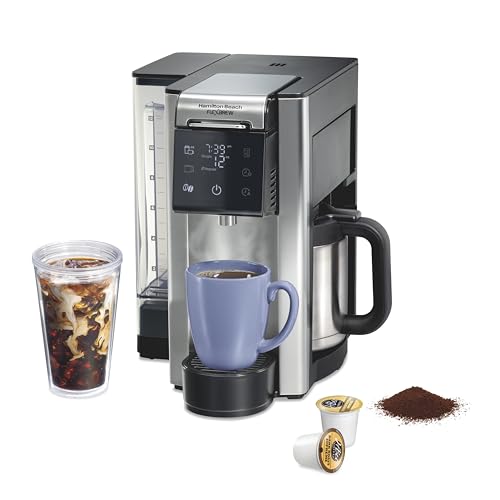
Hamilton Beach FlexBrew Advanced 5-in-1 Coffee Maker
Badge: Best Overall
Strengths
- Brews pods and grounds single-serve, hot and iced — the only verified pod capability in this guide.
- The other side is a real drip brewer: 12-cup, thermal carafe, programmable.
- Removable 60 oz reservoir serves both systems with fresh water and lifts out for cleaning.
Trade-offs
- Two systems mean two cleaning routines and the largest footprint in this guide.
- Pods as a daily default will outspend pot brewing steadily; discipline keeps it a bargain.
- Specialists beat it on single axes — the BUNN is faster, the KRUPS holds longer.
Mini spec box
- Configuration: 5-in-1 drip and single serve
- Drip capacity: 12-cup thermal, programmable
- Single serve: Pods and grounds, hot and iced
- Reservoir: Removable, 60 oz
- Finish: Black
Here is the machine the search is actually for. The FlexBrew Advanced is a 5-in-1 design whose two halves map exactly onto the mixed household’s day. The drip side brews a programmable 12-cup pot into a thermal carafe — not a token pot, but one that stands comparison with the dedicated benchmarks around it, insulation included. The single-serve side brews pods for pure convenience and loose grounds for those who want a single cup without the pod — an option that matters more than it first appears, because it frees the household from total pod dependence and lets a favourite coffee be drunk one cup at a time. Both sides draw on a removable 60 oz reservoir, which is the quiet hero of the design: a tank that lifts out gets rinsed and refilled with fresh water daily, and fresh water improves every cup either system makes.
In daily life, the division of labour writes itself. The pot carries mornings, weekends, and guests en masse. The pod side carries the decaf drinker after dinner, the single cup before an early departure that should not wake the house with a full brew, the iced single on a hot afternoon. Used that way — pot by default, pods by occasion — the hybrid is not a compromise but a consolidation, retiring two machines and their two footprints. The honest costs are the ones listed above: more to clean, more counter, and a running-cost discipline that the household must actually keep. Households that will keep it get, in the FlexBrew, the only machine in this guide that answers the search as asked — Check on Amazon for its live listing.
Best for: genuinely mixed households that will use both sides weekly / Not suited for: households that will use only one side — buy the specialist instead
KRUPS 12-Cup Programmable Thermal Carafe Coffee Maker — Prose-Only Benchmark
Badge: Best Thermal Pot (Benchmark)
Pod status: this machine does not brew pods. It is a dedicated drip pot machine, reviewed here as a benchmark and deliberately not linked.
Strengths
- Double-wall thermal carafe keeps coffee hot for hours — the listing states up to 4 hours — with no warming plate.
- Three brew strengths and 24-hour programmability: the fullest pot-only control set here.
- No plate means the pot’s last cup is never its most cooked cup.
Trade-offs
- No pod brewing and no single-serve side of any kind.
- No published small-batch setting; full pots are its territory.
- The thermal carafe hides the coffee level.
Mini spec box
- Capacity: 12-cup
- Carafe: Double-wall thermal, keeps coffee hot 4 hours
- Controls: 24-hour programmable, 3 brew strengths
- Warming plate: None
- Brand: KRUPS
The KRUPS is the benchmark for the long morning, and it poses the hybrid question in its sharpest form: is a pod worth more than hours of perfect holding? A household that brews once and grazes — remote workers, slow weekends, parents in shifts — gets more daily value from this machine’s double-wall insulation and plate-free design than from any single-serve side, because its coffee problem was never variety; it was time. The three-strength control and full programmability complete a pot machine with no visible compromises, and households matching that description should let this benchmark talk them out of the hybrid with a clear conscience.
For the mixed household, though, the disqualifier stands exactly as with the BUNN: no pods, no single serve, no exceptions. A grazer who also hosts a decaf-drinking partner at dinner faces a genuine either/or, and this guide’s answer is to count the occasions honestly for a week before deciding. If the odd-hour cups number more than a couple a week, the FlexBrew’s consolidation wins; if they do not, this benchmark is the better machine and the pod search was a detour. Either way, the KRUPS is prose-only here — the guide will not link a pot machine under a pod headline.
Best for: long-morning pot households testing whether they need pods at all / Not suited for: any household with a real weekly pod habit
Cuisinart 10-Cup Thermal Classic Coffeemaker (DCC-1170BKNAS) — Prose-Only Benchmark
Badge: Best Compact Pot (Benchmark)
Strengths
- 10-cup thermal format honestly sized for small households.
- Programmable, from a proven line with findable replacement parts.
- Black finish and an uncomplicated daily routine.
Trade-offs
- No pod brewing — a dedicated pot machine in every respect.
- No published strength menu or small-batch mode.
- Ten cups caps out for entertainers.
Mini spec box
- Capacity: 10-cup
- Carafe: Thermal
- Controls: Programmable
- Finish: Black
- Model: DCC-1170BKNAS
The Cuisinart Classic is the benchmark for the small, settled household: two to four drinkers, one pot a day, no interest in novelty. Its argument against the hybrid is footprint and simplicity — a compact thermal machine that asks almost nothing, from a brand whose carafes and parts stay findable for years. Many households arrive at this search imagining a pod need that is really a variety itch, scratched twice a month; for them, this benchmark plus an occasional café visit is the cheaper and calmer answer, and this guide is happy to say so.
The disqualifier is, once again, absolute: no pods. A small household with a genuine split — one pot drinker, one committed pod drinker — is the FlexBrew’s exact design brief, and this Cuisinart cannot serve the second drinker at all. Judge by the household’s real composition, not its size, and let this benchmark be what it is: the low-drama pot against which hybrid complexity must justify itself. It remains prose-only in this guide, unlinked by design.
Best for: small, settled pot households / Not suited for: split households where one drinker truly needs pods
SECPOEDR Grind and Brew Coffee Maker with Built-In Grinder — Prose-Only Benchmark
Badge: Best with a Built-In Grinder (Benchmark)
Strengths
- Built-in grinder: the freshest possible pot, ground seconds before brewing.
- 10-cup programmable platform with a 2-hour keep warm function.
- Stainless steel build.
Trade-offs
- No pod brewing; its single-body talent is grinding, not pods.
- The grind path needs regular cleaning to protect its flavour advantage.
- A newer brand with a shorter parts track record.
Mini spec box
- Capacity: 10-cup
- Grinder: Built-in
- Controls: Programmable
- Keep warm: 2-hour keep warm function
- Build: Stainless steel
The SECPOEDR is the benchmark for a different kind of freshness. Where the FlexBrew’s single-serve side offers a fresh cup by pod or by scoop, this machine offers a fresh pot by grinder — beans ground in the same body, seconds before brewing, which is the largest single flavour upgrade in home drip coffee. Households whose pod curiosity is really a freshness curiosity should study this benchmark carefully: if what you actually want is coffee that tastes more alive, a grinder answers it more completely than a pod does, and the 2-hour keep warm window covers the ordinary morning the pot is brewed for.
The disqualifier remains: no pods. A household with a true pod drinker — for the convenience, the variety packs, the decaf-after-dinner ritual — gets nothing for that drinker here, and the grind path’s cleaning obligation is a real commitment the FlexBrew does not ask for. Freshness-first households belong with this benchmark or its Gevi sibling below; convenience-first households belong with the hybrid. Prose-only, as the rule requires.
Best for: freshness-first households whose “pod” interest is really about flavour / Not suited for: households with a committed pod drinker
Gevi 10-Cup Grind & Brew Coffee Maker — Prose-Only Benchmark
Badge: Best Modern Grind & Brew (Benchmark)
Strengths
- Built-in grinder with a glass carafe and touch screen controls.
- Reusable filter included, trimming recurring costs.
- Programmable brewing and a 1.5L tank in a contemporary format.
Trade-offs
- No pod brewing of any kind.
- Glass carafe on a 90-minute warm plate — a defined flavour window.
- Touch controls divide opinion, and the grind path needs regular cleaning.
Mini spec box
- Capacity: 10-cup, 1.5L tank
- Grinder: Built-in
- Carafe: Glass, 90-min warm plate
- Controls: Touch screen, programmable
- Filter: Reusable filter included
The Gevi closes the benchmark set as the modernist pot: touch screen, glass carafe, reusable filter, and a built-in grinder. Its role in this guide is to represent the shopper whose kitchen is current and whose coffee is fresh-ground — and to test whether that shopper’s pod interest survives contact with a machine that already feels modern without a pod in sight. For many, it will not: the Gevi’s freshness and format scratch the upgrade itch completely, and its glass carafe’s 90-minute window matches households that drink promptly.
And the standing disqualifier completes the set: the Gevi brews no pods. If the household’s pod need is real — a drinker, a routine, a weekly count — this machine, like the other four benchmarks, cannot meet it, and the FlexBrew stands alone as this guide’s linked answer. The benchmarks have done their work if they have made that conclusion feel earned rather than assigned. Readers comparing pot styles more broadly can continue to Best Drip Pot Coffee Makers.
Best for: modern, fresh-ground households testing the pod idea / Not suited for: any household with a genuine pod routine
Comparison Table
| Model | Brews pods? | Capacity | Carafe / format | Standout feature | Link |
|---|---|---|---|---|---|
| BUNN Speed Brew Platinum CSB3T | No | 10-cup | Thermal | Fast brew cycle | Prose-only benchmark |
| Hamilton Beach FlexBrew Advanced | Yes — pods and grounds | 12-cup + single serve | Thermal | 5-in-1 drip and single serve, 60 oz reservoir | Check on Amazon |
| KRUPS Thermal Carafe | No | 12-cup | Double-wall thermal | Keeps coffee hot for hours, no plate | Prose-only benchmark |
| Cuisinart Thermal Classic | No | 10-cup | Thermal | Compact proven format | Prose-only benchmark |
| SECPOEDR Grind and Brew | No | 10-cup | Keep-warm design | Built-in grinder | Prose-only benchmark |
| Gevi Grind & Brew | No | 10-cup | Glass, warm plate | Grinder, touch screen, reusable filter | Prose-only benchmark |
How to Choose a Drip Coffee Maker With Pod Capability
Start by auditing the need, because this category punishes vague shopping. For one week, count your household’s odd-hour cups: the singles brewed outside the morning pot, the decaf after dinner, the guest cup that differs from the house coffee. If the count is near zero, stop here — a dedicated pot machine from the benchmarks above, or the wider field in Best Dripping Coffee Makers, will serve you better and simpler. If the count is real and weekly, a hybrid earns its footprint, and the audit has also told you which hybrid traits matter: a household heavy on decaf and guests needs pod convenience most; a household heavy on single cups of its own coffee should prize a grounds option, which the FlexBrew provides, so the single cup can be the same beans as the pot.
Second, refuse to surrender the pot. The defining failure of hybrid shopping is accepting a mediocre drip side as the tax on pods, and it is an unnecessary tax: the FlexBrew’s drip side is a programmable 12-cup thermal brewer, insulation included, which stands comparison with dedicated machines. Apply that standard to any hybrid you consider — carafe type, programmability, and capacity should read like a pot machine you would buy on its own, because on most mornings that is exactly what it will be. A hybrid whose pot you would not buy alone is a pod machine with a hobby, and it will disappoint you at breakfast daily.
Third, run the running costs honestly. Pods cost more per cup than pot coffee — that is the price of sealed, portioned convenience, and no guide should pretend otherwise. The hybrid bargain works when pods stay occasional: the morning pot carries the volume economically, and pods buy freshness and variety at the margins where a pot cannot. It fails when the household drifts pod-ward for everything, at which point the drip side is dead weight and the pod spend has quietly bought a dedicated machine’s worth of coffee. The FlexBrew’s grounds-capable single serve is the pressure valve here — use it for the routine singles, and reserve pods for the occasions that justify them.
Finally, count the cleaning. Two brew systems mean two paths to rinse, descale, and keep sweet, and the household that will not maintain both should buy one machine and maintain it well. Hybrids reward tidy owners and punish optimistic ones; be the former, or be honest and choose a benchmark.
How to Run a Hybrid Coffee Maker Well: Setup and Daily Care
First setup. Wash the carafe and removable parts, lift out the reservoir and rinse it, then run plain-water cycles through both systems — a full pot cycle on the drip side and several single cups on the pod side — before brewing anything you intend to drink. This clears manufacturing residue from both paths and teaches you the machine’s seating, locks, and fill marks while the stakes are zero.
Daily routine. Keep the division of labour deliberate: pot by default, single serve by occasion. Fill the reservoir with fresh water daily — the removable 60 oz tank makes this a lift-and-rinse rather than a jug operation — and empty the drip side’s basket after each pot. On the single-serve side, remove a used pod promptly rather than letting it sit in the chamber; a spent pod left overnight is a flavour and hygiene debt the next cup pays. Brew the single cup into a warmed mug when the weather is cold, because a small serving loses heat to a cold vessel faster than a pot does.
Descaling and deep care. Scale attacks both systems, and hybrids hide it longer because each side gets partial use. Descale on the maker’s schedule for the whole machine, not just the side you favour, and rinse the reservoir weekly — a removable tank has no excuse for a film. Wash the thermal carafe daily with hot soapy water, soak it weekly, and keep its lid closed between pours so the pot side holds the way insulation intends.
Troubleshooting.
- Problem: single cups taste weak or watery → check that the pod is seated and pierced properly, use the grounds option with a level, tamped-free scoop for a fair comparison, and descale if the flow has slowed.
- Problem: the morning pot tastes stale even with fresh beans → wash the carafe and lid thoroughly and empty the basket after every brew; yesterday’s grounds and oils season today’s pot.
- Problem: one side is drifting unused for weeks → that is information, not failure: your household is telling you it is a one-system home, and the next purchase should be a specialist.
Pod Costs, Waste, and the Grounds Alternative
Pods charge for their convenience twice: once per cup, in a per-serving cost that pot brewing undercuts comfortably, and once in packaging, since every cup arrives in its own sealed portion. Neither charge is a scandal — convenience is a real good, and for the decaf drinker or the occasional guest it buys exactly what it promises — but both charges scale with habit, which is why this guide keeps returning to the same discipline: pot by default, pods by occasion. The FlexBrew’s grounds-capable single serve deserves emphasis in this context, because it dissolves much of the dilemma. A single cup brewed from your own grounds costs what pot coffee costs, produces no pod waste, and tastes like your coffee — the pod side remains for the flavours and occasions your bean shelf does not cover, which is the role pods were always best at. Households that adopt that split usually find their pod purchases shrink to a small, deliberate shelf rather than a subscription-sized habit, and the hybrid’s economics finally match its promise. Shoppers who suspect they are really shopping for an alternative-format machine altogether can compare the neighbouring category in Best Drop Coffee Makers.
A Week in a Mixed Household: How the Hybrid Actually Gets Used
Abstract comparisons settle little; a week settles most things. Monday opens with the pot — the FlexBrew’s drip side, programmed the night before, filling the thermal carafe for two adults’ breakfasts and a travel mug. At four o’clock, one of them, working late, brews a single cup from grounds rather than reviving the morning pot or wasting a fresh one; the carafe’s remains are poured out without guilt, because the day got what it needed from them. Tuesday repeats Monday, which is the point. Wednesday brings a guest who drinks decaf — a pod, brewed in a minute, no separate pot, no apology. Thursday’s heat turns the single-serve side to iced for a teenager’s afternoon cup, while the adults’ morning pot remains untouched by the experiment. Friday is a half-day: a small pot, then singles. The weekend runs two full pots for a houseful, and the pod side rests entirely.
Tally that week honestly and the hybrid’s logic is visible in numbers a household can check against its own life: the pot carried the volume, the single-serve side carried five or six cups that would otherwise have been reheated, wasted, or bought outside the house, and exactly one of those cups needed to be a pod at all. A household whose week resembles this one will use a hybrid the way it was designed to be used. A household whose week is the same pot every day, with no odd cups at all, has just read a description of someone else’s life — and should buy a benchmark.
Pods vs Grounds for the Single Cup: A Taste and Habit Comparison
Because the FlexBrew’s single-serve side takes both, the comparison is worth making on the merits rather than on loyalty. A pod’s virtues are sealing and variety: the coffee is portioned and protected until the moment of brewing, and a household can keep a small shelf of different coffees — regular, decaf, a flavoured option for a guest — without opening bags that stale. Its costs are the per-cup price, the packaging, and a ceiling on freshness, since the coffee was ground when the pod was filled. Grounds brewed singly invert the ledger: the coffee is your coffee, ground as recently as your supply allows, at pot-coffee cost, with no packaging — but it asks a scoop, a rinse, and a moment’s attention, and it offers no variety beyond the bags you own. The households that thrive with a hybrid tend to assign each format its occasion without ideology: pods for guests, decaf, and genuine hurry; grounds for the routine late cup that is really just the morning coffee arriving late. That split is available only on a machine that takes both — which, in this guide, is exactly one machine, and it is not a coincidence that it is the linked one.
Questions to Ask Before Buying Any Hybrid — Including This One
Because this guide links exactly one machine, it owes you the questions that could talk you out of it. Ask them in order, and answer with the week’s evidence rather than with intentions. First: how many single cups did this household actually brew outside the morning pot last week — not imagine brewing, brew? If the answer is fewer than two, the hybrid’s second system is a ornament with a cleaning schedule, and a benchmark pot is the honest purchase. Second: whose cups are they? A single drinker’s odd cups can be served by the grounds option on a smaller machine or even by a kettle and a pour-over; it is the split household — different coffees for different people at different hours — that a hybrid truly serves. Third: where will it live? A 5-in-1 machine is the largest footprint in this guide, and a hybrid exiled to a cupboard because it crowds the counter will brew nothing at all. Fourth: who cleans it? Two systems, two routines, one volunteer — name the volunteer before the machine arrives, or the maintenance will be nobody’s and the flavours will say so.
Fifth, and most revealing: what happens on the machine’s worst morning? The pot side is programmed, a guest wants a pod, a teenager wants iced, and the reservoir is empty. A hybrid that handles that morning gracefully — shared reservoir filled once, both sides independent, carafe holding the pot while the singles queue — is a household appliance. One that turns it into a negotiation is a gadget. The FlexBrew’s design, with its removable shared reservoir and genuinely independent sides, was judged against exactly that morning in this guide’s ranking, and it is why the machine carries the category alone here: not because it is the only hybrid that exists, but because it is the only one among the assigned picks that exists as a pod brewer at all — and it happens to be built the way the worst morning requires.
What This Guide Deliberately Did Not Do
A short note on method belongs in a guide that broke the usual shape. This page could have linked all six assigned machines and written around the pod question with phrases like “pod-style convenience” — the category’s review pages do it often enough that readers have learned to skim past it. It chose instead to link the one machine that brews pods and to label the other five, in their headings, their badges, their comparison row, and their verdicts, as what they are: excellent pot machines that do not brew pods. The cost of that honesty is a shorter shopping list. The benefit is that every link on this page means what the headline promises, and every benchmark’s praise can be trusted at full value, because none of it was written to smuggle a sale. If you buy the FlexBrew from this page, you buy it knowing the whole field. If you buy a benchmark elsewhere, you buy it knowing exactly what it does not do. Both are good outcomes; a guide that cannot say the same should not be believed about smaller things either.
Common Buying Mistakes
- Assuming every “coffee maker” listing with a pot also brews pods. Five of the six machines in this guide do not. Pod capability is a specific system, not a style — verify it in the listing, as this guide did.
- Accepting a weak drip side as the tax on pods. The pot is the machine’s day job. Buy a hybrid whose drip side you would buy alone.
- Letting pods become the default. Per-cup costs compound quietly. Pot by default, pods by occasion, grounds for routine singles.
- Leaving spent pods sitting in the chamber. Remove them after brewing; the next cup should not meet yesterday’s pod.
- Buying a hybrid for a one-system household. Two systems mean two cleaning routines. If one side will gather dust, buy the specialist and enjoy the simpler life.
- Ignoring the reservoir. Shared tanks serve both systems; a removable one, like the FlexBrew’s, is what makes daily fresh water realistic.
Final Recommendation
The best drip coffee maker with pod capability in this group is the only one that has it: the Hamilton Beach FlexBrew Advanced — a genuine 12-cup thermal drip brewer with a pods-and-grounds single-serve side and a removable 60 oz reservoir: Check on Amazon. Buy it if your household’s odd-hour cup count is real and weekly. If the benchmarks persuaded you otherwise, buy the pot your routine actually describes — the KRUPS for long mornings, the BUNN for fast ones, a grinder model for fresh ones — and let the pod idea go without regret. Either way, decide by the week’s honest count, and the machine will fit the household instead of the other way round.
Frequently Asked Questions
Do all drip coffee makers with a carafe also brew pods?
No — and this guide is the proof. Five of the six machines assigned here are respected drip pot machines with no pod capability at all. Pod brewing requires a dedicated single-serve system, which only the Hamilton Beach FlexBrew Advanced in this group has, alongside its drip pot.
Why are five picks in this guide not linked?
Because they do not meet the search’s core attribute. They are reviewed in full as prose-only benchmarks — with their real strengths and specifications — so you can compare what dedicated pot machines offer, but linking them under a pod headline would mislead you, so this guide deliberately does not.
Is a hybrid coffee maker worth it?
For a genuinely mixed household, yes: one footprint replaces a pot brewer and a single-serve machine, and the FlexBrew’s drip side is a proper thermal programmable pot. For a one-system household, a hybrid is cost and cleaning without benefit — buy the specialist.
Are pods more expensive than pot coffee?
Per cup, yes — pods charge for sealed convenience, and the difference compounds with daily use. The economical pattern is pot brewing by default, pods for occasions, and the FlexBrew’s grounds option for routine single cups, which costs what ordinary coffee costs.
Can the FlexBrew brew a single cup without a pod?
Yes. Its single-serve side takes grounds as well as pods, which means a lone cup can be your own coffee rather than a pod flavour — a flexibility that softens both the running cost and the waste of pod brewing.
What size pot does the pod-capable pick brew?
The FlexBrew’s drip side brews a 12-cup pot into a thermal carafe, programmably, and draws on a removable 60 oz reservoir shared with the single-serve side. That is a full household pot, not a compromise carafe attached to a pod machine.
How do I keep a hybrid machine tasting clean?
Descale the whole machine on schedule, remove spent pods promptly, empty the drip basket after each pot, rinse the removable reservoir weekly, and wash the thermal carafe daily. Hybrids stay sweet when both paths are maintained, not just the favourite one.


