Disclosure: topratedkitchenware.com is reader-supported. When you buy through links on our site, we may earn an affiliate commission from Amazon and other retailers, at no extra cost to you.
Where to buy
The six models below are the verified picks for this guide to the best pressure cookers under $100 — with the standing rule of this category stated up front: prices move, so treat $100 as the band to verify on the listing at the moment you buy, not as a promise printed here. Each name links to its Amazon listing, where you can check the latest price on Amazon and confirm the current configuration. Start with our top pick here: Check on Amazon.
- Instant Pot Rio Mini 4 Qt 7-in-1 Electric Pressure Cooker
- CHEF iQ Smart Pressure Cooker with WiFi and Built-in Scale, 6 Quart
- Presto 01362 6-Quart Stainless Steel Pressure Cooker
- T-Fal Secure Trendy Stainless Steel Pressure Cooker, 8.5 qt
- MICHELANGELO Stovetop Pressure Cooker, 4.2 qt
- Peterboo Stainless Steel Pressure Cooker, 6 Quart
Read the full guide ↓ for how value actually works in this tier, the honest limitations of every pick, and one pick we flag openly as a stretch candidate whose current price you must check against the band yourself.
Hunting the best pressure cookers under $100 is an exercise in value engineering: what do you genuinely get at this tier, and what should you refuse to compromise on? The good news, verified across the six models in this guide, is that the under-$100 band contains real cookers in every useful format — a classic stainless stovetop pot in the standard size, a family-size stovetop with modern safety systems, a compact electric from the category’s leading brand, and induction-ready designs with layered bases. The honest news is that this tier also demands two disciplines from the buyer. First, pressure-cooker prices fluctuate with seasons and promotions, so the band is a checkpoint at purchase time, not a fact we can print once and freeze — this guide names no static prices for exactly that reason, and asks you to verify the figure on the listing. Second, one pick below — the smart CHEF iQ — is a premium-tier design whose guidance features normally position it above this band; we include it transparently as the stretch option for readers whose budget can flex, and its review tells you to confirm its current price before treating it as an under-$100 candidate at all.
What this tier should never ask you to compromise on is the core of the appliance: a sound vessel, a reliable seal, layered safety systems, and a size that fits your household. Those are present in every pick here. What the tier trades away, predictably, is breadth — fewer premium finishes, thinner accessory bundles, shorter brand track records at the newer end. The reviews below make those trades explicit, model by model, and the buying section explains how to allocate a sub-$100 budget across format, size and surface so the compromise lands where your cooking will never notice it. For context beyond the band, Best Pressure Cookers Tested shows how evidence-led comparisons treat the wider field, and Best Pressure Cookers Sweethome covers the editorial-pick tradition at all tiers.
Key Takeaways
- The under-$100 band contains genuine cookers in every format — stovetop and electric, compact and family-size — if you shop by verified specification rather than by headline discounts.
- Prices in this category move constantly; verify the current figure on the listing against your $100 line at the moment of purchase.
- Stovetop stainless is the value champion of the tier: no electronics to age, one cheap consumable part, decades of service.
- Never compromise on the seal, the safety systems or the size fit — compromise on finishes, bundles and brand prestige instead.
- One pick here, the CHEF iQ, is a premium smart design included as a transparent stretch option: check its current price before counting it in this band.
- Budget a spare gasket into the purchase and the cheapest cooker on this page becomes cheaper still across its lifetime.
- Judge the tier by five dishes — beans, a tomato braise, rice, eggs and a whole chicken — cooked inside the return window.
- Counts are the tier’s marketing language: ask whether each counted feature changes what the cooker does to food.
- Modern safety architecture is standard at this tier, not a luxury — your part is procedural: clear vent, respected fill lines, a maintained gasket.
- Price the working kit, not the headline item: cooker plus spare gasket plus any basket you need should share the band.
In this guide
Quick Picks
| Pick | Badge | Capacity | Value one-liner |
|---|---|---|---|
| Presto 01362 | Best Overall Value | 6-Quart | The classic stainless stovetop pot in the standard size |
| Instant Pot Rio Mini | Best Electric Value | 4 Qt | Leading-brand electric automation in a couple-sized pot |
| Peterboo 6 Quart | Best Induction Value | 6 Quart | 3-ply base and multi-hob compatibility at the standard size |
| T-Fal Secure Trendy | Best Large-Capacity Value | 8.5 qt | Family volume with a 5-point safety system and basket |
| MICHELANGELO 4.2 qt | Best Small-Household Value | 4.2 qt | Two pressure settings, one-hand lid, basket and glass lid included |
| CHEF iQ Smart | Stretch Pick — Verify Current Price | 6 Quart | Scale and WiFi guidance; a premium design that may sit above the band |
How These Picks Were Chosen
Every model comes from a verified pick pool checked against Amazon’s catalogue data through the Creators API on 2026-11-20, so capacities, materials and feature lists match the current listings. We link a cooker only when the API-returned title confirms a genuine pressure cooker of the stated type and size. The value ranking weighs lifetime cost of ownership alongside purchase tier: a cooker with a replaceable gasket, a stainless vessel and no electronics has a fundamentally different cost curve from a feature-rich model, and at this budget that difference matters more than any single feature.
Two honesty rules govern this guide. We print no static prices, because figures in this category change too often for print to stay truthful — the listings carry the live numbers, and the $100 band is yours to verify there. And where a pick’s market position strains the band — the CHEF iQ, a premium smart appliance — we say so in its badge, its review and this method note, rather than quietly pretending every pick sits comfortably under the line every day of the year. This is a research-led guide, not a hands-on lab test; rankings rest on verified specifications, manufacturer data and recurring owner-evidence patterns.
The 6 Best Pressure Cookers Under $100

Presto 01362 6-Quart Stainless Steel Pressure Cooker
Badge: Best Overall Value
Strengths
- The standard 6-quart size in stainless steel — the format with the lowest lifetime cost in the category.
- No electronics to fail; the gasket is the only routine consumable, and it is widely stocked.
- A proven, long-running design that doubles as a serious everyday pot.
Trade-offs
- Fully manual: no timer, no programmes, no keep-warm.
- Single-pressure design needs timing care for delicate dishes.
- No basket or spare lid in the verified listing data.
Mini spec box
- Capacity: 6-Quart
- Material: Stainless steel
- Type: Stovetop pressure cooker
- Brand: Presto
Value analysis in this category begins with a question most guides skip: cost per year of service. By that measure the Presto is close to unbeatable. A stainless stovetop pot has no circuit board to age out, no coating to wear through, and exactly one cheap consumable — the sealing gasket — standing between it and a second decade of work. The 6-quart size is the one the recipe world writes for, so the cheapest serious cooker here is also the one that asks for no recipe translation. On the hob it behaves like the classic it is: sauté in the open pot, seal, bring to pressure, trim the heat, and choose your release.
Who should buy it: anyone whose budget discipline is real and whose cooking is hob-friendly — which, at this tier, is most people. Who should not: cooks who know they will not watch a pot, because the automation they need lives in the electric picks below, and a manual cooker bought against your temperament is the most expensive kind of cheap. Buy the Presto with a spare gasket in the same order and you have assembled, in one basket, the best-value pressure-cooking proposition in this guide.
Best for: Value-first buyers who cook happily on the hob / Not suited for: Anyone who needs timers and walk-away automation
There is a psychological dividend to this pot that value guides rarely mention: it removes purchase anxiety from the cooking. A cooker this uncomplicated invites experimentation — the unfamiliar bean, the tough cheap cut, the steamed pudding — because nothing about it feels precious. Households learn pressure cooking fastest on equipment they are not afraid of, and the Presto’s entire design philosophy is unafraid: steel, a ring, a lid, a handle. Ten years from now it will look almost exactly as it does on delivery day, which is more than any electronic rival in this guide can promise.


Instant Pot Rio Mini 4 Qt 7-in-1 Electric Pressure Cooker
Badge: Best Electric Value
Strengths
- Electric automation — pressure, rice, steam, sauté, yogurt, warm — from the category’s leading brand family.
- 4 Qt size fits couples and small kitchens without the mini class’s tightest limits.
- Keep-warm holding suits households that eat in shifts.
Trade-offs
- Working capacity suits two to three people, not a family table.
- Standard 6-quart recipes need scaling.
- Electronics have a service life that a stovetop pot’s steel does not.
Mini spec box
- Capacity: 4 Qt
- Format: 7-in-1 electric pressure cooker
- Functions: Pressure cook, slow cook, rice, steam, sauté, yogurt, warm (per listing)
- Finish: Black (per listing title)
The Rio Mini is the answer to the value question in its electric form: how much automation can this tier honestly buy? Its answer — the full seven-function repertoire of the leading brand’s platform, in a 4-quart body sized for couples — is a strong one. You give up the family capacity of the 6-quart class and accept recipe scaling as a weekly habit; in exchange you get timers, programmes and keep-warm holding at the value end of the electric market, from the brand whose recipe ecosystem and accessory shelf are the deepest in the category. For a two-person household, that trade is not a compromise at all — it is the correct specification.
Ownership notes: treat the size honestly (it will not stretch to a dinner party), keep the gasket washed and uncompressed in storage, and learn the platform’s recipe conventions once — they transfer if you ever size up. As with every pick here, confirm the live price against your band on the listing before ordering; electric models in this class are the most promotion-sensitive of all.
Best for: Couples wanting brand-name electric automation at the value tier / Not suited for: Families or batch cooks
Consider the weeknight this cooker is really selling: ingredients in at six, sauté while the table is set, pressure while a salad happens, keep-warm while the household assembles. That choreography — not any single specification — is what electric value means, and the Rio Mini performs it on the leading brand’s conventions, so every recipe habit you build transfers if the household grows into a bigger machine later. Few purchases at this tier can claim to be both the economical choice now and the training platform for later; this one can.


Peterboo Stainless Steel Pressure Cooker, 6 Quart
Badge: Best Induction Value
Strengths
- 3-ply composite base for even heating, listed for induction, gas and ceramic stoves.
- Pressure indicator and multiple safeguard devices per the verified listing.
- Dishwasher-safe body in the standard 6-quart size.
Trade-offs
- Newer brand; long-term parts availability is less proven than the legacy names.
- No basket or second lid named in the verified title.
- Composite base adds weight when the pot is full.
Mini spec box
- Capacity: 6 Quart
- Material: Stainless steel
- Base: 3-ply composite base
- Compatibility: Induction, gas and ceramic stove (per listing title)
- Care: Dishwasher safe (per listing title)
Induction owners usually pay a compatibility premium in cookware; the Peterboo is the value pick that refuses to charge it. Its 3-ply composite base is the engineering that matters at this tier — even heat for the sauté stage, no scorch-prone hot spots under pressure, and explicit compatibility across induction, gas and ceramic hobs. In the standard 6-quart size with a clear pressure indicator, it is the most technically complete stovetop specification in this guide, aimed squarely at modern kitchens.
The value caveat is the brand’s youth: judge it on the verified specification, confirm the gasket source before you need it, and the trade is sound. For an induction household shopping this band, this is where the money works hardest — the base you would otherwise pay a premium tier to obtain, in the size your recipes assume.
Best for: Induction and glass-hob owners who want an engineered base at this tier / Not suited for: Buyers who rank decades-long brand history above specification
The base deserves one more word, because it is where cheap stovetop pots usually confess. A thin, single-layer base warps, hotspots and eventually rocks on a flat hob; a composite base like this one holds its shape and its contact, which is why the same design language appears in cookware tiers far above this one. On a glass or induction hob — surfaces that punish a warped base with uneven heating and buzzing — that stability is not a luxury. It is the difference between a budget pot that behaves and one that merely survives, and it is the core of this pick’s value argument.

T-Fal Secure Trendy Stainless Steel Pressure Cooker, 8.5 qt
Badge: Best Large-Capacity Value
Strengths
- 8.5 qt of family capacity — volume that usually costs a tier more.
- 5-point safety system and 2 cooking modes per the verified listing.
- Steam basket included; induction compatible; dishwasher-safe body.
Trade-offs
- Large and heavy; needs a big burner and real storage.
- Too much pot for small households and small daily loads.
- Verify the live price carefully — large models drift above the band outside promotions.
Mini spec box
- Capacity: 8.5 qt
- Material: Stainless steel
- Safety: 5-point safety system
- Modes: 2 cooking modes
- Included: Steam basket
- Compatibility: Induction (per listing title)
Capacity is the most expensive dimension in cookware, which makes the T-Fal the value outlier of this guide: a genuinely family-sized, safety-layered stovetop cooker with a basket included, competing in a band where most rivals are a size smaller. For the household whose current pot forces double sessions — soup in two runs, beans in two batches — stepping to 8.5 quarts inside this budget is the single largest capability jump available here. The two cooking modes and the multi-point safety system keep it civilised at that size.
The disciplines are physical and financial. Physically: measure the cupboard and the sink, and put it on your largest burner. Financially: large models are the most likely in this set to sit above the band when no promotion is running, so this pick rewards the patient buyer who verifies the live figure rather than assuming it. Patience, at this tier, is a feature of the shopper rather than the product.
Best for: Families wanting maximum capacity inside the band / Not suited for: Small households or buyers who cannot verify the live price first
Run the capacity maths once and the appeal settles: at the two-thirds rule this pot cooks close to five and two-thirds quarts of food, against four quarts from the standard size — more than a third again from the same session, the same sauté and the same washing up. For a family that cooks soup, beans or braises weekly, that third compounds into dozens of hours and dozens of second sessions avoided across a year. Value at this tier is rarely about the ticket; it is about the sessions a bigger, still-in-band pot makes unnecessary.
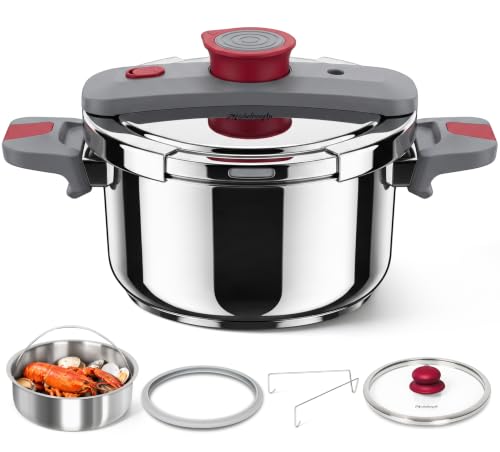
MICHELANGELO Stovetop Pressure Cooker, 4.2 qt
Badge: Best Small-Household Value
Strengths
- Accessory-rich for the tier: steamer basket and glass lid included in the box.
- Two pressure settings and a one-hand easy-open lid.
- 304 stainless steel with a listed 6-fold safety system; induction compatible.
Trade-offs
- 4.2 qt working capacity is modest; big roasts do not fit.
- Newer brand, with a shorter parts track record.
- Accessory value only counts if your cooking uses baskets and glass lids — most small households do.
Mini spec box
- Capacity: 4.2 qt
- Material: 304 stainless steel
- Safety: 6-fold safety system
- Settings: 2 pressure settings
- Included: Steamer basket and glass lid
- Compatibility: Induction compatible (per listing title)
Value hides in bundles, and the MICHELANGELO is the bundle pick: at a tier where rivals sell the bare pot, this one includes the steamer basket and the glass lid that turn a pressure cooker into a small kitchen’s all-purpose vessel — pressure pot by night, steamer and saucepan by day. The two pressure settings add the delicate-dish control that small households, cooking eggs and vegetables often, actually use, and the one-hand lid makes the whole ritual calmer at the stove.
For one to three people, this is arguably the most complete pound-for-pound — forgive the expression, tier-for-tier — package in the guide. Its limits are the small pot’s eternal ones: no crowds, no canning, no whole birds. Within its brief, it asks the fewest follow-up purchases of any pick here, which is what value means in a small kitchen.
Best for: Small households wanting a complete bundle in one purchase / Not suited for: Large families or batch cooking
Small kitchens should also count the storage dividend: a 4.2-quart pot with its glass lid replaces a saucepan, a steamer and a pressure cooker in one cupboard slot, and in a flat or a small house that consolidation is worth more than any single cooking feature. The MICHELANGELO is the pick in this guide most likely to be reached for daily by the households it suits — and daily reach, multiplied across a year, is the truest measure of value any of these six can offer.

CHEF iQ Smart Pressure Cooker with WiFi and Built-in Scale, 6 Quart
Badge: Stretch Pick — Verify Current Price
Strengths
- Built-in scale and WiFi-guided recipes — the most advanced feature set in this guide by a distance.
- 10-in-1 family-size platform for learners who want instruction built in.
- Guidance attacks the two biggest beginner error sources: proportions and skipped steps.
Trade-offs
- Premium-tier design: its smart positioning normally places it above this band — verify the live price before counting it as an under-$100 option.
- App-dependent features tie part of its value to software support.
- Confident cooks may find the supervision unnecessary.
Mini spec box
- Capacity: 6 Quart
- Format: 10-in-1 smart multi-cooker
- Connectivity: WiFi (per listing title)
- Scale: Built-in scale (per listing title)
- Price note: Premium tier — confirm the current listing price against your band
Every value guide owes its readers one honest stretch option, clearly labelled — and this is ours. The CHEF iQ is not a budget appliance wearing smart clothes; it is a premium guided-cooking system whose built-in scale and recipe guidance genuinely change outcomes for learners. We include it because budgets flex for capability that matters, and because promotions periodically pull premium appliances toward bands they do not usually inhabit. What we will not do is assert that it sits under $100: check the live listing, and if the figure respects your band on the day you shop, you have found the best-equipped cooker in this guide at a band price. If it does not, the five picks above are the under-$100 answer, and the CHEF iQ is the upgrade to remember.
That transparency is the difference between a value guide and a discount leaflet. Buy the CHEF iQ for its guidance, at a price you have verified, or buy the tier’s honest workhorses — both decisions are respectable, and this guide’s job is to make sure you know which one you are making.
Best for: Learners whose budget can stretch for guided, weighed cooking / Not suited for: Strict-band buyers until the live price confirms it fits
And if the price check disappoints today, take the long view this guide recommends elsewhere: premium appliances cycle through promotions, and a patient buyer who has already decided the CHEF iQ is the right machine can let the calendar do the negotiating. Set the band, verify periodically, and buy the moment the live figure respects it — that is not indecision, it is the entire skill of value shopping, practised on the one pick in this guide where the skill pays for the upgrade by itself.

Comparison Table
| Model | Type | Capacity | Value logic | Watch out for | Link |
|---|---|---|---|---|---|
| Presto 01362 | Stovetop | 6-Quart | Lowest lifetime cost | Fully manual | Check on Amazon |
| Rio Mini | Electric 7-in-1 | 4 Qt | Brand automation, couple size | Modest capacity | Check on Amazon |
| Peterboo 6 Quart | Stovetop | 6 Quart | Engineered base, multi-hob | Newer brand | Check on Amazon |
| T-Fal Secure Trendy | Stovetop | 8.5 qt | Maximum capacity in band | Verify live price; size | Check on Amazon |
| MICHELANGELO | Stovetop | 4.2 qt | Complete accessory bundle | Small capacity | Check on Amazon |
| CHEF iQ Smart | Electric smart | 6 Quart | Guidance and scale — stretch option | May sit above the band | Check on Amazon |
How to Choose on a $100 Budget
Decide what “under $100” must include. A cooker, a spare gasket and perhaps a basket can share the band more honestly than a cooker alone at the band’s ceiling. Price the working kit, not the headline item: the household that spends the band on a bare flagship and then cannot steam an egg has allocated worse than the one that buys the bundle-complete pick and a spare ring with room to spare. This guide’s badges quietly encode that logic — overall value, bundle value, capacity value — so use them as allocation hints, not just rankings.
Allocate by format first.
The stovetop dollar buys vessel and longevity; the electric dollar buys automation and electronics. At this tier the stovetop picks deliver more cooker per unit of currency over a decade, while the electric pick delivers more convenience per evening this year. Neither is the wrong answer; buying against your temperament is.
Then by size, honestly. Under-sizing is the false economy of this category — a too-small pot gets replaced, and two purchases break any budget. Size for the household you feed weekly under the fill rules (two-thirds generally, half for foamy foods), and let the rare crowd borrow, batch or wait.
Read the tier’s language carefully. Budget listings speak in counts — functions, menus, safety features, accessories — because counts are cheap to print. Some of those counts describe real engineering (a layered safety system, a composite base) and some describe menu subdivisions of the same capability. The translation skill is to ask of every count: does this change what the cooker does to food, or only how the buttons are labelled? Spend on the former; let the latter be a tiebreaker at most. The picks in this guide were filtered by exactly that question, which is why a six-function classic can outrank a sixteen-function novelty here without apology.
Protect the non-negotiables.
At any price in this band, insist on: a vessel material you trust (stainless or a coating you will care for properly), layered safety systems named in the listing, a gasket you can source, and a size that fits. Compromise, if you must, on finishes, programme counts and bundle extras. The wider value landscape, including the rice-cooker side of the family, is mapped at Best Pressure Rice Cookers for readers comparing across the cooker shelf.
How to Keep a Budget Cooker Cooking Like an Expensive One
Start with storage and setup, because budget kitchens are usually small kitchens. Keep the cooker where it will be used — a budget appliance exiled to a high cupboard is a budget wasted — and give the steam release a clear path away from cupboard undersides and your own hands. Measure the counter spot before ordering if space is tight, particularly for the larger stovetop pick, and plan where the hot, full pot will land when it comes off the heat. Two minutes of spatial honesty at purchase time prevents the daily friction that quietly retires more budget appliances than any mechanical failure.
Ownership technique is the great equaliser of tiers.
Run the water test on day one to learn the seal. Build flavour in the pot before sealing — the sauté stage costs nothing and is worth more than any programme. Respect the fill lines, release with intent (natural for pulses, grains and meats; quick for vegetables and eggs), and finish dishes actively with salt, acid and fresh elements after pressure. Wash the gasket after strong dishes, rinse the vent after foamy ones, store the lid inverted, and descale periodically if your water is hard. A budget cooker maintained like a flagship will out-cook a neglected flagship within a year — the tiers differ in features, not in how much they reward care.
Troubleshooting on a Budget
Problem: The cooker leaks steam and will not pressurise → The gasket is mis-seated, dirty or tired. Cool, clean and reseat it; if leaks persist, the replacement ring — the cheapest part in pressure cooking — restores the seal.
Problem: Food scorches during the sauté stage → The base was too hot or the layer too still. Deglaze with liquid and scrape the fond up before sealing; a scorched layer under pressure flavours everything and can trigger warnings on electric models.
Problem: Beans are unevenly cooked → Mixed-age beans or an overfilled pot. Sort the batch, respect the halfway line for foamy foods, and add time — undercooked pulses can always go back under pressure.
Five Dishes That Prove a Budget Cooker
If you want to know whether a sub-$100 cooker was money well spent, cook the five dishes that expose pretenders. Dried beans from dry test extraction and foam discipline. A tomato-based braise tests the seal, the base and the pot’s tolerance for acid and sugar. Long-grain rice tests precision — there is nowhere for a sloppy timer or a wandering heat to hide. Eggs test the gentle end of control. A whole chicken tests the capacity claim on the box against the fill line in the real world. Every pick in this guide was chosen with those five in mind, and every one of them will pass the tests its format claims — the stovetop pots on hob craft, the electric on programme accuracy, the smart pick on guided measurement. Run them in your first fortnight, inside the return window, and your budget purchase becomes a verified one.
Where the Money Goes: A Tier Anatomy
Understanding what a pressure cooker’s price is made of helps a budget buyer shop without superstition. The vessel and base are the honest core: stainless thickness and layered bases cost real money and repay it in even heating and decades of service — which is why the stovetop picks here, spending nearly everything on the pot, are such strong value. Electronics are the second block: controls, sensors and programmes buy automation and convenience, and they set the appliance’s lifespan ceiling. Surfaces are the third: coatings trade service life for release and easy cleaning. Brand is the fourth: track record, recipe ecosystems, accessory shelves and support — real things, priced as such. A sub-$100 budget cannot maximise all four blocks, and it does not need to. It needs the first block sound, the second chosen deliberately, the third matched to your tools, and the fourth bought only where your cooking will feel it. The six picks above are simply that allocation, made six different ways.
The Lifetime Ledger: What Each Format Really Costs
Stretch the accounting across five years and the tier sorts itself with unusual clarity. A stainless stovetop cooker asks for its purchase, a handful of gaskets across the years, and nothing else — no standby power worth mentioning, no parts beyond the ring, no software. Its cost curve is nearly flat, which is why the Presto and its stovetop siblings dominate any honest lifetime table. A coated or electronic cooker asks for gentler handling, possibly a replacement inner pot mid-life if the surface is worked hard, and acceptance that electronics eventually end the story; in exchange it pays a daily dividend in automation and release-easy cleaning that the ledger should record as honestly as the costs. Neither curve is a trick. The budget buyer’s job is to choose which currency they are richer in — years or evenings — and this guide’s six picks are best read as six different exchange rates between the two.
One more line belongs in the ledger: food savings. A pressure cooker that gets used turns dried pulses into dinners, tough cuts into centrepieces and leftovers into stocks, and it does so with less energy than the oven it replaces. The cheapest cooker is the one that changes how a household shops for food, and that change is available at every point in this band — which is the deepest reason the under-$100 tier deserves a serious guide rather than a dismissive one.
Buying Second-Hand at This Tier: A Cautious Yes
Because the stovetop format is nearly immortal, the used market at this budget deserves a paragraph. A second-hand stainless stovetop cooker from a known maker, with an undented rim, a freely moving vent and a gasket you replace on day one regardless of its apparent condition, can be the best value in this entire article. Electric models second-hand are a different calculation: you inherit unknown electronics history, an unknown gasket and usually no warranty, so the discount must be steep and the water test non-negotiable before food ever enters the pot. Whichever route you take, the checks are the same ones this guide applies to new picks — vessel, seal, safety systems, size — because a bargain that fails any of them is not a bargain at any figure.
Common Buying Mistakes
- Trusting a printed price. Figures in this category move; verify the live listing against your band on the day you buy.
- Buying too small to save money. A replaced cooker is the most expensive cooker; size for your weekly household.
- Paying for programmes instead of vessel. At this tier, pot quality outlasts menu quantity.
- Forgetting the gasket budget. A spare ring in the first order is the cheapest insurance in the category.
- Assuming the smart pick is in-band. Premium designs drift above the line outside promotions — check, as this guide flags.
- Skipping the parts check on newer brands. Confirm the gasket source before the cooker arrives, not after it leaks.
A final note on confidence at this tier. Budget shoppers are often made to feel that a serious appliance requires a serious budget, and in this category that is simply not what the evidence shows: the physics of pressure cooking was perfected in pots that cost less, in today’s money, than several picks on this page. What a careful sub-$100 purchase buys is the perfected physics without the surrounding theatre — and for most kitchens, most weeks, the physics is the part that feeds people. Buy the vessel well, verify the live price, keep the gasket fresh, and cook with the confidence the tier has honestly earned.
Final Recommendation
For most households shopping this band, the first choice is the Presto 01362: the standard size, in stainless, with the lowest lifetime cost in the category. Couples wanting automation choose the Rio Mini; induction owners choose the Peterboo 6 Quart; families choose the T-Fal when its live price sits in band; small households choose the bundle-complete MICHELANGELO; and learners with a flexible budget verify the CHEF iQ’s current figure and stretch if it fits. Whichever you choose, verify the price on the listing, order the spare gasket, and your sub-$100 cooker will cook like a much more expensive decision.
Frequently Asked Questions
Can a pressure cooker under $100 really be good?
Yes — because pressure cooking is a mature technology whose core (a sound vessel, a good seal, layered safety systems and honest capacity) is fully available at this tier, as the six verified picks here show in both stovetop and electric form. What the band trades away is breadth and finish, not the ability to cook beans, braises and grains properly for years.
Why does this guide not print exact prices?
Because prices in this category change with promotions, seasons and retailer strategy, sometimes from one week to the next, and a printed figure becomes a false promise the first time the market moves after publication. The listings carry the live number; treat $100 as your verification line at checkout, especially for the larger and smarter models whose prices move the most.
Is the CHEF iQ actually under $100?
It is a premium-tier smart appliance, and this guide does not claim it sits in the band on any given day — it is included as a clearly labelled stretch option whose current price you should check on the listing before deciding which side of your line it falls on today. On promotion it may approach the band; the five other picks are the dependable in-band answers.
Stovetop or electric at this budget?
Stovetop buys longevity and vessel quality; electric buys automation, scheduling and the keep-warm landing that busy households lean on. At this tier the stovetop picks offer the strongest decade-long value, while the Rio Mini offers the most convenience per evening for a couple. Choose by temperament and household size, not by feature counts.
Are budget pressure cookers safe?
The picks in this guide carry the layered safety architecture modern buyers should insist on — locking lids, pressure indicators or sensors, and multi-point safety systems named in their verified listings (a 5-point system on the T-Fal, a 6-fold system on the MICHELANGELO, multiple safeguard devices on the Peterboo). Safety in this category is a design standard, not a luxury tier. Your part of the bargain is procedural: keep the vent clear, respect fill lines, maintain the gasket, and never force a lid. A budget cooker used by the book is a safe cooker.
What extra costs should I budget for?
A spare sealing gasket — the one true consumable — and, if your cooking wants them, a steamer basket or trivet where the box does not include one. Beyond that, a well-chosen cooker in this band asks for nothing but ingredients — and the discipline, once a season, of checking the gasket against the light and rinsing the vent, which together take less time than reading this answer.
When is the best time to buy at this tier?
When promotions run — the category’s prices move most around the big retail events and seasonal sales, and the models most likely to cross into the band from above (the large stovetop and the smart pick in this guide) do so then, sometimes for only a few days at a time. A decided buyer with a verified shortlist can afford patience: set the band, check the live figures periodically, and buy the moment your pick respects it. Indecision is expensive; patience with a shortlist is free.
How long should a budget pressure cooker last?
A stainless stovetop pot, with gaskets replaced as they tire, is a decades-long appliance — the kind that gets handed down, lent out and still seals on its second owner’s hob. An electric model in this tier should be judged as a multi-year appliance whose electronics set its ceiling, and whose value is measured in evenings automated rather than decades survived. Buying the format whose lifespan matches your expectations is part of buying well at any price — and the broader cooker market context at Best Prices For Cookers can help you sanity-check the tier before you commit.


