Disclosure: topratedkitchenware.com is reader-supported. When you buy through links on our site, we may earn an affiliate commission from Amazon and other retailers, at no extra cost to you.
Where to buy
The six models below are the verified picks available for this guide to the best pressure cookers wit ceramic inserts — and this guide begins with the disclosure most roundups would bury: after verification against current catalogue data, none of the six confirmed models below is actually a ceramic-insert pressure cooker. Each name links to its Amazon listing, where you can check the latest price on Amazon and confirm the configuration yourself. Start with our top pick here: Check on Amazon.
- Presto 01362 6-Quart Stainless Steel Pressure Cooker
- T-Fal Secure Trendy Stainless Steel Pressure Cooker, 8.5 qt
- MICHELANGELO Stovetop Pressure Cooker, 4.2 qt
- Peterboo Stainless Steel Pressure Cooker, 6 Quart
- RVGMBO Pressure Cooker 12 Quart, 18/8 Stainless Steel
- Peterboo 3Qt Stainless Steel Pressure Cooker
Read the full guide ↓ for what a ceramic insert actually is, why the verified market offered none for this guide, and how the stainless cookers below compare for the exact jobs ceramic shoppers have in mind.
Let us handle the search for the best pressure cookers wit ceramic inserts the honest way, starting with the finding itself. Shoppers type this query — typo and all — because they want a specific thing: a pressure cooker whose inner pot is ceramic or ceramic-coated, for the easy release, the non-reactive surface and the gentle cooking associated with ceramic. So we verified the available pick pool against Amazon’s catalogue data on 2026-11-20, title by title, looking for exactly that. The result deserves a headline rather than a footnote: every verified model in the pool is a stainless steel stovetop pressure cooker. Not one carries a ceramic insert, a ceramic-coated inner pot, or any ceramic cooking surface in its confirmed specification. A less careful guide would have written the word “ceramic” over stainless products and hoped you would not notice. This guide instead does the two useful things: it explains the ceramic question properly — what inserts are, where they genuinely exist in this category, and what they do and do not change — and it reviews the six verified stainless cookers for what they are, including a direct, job-by-job comparison of stainless against ceramic for the dishes ceramic shoppers typically cook.
Why does this happen? Because “ceramic insert” pressure cookers are a genuinely small niche. In the modern market, ceramic surfaces in pressure cooking live mostly in two places: ceramic-coated inner pots inside certain electric multi-cookers, and standalone ceramic cookware that is not pressure equipment at all. Dedicated stovetop pressure cookers — the format of every verified pick here — are overwhelmingly stainless steel or aluminium, for sound engineering reasons this guide will explain. So consider this page a field guide to a confusing corner of the category: the ceramic facts first, the verified stainless alternatives second, and no invented specifications anywhere. Readers set on a coated electric pot will find the relevant models discussed in our companion roundups, including Best Pressure Cookers Recipes and Best Pressure Instant Cookers, where ceramic-coated electric cookers appear in their proper place.
Key Takeaways
- Verified finding: none of the six confirmed picks in this guide has a ceramic insert or ceramic-coated pot — all six are stainless steel stovetop pressure cookers, and this guide says so rather than dressing them up.
- In today’s market, ceramic surfaces in pressure cooking are found mainly as ceramic-coated inner pots in some electric multi-cookers — not in stovetop pressure pots.
- Ceramic coatings buy easy release and easy rinsing; stainless buys durability, metal-tool freedom, immersion-blender tolerance and decades of unchanging service.
- For acidic, long and aggressive cooking, stainless is the more non-reactive long-term surface; coatings, however good, have a finite service life measured in years of careful use.
- If ceramic is non-negotiable for you, shop the electric multi-cooker format and verify “ceramic-coated inner pot” in the listing title itself.
- If your real goal is easy cleanup and good pressure cooking, the stainless picks below may serve you better than the niche you searched for.
- Scored job by job, the surfaces split the repertoire: coatings take the sticky, delicate corner; stainless takes the acidic, abrasive, large-scale and long-lived remainder of real cooking.
- Verify like an editor: the material words that count are the ones attached to the pot itself, repeated in the specifications and the box contents — a real feature survives repetition across the whole listing.
In this guide
Quick Picks
| Pick | Badge | Capacity | Honest one-liner |
|---|---|---|---|
| Presto 01362 | Best Stainless Alternative | 6-Quart | The classic standard-size pot — stainless, not ceramic |
| Peterboo 6 Quart | Best for Easy, Even Cooking | 6 Quart | 3-ply base reduces the scorching that makes cleanup hard |
| T-Fal Secure Trendy | Best for Families | 8.5 qt | Large stainless pot with basket and 2 modes |
| MICHELANGELO 4.2 qt | Best for Small Households | 4.2 qt | Two settings and a glass lid for everyday flexibility |
| RVGMBO 12 Quart | Best for Big Batches | 12 Quart | Canner-sized stainless for stock and preserving days |
| Peterboo 3Qt | Best for One or Two People | 3Qt | The compact stainless option for small, fresh batches |
How These Picks Were Chosen
Every model comes from a verified pick pool checked against Amazon’s catalogue data through the Creators API on 2026-11-20. The verification step is the story of this guide: we read the API-returned titles looking specifically for a ceramic insert, a ceramic-coated inner pot or any ceramic cooking surface, and found none — the pool is six stainless steel stovetop pressure cookers. Under this site’s honesty rules, an unverified feature is never printed as fact, so the article was reframed rather than faked: the ceramic topic is covered accurately as a topic, and the six real products are reviewed as what they are, with their badges rewritten to describe stainless strengths instead of imaginary ceramic ones.
The ranking among the six follows the concerns ceramic shoppers actually bring: ease of cleanup (helped by even bases that prevent scorching), non-reactive cooking for acidic dishes, capacity fit, safety systems, and included accessories. This is a research-led guide, not a hands-on lab test, and no pick below is described anywhere in this article as having a ceramic component, because none verifiably does. The sources file records the check explicitly so the reasoning can be audited.
The 6 Best Verified Alternatives, Reviewed Honestly

Presto 01362 6-Quart Stainless Steel Pressure Cooker
Badge: Best Stainless Alternative
Strengths
- Stainless steel is fully non-reactive — tomato, wine and vinegar dishes cook without surface interaction, forever.
- Metal utensils, immersion blenders and honest scrubbing are all welcome; there is no coating to protect.
- The standard 6-quart size matches the yields most recipes assume.
Trade-offs
- It is not ceramic: starchy foods will stick more than they would in a coated pot, and soaking is part of the rhythm.
- Fully manual stovetop operation — no timer or keep-warm.
- Single-pressure design asks for care with delicate dishes.
Mini spec box
- Capacity: 6-Quart
- Material: Stainless steel (not ceramic — verified title)
- Type: Stovetop pressure cooker
- Brand: Presto
If the ceramic search was really a search for a healthy, non-reactive, long-lived cooking surface, the Presto is where the honest answer lives. Stainless steel’s non-reactivity is not a coating that wears; it is the metal itself, as true in year fifteen as on day one, and it tolerates the tools and techniques — metal ladles, in-pot blending, a scouring pad after a scorched bean day — that coated surfaces forbid. For the acidic end of the repertoire, the tomato braises and wine-based stews that ceramic shoppers often cite, stainless is arguably the better engineering answer outright.
What you give up, stated plainly, is release. Rice, oats and cheesy dishes will cling more than they would to ceramic coating, and the pot will sometimes soak where a coated pot would rinse. Generations of cooks have managed that trade with a few minutes of soaking and the occasional paste of baking soda; in exchange they own a pot with no surface to baby and no replacement clock ticking. Judged as the stainless alternative to the ceramic idea, this is the benchmark pick of the six.
Best for: Cooks whose ceramic interest is really about a non-reactive, durable surface / Not suited for: Anyone for whom a ceramic coating itself is non-negotiable
One more consideration seals its position at the head of this list: parts and knowledge. A design in production for as long as this one accumulates a public record — gasket sizes, troubleshooting lore, recipe timings written for exactly this pot — that a newer model cannot match. The ceramic shopper arriving here is, at bottom, shopping for confidence about a surface; the Presto offers the adjacent and arguably deeper confidence of a product whose entire behaviour, across decades, is already known.


Peterboo Stainless Steel Pressure Cooker, 6 Quart
Badge: Best for Easy, Even Cooking
Strengths
- 3-ply composite base spreads heat evenly — less scorching means less stuck-on food, ceramic or not.
- Listed for induction, gas and ceramic-glass stoves (note: that is hob compatibility, not a ceramic pot).
- Pressure indicator, multiple safeguards, dishwasher-safe body per the listing.
Trade-offs
- Stainless surface: easier than thin steel, still not a nonstick release.
- Newer brand; parts history is shorter than the legacy names.
- No basket or glass lid named in the verified title.
Mini spec box
- Capacity: 6 Quart
- Material: Stainless steel (not ceramic — verified title)
- Base: 3-ply composite base
- Compatibility: Induction, gas and ceramic stove (per listing title)
- Care: Dishwasher safe (per listing title)
A word of terminological rescue first, because this listing causes real confusion: when the Peterboo title says “ceramic stove”, it means a ceramic-glass hob — the flat glass cooktop — not a ceramic cooking surface inside the pot. The pot is stainless steel. With that cleared, its relevance to ceramic-minded shoppers is the base. Most of what people hate about cleaning stainless is not the steel; it is the scorch patches left by uneven heat, which then bake on under pressure. A 3-ply composite base attacks exactly that, spreading the hob’s heat so the sauté stage browns evenly and the pressure stage leaves a pot that washes instead of soaking.
For an induction or glass-hob kitchen, this is also the most explicitly compatible pick here. It will not rinse clean like a fresh ceramic coating — no stainless pot does — but across years it will clean exactly as well as it did on day one, which no coating can promise. For shoppers whose ceramic interest is really a cleanup interest, that durability of “easy” is the argument.
Best for: Cleanup-focused shoppers on induction or glass hobs / Not suited for: Anyone expecting true nonstick release from the surface
There is also a serving argument. A stainless pot can go from hob to table and hold its appearance for years of doing so; a coated pot, once its surface begins to age, increasingly cannot. Households that cook and serve in the same vessel — the stew brought to the table in its pot — will feel that difference at every meal. It is a small, daily, visible thing, and daily visible things are what ownership satisfaction is actually made of.

T-Fal Secure Trendy Stainless Steel Pressure Cooker, 8.5 qt
Badge: Best for Families
Strengths
- 8.5 qt family capacity in durable stainless, with a steam basket that keeps foods out of the liquid.
- 5-point safety system and 2 cooking modes per the verified listing.
- Dishwasher-safe body (per listing) softens the big-pot cleanup.
Trade-offs
- Not ceramic, and at this size the stainless soak-after-a-big-batch is a real sink event.
- Large and heavy; needs a big burner and storage.
- Too much pot for small households.
Mini spec box
- Capacity: 8.5 qt
- Material: Stainless steel (not ceramic — verified title)
- Safety: 5-point safety system
- Modes: 2 cooking modes
- Included: Steam basket
- Compatibility: Induction (per listing title)
Family cooking reframes the ceramic question: at 8.5-quart scale, what matters is a surface that survives family use — big batches, metal serving spoons, the occasional distracted scorch — and stainless is the surface that does. The T-Fal adds the practical helpers: a steam basket so vegetables and dumplings cook above the sauce rather than in it, two cooking modes for delicate versus hearty loads, and a body the listing calls dishwasher-safe, which at this size is a genuine quality-of-life feature.
The honest trade remains release and effort after starchy megabatches; a family pot of beans will ask for a soak. But a ceramic-coated surface at this scale and duty cycle would be living on borrowed time anyway — family cooking is precisely where coatings age fastest. For the family shopper who arrived via the ceramic query, this is the durable answer to the same need.
Best for: Families wanting a big, durable, easy-to-live-with pot / Not suited for: Small households or coating-first shoppers
Think, too, about who else uses a family pot: children learning to cook, relatives helping at holidays, the occasional borrowed kitchen hand. Stainless forgives all of them — the wrong spoon, the enthusiastic scrub, the forgotten soak — in a way no coated surface survives gracefully. A family appliance is a shared appliance, and shared appliances should be specified for the least careful user they will meet. On that entirely practical test, the big stainless T-Fal is the most honest family pick in this guide.
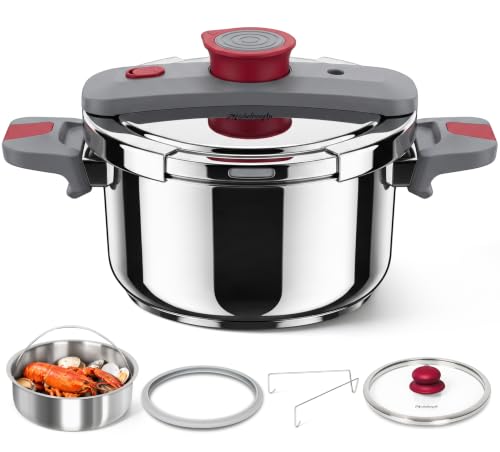
MICHELANGELO Stovetop Pressure Cooker, 4.2 qt
Badge: Best for Small Households
Strengths
- 304 stainless steel in a small, quick size; two pressure settings for delicate dishes.
- Glass lid included — the everyday simmering role ceramic-pot shoppers often want covered.
- One-hand easy-open lid and a listed 6-fold safety system.
Trade-offs
- Stainless, not ceramic: expect ordinary steel release behaviour.
- 4.2 qt capacity limits big dishes and whole poultry.
- Newer brand; shorter parts track record.
Mini spec box
- Capacity: 4.2 qt
- Material: 304 stainless steel (not ceramic — verified title)
- Safety: 6-fold safety system
- Settings: 2 pressure settings
- Included: Steamer basket and glass lid
- Compatibility: Induction compatible (per listing title)
Small households often arrive at the ceramic query through the side door of versatility: they want one pot that pressure-cooks, steams, simmers and reheats without a cupboard of specialised vessels. The MICHELANGELO answers that brief in stainless — a 4.2-quart pressure pot with a steamer basket for the gentle jobs and a glass lid that turns it into an ordinary saucepan for the rest of the week’s cooking. The two pressure settings protect the delicate dishes (eggs, fish, vegetables) that small households cook most.
Its surface story is the stainless story: durable, non-reactive, unbothered by metal tools, and more clingy with starch than a coating would be. In a small pot that rinses in a minute and soaks in a small sink, that trade is at its most painless — which is why, of the six, this is the pick where the absence of ceramic is felt least.
Best for: Small households wanting one versatile pot / Not suited for: Coating-first buyers or large-batch cooking
Breakfast, the meal small households cook most, flatters this pot in particular: small batches of oats, eggs at the gentle setting, congee and rice porridge all suit a vessel that heats and cools quickly, and the glass lid covers the reheating and simmering that breakfast’s second acts require. A pot that anchors the first meal of the day earns its cupboard space on a schedule no batch cooker can match — another way in which the right stainless pot quietly out-serves the ceramic idea that sent you shopping.

RVGMBO Pressure Cooker 12 Quart, 18/8 Stainless Steel
Badge: Best for Big Batches
Strengths
- 12-quart 18/8 stainless vessel for stock days, batch cooking and canning-format work.
- Glass lid and steamer rack included for the non-pressure roles.
- At this duty level, stainless is the only surface that makes long-term sense.
Trade-offs
- Not ceramic — and no ceramic pressure vessel exists at this canner scale in the verified pool.
- Very heavy full; a two-hand, planned lift.
- Far too large for everyday small meals.
Mini spec box
- Capacity: 12 Quart
- Material: 18/8 stainless steel (not ceramic — verified title)
- Format: 3-in-1 pressure cooker / pressure canner
- Included: Glass lid and steamer rack
- Compatibility: Induction and gas stovetop (per listing title)
The RVGMBO makes the engineering argument against ceramic at scale better than any essay could. Pressure canning and batch stock work involve jars, racks, long cycles and heavy loads; a coated surface in that environment would be a consumable, not a feature. The 18/8 stainless vessel — the food-grade grade cooks look for — with its rack for lifting jars and solids and its glass lid for open simmering, is the correct tool for the biggest jobs in pressure cooking, and it is included here so this guide’s size range is complete from 3 quarts to 12.
Buy it for stock days, preserving (with tested recipes and current official guidance, as always for canning) and crowd cooking. Do not buy it as an everyday pot, and do not buy it looking for ceramic — at this end of the category, ceramic was never really on the menu.
Best for: Batch cooks, stock-makers and canners / Not suited for: Everyday small meals or ceramic seekers
Storage is the final practical word: a 12-quart vessel is furniture as much as cookware, and it should be bought with its home already chosen — a deep cupboard, a utility shelf, the top of a wardrobe in a small flat. Households that solve that question in advance use their big pot for decades; households that do not, curse it monthly. The RVGMBO rewards the planners with the most capable batch instrument in this guide, in the only surface material that batch duty respects.

Peterboo 3Qt Stainless Steel Pressure Cooker
Badge: Best for One or Two People
Strengths
- Compact stainless pot sized for one or two people per the listing.
- Small batches mean small cleanup — the soak, when needed, is a two-minute event.
- 8+ safety features listed; induction compatible.
Trade-offs
- Stainless surface, with the usual starch behaviour.
- Working capacity near two quarts of food; guests outgrow it.
- The listing’s broad 8-in-1 wording should be read as a compact stovetop pressure pot.
Mini spec box
- Capacity: 3Qt
- Material: Stainless steel (not ceramic — verified title)
- Safety: 8+ safety features (per listing title)
- Compatibility: Induction compatible (per listing title)
- Audience: Sized for 1–2 people (per listing title)
For the solo cook or couple, the cleanup argument that drives ceramic shopping mostly dissolves at this scale: a 3-quart pot that cooked two servings rinses fast whatever it is made of, and its stainless body will do so unchanged for years. The Peterboo 3Qt is the compact, quick, small-burner option of the six — fast to pressure, fast to release, easy to store — with the highest listed safety-feature count in the set.
Its honest limits are size and surface, in that order. If your cooking grows to entertain, it becomes a side pot; if your heart is set on a coated release for sticky grains, the electric format discussed in this guide’s ceramic section is where that wish is granted. As a small stainless pressure pot, it is exactly what its verified title says.
Best for: Singles and couples cooking small and fresh / Not suited for: Families, batches, or coating-first buyers
Solo cooks also gain a subtler freedom here: experimentation without consequence. A two-serving test of an unfamiliar grain or spice blend costs little, cleans in a moment, and teaches the pressure instincts that make every later, larger cook easier. The small stainless pot is the laboratory of the pressure world — and a laboratory, of all places, is where you want a surface that nothing can damage and nothing can stain beyond a vinegar wipe’s repair.
Comparison Table
| Model | Capacity | Surface (verified) | Ceramic insert? | Cleanup character | Link |
|---|---|---|---|---|---|
| Presto 01362 | 6-Quart | Stainless steel | No | Soak-and-scrub tolerant | Check on Amazon |
| Peterboo 6 Quart | 6 Quart | Stainless steel, 3-ply base | No | Even heat, less scorching | Check on Amazon |
| T-Fal Secure Trendy | 8.5 qt | Stainless steel | No | Dishwasher-safe body per listing | Check on Amazon |
| MICHELANGELO | 4.2 qt | 304 stainless steel | No | Small pot, quick rinse | Check on Amazon |
| RVGMBO | 12 Quart | 18/8 stainless steel | No | Built for heavy duty cycles | Check on Amazon |
| Peterboo 3Qt | 3Qt | Stainless steel | No | Small batches, small cleanup | Check on Amazon |
Ceramic Inserts, Explained Properly
What the term means. A “ceramic insert” in cooker language is a removable inner pot or liner made of, or coated with, a ceramic material. In the pressure-cooker market as it exists today, the realistic form is the ceramic-coated inner pot: a metal pot carrying a ceramic-based nonstick coating, found in a number of electric multi-cookers. Solid ceramic pressure vessels are essentially absent from the verified market, for practical reasons — pressure equipment needs lids that lock against metal rims, seals that compress evenly, and bodies that tolerate rapid temperature change, all of which favour metal construction.
What ceramic coating genuinely does. It releases food — rice, oats, eggs, cheese dishes slide rather than cling — and it rinses clean with minimal effort when new and well kept. It is also non-reactive while intact. What it does not do: it does not cook differently in any way pressure physics would notice, it does not last indefinitely (coatings age, and their easy release fades with years, heat and utensils), and it asks for gentle tools — no metal, no abrasive pads, no in-pot immersion blending if you want it to live long. Shoppers who understand that bargain and still want it should shop the electric multi-cooker shelves and verify the words “ceramic-coated inner pot” in the product title itself — as this guide verified their absence here. The category overview at Best Pressure Cookers Under $100 includes coated electric options at the value tier, and Best Prices For Electric Cookers tracks the wider electric shelf.
How to Choose: Ceramic Dreams vs Stainless Reality
Name the job the surface must do. If your cooking is dominated by sticky, delicate, dairy-rich dishes and your temperament is gentle-tools-and-rinse, a ceramic-coated electric pot is a legitimate target — in the electric format, verified in the title. If your cooking is acidic, aggressive, batch-scale or decades-long, stainless is not the consolation prize; it is the correct engineering answer, and the six picks above cover it from 3 to 12 quarts.
Price the surface across its life. A coating is a consumable surface on a durable appliance; stainless is a permanent surface on a durable appliance. Neither is a scam — they are different ownership contracts. Choose the contract you will honour: the cook who will use silicone tools forever should buy coating without guilt; the cook who reaches for the metal spoon should buy steel without regret.
Decide who else will cook with it. A surface contract is only as strong as the least careful cook in the household. If the pot will meet teenagers, guests and helpful relatives armed with metal spoons, the stainless contract enforces itself and the coating contract will be broken by someone else, on your behalf, within the year. Households are ecosystems; specify for the ecosystem, not for the purchaser’s best intentions, and the surface you choose will still be performing when the alternative would be a cautionary tale.
Use base quality as the cleanup proxy in stainless.
If you choose steel, cleanup is decided less by the surface than by the base: even, layered bases (the Peterboo’s 3-ply is the example here) scorch less, and unscorched steel washes easily. That single specification does more for a stainless pot’s daily cleanup than any marketing word — including, on some listings, the word ceramic itself.
Reading Listings Like a Verifier: A Two-Minute Method
Since this entire guide exists because a headline and a product list disagreed, it owes you the method to catch the same disagreement anywhere. Open the listing and read the title as a contract: the material words that matter are the ones attached to the pot itself — “stainless steel pressure cooker”, “ceramic-coated inner pot” — not the ones attached to your hob, your stove or the marketing scenery. Then find the same claim repeated in the specifications, because a real feature survives repetition across a page while a keyword garnish appears once and vanishes. Check what is in the box: a genuine coated model names its inner pot as an item, because the pot is a replaceable part with its own identity. Finally, read the questions-and-answers for the surface question asked by a previous shopper; in this category, someone has always asked before you. Two minutes of that discipline would have written this guide’s introduction for any shopper, on any site, without our help — which is rather the point of teaching it.
How to Cook and Clean in Stainless Like a Pro
One preliminary habit outranks the rest: dry the pot properly and store it dry. Stainless is sometimes lazily called maintenance-free, and while it forgives more than any rival surface, a pot put away wet in a steamy kitchen can carry water spots and odour into its next outing, and a gasket stored compressed and damp ages before its time. Thirty seconds with a towel is the entire secret; the surface does the rest.
Stainless rewards three habits.
Preheat, then oil, then food: a properly warmed pan surface releases proteins far better than a cold one — the difference between stainless that sticks and stainless that behaves is usually temperature discipline, not the pot. Deglaze completely after the sauté stage; the lifted fond is both flavour and insurance, since a clean base pressurises without scorch notes or warnings. Soak smart: fill the warm pot with water and a drop of detergent while you eat, and most “stuck” food surrenders without a fight; a paste of baking soda handles the rest, and a vinegar rinse keeps hard-water film away. Care for the gasket as with any pressure cooker — wash it, dry it, store the lid inverted — and descale the vent path periodically in hard-water areas.
Troubleshooting Surface Problems
Problem: Rice and grains weld to the base → The pot went to pressure with settled starch and no stir, or the release was rushed. Stir before sealing, rest the pot a few minutes before opening, and let a short soak do the work afterwards rather than attacking the surface.
Problem: A rainbow or white film appears on the steel → Mineral and heat tinting, cosmetic only. A vinegar wipe or a vinegar-water simmer restores the finish; it does not affect cooking or safety.
Problem: Food tastes of the last dish → The gasket, not the pot, is carrying the flavour. Wash the ring thoroughly, air it, and keep a second ring for mild and sweet dishes.
Job by Job: Stainless vs Ceramic-Coated, Scored Honestly
To make the comparison concrete, walk the dishes that bring shoppers to this query. Rice and grains: the coated pot wins on release and rinsing; stainless manages well with correct ratios and a resting period, and wins the rematch in year five when the coating has aged. Oats and porridge: coating wins the morning cleanup; stainless asks for a stir and a soak. Eggs: a draw — steaming above water in a basket, as several picks here allow, makes the surface nearly irrelevant. Tomato and wine braises: stainless wins outright on non-reactivity and on tolerating the deglazing scrape that builds the sauce. Beans and pulses: stainless wins on durability across hundreds of foamy, abrasive batches. Cheese and dairy-rich dishes: coating wins the serving and the rinse, provided the dairy goes in after pressure, as it should in any pot. Stocks and canning-scale work: stainless, unopposed — the coated format does not contest this ground at all.
Tallied honestly, the surfaces split the repertoire: coating takes the sticky-and-delicate corner, stainless takes the acidic, abrasive, large and long-lived remainder. Most households cook more of the remainder than the corner, which is why this guide can recommend its stainless six without feeling like a consolation — while remaining precise about the corner where a coated electric pot, bought in its own format, is genuinely the better tool.
A Short History of the Ceramic Cooker Idea
The desire behind this search is older than the products that fail to meet it. Ceramic and earthenware are humanity’s original cooking vessels, prized for even, gentle heat and for flavours that cooks in many traditions insist taste rounder from clay. The modern ceramic-coated pot is an attempt to marry that heritage to metal’s practicality — a mineral-based surface over an aluminium or steel core — and in ordinary saucepans and electric multi-cookers the marriage works well enough to sustain a real market. Pressure cooking is simply the hardest room in the house for it: locking rims, compressible seals, rapid thermal swings and abrasive batch foods all conspire against surfaces, which is why the verified stovetop pressure market remains a steel market. Understanding that engineering reality turns a confusing search into a clear choice: heritage surface in the electric format, or pressure performance in steel — with this guide’s six picks representing the steel side at its most complete.
Common Buying Mistakes
- Trusting the word “ceramic” anywhere on a page. “Ceramic stove compatible” means a glass hob. Verify “ceramic-coated inner pot” in the title — as this guide did, finding none here.
- Assuming a guide’s picks match its headline. This page’s pool did not, and we said so; check any roundup’s spec boxes against its title claims.
- Buying a coating for a metal-utensil household. The surface will lose. Match the contract to the cook.
- Expecting ceramic cooking physics. Coatings change release and cleanup, not how pressure cooks food.
- Ignoring the base when buying stainless. Even heat is the real cleanup feature in a steel pot.
- Overlooking the electric format for coated pots. That is where ceramic-coated pressure cooking actually lives today.
A closing reflection on what this search teaches. The shoppers who type this query are among the most thoughtful in the category — they have a specific material in mind, for specific reasons, and they are asking a precise question. The market’s honest answer turned out to be “not in this format”, and a guide’s first duty was to say exactly that, in the first paragraph, before selling anything. If you leave this page with a stainless pot, you will leave knowing its surface is steel and why that may suit you better; if you leave for the electric shelves, you will leave knowing the exact phrase to verify. Either outcome is a successful search — the only failed one would have been a ceramic label pasted over a steel pot, and that is the one outcome this guide refused to sell you.
Final Recommendation
The honest verdict has two halves. If a ceramic-coated pot is truly what you want, it is not on this page: shop the electric multi-cooker format, verify “ceramic-coated inner pot” in the listing title, and use our companion guides to compare those models. If what you want is a non-reactive, durable pressure cooker that cooks superbly and asks little — the need underneath most ceramic searches — the first choice here is the Presto 01362, with the Peterboo 6 Quart as the even-heating induction alternative, the T-Fal for families, the MICHELANGELO for small households, the RVGMBO for batches, and the Peterboo 3Qt for one or two people. Either way, you now know exactly what you are buying — which is what this guide owed you from its first line.
Frequently Asked Questions
Do any of the cookers in this guide actually have a ceramic insert?
No. We verified all six, one by one, against current catalogue data on 2026-11-20, and every one is a stainless steel stovetop pressure cooker with no ceramic insert or ceramic-coated pot anywhere in its confirmed specification. This guide discloses that up front and reviews the six honestly as stainless alternatives, rather than relabelling them.
Where can I actually buy a pressure cooker with a ceramic-coated pot?
In the electric multi-cooker format: a number of electric models use ceramic-coated inner pots, because a countertop appliance’s inner vessel is a simple removable pot in a way a stovetop pressure vessel is not. Shop that format deliberately, read the inner-pot description in the title and the box contents, and you will find the genuine article without difficulty — it exists, just not between the covers of this particular guide.
Shop that format, and verify the exact phrase describing a ceramic-coated inner pot in the product title before buying — and be aware the coating needs gentle tools and has a finite service life.
Is stainless steel a healthy cooking surface?
Stainless steel is one of the most established food-contact surfaces in cooking: non-reactive with acidic foods, free of any coating that can wear, chip or age into food, and stable across decades of daily use in home and professional kitchens alike. It is the surface professional kitchens standardise on, and the grades named in these listings (304 and 18/8) are the food-grade grades buyers look for.
Why do listings say “ceramic” if the pot is steel?
Usually because of hob compatibility: “ceramic stove” or “ceramic glass compatible” describes the flat glass cooktop the pot can sit on, not the pot’s own surface — the word belongs to the stove in the sentence, however the headline may arrange it. It is the single most common source of confusion in this corner of the category, and the reason title-level verification matters. The same caution applies to “induction” and “dishwasher-safe”: each describes a relationship between the pot and something else in your kitchen, not a material the pot is made of.
Can I buy a separate ceramic insert for one of these pots?
Not as a verified option for these models: an inner vessel in a pressure cooker is part of a tested pressure system — its dimensions, rim, weight and thermal behaviour are engineered together with the lid and the seal — so swapping in an unverified third-party insert is not something this guide can recommend for any pressure cooker, however appealing the idea sounds. If a manufacturer offers its own alternative inner pot for a specific model, that is a different matter; verify it on the model’s own listing, in the manufacturer’s name, before considering it.
Does a ceramic coating cook food better than stainless?
It releases food better and rinses easier while the coating is young and intact; it does not change pressure, temperature, timing or cooking results in any way the food itself could detect. Stainless counters with durability, tool freedom and scorch recovery. The better surface is the one matched to your dishes and your utensil habits.
Are ceramic-coated pots safer than other nonstick surfaces?
Ceramic-based coatings are a different family from traditional nonstick coatings, with different chemistry and different ageing behaviour, and they are generally chosen by shoppers who prefer a mineral-based surface in contact with their food. The practical points for a buyer are the ones this guide stresses: the coating is a surface with a service life, it wants gentle tools and moderate handling, and its condition — not its category — is what matters over years of use. A worn coating of any family should be retired; a stainless pot, having no coating, never presents that decision.
How can I make stainless cleanup closer to ceramic?
Choose an even, layered base to prevent scorching, preheat before adding oil and food, deglaze fully after sautéing, rest grains off the heat before opening, and soak the warm pot while you eat. With those habits, a stainless pot’s cleanup is a two-minute routine rather than a project — the practical gap to a coating becomes much smaller than the marketing suggests. For the wider cooker shelf beyond pressure, Best Prices For Gas Cookers covers the hob side of the market.


