Disclosure: topratedkitchenware.com is reader-supported. When you buy through links on our site, we may earn an affiliate commission from Amazon and other retailers, at no extra cost to you.
Where to buy
The six models below are the verified picks for this guide to the best pressure cookers recipes turn out well in. Each name links to its Amazon listing, where you can check the latest price on Amazon, confirm the current configuration, and read the newest owner feedback before you decide. Start with our top pick here: Check on Amazon.
- MICHELANGELO Stovetop Pressure Cooker, 4.2 qt
- Peterboo Stainless Steel Pressure Cooker, 6 Quart
- RVGMBO Pressure Cooker 12 Quart, 18/8 Stainless Steel
- Peterboo 3Qt Stainless Steel Pressure Cooker
- Instant Pot Duo 6 Qt 7-in-1 Electric Pressure Cooker
- Cosori Pressure Cooker 6QT, 9-in-1
Read the full guide ↓ for the ranking logic, the honest limitations of every pick, and a full section on adapting ordinary recipes to pressure without ruining them.
Searching for the best pressure cookers recipes actually succeed in is a different hunt from searching for the best pressure cooker, full stop. A recipe makes demands a spec sheet never mentions: it wants you to sauté onions and bloom spices in the pot before the lid goes on, it wants a gentle setting for eggs and a fierce one for beans, it wants enough headroom that a foamy dal does not reach the vent, and — if the recipe comes from the enormous electric-cooker ecosystem — it assumes buttons and timings your pot may not have. This guide is written from the recipe’s point of view. We ranked six verified cookers by how faithfully they execute the dishes people really cook: weeknight curries and grains, Sunday braises, soups and stocks, steamed vegetables and eggs, yogurts and desserts, and the big batch recipes that fill a freezer.
The line-up deliberately mixes formats, because recipe collections do. Four picks are stovetop pots, which follow the classic timing charts printed in cookbooks for generations and give you full manual control; two are electric multi-cookers, which match the app- and preset-driven recipes that dominate modern cooking sites. Neither format is universally better for recipes — they are better for different recipe libraries, and the reviews below say plainly which library each pot belongs to. You will also find a comparison table, a step-by-step guide to converting conventional recipes, a troubleshooting section built around ruined-dish rescue, and answers to the recipe questions buyers ask most. If your recipe interests lean brothy, the soup-focused companion at Best Pressure Cookers Soups goes deeper on that one category, and Best Pressure Cookers Stovetop covers the manual-format side of the family in full.
Key Takeaways
- Match the cooker to your recipe library: stovetop pots follow classic cookbook timings; electric models follow app and preset recipes.
- A sauté stage in the same pot is the single biggest recipe-quality feature — it is where flavour is built before pressure takes over.
- Two pressure settings protect delicate recipes (eggs, fish, vegetables) that a single high setting easily overcooks.
- Respect the fill rules recipes assume: two-thirds full at most, halfway for beans, grains and foamy dishes.
- Release method is an ingredient: natural release finishes meats gently, quick release keeps vegetables and eggs where the recipe wants them.
- Keep notes on your own pot for the first month — your recorded liquid, time and release for each dish family becomes a personal conversion chart no book can match, and it is the fastest route from following recipes to confidently adapting your own.
In this guide
Quick Picks
| Pick | Badge | Capacity | Why recipes love it |
|---|---|---|---|
| Instant Pot Duo | Best Overall for Recipes | 6 Qt | 7-in-1 electric with an app featuring hundreds of recipes per the listing |
| Cosori 9-in-1 | Most Versatile | 6QT | Adds sous vide and a ceramic-coated pot to the recipe toolkit |
| Peterboo 6 Quart | Best Stovetop All-Rounder | 6 Quart | 3-ply base for scorch-free sautéing before pressure |
| MICHELANGELO 4.2 qt | Best for Delicate Recipes | 4.2 qt | Two pressure settings and a one-hand lid for small kitchens |
| RVGMBO 12 Quart | Best for Batch Recipes | 12 Quart | Canner-sized volume for stocks, big soups and preserving recipes |
| Peterboo 3Qt | Best for Two-Person Recipes | 3Qt | Small batches keep sauces concentrated and timings snappy |
How These Picks Were Chosen
Every model here comes from a verified pick pool checked against Amazon’s catalogue data through the Creators API on 2026-11-20, so capacities, function lists and included accessories match the current listings. We only link a cooker when the API-returned title confirms it is a genuine pressure cooker of the stated type and size. Ranking for this guide weighted recipe execution above all: the quality of the pre-pressure sauté, the availability of a gentler pressure setting, how the capacity maps onto real recipe yields, how release is controlled, and how large and trustworthy the matching recipe ecosystem is — manufacturer apps and preset libraries for the electric models, classic published timing charts for the stovetop pots.
This is a research-led guide, not a hands-on lab test, and we do not claim to have cooked in these pots. What we can do — and did — is compare verified specifications, manufacturer function lists, and the recurring patterns in owner feedback about how each model handles real dishes: which ones scorch a tomato sauce, which ones make yogurt reliably, which ones leave eggs green-ringed when a recipe is followed carelessly. Where a listing’s wording is broader than the data supports, the reviews say so and tell you what to count on instead. Recipe success is mostly technique, and the how-to section below carries as much weight as the picks themselves.
The 6 Best Pressure Cookers for Recipes

Instant Pot Duo 6 Qt 7-in-1 Electric Pressure Cooker
Badge: Best Overall for Recipes
Strengths
- The largest recipe ecosystem of any pick here, with an app featuring hundreds of recipes per the listing.
- Sauté, slow cook, rice, yogurt, steam and warm functions cover most published recipe methods in one pot.
- Stainless steel inner pot handles acidic tomato and wine-based recipes without coating worries.
Trade-offs
- Electric pressure and stovetop pressure are not identical; classic cookbook timings need small adjustments.
- Searing is gentler than a stovetop pot on a strong burner, so browning takes patience.
- The sealing ring absorbs strong flavours; dessert and yogurt cooks often keep a second ring.
Mini spec box
- Capacity: 6 Qt
- Format: 7-in-1 electric pressure cooker
- Functions: Pressure cook, slow cook, rice, yogurt, steam, sauté, warm, sterilize (per listing)
- Inner pot: Stainless steel
- Recipe support: Companion app with recipes (per listing title)
If your recipe life lives on cooking sites, saved pins and app collections, the Duo is the cooker those recipes were written for. The modern pressure-cooker recipe canon — the dump dinners, the butter chicken variations, the cheesecake-in-a-pot desserts — overwhelmingly assumes an electric 6-quart multi-cooker with a sauté function and a yogurt setting, and the Duo is the reference model for that canon. Following a recipe exactly, with the same functions in the same order, removes the translation errors that cause most pressure-cooking failures. The stainless inner pot matters more than it sounds: you can deglaze with wine, simmer a tomato sauce down after pressure, and scrub the pot properly without babying a coating.
Where recipes need care: stovetop-derived timings from older cookbooks assume the slightly different pressure behaviour of a rangetop pot, so treat the first run of any treasured family recipe as a calibration — check doneness a few minutes early and note the adjustment. The yogurt function deserves its reputation among recipe hunters: it holds the incubation temperature steadily, which is the entire technical challenge of homemade yogurt, and the sterilize function is genuinely useful for jars and utensils. For households whose cooking is recipe-led and internet-fed, this is the most faithful executor in the group.
Best for: Cooks who follow modern online and app recipes exactly as written / Not suited for: Cooks loyal to classic stovetop timing charts or who want maximum searing power
A practical recipe workflow worth adopting with this pot: use the sauté stage aggressively and the pressure stage conservatively. Most disappointing electric-cooker meals trace back to timid browning and optimistic timings copied from a differently sized model. Brown in two batches so the pot stays hot, deglaze until the base is clean and the liquid is glossy, then set the timer at the low end of the recipe’s range and let natural release finish the job — carryover under falling pressure is real cooking time, and experienced recipe writers count on it. Keep a notebook page for your own model: the day you learn exactly how your Duo handles your chilli, your rice and your eggs, the app becomes a starting point rather than a script.

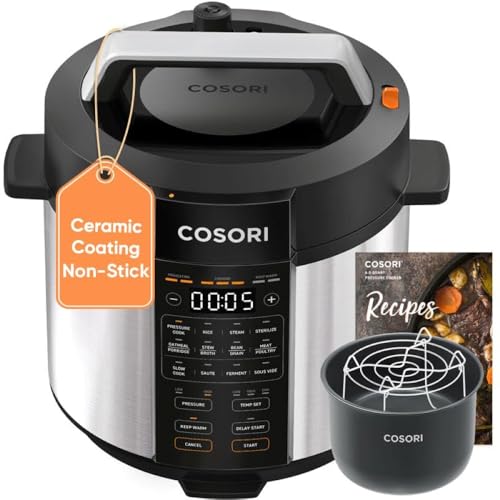
Cosori Pressure Cooker 6QT, 9-in-1
Badge: Most Versatile
Strengths
- Nine functions including sous vide — the widest recipe-method range in this group.
- Ceramic-coated inner pot releases rice, oats and cheesy dishes with less sticking.
- Twelve safety features listed, with a stainless steel exterior.
Trade-offs
- Coated pots need non-metal utensils and gentler scrubbing than bare stainless.
- Sous vide in a multi-cooker suits small portions, not a feast-sized bath.
- Recipe ecosystem is smaller than the market leader’s, so more recipes need light adaptation.
Mini spec box
- Capacity: 6QT
- Format: 9-in-1 electric pressure cooker
- Functions: Pressure cook, rice, slow cook, sous vide, sauté and more (per listing)
- Inner pot: Ceramic coating
- Power: 1100W (per listing title)
- Safety: 12 safety features (per listing title)
The Cosori is the pick for the cook whose recipe folder refuses to stay in one category. Pressure recipes are its home turf, but the sous vide function opens an entire second library — eggs at precise temperatures, steaks finished with a sear, custards — that no other pick in this guide can execute at all. The ceramic-coated pot earns its keep with the sticky end of the recipe spectrum: rice dishes, oatmeal, macaroni and cheese, and anything cheesy or sugary that welds itself to bare metal. Food releases cleanly, and the pot rinses instead of soaking.
The trade-offs are the honest ones for coated cookware. Use silicone, wood or nylon tools, avoid abrasive pads, and accept that a coating has a service life that stainless does not. Recipe-wise, most electric-cooker recipes written for the category leader translate directly — same capacity, same core functions — but expect to choose settings manually where a recipe names a proprietary preset button. For adventurous cooks who want one appliance to cover pressure, slow, rice and sous vide recipe collections, this is the broadest single purchase in the guide.
Best for: Adventurous cooks with mixed recipe collections, including sous vide / Not suited for: Metal-utensil cooks or anyone who wants a pot that lasts decades untouched
One recipe category deserves a special mention here: grains and one-pot rice dishes. The coated pot changes the failure maths — the scorched-bottom warning that haunts stainless pots with biryanis, pilafs and cheesy rice bakes is far less likely, and serving from the pot is easier because the food lets go. Pair that with the slow-cook function for the recipes that were never meant to be hurried, and the Cosori covers the full tempo range of a home recipe collection, from a 4-minute egg to an all-day braise, in a single appliance footprint. That breadth is why it holds the versatility badge even against a rival with a bigger recipe app.

Peterboo Stainless Steel Pressure Cooker, 6 Quart
Badge: Best Stovetop All-Rounder
Strengths
- 3-ply composite base gives even sautéing — the foundation step of most savoury recipes.
- Classic 6-quart size matches the yields most cookbooks are written around.
- Listed for induction, gas and ceramic stoves, with a clear pressure indicator.
Trade-offs
- No preset or app ecosystem; timings come from charts and experience.
- No steamer basket is named in the verified listing, though most recipes work without one.
- You manage burner heat yourself for the whole cook.
Mini spec box
- Capacity: 6 Quart
- Material: Stainless steel
- Base: 3-ply composite base
- Indicator: Pressure indicator
- Compatibility: Induction, gas and ceramic stove (per listing title)
- Care: Dishwasher safe (per listing title)
For the cookbook loyalist, this is the recipe pot. Classic pressure-cooker literature — the timing charts for beans by variety, grains by type, and cuts of meat by thickness — was written for stovetop pots, and a well-made 6-quart stainless model executes those charts exactly as their authors intended. The 3-ply base is the recipe feature that matters most here: nearly every great pressure recipe begins with browning or sweating aromatics, and an even base means the fond builds without scorching, so the deglazing liquid lifts flavour instead of bitterness into the dish. The pressure indicator gives you the clear visual reference that chart timings assume.
Who it suits: cooks who own or plan to own real pressure-cooker cookbooks, who cook Indian, Latin and Mediterranean recipes with a proper tempering or sofrito stage, and who prefer skill over presets. The honest limitation is guidance: nothing beeps when the recipe’s next step is due, and electric-cooker recipes from the internet need the small translation described in the conversion section below. Treat that as a craft skill rather than a defect and this pot will execute a wider range of the world’s pressure recipes than any button-driven model.
Best for: Cookbook-driven cooks who sauté properly and follow classic timing charts / Not suited for: Cooks who want presets, apps and walk-away automation
Recipe categories that flatter this pot most: the great bean dishes, where the chart-driven timing by variety and soak state is exact; the long Italian and Spanish braises that begin with a serious sofrito; and stocks, where a stovetop pot’s rolling, controllable heat extracts cleanly and the finished stock can be reduced in the same vessel with the lid off. If your recipe shelf includes cuisines built on a tempered-spice or browned-base opening move, the even 3-ply base is not a luxury — it is the difference between the recipe as written and the recipe as compromised.
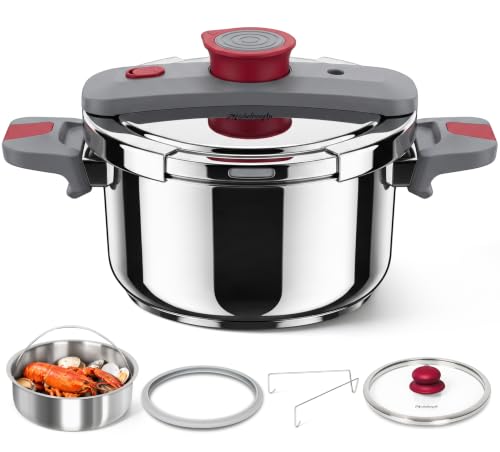
MICHELANGELO Stovetop Pressure Cooker, 4.2 qt
Badge: Best for Delicate Recipes
Strengths
- Two pressure settings protect eggs, fish, custards and vegetables from overcooking.
- One-hand easy-open lid keeps mid-recipe lid handling calm and safe.
- Steamer basket and glass lid included — steaming and simmering recipes need no extra kit.
Trade-offs
- Working capacity under the two-thirds rule is modest; big roasts do not fit.
- Newer brand, so its long-term parts story is less proven than legacy names.
- Small pot means halving many standard recipes — easy, but an extra step.
Mini spec box
- Capacity: 4.2 qt
- Material: 304 stainless steel
- Safety: 6-fold safety system
- Settings: 2 pressure settings
- Included: Steamer basket and glass lid
- Compatibility: Induction compatible (per listing title)
Delicate recipes are where pressure cookers earn their bad reputation — the grey egg, the collapsed fish fillet, the vegetable that went from raw to mush between two glances at the stove. The MICHELANGELO’s lower pressure setting exists precisely for that end of the recipe book: gentler pressure and a small pot that reaches and leaves pressure quickly give you a control window that a big single-setting cooker cannot match. Add the included steamer basket — eggs, vegetables and dumplings cook above the water, not in it — and the glass lid for finishing and simmering, and this is the most recipe-complete small package in the guide.
Who it suits: small households whose recipe tastes run to steamed dishes, eggs, grains in modest quantities, curries and custards. Halving standard recipes is genuinely simple in a pot this size — keep liquid proportions slightly generous, since small pots lose relatively more to evaporation before sealing, and keep timings the same, because pressure timing depends on the food’s thickness, not the batch size. The honest limitation remains headroom: a whole chicken or a large roast belongs in a bigger pot.
Best for: Small households cooking delicate and steamed recipes / Not suited for: Large roasts, whole poultry, or big-batch cooking
Breakfast is this pot’s quiet speciality. Steel-cut oats in a small batch, eggs at the low setting with a quick release, and congee or rice porridge all suit a vessel that heats and cools quickly — the two moments where big pots waste your morning. The glass lid then keeps the same pot useful for the non-pressure half of small-kitchen cooking: reheating soup, simmering a sauce, wilting greens. In a studio or a small flat, a cooker that covers pressure, steaming and ordinary saucepan work in one 4.2-quart footprint is not a compromise pick; it is the rational one.

RVGMBO Pressure Cooker 12 Quart, 18/8 Stainless Steel
Badge: Best for Batch Recipes
Strengths
- 12-quart volume executes doubled and tripled recipes in a single run.
- Pressure-canner format also covers tested preserving recipes when used per official guidance.
- Glass lid and steamer rack included for stockpot-style recipes.
Trade-offs
- Far too large for everyday recipes; small loads pressurise slowly and cook unevenly.
- Very heavy when full, and it will monopolise your largest burner.
- Recipe timings for standard pots need no change, but liquid scaling needs judgement.
Mini spec box
- Capacity: 12 Quart
- Material: 18/8 stainless steel
- Format: 3-in-1 pressure cooker / pressure canner
- Lid: One-hand locking; glass lid included
- Included: Steamer rack
- Compatibility: Induction and gas stovetop (per listing title)
Batch recipes are a genre of their own: the stock that becomes a month of soups, the bean batch that fills freezer tubs, the pulled pork for a party, the tomato glut turned into sauce. The RVGMBO is the only pick here that executes that genre without compromise, and its canner format adds the preserving recipe book — jams with the glass lid as a water-bath style pot, and pressure-canned low-acid foods only when you follow tested recipes and current official guidance for your altitude exactly. The one-hand locking lid is a thoughtful touch on a vessel this size, and the steamer rack keeps jars and large items off the base.
Scaling guidance matters more than the pot: when you double a pressure recipe, keep the cooking time the same, keep seasonings slightly under-doubled until you taste, and never let the scaled liquid and food pass the two-thirds line — for foamy bean and grain batches, stay at halfway. The honest limitation is everyday life: this is a weekend-project pot, not a Tuesday pot, and households without storage for a 12-quart vessel should admire it from a distance.
Best for: Batch cooks, canners and party-scale recipes / Not suited for: Everyday small meals or small kitchens
There is also a social dimension to a pot this size: it is the recipe equivalent of a bigger table. Soup kitchens, team meals, holiday sides for a crowd, a whole batch of tamales steamed above the rack — these are recipes measured in goodwill as much as servings, and they simply do not fit the standard 6-quart mould. If your cooking life includes feeding people beyond your household with any regularity, the RVGMBO stops being an extravagance and becomes the tool that makes those recipes possible in one run instead of three.

Peterboo 3Qt Stainless Steel Pressure Cooker
Badge: Best for Two-Person Recipes
Strengths
- Sized for one or two people per the listing — recipes land in realistic portions.
- Small volume keeps braising liquids concentrated and flavourful.
- 8+ safety features listed; induction compatible.
Trade-offs
- Most standard recipes must be halved, and some (whole poultry, large roasts) excluded.
- The listing’s broad 8-in-1 wording should be read as a compact stovetop pressure pot first.
- Minimum-liquid needs are proportionally higher, so very dry braises are tricky.
Mini spec box
- Capacity: 3Qt
- Material: Stainless steel
- Safety: 8+ safety features (per listing title)
- Compatibility: Induction compatible (per listing title)
- Audience: Sized for 1–2 people (per listing title)
Two-person households know the quiet failure of standard recipes: they assume four to six servings, and the leftovers outstay their welcome. The Peterboo 3Qt is built for the halved-recipe life. A small pot changes recipe behaviour in your favour — less liquid is needed to cover ingredients, so curries and braises taste concentrated rather than diluted, and the pot reaches pressure fast enough that a rice-and-dal weeknight dinner is a realistic 30-minute project. It is also the natural second pot for owners of a big cooker: the main cooks under pressure in the large vessel while this one handles the grain or vegetable side without a burner conflict over timing.
Halving rules that work: halve ingredients, keep the cooking time identical, and keep liquid at no less than the pot’s minimum even if that is slightly more than half the original — you can simmer the sauce down with the lid off afterwards. The honest limitation is the ceiling: entertaining, batch cooking and big cuts are simply outside this pot’s recipe range, and buyers who regularly cook for guests should size up to the 4.2-quart or 6-quart picks.
Best for: Singles and couples cooking fresh, small recipes / Not suited for: Entertaining, batch cooking, or large cuts
Solo cooks also report a subtler benefit: recipe confidence. When the cost of an experiment is two servings instead of eight, you try the unfamiliar dal, the new grain, the spice blend you were unsure about. Small pots lower the stakes of learning, and pressure cooking rewards the cooks who experiment, because its timings and liquid rules become intuitive only through repetition. A 3-quart pot on a small burner gives a new pressure cook more repetitions per week than any other format in this guide — and repetitions, not features, are what turn recipe followers into recipe adapters.
Comparison Table
| Model | Format | Capacity | Recipe strengths | Watch out for | Link |
|---|---|---|---|---|---|
| Instant Pot Duo | Electric 7-in-1 | 6 Qt | App recipes, yogurt, sauté | Gentler sear | Check on Amazon |
| Cosori 9-in-1 | Electric 9-in-1 | 6QT | Sous vide, sticky dishes, rice | Coated pot care | Check on Amazon |
| Peterboo 6 Quart | Stovetop | 6 Quart | Classic charts, strong sauté base | Manual heat control | Check on Amazon |
| MICHELANGELO | Stovetop | 4.2 qt | Delicate and steamed recipes | Modest capacity | Check on Amazon |
| RVGMBO | Stovetop canner | 12 Quart | Batch and preserving recipes | Size and weight | Check on Amazon |
| Peterboo 3Qt | Stovetop mini | 3Qt | Two-person and side-dish recipes | Halving required | Check on Amazon |
How to Choose a Pressure Cooker for the Recipes You Cook
Start from your recipe sources. If your saved recipes come from apps, blogs and the cooker makers’ own collections, an electric model executes them with the fewest translations — the Duo and Cosori are your shortlist. If your recipes come from printed cookbooks, family cards and classic charts, a stovetop pot is the native format. Mixed libraries are the norm, which is why so many households eventually own one of each size class; start with the format that matches the majority of your cooking.
Check the recipe functions you actually use. Yogurt makers need a yogurt function or a reliable low setting. Bakers of pressure-cooker cheesecakes and breads need a pot that fits a springform or loaf pan with room for steam circulation — a tape measure against the inner diameter settles that question before purchase. Rice-heavy households should weigh the coated pot of the Cosori; bean-heavy households should weigh headroom and the half-fill rule, which pushes toward 6 quarts and up. If you are also comparing the value end of the category, Best Pressure Cookers Under $100 frames the budget tier of this same family.
Match capacity to yield, not appetite. Recipes are written to a pot size. A 6-quart recipe shoehorned into a 4.2-quart pot overflows the fill line; the same recipe lost in a 12-quart pot may not build pressure properly. The working-capacity rule — two-thirds for most dishes, half for foamy ones — converts headline quarts into real servings, and it is the single most useful calculation in this entire guide.
Timing by Ingredient Family: The Pattern Behind Every Chart
Printed timing charts look like hundreds of unrelated numbers, but they follow one pattern: pressure time scales with density and thickness, not with weight or volume. A whole potato and a cubed potato are different recipes; a thick pork shoulder needs its full braise while the same meat cubed needs a fraction of it. Beans vary by variety and by whether they were soaked — soaked beans cook in a fraction of the time of dry ones, and old beans from the back of the cupboard take longer than fresh stock from a busy shop, which is why honest charts give ranges and tell you to add time rather than subtract it. Grains are the most predictable family: once you know your pot’s rice and your pot’s oats, those numbers rarely move. Vegetables sit at the fast extreme — many need only a brief spell at pressure followed by an immediate quick release, and some, like delicate greens, should be stirred into the hot finished dish instead of pressurised at all.
Release choice follows its own pattern. Anything that foams — beans, grains, porridges — wants at least a partial natural release so the foam subsides before the vent opens. Anything whose texture is the point — eggs, vegetables, fish, custards — wants the pressure gone the moment timing ends. Meats want patience: the natural release is effectively part of their cooking time, and recipes written by careful authors set their stated minutes assuming it. When you adapt a recipe from one format to another, keep the ingredient pattern and the release logic, adjust the minutes modestly, and check early. That discipline converts almost any recipe successfully, in any of the six pots in this guide.
How to Convert Ordinary Recipes to Pressure (and Cook Them Well)
Converting a conventional braise, stew or soup to pressure follows five reliable steps. First, keep the ingredients and their order, but plan the sauté stage in the pot: brown meat in batches, sweat aromatics, bloom spices in fat for half a minute. Second, reduce the liquid: pressure pots lose almost nothing to evaporation, so a conventional recipe usually needs noticeably less added liquid — keep enough thin liquid to build steam and cover the minimum for your pot size. Third, set the time by the densest ingredient: as a working rule, pressure cooking takes roughly a third of the conventional covered time for braises and beans, and far less for vegetables, which is why mixed dishes add quick-cooking ingredients after a first pressure stage. Fourth, choose the release the dish needs: natural for meats, grains and foamy pots; quick for vegetables, eggs and seafood. Fifth, finish open: reduce sauces, stir in dairy, herbs and acids at the end, and adjust salt after pressure, not before, because flavours concentrate differently.
Cleaning and care follow the recipe life you lead. Tomato and turmeric will tint gaskets; a dedicated savoury ring and a plain ring for desserts and yogurt is the veteran’s trick on electric models. Stovetop pots ask for vent checks and gasket inspections; coated pots ask for gentle tools. Store lids upside down, gaskets uncompressed, and every format will serve your recipe collection for years.
Troubleshooting Ruined Dishes
Problem: The sauce is thin and watery → The recipe kept its conventional liquid. Simmer uncovered after pressure to reduce, or whisk in a small starch slurry; next time, cut the added liquid and let ingredient juices do the work.
Problem: Meat is tender but bland → The sauté stage was rushed or salt went in only at the start. Brown harder, bloom spices in fat, deglaze fully, and finish with salt, acid and fresh herbs after pressure.
Problem: Vegetables disintegrated while the meat was still tough → The recipe mixed fast and slow ingredients in one stage. Pressure the meat first with a natural release, then add vegetables for a short second stage.
Reading Recipe Claims Like an Editor
Recipe collections are marketing surfaces as much as instruction sets, and a little editorial scepticism improves results. Treat headline recipe counts in apps as a library size, not a quality score; what matters is whether the collection is tested, maintained and written for your exact format. Be wary of any recipe that ignores fill limits, that gives a single time for ingredients of wildly different density, or that promises pressure-cooked results for dishes pressure ruins — delicate fish fillets and crisp textures among them. The healthiest sign in a recipe source is an honest note about release method and a doneness check rather than blind faith in a number. Builds like that are what we looked for when ranking ecosystem strength in this guide, and the same scepticism serves you when browsing Best Pressure Cookers Sweethome and other editorial roundups of the category.
A Recipe-First Tour of the Week
To make the differences between these six pots concrete, walk a normal week of cooking through them. Monday is a red lentil soup: any pot here handles it, but the small MICHELANGELO and Peterboo 3Qt shine because the batch is modest and the low setting keeps the lentils intact until the finish. Tuesday is rice and a curry: the Cosori’s coated pot makes the rice release cleanly while its pressure function handles the curry, and the Duo’s yogurt setting can be quietly incubating tomorrow’s breakfast at the same time of day. Wednesday is beans from dry: the Peterboo 6 Quart on the stovetop, chart open, is the traditionalist’s pleasure, while the Duo does the same job with a timer and no burner-watching. Thursday is eggs and steamed vegetables — delicate work that rewards the two-setting stovetop pot and punishes carelessness in any format. Friday is a braise: choose by your recipe source, app or cookbook, and let the format follow. The weekend belongs to the RVGMBO if you are batching or preserving, and to whichever pot you own if you are not. No single pick wins the whole week; the winner is the one whose wins fall on your busiest days.
Building a Recipe Collection That Fits Your Pot
Whatever you buy, spend the first month deliberately. Cook one recipe from each family — a soup, a grain, a bean dish, a braise, an egg dish, a steamed vegetable — and write down three numbers for each: the liquid you used, the minutes at pressure, and the release you chose. Note what you would change. That single page becomes your personal conversion chart, more valuable than any printed table because it is calibrated to your pot, your stove and your ingredients. Save recipes in one place, tag them by the pot and setting that worked, and ruthlessly delete the ones that failed twice. Within a season you will own a small, trustworthy collection that fits your cooker exactly — which is the real end-point of shopping for a recipe-friendly pressure cooker: not the appliance, but the repertoire that grows around it.
Common Buying Mistakes
- Buying the format your recipes do not use. App recipes in a stovetop pot and cookbook charts in a preset machine both work — with friction you will feel weekly.
- Ignoring the sauté stage. A pot that cannot brown properly flattens every savoury recipe built on fond.
- Overfilling for a doubled recipe. Doubling ingredients without respecting the two-thirds and half-fill rules causes vent clogs and uneven cooking.
- Forgetting pan-fit for baking recipes. Measure the inner diameter before assuming your springform fits.
- Using one gasket for everything. Last night’s curry in tomorrow’s cheesecake is a flavour transfer nobody wants; spare rings are cheap.
- Chasing function counts. Nine functions you never open lose to four you use weekly.
Think in terms of your next fifty recipes, not your next one. Any of these pots will cook tonight’s dinner. The differences appear across a season: the app ecosystem that keeps suggesting your next dish, the coated pot that keeps releasing your rice, the stovetop base that keeps your sofrito honest, the small pot that keeps your portions sane. If you can, list the last ten pressure-friendly dishes you actually cooked and score each pick against that list before you score it against any feature table. The pot that wins your real menu is the right purchase, and it is rarely the one with the longest function list. Shoppers comparing the wider family before committing will find the general roundup at Best Pressure Cookers Wit Ceramic Inserts useful for the coated-pot question in particular, since one pick here and several there turn on exactly that choice of inner surface.
Final Recommendation
For most recipe-led kitchens, the first choice is the Instant Pot Duo: it speaks the language of the modern recipe internet fluently and covers yogurt, rice and sauté work in one stainless pot. Adventurous cooks should step to the Cosori for sous vide and its easy-release coated pot. Cookbook loyalists belong with the Peterboo 6 Quart, delicate-recipe cooks with the MICHELANGELO, batch cooks with the RVGMBO, and two-person households with the Peterboo 3Qt. Choose by your recipe library and the pot will feel less like an appliance and more like a co-author.
Frequently Asked Questions
Can I use electric pressure cooker recipes in a stovetop pot, and vice versa?
Yes, with small translations. Ingredients and order stay the same; timings usually carry across closely, but stovetop pots reward checking a few minutes early the first time, and electric recipes that name a proprietary preset need the equivalent manual setting — pressure level and time — chosen on a stovetop model or a rival electric.
How much liquid does a pressure recipe really need?
Enough thin liquid to generate steam and satisfy your pot’s minimum — and far less than the conventional version of the dish, because almost nothing evaporates under a sealed lid. Juicy ingredients like tomatoes, onions and mushrooms contribute liquid of their own; thick sauces should be thinned for the pressure stage and reduced afterwards.
Why do recipes insist on natural release for meat?
A sudden pressure drop makes the liquid inside meat fibres boil and squeeze out, toughening the texture. Natural release lets pressure fall gradually, keeping braised and roasted meats juicy. It also prevents foamy bean and grain pots from sputtering through the vent.
Can I bake cakes and bread in a pressure cooker?
Yes — steamed-bake is a long pressure tradition, from puddings to cheesecakes. You need a pan that fits with clearance for steam, a trivet or rack to lift it off the base, and water in the pot to generate steam. Dense, moist bakes suit the method best; anything that needs a dry crust does not.
How do I halve a recipe for a small pot?
Halve the ingredients, keep the cooking time the same, and keep liquid at or above the pot’s minimum even if that is slightly more than half — you can reduce the sauce afterwards with the lid off. Season a little under half and correct at the end.
What is the best first recipe to learn a new pressure cooker with?
Choose something forgiving, liquid-rich and cheap, ideally a dish you already know well in its conventional form, so your palate can judge the pressure version against a memory rather than a guess: a bean soup, a lentil dal or a simple stock. These dishes tolerate a few minutes of timing error, teach you how your pot signals pressure and release, and reveal your stove’s holding setting if you chose a stovetop model. Save the cheesecake, the eggs and the family heirloom braise for the second week, when the pot’s habits are familiar and a mistake costs less.
Are the recipe apps and preset libraries worth paying attention to?
As a starting library, yes — especially when they are maintained and written for your exact model class. Treat them as well-tested defaults to learn from, then graduate to adapting your own conventional recipes with the conversion steps in this guide. And if your recipe ambitions centre on one dish family, the specialised roundup at Best Pressure Cookers Tested shows how evidence-led picks compare when a single use case leads.


