Disclosure: topratedkitchenware.com is reader-supported. When you buy through links on our site, we may earn an affiliate commission from Amazon and other retailers, at no extra cost to you.
Where to buy
The six models below are the verified picks for this guide to pressure cookers that handle rice well. Each name links to its Amazon listing, where you can check the latest price on Amazon, confirm the current configuration, and read the newest owner feedback before you decide.
- RVGMBO 12 Quart Stainless Steel Pressure Cooker and Canner
- Peterboo 3Qt Stainless Steel Pressure Cooker
- Instant Pot Duo 6 Qt 7-in-1 Electric Pressure Cooker
- Cosori Pressure Cooker 6QT 9-in-1
- Instant Pot Duo Mini 3 Quart Electric Pressure Cooker
- Instant Pot Pro 6 Qt 10-in-1 Electric Pressure Cooker
Read the full guide ↓ for the rice-specific reasoning behind each pick, the honest limitations, and the checks that matter more than any headline claim.
Searching for the best pressure rice cookers usually means one of two things: you want rice cooked faster than a conventional rice cooker manages it, or you want one countertop machine that handles rice on weeknights and stews, beans, and braises on weekends. Pressure changes the rice equation. Sealed steam raises the cooking temperature above the boiling point of water, so grains hydrate and soften in a fraction of the usual time, and the sealed environment keeps the texture even from the top of the pot to the bottom. The catch is that not every pressure cooker treats rice equally well. Some have a dedicated rice program tuned for grain-to-water ratios, some rely on a generic pressure setting you time yourself, and stovetop models ask you to manage the heat by hand. This guide separates those approaches honestly, so the pick you choose matches the way you actually cook rice.
One clarification up front, because it shapes the whole list: this pool mixes electric multi-cookers with true rice programs and stovetop pressure cookers that cook excellent rice once you learn their timing. Both styles can produce fluffy, separate grains. They differ in how much attention they demand. The electric models below are the set-and-walk-away options. The stovetop models reward a cook who is already comfortable at the stove, and in exchange they offer stainless steel construction, no electronics to fail, and in one case a pot big enough to double as a pressure canner. Neither style is automatically better. The right choice depends on whether you value automation or durability more, and on how much rice you cook at once.
Below you will find six verified picks reviewed in detail, each with strengths, trade-offs, a mini spec box built only from verified listing information, and a plain verdict. There is also a comparison table, a full how-to section on cooking rice under pressure including troubleshooting, and the mistakes that most often lead people to blame the cooker for what was really a ratio or release problem. If you are comparing neighbouring cooker questions at the same time, our notes on Best Prices For Pressure Cookers Today cover the wider pressure cooker market that these rice-focused picks sit inside.
Key Takeaways
- The best pressure rice cookers for most households are electric multi-cookers with a dedicated rice function, because they automate the timing and pressure release that rice is sensitive to.
- Stovetop pressure cookers cook rice beautifully but manually: you control the heat and the clock, so results depend on your attention the first few times.
- Capacity is about cooked yield, not the number on the box. A 3-quart cooker suits one or two people; a 6-quart handles family batches and meal prep.
- Natural release matters for rice. A short natural release after the cook cycle finishes resting the grains is the difference between fluffy and gummy.
- Rinse your rice and respect the ratio. Most pressure-cooker rice failures trace back to unrinsed grains or too much water, not to the machine.
- Check the latest price on Amazon for each pick before deciding, and confirm the pot material and included accessories on the listing, because configurations change.
In this guide
Quick Picks
| Pick | Badge | Style | Capacity | Link |
|---|---|---|---|---|
| Instant Pot Duo 6 Qt | Best Overall | Electric, 7-in-1 | 6 Qt | Instant Pot Duo 6 Qt |
| Cosori Pressure Cooker 6QT | Best for Rice Programs | Electric, 9-in-1 | 6 Qt | Cosori Pressure Cooker 6QT |
| Instant Pot Pro 6 Qt | Best Premium | Electric, 10-in-1 | 6 Qt | Instant Pot Pro 6 Qt |
| Instant Pot Duo Mini | Best for Small Households | Electric, 7-in-1 | 3 Qt | Instant Pot Duo Mini |
| RVGMBO 12 Quart | Best for Big Batches | Stovetop cooker and canner | 12 Qt | RVGMBO 12 Quart |
| Peterboo 3Qt | Best Compact Stovetop | Stovetop, 8-in-1 | 3 Qt | Peterboo 3Qt |
The badges above are used consistently through the detailed reviews, so you can jump straight to the pick whose badge matches your situation. Best Overall goes to the model that balances rice performance, capacity, and everyday ease for the widest range of kitchens. The premium and rice-program badges mark the two electrics that add refinement or breadth beyond that baseline. The two stovetop picks earn their places on build and capacity rather than automation, and both reviews say so plainly.
How These Picks Were Chosen
This is a research-led guide. The picks come from a verified product pool checked against Amazon’s own catalogue data, and every model named here was confirmed as a genuine pressure cooker with a credible rice use case before it earned a place. That verification step matters more than it might sound: pressure cooking and rice cooking are neighbouring categories, and plenty of roundups blur them by listing ordinary rice cookers under pressure headings. Every pick below actually cooks under pressure. Where a model’s rice ability comes from a dedicated program, the review says so. Where it comes from manual pressure timing on a stovetop pot, the review says that instead, so you are never sold automation a product does not have.
Beyond the pressure check, the selection weighed five things. First, pot material and construction, because stainless steel and ceramic-coated pots behave differently with starchy rice water and clean up differently afterwards. Second, capacity realism: the working fill limit for grains is lower than for soups, so nominal quarts were translated into realistic cooked-rice yields. Third, the control set, meaning whether the cooker offers a rice-specific program, a manual pressure mode you can time precisely, or only stovetop judgement. Fourth, safety systems, since pressure and steam demand respect and modern cookers answer with layered locks and release controls. Fifth, the breadth of the wider function set, because most buyers want the same machine to handle beans, stews, and steaming once the rice is done. Models that were strong on rice but hopeless at everything else ranked below models that did both jobs well.
What this guide does not do is claim hands-on laboratory testing. The judgements here are built from verified specifications, manufacturer documentation, and the accumulated patterns in owner feedback: which models people praise for consistent rice, which ones draw complaints about scorching or fiddly lids, and which ones keep working year after year. Treat the reviews as well-researched buying guidance, and use the Amazon listings linked throughout to check the current configuration before you commit, since bundles and included accessories do change over time. Readers comparing the broader market will also find our coverage of Best Prices For Electric Cookers useful context for how these multi-cookers sit among other electric cooker types.
The 6 Best Pressure Rice Cookers
A note on ordering before the reviews begin: the list runs from the most broadly suitable pick to the most specialised. The stovetop models sit lower not because they cook worse rice, but because they ask more of the cook. If you already know you want a stovetop pot, read their reviews on their own terms rather than as runners-up.

Instant Pot Duo 6 Qt 7-in-1 Electric Pressure Cooker
Badge: Best Overall
Strengths
- A dedicated rice function alongside pressure cooking, slow cooking, steaming, sautéing, yogurt making, warming, and sterilising, so one machine covers the whole week.
- Stainless steel inner pot handles starchy rice water without a coating to baby, and goes in the dishwasher afterwards.
- The 6-quart size is the sweet spot for rice: big enough for family batches and meal prep, small enough for a two-person dinner without waste.
Trade-offs
- The sealing ring absorbs odours over time, so rice cooked after a heavily spiced stew can pick up a faint echo unless you keep a spare ring for mild foods.
- It is a countertop commitment; the footprint and height under cabinets deserve a tape measure before ordering.
- The control panel is functional rather than luxurious, with a learning curve for the manual pressure settings.
Mini spec box
- Capacity: 6 Qt
- Functions: 7-in-1 — pressure cook, slow cook, rice, steam, sauté, yogurt, warm, sterilise (per listing)
- Construction: stainless steel
- Extras: companion app with a large recipe library (per listing)
For most people searching for the best pressure rice cookers, this is the machine the search ends at. The Duo’s rice program handles the timing and pressure management automatically, which removes the two variables that make stovetop rice inconsistent for beginners. White rice comes out separate and tender, brown rice gets the longer, hotter treatment it needs without a second appliance, and the keep-warm function holds the result safely while the rest of dinner catches up. Because it is also a capable general pressure cooker, the same pot that cooks tonight’s jasmine rice can cook tomorrow’s dried beans without a pre-soak, which is exactly the two-jobs-one-machine logic that justifies the counter space.
The honest limitation is the one shared by almost every electric multi-cooker: the results depend on the sealing ring and lid staying clean, and rice starch loves to hide in both. A quick rinse of the lid and a periodic deep clean of the ring keep the pressure seal honest. Owners who skip that maintenance eventually meet the burn warning or a pot that struggles to seal, and blame the machine. Five minutes of care after starchy cooks prevents nearly all of it.
Best for: households that want automated, reliable rice plus a full multi-cooker in one 6-quart machine / Not suited for: anyone cooking rice for one in a very small kitchen, who should look at the Mini below

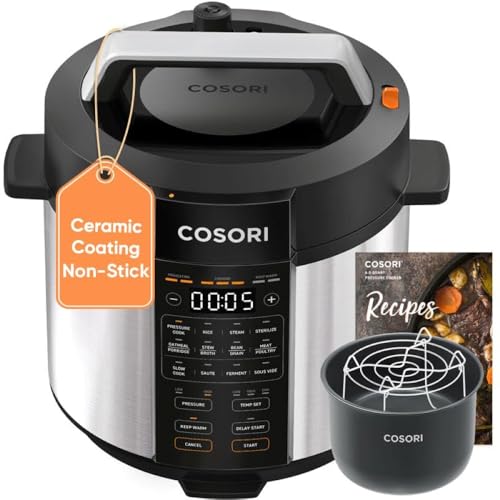
Cosori Pressure Cooker 6QT 9-in-1
Badge: Best for Rice Programs
Strengths
- Nine functions with rice cooking designed in from the start, plus slow cook, sous vide, and sauté for a genuinely broad weekly rotation.
- Ceramic-coated inner pot releases sticky rice cleanly, which makes the cleanup after short-grain and sushi rice noticeably easier.
- A dozen listed safety features give new pressure cooks a reassuring margin while they learn.
Trade-offs
- Ceramic coating, however durable, is still a coating: metal utensils and abrasive pads will shorten its life.
- The stainless exterior shows fingerprints and water spots more readily than a matte finish.
- At 1100W it is powerful, but very large frozen loads still need realistic expectations on time to pressure.
Mini spec box
- Capacity: 6 Qt
- Functions: 9-in-1 — pressure cook, rice cooker, slow cook, sous vide, sauté (per listing)
- Inner pot: ceramic coating
- Power: 1100W
- Safety: 12 safety features (per listing)
The Cosori earns its badge by treating rice as a headline job rather than an afterthought preset. Its rice cooking sits alongside a function set that stretches to sous vide, which tells you something about the design intent: this is a cooker for people who like having the right program for the food in front of them. In practice the ceramic pot is the daily pleasure. Rice that would cling to bare steel lifts away, the pot rinses clean in seconds, and the slightly gentler surface suits the sticky end of the rice spectrum, from short-grain to porridge-style cooking, particularly well.
The limitation to weigh is the coating itself. If your household is rough on cookware, or you prefer to scrub aggressively and use metal tools without thinking, a stainless pot like the Duo’s will age more gracefully. Treat the Cosori’s pot with wooden or silicone utensils and it will serve well; treat it like a steel pan and you will eventually be shopping for a replacement pot. Neither answer is wrong, but you should choose with your habits, not your intentions.
Best for: rice lovers who cook sticky and short-grain styles often and want easy cleanup plus sous vide range / Not suited for: cooks who want a coating-free pot they can treat roughly for a decade

Instant Pot Pro 6 Qt 10-in-1 Electric Pressure Cooker
Badge: Best Premium
Strengths
- Ten functions including rice and grains, sous vide, yogurt, and sterilising: the broadest program set among the electric picks here.
- The step up in controls and finish over the standard Duo suits cooks who use their multi-cooker daily and notice the details.
- Same family 6-quart capacity, so batch sizes and accessory compatibility stay familiar if you are upgrading.
Trade-offs
- It sits in a premium tier, and the extra spend buys refinement and functions rather than dramatically different rice.
- The black finish and larger control housing make it the most visually assertive machine on this list.
- More programs mean a longer manual; the learning curve is real for first-time pressure cooks.
Mini spec box
- Capacity: 6 Qt
- Functions: 10-in-1 — pressure cook, slow cook, rice and grains, steam, sauté, sous vide, yogurt, warm, sterilise (per listing)
- Finish: black
Think of the Pro as the Duo’s more serious sibling. For rice specifically, the dedicated grains programming and the generally more precise control set reward cooks who rotate through several grain types in a week: long-grain one night, brown rice the next, perhaps a mixed-grain blend on the weekend. The machine handles the switching without you keeping a notebook of timings, and the wider function set means it can also cover slow cooking and sous vide duties that would otherwise need separate appliances.
The honest caveat is value rather than performance. If your rice cooking is a twice-a-week pot of white rice beside something else, the Pro’s extra refinement will mostly go unused, and the standard Duo further up this list does that job admirably. The Pro makes sense when the cooker is a daily driver and small ergonomic and program advantages compound across hundreds of uses. Buy it as a long-term kitchen anchor, not as a gadget.
Best for: daily multi-cooker users who rotate grains and want the most complete electric option / Not suited for: occasional rice cooks, for whom the standard Duo covers the need at a lower tier

Instant Pot Duo Mini 3 Quart Electric Pressure Cooker
Badge: Best for Small Households
Strengths
- The full Duo formula — pressure, rice, steam, sauté, yogurt, warm, sterilise — shrunk honestly to a 3-quart footprint.
- Perfect rice batch sizes for one or two people, with no sad leftover layer drying out in a too-big pot.
- Smaller pot means faster time to pressure on small loads and easier storage in tight kitchens and dorms.
Trade-offs
- Batch cooking and entertaining outgrow it quickly; a whole chicken or a party-size stew is beyond its sensible range.
- Accessory choice in the 3-quart size is narrower than the huge 6-quart ecosystem.
- Per-quart value is weaker than the bigger models if you later find you needed the space.
Mini spec box
- Capacity: 3 Qt
- Functions: 7-in-1 — pressure cook, slow cook, rice, steam, sauté, yogurt, warm, sterilise (per listing)
- Construction: stainless steel
- Extras: companion app with a large recipe library (per listing)
Small cookers are often compromised cookers, with functions stripped to hit a size. The Duo Mini is the exception worth recommending: it keeps the rice function and the rest of the Duo’s repertoire, and simply scales the pot. For rice, the smaller chamber is arguably an advantage. Small batches sit at the right depth for even hydration, the cooker reaches pressure quickly, and the keep-warm hold suits a household where two people eat at slightly different times. Couples, single cooks, and anyone outfitting a small flat or a caravan kitchen will find this the most honest fit on the list.
The limitation is arithmetic, not quality. Three quarts is three quarts. If your life includes Sunday meal prep for the week or regular dinners for four, you will hit the ceiling and hit it often, and a too-small cooker is more frustrating than a too-large one. Be honest about your next two years of cooking, not just this month’s.
Best for: singles, couples, and small kitchens wanting real rice automation in a compact pot / Not suited for: families and batch cooks, who need the 6-quart models above


RVGMBO 12 Quart Stainless Steel Pressure Cooker and Canner
Badge: Best for Big Batches
Strengths
- A genuinely large 12-quart capacity that cooks rice for gatherings, big families, and serious meal prep in one batch.
- 18/8 stainless steel construction with a one-hand locking lid, built for stovetop durability rather than electronic features.
- Doubles as a pressure canner and includes a glass lid and steamer rack, so it covers jobs no electric on this list can touch.
Trade-offs
- No rice program and no timer: you manage burner heat and timing yourself, and the first batches are a learning process.
- It is big and heavy, especially full; storage and handling need thought.
- Induction and gas compatibility is broad, but a pot this size needs a burner that can keep up with it.
Mini spec box
- Capacity: 12 Qt
- Material: 18/8 stainless steel
- Type: 3-in-1 stovetop pressure cooker and canner
- Compatibility: induction and gas stovetop (per listing)
- Included: glass lid, steamer rack (per listing)
- Lid: one-hand locking (per listing)
Every list like this needs one pick for the cook whose problem is scale, and the RVGMBO is it. When the rice has to feed a family gathering, a community event, or a week of lunches for a large household, the 6-quart electrics force you into multiple batches while this pot simply gets on with it. Stovetop pressure rice follows the same principles as electric — rinsed grains, a measured ratio, a timed cook, a patient natural release — but you are the control system. Experienced stovetop cooks often prefer exactly that: the feedback is immediate, the pot responds the moment you adjust the burner, and there is no electronics package between you and dinner.
Be clear-eyed about the trade. There is no walk-away convenience here, and rice is less forgiving of distraction than a stew. You will also want to confirm your stovetop can handle the footprint and that you have somewhere to keep a 12-quart vessel. For the right kitchen, though, this is the most capable and longest-lived rice tool on the list, with canning ability as a genuine bonus rather than a gimmick. Shoppers whose main interest is canning-scale capacity often cross-shop Best Prices For Gas Cookers setups, since burner output matters at this size.
Best for: large households, event cooking, and canners who want one big stainless pot / Not suited for: beginners wanting automated rice, or small kitchens short on storage

Peterboo 3Qt Stainless Steel Pressure Cooker
Badge: Best Compact Stovetop
Strengths
- A small stainless stovetop pot sized for one or two people, with none of the bulk of family-size cookers.
- Eight listed safety features, a reassuring count for a compact stovetop design.
- Induction compatible, so it works across modern and traditional stovetops alike.
Trade-offs
- Manual stovetop operation: no rice program, no automatic release, so your timing is the program.
- The 3-quart ceiling rules out entertaining and most batch cooking.
- As a smaller brand entry, its long-term accessory and gasket ecosystem is thinner than the big names.
Mini spec box
- Capacity: 3 Qt
- Material: stainless steel
- Type: 8-in-1 stovetop and electric-compatible multi-cooker (per listing)
- Compatibility: induction (per listing)
- Safety: 8+ safety features (per listing)
- Sized for: 1–2 people (per listing)
The Peterboo is the stovetop answer to the Duo Mini: a compact pressure pot for small households that prefer metal and a burner to electronics. For a single cook or a couple, a 3-quart stovetop cooker is a sweet size for rice — a cup or two of grains cooks quickly, the pot comes to pressure fast on a small burner, and the whole thing washes and stores like an ordinary saucepan. The listed safety set is generous for the class, which matters because small stovetop pots are often bought by first-time pressure cooks.
The caveat mirrors the RVGMBO’s, scaled down: you are the timer and the thermostat. Rice in a stovetop pot rewards a small notebook habit for the first few cooks — ratio, minutes at pressure, release style — after which it becomes second nature and extremely consistent. If that sounds like a chore rather than a pleasure, the electric Mini above is your pick instead. If it sounds like cooking, this little pot will suit you for years.
Best for: one- and two-person households that prefer stovetop control in a compact stainless pot / Not suited for: anyone who wants to press a rice button and walk away
Comparison Table
| Pick | Type | Capacity | Rice approach | Pot | Link |
|---|---|---|---|---|---|
| Instant Pot Duo 6 Qt | Electric 7-in-1 | 6 Qt | Dedicated rice function | Stainless steel | Check on Amazon |
| Cosori 6QT | Electric 9-in-1 | 6 Qt | Rice cooker function | Ceramic coating | Check on Amazon |
| Instant Pot Pro 6 Qt | Electric 10-in-1 | 6 Qt | Rice and grains programs | Stainless steel | Check on Amazon |
| Instant Pot Duo Mini | Electric 7-in-1 | 3 Qt | Dedicated rice function | Stainless steel | Check on Amazon |
| RVGMBO 12 Quart | Stovetop cooker/canner | 12 Qt | Manual timed pressure | 18/8 stainless steel | Check on Amazon |
| Peterboo 3Qt | Stovetop | 3 Qt | Manual timed pressure | Stainless steel | Check on Amazon |
Read the rice approach column first. It is the honest dividing line of this guide: the four electrics automate rice, the two stovetop pots put you in charge. Everything else — capacity, pot material, extra functions — is secondary to deciding which side of that line your cooking life sits on.
How to Choose the Right Pressure Rice Cooker
Start with how you actually eat rice. If rice appears beside dinner three or four nights a week in modest portions, automation wins and a 3- or 6-quart electric is the answer. If rice is a weekend event for a crowd, capacity wins and the stovetop 12-quart earns its shelf. Buy for your real pattern, not the cook you imagine becoming, because a cooker that fits your routine gets used and one that does not becomes cupboard furniture.
Do the capacity maths in cooked rice, not quarts. Grains expand and foam, so pressure cookers should not be filled beyond roughly half for rice. A 3-quart pot therefore handles small household batches comfortably, a 6-quart covers family dinners and meal prep, and the 12-quart stovetop exists for gatherings. If you regularly cook for six or more, skip the minis no matter how appealing their footprint is.
Decide how you feel about coatings. Stainless pots like the Instant Pot models and both stovetop picks tolerate any utensil and any scrubbing, and they can develop a thin starchy film that needs a soak after sticky rice. The Cosori’s ceramic pot releases rice more easily day to day but asks for gentler tools. There is no universally right answer; there is only the answer that matches your habits.
Count the jobs the machine replaces. Every pick here also slow cooks, steams, or sautés to some degree, and the electrics add yogurt and keep-warm functions. A cooker that replaces a separate rice cooker, slow cooker, and steamer justifies a bigger footprint and a higher tier than one bought for rice alone. Readers weighing a full cooker refresh often start from Best Prices For Cookers and narrow down to the pressure category from there.
Check the unglamorous details. Lid storage, cord length, the height of the open lid under your cabinets, the availability of replacement sealing rings and gaskets, and whether the inner pot is dishwasher safe will affect your satisfaction more after six months than any preset count. These details are all on the listings linked in this guide; spend two minutes there before you spend money.
How to Cook Rice Under Pressure, Step by Step
The method below works, with timing judgement, across every pick in this guide. Electric owners use the rice program or manual pressure; stovetop owners bring the pot to pressure and hold it there with burner control.
- Rinse the rice. Swish the grains in water until the rinse water runs mostly clear. This removes surface starch, the main cause of gummy, clumped results.
- Measure the ratio. Pressure cooking loses almost no water to evaporation, so use less than stovetop habits suggest — roughly equal parts water and white rice by volume is the classic pressure starting point. Adjust a spoonful at a time across cooks until it matches your preferred texture.
- Mind the fill line. Keep rice and water below half the pot’s capacity to leave room for foaming and expansion.
- Cook at pressure. Seal the lid, set the valve, and run the rice program on an electric, or time a short cook at full pressure on a stovetop pot.
- Rest with a natural release. When the cook ends, leave the cooker alone for a short natural release. The grains finish absorbing moisture evenly during this rest, and the texture improves noticeably.
- Fluff, do not stir. Open the lid away from your face, then fluff the rice with a paddle or fork, lifting and separating rather than mashing.
Cleaning and care. Wash the inner pot promptly; dried rice starch is far harder to shift than fresh. Wipe the lid’s underside and the sealing ring after starchy cooks, and check the steam release path is clear before the next use. Stainless pots with a stubborn starchy film respond well to a soak in hot water with a little vinegar. Stovetop gaskets should be checked for cracks each season and replaced at the first sign of perishing, since the seal is the whole system.
Troubleshooting
Problem: the rice is gummy and clumped → rinse more thoroughly next time and reduce the water slightly; gummy rice is almost always excess surface starch plus excess water, not a faulty cooker.
Problem: the rice is undercooked in the centre of the batch → let the natural release run longer before opening, and make sure the batch was not over the half-fill line, which insulates the middle grains from the steam.
Problem: the cooker struggles to reach pressure or shows a burn warning → check the sealing ring is seated, the valve is set to sealing, and there is enough thin liquid in the pot; scorched starch on the pot base from a previous cook can also trigger it, so start with a clean pot.
Stovetop vs Electric: Which Rice Suits You?
This deserves its own section because the pool deliberately spans both worlds. Electric multi-cookers win on consistency for beginners and on convenience for everyone: the rice program encodes the timing, the machine manages pressure, and keep-warm holds the result. They also win on breadth, since the same appliance slow cooks and steams. Their weaknesses are lifespan and dependence: electronics, displays, and control boards give a multi-cooker more ways to age out than a pot, and a power cut mid-cook is a ruined batch.
Stovetop cookers win on longevity, capacity per dollar of shelf space, and repairability — a gasket is a cheap, user-replaceable part, and a stainless pot can serve for decades. They also win on responsiveness for experienced cooks who like to adjust heat by feel. Their weakness is attention: the cook is the program. Households that already cook confidently on the stove often end up preferring stovetop pressure rice precisely because the results, once learned, are repeatable to the minute. Households that want rice to be a background task should buy electric and never look back. Kitchens organised around a range often compare these stovetop options alongside Best Prices For Range Cookers when planning a wider upgrade.
Rice Varieties Under Pressure: What Changes
Different grains ask different things of a pressure cooker, and the picks handle the range unevenly. Long-grain white rice is the easy case every model here manages well. Brown rice benefits most from pressure, since the sealed heat softens the bran far faster than simmering, and the electric programs handle its longer timing automatically; on a stovetop pot, simply extend the time at pressure and keep the natural release. Short-grain and sushi styles reward the Cosori’s ceramic pot at serving time, because sticky grains release cleanly. Wild rice blends and mixed grains sit between: pressure tames their toughness, but check the blend’s longest-cooking component and time for that. Congee and rice porridge deserve a caution everywhere — they foam enthusiastically, so keep batches small, respect the half-fill rule strictly, and always use a natural release so the starchy liquid settles instead of spraying from the valve.
Meal Prep and Batch Rice: Getting the Most From a Big Pot
Pressure cookers have quietly become meal-prep staples, and rice is the reason. A single 6-quart batch produces enough cooked rice to anchor several days of lunches, and the sealed cooking environment keeps the texture more consistent across a large batch than a saucepan does. A few habits separate good batch rice from a gummy brick by Wednesday. Cook the rice plainly, without oils or strong seasonings, so it can pair with anything during the week. Spread the cooked rice on a tray to cool quickly before refrigerating, which keeps the grains separate and is also the food-safe way to handle cooked rice: it should be cooled promptly and refrigerated rather than left sitting warm on the counter. Portion it while you pack it, because reheating a single portion with a sprinkle of water restores a near-fresh texture, while reheating the whole container repeatedly dries the top layer and steams the bottom into mush.
Freezing works better than most people expect. Portioned cooked rice freezes well and reheats from frozen with a splash of water, which makes a big Sunday batch in the RVGMBO or a 6-quart electric a genuine time asset rather than a fridge gamble. Brown rice and mixed grains freeze especially gracefully, since their firmer structure survives the freeze-thaw cycle. If your household eats rice most days, this batch logic should feed back into your size choice: a cooker one size larger than your dinner needs is often the right buy, because the surplus becomes lunches instead of leftovers nobody wants.
Accessories and Running Costs Worth Knowing About
The purchase price of the cooker is only the start of the ownership picture, and the accessories divide neatly into genuinely useful and purely decorative. A spare sealing ring is the single best accessory for any electric pick here, for the flavour carry-over reason covered earlier, and a second inner pot earns its place if you cook rice and a main in sequence, since you can lift one pot out and drop the other in without washing between courses. A steamer basket or trivet is useful if you want to cook rice and steam vegetables or fish in the same cycle, a classic pressure-cooker party trick that turns the machine into a one-pot dinner. Glass lids, where offered or included as with the RVGMBO, make the pot double as a regular stockpot for slow stovetop work.
Running costs are modest but real. Stovetop gaskets and electric sealing rings are consumables with a lifespan measured in years of regular use, and both are cheap when bought before you urgently need one. Ceramic-coated pots, like the Cosori’s, may eventually need replacement if the coating wears, while stainless pots effectively last the life of the machine. None of this should scare anyone off a pick; it should simply be priced into the decision qualitatively. A cooker whose consumables are easy to find — and the big-brand electrics win here — will almost always be the cheaper machine to own over five years, whatever the shelf tickets say on the day you buy. That long view is also why this guide weights established models with deep accessory ecosystems so heavily in its top positions.
Common Buying Mistakes
- Buying a rice cooker and calling it a pressure cooker. The categories overlap in shop listings but not in function. Every pick here genuinely cooks under pressure; if a listing never mentions pressure, it is not one, whatever the page title implies.
- Choosing capacity by the number on the box. Rice fill limits mean usable batch size is well under nominal quarts. Size up if you entertain.
- Expecting stovetop pots to behave like electrics. A manual cooker has no rice button. Buying one for automation guarantees disappointment.
- Ignoring the sealing ring. Rings are consumables. Check that spares exist for your model before you buy, especially for smaller brands.
- Using stovetop ratios in a pressure pot. Extra water that would evaporate from a saucepan stays in a sealed cooker and makes porridge. Measure for pressure from the first cook.
- Skipping the listing check. Bundles change. Confirm what is in the box — racks, lids, spare rings — on the current listing rather than assuming.
Final Recommendation
For most households, the Instant Pot Duo 6 Qt is the right first answer: automated rice, a stainless pot, family capacity, and a full multi-cooker repertoire in one machine. If sticky and short-grain rice dominate your cooking and easy cleanup matters most, choose the Cosori 6QT and treat its ceramic pot kindly. If you cook for a crowd or want a pot that will outlast trends, the RVGMBO 12 Quart stovetop cooker is the specialist pick, provided you are happy being the timer. Small households should not buy big: the Duo Mini does the same automated job in the right size. Whichever you choose, rinse the rice, respect the ratio, and let the natural release finish the work.
Frequently Asked Questions
Is rice actually better cooked under pressure?
It is faster and very consistent, because the sealed steam hydrates grains evenly at a temperature above normal boiling. Whether it is better depends on the style you like: pressure rice tends toward tender and slightly plump, while devotees of very distinct, dry grains sometimes prefer other methods. For brown rice, pressure is a clear win on both time and texture.
Can a pressure cooker replace my rice cooker entirely?
For most households, yes. The electric picks here include rice programs that handle daily rice without supervision, and the same machine covers other jobs. The exception is households that cook rice at the same time as a main dish in the same appliance slot — one pot cannot be in two places, so heavy parallel cooks may still want both.
Why did my pressure-cooked rice turn out wet?
Almost always the ratio. Sealed cooking loses almost no moisture, so stovetop habits put too much water in. Reduce the water a little, rinse the grains, and let the natural release finish before fluffing. Wet rice is a measurement problem, not a machine problem.
Are stovetop pressure cookers safe for rice?
Modern stovetop cookers carry layered safety systems — the Peterboo lists eight-plus safety features and the RVGMBO uses a one-hand locking lid — and rice is a routine load for them. The safety basics are the cook’s: respect fill limits, keep the valve and gasket clean, and never force a lid open while pressure remains.
Which size should a family of four buy?
A 6-quart electric is the comfortable answer, covering daily rice with room for mains and batch cooking. The 3-quart models will feel tight within months, and the 12-quart stovetop is for families who regularly cook for more than the household or who also want canning capacity.
Do I need a separate ring for rice?
It helps. Sealing rings absorb flavours from strongly spiced dishes, and a faint carry-over can show up in plain rice. Many owners keep one ring for savoury and one for mild foods like rice and yogurt. Rings are inexpensive consumables; check availability for your model on the listing before buying.


