Disclosure: topratedkitchenware.com is reader-supported. When you buy through links on our site, we may earn an affiliate commission from Amazon and other retailers, at no extra cost to you.
Where to buy
The six models below are the verified picks for anyone comparing the best prices for pressure cookers today. Each name links to its Amazon listing, where you can check the latest price on Amazon as it stands right now, confirm the current configuration, and read the newest owner feedback before you decide.
- Instant Pot Duo 6 Qt 7-in-1 Electric Pressure Cooker
- Cosori Pressure Cooker 6QT 9-in-1
- Instant Pot Duo Mini 3 Quart Electric Pressure Cooker
- Instant Pot Pro 6 Qt 10-in-1 Electric Pressure Cooker
- Sweetcrispy 16-in-1 Electric Pressure Cooker 8QT
- Instant Pot Duo Plus 6 Qt 9-in-1 Electric Pressure Cooker
Read the full guide ↓ for how to judge whether today’s price on each model is genuinely good, what separates a fair deal from a dressed-up one, and which pick fits which budget style.
Hunting the best prices for pressure cookers today runs into an immediate problem: pressure cooker prices are not stable things. The same model can wear several different price tags across a single month as promotions start and end, bundles change, and sellers rotate. Any guide that printed a fixed figure would be lying to you by next week, which is why this guide takes a different approach. It gives you six verified picks worth buying at the right price, explains exactly what drives the price of each one up or down, and teaches you how to read today’s listing like someone who understands the category. Armed with that, the live price you check on Amazon becomes a number you can judge, instead of a number you have to take on faith.
The six picks below were chosen to span the realistic price landscape rather than to crown one winner. There is a benchmark mid-range model that anchors the whole category, a feature-rich alternative at a similar tier, a compact budget-friendly option for small households, a premium step-up for daily users, a big 8-quart value play for families, and a well-rounded upgrade model between the benchmark and the premium tier. Between them, they cover nearly every sensible way to spend money on a pressure cooker right now. What they do not include is any model whose appeal depends on a discount being real; each one is defensible at its normal tier, which is the only honest foundation for price advice.
You will also find the mechanics of pressure cooker pricing explained in plain terms: why capacity costs money, why function counts inflate tickets, why the same brand sells near-identical models at different tiers, and which extras are worth paying for versus which are box copy. There is a comparison table, a how-to section on using and caring for whichever cooker you buy, troubleshooting, and the specific mistakes that make people overpay. If your search started wider, our overview of Best Prices On Pressure Cookers tracks the same market from a broader angle.
Key Takeaways
- Judge today’s price against the model’s normal tier, not against a claimed discount. A fair everyday price on the right model beats a dramatic markdown on the wrong one.
- Capacity and function count are the two big price drivers. Pay for the size your household needs and the programs you will actually use, nothing more.
- The 6-quart electric multi-cooker is the category’s value centre of gravity; smaller and larger models should justify their price difference clearly.
- Check the listing’s current bundle before comparing prices between sellers — included accessories change the real value of the same headline price.
- Never pay a premium tier for a first pressure cooker. The mid-range benchmark models teach you what you actually use, and they hold their value as second cookers later.
- Check the latest price on Amazon at the moment you are ready to buy, because that live figure, judged against the tiers explained here, is the only price that matters.
In this guide
Quick Picks
| Pick | Badge | Style | Capacity | Link |
|---|---|---|---|---|
| Instant Pot Duo 6 Qt | Best Overall Value | Electric, 7-in-1 | 6 Qt | Instant Pot Duo 6 Qt |
| Cosori Pressure Cooker 6QT | Best Feature Value | Electric, 9-in-1 | 6 Qt | Cosori Pressure Cooker 6QT |
| Instant Pot Duo Mini | Best Budget Pick | Electric, 7-in-1 | 3 Qt | Instant Pot Duo Mini |
| Sweetcrispy 16-in-1 8QT | Best Big-Capacity Value | Electric, 16-in-1 | 8 Qt | Sweetcrispy 16-in-1 8QT |
| Instant Pot Duo Plus 6 Qt | Best Mid-Range Upgrade | Electric, 9-in-1 | 6 Qt | Instant Pot Duo Plus 6 Qt |
| Instant Pot Pro 6 Qt | Best Premium | Electric, 10-in-1 | 6 Qt | Instant Pot Pro 6 Qt |
The badges reflect value roles, not raw cheapness. Best Budget Pick goes to the model that lowers the cost of entry without cutting the functions that matter. Best Premium goes to the model whose higher tier is honestly earned by people who will use it daily. Everything between is arranged so you can find the tier that matches your cooking before you ever look at a number.
How These Picks Were Chosen
This is a research-led guide built on a verified product pool checked against Amazon’s catalogue data. Every pick is a genuine electric pressure cooker — a point worth stating because price searches attract mislabelled listings, and a cheap slow cooker wearing a pressure cooker title is not a bargain at any price. Beyond that verification, the selection deliberately sampled the price structure of the category: one model from each meaningful tier, so the guide can explain the ladder by standing on its rungs. A list of six near-identical mid-range cookers would tell you nothing about what your money buys at the bottom or the top.
Within each tier, picks were weighed on the things that determine whether a price is fair. Pot material and construction, because a stainless pot and a ceramic-coated pot age differently and replacement costs differ. The realism of the function set, because honest programs you will use beat a long list of presets you will not. Safety systems, since layered protection is standard at the good tiers and its absence is a warning sign at any tier. Brand support and accessory availability, because a cooker is a multi-year appliance and a cheap model with no spare sealing rings available is expensive in disguise. Finally, the pattern of owner feedback over time: models that keep satisfying owners after the honeymoon period are the ones whose prices hold up as fair in hindsight.
What this guide will not do is print prices, invent discounts, or claim a model is on sale. Prices move; tiers endure. The structure below teaches you the tiers and the tells, and every pick links to its live listing so the figure you act on is today’s real one. Readers who want the widest possible scan before narrowing down can also browse Best Prices For Slow Cookers for the neighbouring category, since many households weigh a pressure cooker against a slow cooker for the same weeknight jobs.
The 6 Best Pressure Cookers to Price-Check Today
Read each review with one question in mind: what am I paying for here, and will I use it? Every review answers that question for its model, including the honest case for stepping down a tier instead.

Instant Pot Duo 6 Qt 7-in-1 Electric Pressure Cooker
Badge: Best Overall Value
Strengths
- The category benchmark: pressure cook, slow cook, rice, steam, sauté, yogurt, warm, and sterilise in one stainless-pot machine.
- The deepest accessory and spare-parts ecosystem in the category, which keeps long-term ownership costs low.
- Its popularity means pricing is competitive and transparent; this is the model every other price should be compared against.
Trade-offs
- So common that bundles vary between sellers; check exactly what is in the box before comparing two listings’ prices.
- The control panel is practical rather than premium, and heavy users may eventually want the step-up models.
- The sealing ring absorbs strong flavours, so budget a spare ring into ownership if you cook both curries and yogurt.
Mini spec box
- Capacity: 6 Qt
- Functions: 7-in-1 — pressure cook, slow cook, rice, steam, sauté, yogurt, warm, sterilise (per listing)
- Construction: stainless steel
- Extras: companion app with a large recipe library (per listing)
Every price conversation in this category starts here, whether it admits it or not. The Duo is the reference point: a 6-quart, 7-in-1 electric pressure cooker with a stainless steel pot, from the brand that defined the modern multi-cooker. When you check its price today, you are learning the going rate for a fully capable family pressure cooker, and every other model in this guide can be judged as a variation on that theme — smaller and cheaper, bigger and cheaper per quart, or similar money with a different feature mix. If today’s Duo price sits in its usual mid-range band, it is simply a fair deal, no promotion required.
The value case is strengthened by ownership economics. Because the Duo is everywhere, spare rings, extra pots, lids, and accessories are easy to find and competitively priced, and advice for any problem you meet is a search away. The honest limitation is that the Duo’s very ubiquity means listings proliferate, and not every listing bundles the same extras. Two prices for “the same” cooker may differ because one includes accessories the other omits. Read the box contents, not just the headline, before deciding which of today’s prices is really lower.
Best for: most households, as the benchmark purchase against which all other prices are judged / Not suited for: buyers who know they need 8-quart capacity or premium controls, who should step sideways or up

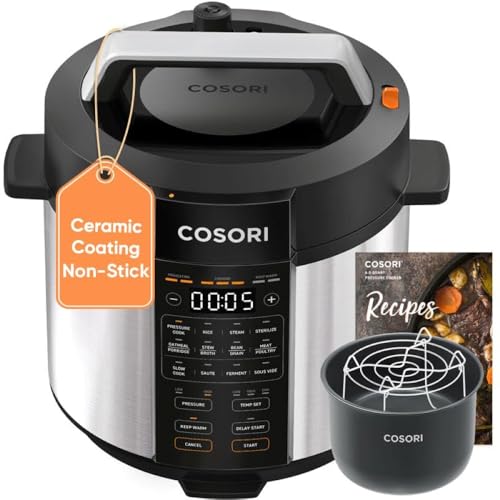
Cosori Pressure Cooker 6QT 9-in-1
Badge: Best Feature Value
Strengths
- Nine functions including sous vide, a program many rivals reserve for their premium tiers.
- Ceramic-coated pot makes sticky foods and cleanup easier, adding daily-use value beyond the spec sheet.
- A dozen listed safety features at a competitive tier is a strong specification for the money.
Trade-offs
- The ceramic coating will eventually wear in a way stainless does not; a replacement pot is a future cost to accept knowingly.
- Its accessory ecosystem is smaller than Instant Pot’s, so spares take slightly more hunting.
- The stainless exterior needs a wipe to stay looking its best.
Mini spec box
- Capacity: 6 Qt
- Functions: 9-in-1 — pressure cook, rice cooker, slow cook, sous vide, sauté (per listing)
- Inner pot: ceramic coating
- Power: 1100W
- Safety: 12 safety features (per listing)
The Cosori is the pick for shoppers who compare feature lists carefully, because on paper it gives you more machine for a similar tier of money than the benchmark does. Sous vide is the headline example: precise, low-temperature cooking that the Duo simply does not offer, bundled into a 6-quart pressure cooker that also handles rice, slow cooking, and sautéing. Add the ceramic pot’s easy release and cleanup, and the Cosori makes a persuasive case that its price buys more weekly usefulness, not just more bullet points.
The value judgement has one honest asterisk. A coated pot is a consumable on a long enough timeline, while the Duo’s stainless pot is effectively permanent. If you keep a cooker for many years and treat cookware roughly, the Cosori’s eventual replacement-pot cost narrows its feature-value lead. If you treat pots gently and value easy cleanup every single day, the trade runs the other way. Either way, when you check today’s price, compare it against the Duo’s: the gap between them, whatever it is today, is the real price of the Cosori’s extra features, and you can decide if that gap is worth it to you.
Best for: feature-focused buyers who will use sous vide and value easy cleanup / Not suited for: buy-it-for-a-decade minimalists who prefer an all-stainless, coating-free pot

Instant Pot Duo Mini 3 Quart Electric Pressure Cooker
Badge: Best Budget Pick
Strengths
- The lowest sensible cost of entry into real pressure cooking: the full 7-in-1 function set, not a stripped-down teaser model.
- Perfectly sized batches for one or two people, which also saves money on wasted food over time.
- Small footprint and quick time to pressure make it the cheapest pick to run and store as well as to buy.
Trade-offs
- Per-quart, small cookers are not the cheapest way to buy capacity; you are paying for compactness.
- Families will outgrow it, and a second purchase later erases the initial saving.
- Fewer accessories exist in the 3-quart size than in the 6-quart mainstream.
Mini spec box
- Capacity: 3 Qt
- Functions: 7-in-1 — pressure cook, slow cook, rice, steam, sauté, yogurt, warm, sterilise (per listing)
- Construction: stainless steel
- Extras: companion app with a large recipe library (per listing)
Budget picks in appliance categories are usually traps — hollowed-out models that disappoint until you buy the real thing. The Duo Mini is the rare exception, and that is why it anchors the budget end of this guide. It is the genuine Duo formula at half the capacity, which means the money you save by choosing it is money saved on size you may truly not need. For a single cook, a couple, a student kitchen, or a second cooker for side dishes, its everyday price is the smartest spend in the category.
The honest caution is about fit, not quality. If there is a realistic chance your household grows, entertains, or batch-cooks, the Mini’s saving is borrowed money: you will spend it again, with interest, on the 6-quart you should have bought. Judge today’s Mini price against your next two years of cooking, not this month’s. Chosen for the right kitchen, it is not the cheap option; it is the correct one.
Best for: singles, couples, small kitchens, and second-cooker buyers who want real functions at the entry tier / Not suited for: families or batch cooks, for whom the 6-quart models are better value over time


Sweetcrispy 16-in-1 Electric Pressure Cooker 8QT
Badge: Best Big-Capacity Value
Strengths
- A full 8-quart capacity aimed at big families and batch cooking, in a class where capacity usually costs a clear premium.
- A long preset list — 16-in-1 with 12 presets — plus a ceramic pot and a recipe book included, so the bundle is generous out of the box.
- Covers rice, steaming, sautéing, soup, slow cooking, and yogurt, so the big pot earns its counter space across the week.
Trade-offs
- A newer, smaller brand: the accessory and spare-parts ecosystem is thinner than the big names, so check ring and pot availability.
- Preset counts flatter every cooker in this class; judge it on capacity and pot, not on the number 16.
- An 8-quart machine is a large, heavy countertop presence, and overkill for small households at any price.
Mini spec box
- Capacity: 8 Qt
- Functions: 16-in-1 with 12 presets — slow cook, rice, steamer, sauté, soup, yogurt maker and more (per listing)
- Inner pot: ceramic pot
- Included: recipe book (per listing)
Capacity is where pressure cooker prices climb fastest, which makes the Sweetcrispy the most interesting price story in this guide. Eight quarts is the size large families, holiday cooks, and serious meal preppers actually need, and the established brands price that size as a step up. This model attacks exactly that gap: big pot, broad presets, ceramic interior, and a recipe book in the box, positioned as the value route into family-size pressure cooking. When you check its price today, compare it specifically against other 8-quart options rather than against 6-quart benchmarks — judged size for size, its value case is strongest.
The trade-off is the familiar challenger-brand one. You are exchanging the deep accessory ecosystem and long track record of the biggest names for capacity per unit of money. That can be the right trade, especially if you are diligent about confirming spare sealing rings are orderable before you need one. What it should never be is an impulse trade made because a preset count looked impressive. Sixteen functions is marketing arithmetic; eight honest quarts is the real product.
Best for: large families and meal preppers who need 8 quarts and shop value-first / Not suited for: small households, or buyers who prioritise a deep spare-parts ecosystem above capacity

Instant Pot Duo Plus 6 Qt 9-in-1 Electric Pressure Cooker
Badge: Best Mid-Range Upgrade
Strengths
- Nine functions in the proven 6-quart stainless format, a step up in breadth from the standard Duo without jumping to the premium tier.
- Shares the big-brand ecosystem, so accessories and spares stay easy and competitively priced.
- A sensible middle rung: buyers who outgrow the base model usually land exactly here.
Trade-offs
- The differences from the standard Duo are incremental rather than transformational; price the gap carefully before paying it.
- Still a coated-accessory-free stainless pot experience, with the same ring-flavour quirk as its sibling.
- If its price today drifts close to the Pro’s, the Pro becomes the smarter spend.
Mini spec box
- Capacity: 6 Qt
- Functions: 9-in-1 — pressure cook, slow cook, rice, yogurt, steam, sauté, warm, sterilise (per listing)
- Construction: stainless steel
- Extras: companion app with a large recipe library (per listing)
The Duo Plus exists for the buyer who has done the maths and wants a little more than the benchmark without paying the premium tier’s admission. Nine functions instead of seven, the same trusted 6-quart stainless platform, and the same ownership advantages. Its review in a price guide is really a lesson in ladder logic: the Plus is a good buy precisely when the gap between its price and the standard Duo’s price is modest, and a questionable one when the gap widens or when its price crowds the Pro below. Prices move independently, so the right choice between these three siblings genuinely changes from week to week — which is the whole point of checking today rather than trusting a printed figure.
Who should take the step? Cooks who use their multi-cooker several times a week and can name the extra programs they will actually run. If you cannot name them, the standard Duo is your model and the saving is real money kept. If you can, the Plus at a fair gap is money well spent on a machine you will use daily.
Best for: regular users who want more programs than the base Duo while staying in the sensible middle tier / Not suited for: occasional cooks, or anyone on a day when its price sits too close to the Pro’s

Instant Pot Pro 6 Qt 10-in-1 Electric Pressure Cooker
Badge: Best Premium
Strengths
- Ten functions including sous vide and grains programming: the most complete electric package in this guide.
- Premium-tier controls and finish that daily users feel every time they cook, not just on unboxing day.
- Retains the 6-quart family size and the brand ecosystem, so the premium buys refinement rather than risk.
Trade-offs
- The highest tier in this guide; the premium buys refinement and breadth, not bigger batches.
- Occasional cooks will never use enough of the extra capability to justify the step up.
- More programs mean more interface to learn before the machine feels effortless.
Mini spec box
- Capacity: 6 Qt
- Functions: 10-in-1 — pressure cook, slow cook, rice and grains, steam, sauté, sous vide, yogurt, warm, sterilise (per listing)
- Finish: black
The Pro is the honest top of this ladder: the model whose premium is real, itemised, and worth paying for a specific kind of buyer. Ten functions, the broadest program set here, and the fit and finish of a flagship. In price terms, its role in this guide is to define the ceiling — the most you should expect to pay for a 6-quart electric pressure cooker — and to make the models below it legible. If today’s Pro price tempts you, the qualifying question is usage frequency. A cooker used daily repays refinement quickly; a cooker used monthly never does.
There is also a strategic point worth making in a price guide: premium models are where promotional movement is often largest in absolute terms, because there is more margin to move. That does not change the advice — never trust a claimed discount, always judge the live figure against the tier structure — but it does mean the Pro is the pick most worth re-checking on the day you buy, since its price relative to the Duo Plus can compress enough to flip the sensible choice.
Best for: daily multi-cooker users who want the flagship feature set and will use it for years / Not suited for: occasional cooks, for whom the Duo or Duo Plus delivers the same dinners at a lower tier
Comparison Table
| Pick | Value role | Capacity | Functions | Pot | Link |
|---|---|---|---|---|---|
| Instant Pot Duo 6 Qt | Benchmark value | 6 Qt | 7-in-1 | Stainless steel | Check on Amazon |
| Cosori 6QT | Feature value | 6 Qt | 9-in-1 | Ceramic coating | Check on Amazon |
| Instant Pot Duo Mini | Budget entry | 3 Qt | 7-in-1 | Stainless steel | Check on Amazon |
| Sweetcrispy 8QT | Big-capacity value | 8 Qt | 16-in-1 | Ceramic pot | Check on Amazon |
| Instant Pot Duo Plus | Mid-range upgrade | 6 Qt | 9-in-1 | Stainless steel | Check on Amazon |
| Instant Pot Pro | Premium | 6 Qt | 10-in-1 | Stainless steel | Check on Amazon |
Use the table as a ladder, not a league table. Find the row whose value role matches your household, then check that model’s live price. Comparing rows against each other on price alone, without the role, is how people end up with a premium cooker they use twice a month or a mini they outgrow by spring.
How to Choose: Reading Pressure Cooker Prices Like an Insider
Learn the tier structure first. Pressure cookers cluster into recognisable tiers: compact entry models, the 6-quart mainstream where the Duo sits, feature-rich mainstream rivals like the Cosori and Duo Plus, big-capacity value models like the Sweetcrispy, and premium flagships like the Pro. A price is only good or bad relative to its tier. The same figure that would be a bargain for the Pro would be overpaying for the Mini, and no percentage-off claim changes that arithmetic.
Price the attributes, not the adjectives. Capacity is the most expensive attribute, then pot material and construction, then genuinely distinct functions like sous vide. Preset counts are the cheapest attribute to inflate, because a preset is mostly a stored time and temperature. When two models differ in price, list what physically differs — quarts, pot, programs you will run — and ignore everything else. If the physical differences do not explain the price gap, the cheaper model is the better buy that day.
Compare bundles, not headlines. Sellers package the same cooker with different extras: an included recipe book here, an extra ring or rack there, nothing somewhere else. Two listings for the same model at different prices may both be fair once the box contents are counted. The listings linked in this guide show the current bundle; read that section before concluding anything from the headline figure. Shoppers comparing across the whole cooker aisle, including range-style machines, will find Best Prices For Rangemaster Cookers a useful reminder of how different cooker categories price entirely differently.
Factor ownership costs into value. Sealing rings, replacement pots, and lids are the running costs of pressure cooking. Big-brand models keep those costs low and predictable because the parts market is competitive. A challenger brand can still win on value — the Sweetcrispy’s capacity case is real — but confirm the spares exist and are orderable before you count the saving as real.
Time your purchase with clear eyes. Prices in this category move with retail seasons and promotional events, and they also drift quietly week to week. If you need a cooker now, buy the right tier now; the difference between a fair price today and a slightly better price in a future promotion is usually smaller than a month of weeknight dinners is worth. If you do not need one yet, shortlist your model, learn its normal tier, and let that knowledge — not a countdown timer — tell you when a price is genuinely good.
How to Use and Care for Your Pressure Cooker
Whichever pick your price research lands on, the ownership basics are the same, and they protect both your dinners and your investment.
- Start with water. Run a plain water pressure cycle first to learn the sounds, the valve behaviour, and the release timing of your specific model without risking food.
- Respect the liquid minimum and the fill lines. Pressure needs thin liquid to build steam, and grains and foaming foods need headroom. The manual’s lines are engineering, not suggestions.
- Brown before you seal. Use the sauté function to build flavour first; pressure cooking does not brown anything, and this one habit lifts every stew and braise.
- Choose the release deliberately. Quick release for vegetables and delicate foods; natural release for meats, grains, and foaming loads, where a sudden release toughens fibres or sprays starch.
- Clean the sealing path every time. Rinse the lid, check the valve moves freely, and wash the ring. Most pressure failures are hygiene failures in disguise.
Troubleshooting
Problem: the cooker never reaches pressure → check the valve is set to sealing, the ring is seated evenly, and there is enough thin liquid; a warped or perished ring is the usual culprit on an older machine.
Problem: a burn warning appears → something starchy or sugary has stuck to the pot base; deglaze thoroughly after sautéing, layer thick sauces on top of other ingredients rather than stirring them to the bottom, and start from a clean pot.
Problem: steam leaks from the lid edge → stop the cook, let the pressure fall, and inspect the ring for food debris, cracks, or a stretched fit; replace the ring if cleaning does not restore the seal.
Why Pressure Cooker Prices Move So Much
It helps to understand why this category’s prices refuse to sit still, because the volatility is structural rather than suspicious. Multi-cookers are promotional workhorses for retailers: they are giftable, demonstrable, and easy to discount in headline terms, so they feature heavily in seasonal events. Models also proliferate — the same brand sells several near-identical 6-quart machines at staggered tiers, as the Duo, Duo Plus, and Pro in this guide show — and each tier’s price is managed relative to its siblings, so one model’s promotion reshuffles the apparent value of the others. Add bundle rotation, where accessories quietly enter and leave the box, and the result is a market where last month’s comparison is genuinely stale. This is not a reason for cynicism; it is a reason to anchor on tiers and attributes, which barely move, and to treat every specific figure as a same-day fact. It is also why guides in this series, including Best Prices On Insta Pot Pressure Cookers, refuse to print prices at all: the honest unit of advice is the structure, not the number.
What Your Money Actually Buys at Each Tier
It is worth spelling out, tier by tier, what stepping up genuinely purchases, because vague ideas of “better” are where overpayment breeds. At the entry tier, represented here by the Duo Mini, your money buys the core technology honestly: real pressure cooking, the standard function set, a stainless pot, and the safety systems that make modern pressure cooking a relaxed activity. Nothing essential is missing. What you give up is capacity and the wider accessory market, not cooking quality. For a small household, the entry tier is not a compromise at all.
In the mainstream tier — the Duo, and its close rivals the Cosori and Duo Plus — your money buys family capacity and choice. Six quarts covers the centre of household cooking, and the tier is where competition is fiercest, which is precisely why it is the value sweet spot: several strong brands fight over the same buyer, and the buyer keeps the change. Differences within the tier are about pot material, a sous vide program here, an extra preset family there. None of them will change your dinners fundamentally, so within this tier you should feel free to let the day’s prices arbitrate between genuinely good options.
At the big-capacity tier, your money buys quarts, and the Sweetcrispy shows how a challenger can undercut the established names on exactly that axis. Judge this tier purely on cost per usable quart, pot quality, and parts availability. At the premium tier, finally, your money buys refinement: the Pro’s broader programs, finer controls, and finish. That is a legitimate purchase for a daily cook, in the same way better knives are legitimate for someone who cooks daily. It is a poor purchase as a status object for a monthly cook, because refinement you rarely touch has no way to repay you. The ladder is honest at every rung; the only dishonest rung is the one you climb without knowing why.
Second-Hand, Refurbished, and Open-Box: A Cautious Word
Price hunters inevitably ask about used machines, and pressure cookers deserve a more careful answer than most appliances. A pressure cooker is a sealed vessel that works with steam under force, so its safety depends on components a second-hand buyer cannot easily assess: the sealing ring’s elasticity, the valve’s freedom of movement, the lid’s locking surfaces, and the pot’s freedom from dents that could compromise the seal. None of this makes a used cooker automatically dangerous — these machines carry layered safety systems, and a well-kept example with a fresh ring can serve perfectly well. It does mean the saving has to pay for diligence: budget for a new sealing ring immediately, run water-only test cycles, inspect the valve and float, and walk away from any unit with a dented rim, a stiff valve, or a lid that does not lock with a clean, positive action.
Manufacturer-refurbished units from reputable channels sit in a safer middle ground, since the safety-relevant parts are inspected or replaced and some warranty usually applies. Open-box returns of current models, checked on arrival with the same water test, are another reasonable route. What this guide recommends against is the anonymous, untestable bargain: a cooker whose history you cannot know, sold without recourse, at a saving too small to justify uncertainty about a pressure vessel. The picks in this guide were chosen partly because their new prices, at their proper tiers, leave little room for that gamble to make sense. When the mainstream tier is this competitive, the smart money usually buys new, buys the right size, and keeps the receipt.
Common Buying Mistakes
- Trusting a percentage-off claim. A discount is only as real as the reference price behind it. Judge the live figure against the tier structure instead.
- Paying for preset counts. Sixteen presets are not twice as good as eight. Pay for capacity, pot quality, and the few distinct functions you will actually run.
- Comparing prices across sizes. A 3-quart and an 8-quart at similar prices are not rivals; they are different tools. Compare within your size class first.
- Ignoring the bundle. The same model can ship with meaningfully different extras. The cheaper headline may be the emptier box.
- Buying premium first. A flagship teaches you nothing a benchmark cannot, and most first-time owners discover their real habits only after months of cooking. Start at the tier that fits, upgrade with knowledge.
- Forgetting the spares check. A bargain cooker with no available replacement ring becomes landfill on a schedule. Verify parts availability before the saving seduces you.
Buying for Someone Else: Gift Logic Is Different
A large share of pressure cooker purchases are gifts, and gift purchases break the normal price logic in ways worth naming. When you buy for yourself, you can weigh a challenger brand’s thinner accessory ecosystem against your own willingness to hunt for spares. When you buy for someone else, you are choosing their ownership experience too, and the safest gift is the model whose support, accessories, and sheer volume of online advice will rescue the recipient from any confusion at midnight in their own kitchen. That is a strong argument for the benchmark brands in this guide when the recipient is a first-time pressure cook: the Duo family’s ecosystem is a gift that keeps helping long after the wrapping is gone.
Size is the other gift trap. A cooker that is too big intimidates and gathers dust; one that is too small frustrates. For a couple, the 6-quart mainstream is the generous-but-sensible default, and the Mini is the thoughtful pick for a single person in a small flat. Avoid the 8-quart as a gift unless you know the household cooks for a crowd, and avoid the premium tier unless you know the recipient cooks daily — an over-specified gift quietly becomes a cupboard monument. Finally, keep the receipt and favour sellers with painless returns: a gift appliance that can be exchanged for the right size is worth slightly more than the same appliance bought a fraction cheaper with no way back. Price, for gifts, is only one component of value, and rarely the decisive one.
Final Recommendation
Start your price check with the Instant Pot Duo 6 Qt: its live price today defines the fair centre of the market, and for most households it is also the right purchase. If its price and the Cosori 6QT are close today and you will use sous vide and easy-clean ceramic, the Cosori is the sharper buy. If you need real capacity, judge the Sweetcrispy 8QT against other 8-quart options only. Small households should take the Duo Mini’s honest saving, and daily power users can justify the Pro when its premium narrows. In every case, let the tier logic in this guide — not a printed number or a countdown — make the final call.
Frequently Asked Questions
Why does this guide not list the actual prices?
Because any printed figure would be stale within days and could mislead you into overpaying or into skipping a fair deal. Instead, the guide gives you the tier structure and links to each live listing, so the price you judge is the real one on the day you buy.
When are pressure cookers cheapest?
Prices soften around major retail promotional periods and when new model generations arrive, but movement is unpredictable at the level of a specific model. The reliable strategy is to learn your target model’s normal tier and buy when the live price sits at or below it, rather than waiting for a rumoured event.
Is a more expensive pressure cooker actually better?
Sometimes, in specific ways: more distinct functions, better controls, finer finish. It is not better at the core job — a mid-range cooker pressures beans and stews essentially as well as a flagship. Pay the premium for breadth and refinement you will use, not for better pressure.
Should I buy the biggest size I can afford?
No. Buy the size your household fills sensibly. Oversized cookers take longer to pressurise small loads, eat counter space, and cost more to buy and to fit with accessories. Size to your real batches, with one step of headroom for guests and meal prep.
Are challenger brands a false economy?
Not inherently. The Sweetcrispy in this guide makes a genuine capacity-value case. The discipline is to verify spare parts availability and to value the machine on its physical attributes rather than its preset count. Do that, and a challenger brand can be the smartest spend in the category.
Does the cheapest model in a brand’s range cook worse?
Usually not in any way you can taste. Entry models pressure cook with the same core mechanism as their expensive siblings; what changes is capacity, program breadth, controls, and finish. A dried bean does not know which tier cooked it. Spend extra only when the extra buys something specific you have named — more quarts, sous vide, a pot material you prefer — and let the entry and mainstream tiers do their excellent work otherwise.
What is the single best price-check habit?
Compare the live price of your shortlisted model against the benchmark model’s live price on the same day. Same-day, same-market comparison removes all the noise of stale references and seasonal claims, and it is exactly what the links throughout this guide are set up for.


