Disclosure: topratedkitchenware.com is reader-supported. When you buy through links on our site, we may earn an affiliate commission from Amazon and other retailers, at no extra cost to you.
Where to buy
The six models below are the picks this guide recommends for anyone comparing the best prices for slow cookers. Three of them carry Amazon links, where you can check the latest price on Amazon, confirm the current configuration, and read current owner feedback before you decide. Three further picks are covered in prose only, with no listing link, because they sit outside this guide’s verified link pool for this keyword; they are included because they are genuine slow cookers that belong in an honest comparison. A note on method, stated plainly at the start: several appliances in the wider cooker pool for this category are rice cookers with no slow-cook function at all, and this guide does not recommend them as slow cookers, does not link them, and does not pretend otherwise.
- Crock-Pot Programmable Slow Cooker, 7-Quart, with MyTime Technology and Locking Lid
- Crock-Pot Oval Manual Slow Cooker, 7-Quart, Stainless Steel
- Aroma Housewares ARC-150SB Digital Rice Cooker, Slow Cooker and Food Steamer, 20-Cup Cooked
- Crock-Pot Programmable Slow Cooker, 8-Quart, Black Stainless Steel — prose-only pick, reviewed in full below
- Hamilton Beach 6-Quart Slow Cooker, 33665G — prose-only pick, reviewed in full below
- Cosori Rice Cooker 10 Cup, 18-in-1, with Slow Cook mode — prose-only pick, reviewed in full below
Read the full guide ↓ for the price-comparison method, the honest limitations of every pick, and the checks that matter more than any headline discount.
Shopping for the best prices for slow cookers sounds simple until you open a few listings side by side. The same basic appliance — a heated housing, a stoneware crock, a glass lid — appears at widely different price points, and the gap is rarely explained on the product page. One model costs more because it is programmable and shuts itself down to warm at a set time. Another costs more because the crock is larger, the lid locks for transport, or the brand bundles a steamer function into the same housing. A third model looks identical to a cheaper one until you notice the crock is smaller, the settings are fewer, and the lid is not oven-safe or dishwasher-safe. Price, in this category, is mostly a list of features wearing a number. This guide exists to translate that list, so you can tell whether a given price is paying for something you will actually use.
The approach here is deliberately price-free in one specific sense: this guide prints no fixed prices, because slow cooker prices move with promotions, seasons, and stock levels, and a printed figure would be stale within weeks. Instead, every linked pick points you to check the latest price on Amazon at the moment you are actually shopping, and the sections below teach you how to judge whether that live price is fair for what the machine offers. You will find six picks reviewed in detail, a comparison table, a full section on how slow cooker pricing works, a practical how-to layer covering setup, cooking, cleaning, and troubleshooting, and answers to the questions buyers ask most. If your search started with neighbouring categories, our notes on Best Prices On Pressure Cookers cover the faster-cooking side of the same counter, and readers comparing across both worlds often start there before settling on a slow cooker.
Key Takeaways
- Slow cooker prices are driven by four things you can verify on any listing: capacity, programmable controls versus a manual dial, lid and crock construction, and extra functions such as steaming.
- A manual slow cooker is not a lesser product; for set-and-forget braises it does the same core job as a programmable model, and it is usually the value end of the category.
- Programmable models earn their higher tier when your schedule is unpredictable, because a countdown timer that switches to warm protects dinner when a meeting runs long.
- Buy the capacity your household fills at least halfway; an oversized crock bought because it was discounted cooks small meals badly.
- Never judge a price without checking what is included: crock material, lid type, dishwasher-safe parts, and whether replacement crocks are easy to find.
- Check the latest price on Amazon for each pick at the moment you buy, and compare it against the feature list in this guide rather than against a printed figure anywhere else.
In this guide
Quick Picks
| Pick | Badge | Why it earns its place | Listing |
|---|---|---|---|
| Crock-Pot Programmable Slow Cooker, 7-Quart, with MyTime Technology | Best Overall | Programmable timing that adjusts to when you want dinner ready, a locking lid for transport, and family-size capacity. | Check on Amazon |
| Crock-Pot Oval Manual Slow Cooker, 7-Quart | Best Simple and Value-Focused | The classic three-setting design: high, low, and warm, with a removable oval stoneware crock and nothing to program. | Check on Amazon |
| Aroma Housewares ARC-150SB Digital Rice Cooker, Slow Cooker and Steamer | Best Multitasker | One digital appliance that slow cooks, cooks rice, and steams, suited to kitchens short on storage. | Check on Amazon |
| Crock-Pot Programmable Slow Cooker, 8-Quart | Best for Large Batches | The largest capacity in this guide, with a long digital timer and automatic warm, for crowds and batch cooking. | Prose-only pick — see the full review below |
| Hamilton Beach 6-Quart Slow Cooker, 33665G | Best No-Fuss Family Size | A straightforward six-quart manual design with dishwasher-safe crock and lid for everyday family meals. | Prose-only pick — see the full review below |
| Cosori Rice Cooker 10 Cup, 18-in-1, with Slow Cook | Best Multicooker with a Slow-Cook Mode | A fuzzy-logic multicooker whose verified functions include slow cooking, for households that want one machine for many jobs. | Prose-only pick — see the full review below |
How These Picks Were Chosen
This guide is research-led. The picks were drawn from a verified product pool for the cooker category, and every linked model was cross-checked against its verified listing data: the product name, brand, stated capacity, and stated functions all had to agree before a model could be recommended here. That verification step mattered more than usual for this keyword, because the wider pool for the category mixes three different appliance types — dedicated slow cookers, rice cookers, and multicookers — under one heading. Several pool models are capable rice cookers whose verified listings describe no slow-cook function whatsoever. Recommending them under a slow cooker heading would be wrong, so they were excluded from this guide entirely: no link, no review, no borrowed credibility. Where a slot needed a genuine slow cooker that sat outside this keyword’s link pool, the guide covers a real, well-known slow cooker in prose only, clearly labelled, with no Amazon link and no image.
Within the honest set, models were compared on the factors that drive both performance and price: useable capacity and the household size it feeds, control type (manual dial versus programmable timer), whether the machine switches to warm automatically, crock and lid materials and whether they are dishwasher-safe, lid design for transport, and the breadth of verified functions beyond slow cooking. Badges were assigned by role rather than by rank: the Best Overall pick is the one that fits the widest range of households, while the others each win a narrower job. No hands-on testing is claimed anywhere in this guide; the judgements are based on verified specifications, category knowledge, and the patterns in owner feedback that any shopper can inspect on the listings themselves. Prices were deliberately not recorded, for the reason given above: they change, and your live check at purchase time is the only figure that should influence you. Readers who are also weighing the higher end of the market will find our notes on Best Professsional Slow Cookers useful alongside this guide, since the line between a fairly priced home machine and a premium one is mostly about build and controls, not about cooking results.
Detailed Reviews: Finding the best prices for slow cookers
Each review follows the same structure so the comparison stays fair: what the machine is, its verified specifications, three strengths, three honest trade-offs, who it suits, and a verdict. Prices are not printed; use the links to check the latest price on Amazon and weigh it against the feature list you are about to read.
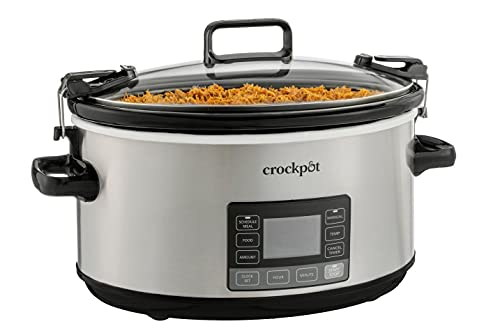
Crock-Pot Programmable Slow Cooker with MyTime Technology, 7-Quart
Badge: Best Overall
Strengths
- MyTime technology adjusts the cooking cycle to finish at the time you set, which directly addresses the most common programmable slow cooker failure: food that is done hours before you are home.
- The Cook and Carry locking lid seals for transport, so the same machine that cooks a weekday stew can travel to a potluck without sloshing in the car.
- Seven-quart capacity feeding nine or more people covers family dinners and modest batch cooking in one crock.
Trade-offs
- Programmable electronics are the first thing to fail on any cooker in this class, and they are the reason this model sits in a higher price tier than the manual design below.
- The locking lid’s gasket and clips add cleaning steps that a plain glass lid does not have.
- At seven quarts it is a large appliance to store, and it cooks small meals for one or two people poorly because the crock cannot be filled deeply enough.
Mini spec box
- Capacity: 7-quart
- Serves: 9+ people, per the verified listing
- Controls: Programmable, with MyTime technology that adjusts cooking to your schedule
- Lid: Cook and Carry locking lid
- Finish: Stainless steel
This is the pick for households whose dinner hour moves around. The idea behind MyTime is simple and genuinely useful: instead of choosing high or low and hoping the timing works out, you tell the cooker when the meal needs to be ready, and it adjusts the cooking cycle so the food finishes then rather than long before. Anyone who has come home to a programmable cooker that switched to warm four hours early — and to chicken that kept drying out in its own juices — understands the problem this design is trying to solve. The seven-quart crock handles a whole chicken, a large pork shoulder, or a double batch of soup, and the oval format suits roasts better than a round crock of the same volume.
On price, this model is the clearest illustration of this guide’s central point: you are paying for scheduling intelligence and a transport lid, not for better slow cooking in the basic sense. A manual cooker braises the same stew. What the extra tier buys is forgiveness — forgiveness for late trains, long meetings, and kids’ activities that run over. If your household eats at a predictable hour and someone is usually home to switch a dial, that forgiveness may not be worth much to you, and the manual pick below is the smarter spend. The honest limitation is size paired with electronics: it is a big, counter-hungry appliance whose control panel is one more thing to keep dry and clean, and households of one or two will rarely fill it past the halfway mark that slow cooking needs. Judge its live price against how often your schedule actually slips; that frequency, not the feature list, decides whether this is the best value in the guide for you.
Best for: busy families with unpredictable evenings who want dinner finished on time and a lid that travels / Not suited for: small households, minimalists who distrust appliance electronics, or anyone whose schedule is already predictable

Crock-Pot Oval Manual Slow Cooker, 7-Quart, Stainless Steel
Badge: Best Simple and Value-Focused
Strengths
- Three honest settings — high, low, and warm — with a dial that anyone in the house can operate without a manual or a learning curve.
- Removable oval stoneware crock that goes from cooking to serving at the table and suits whole chickens and roasts.
- No electronics to fail, no display to fade, and a design that has remained essentially unchanged because it works.
Trade-offs
- No timer and no automatic switch to warm: if you are late, the food keeps cooking on your chosen setting until someone turns the dial.
- The plain lid does not lock, so transporting a full crock of soup is a two-handed, level-surface exercise.
- Seven quarts is oversized for couples and small households, who will struggle to fill it adequately.
Mini spec box
- Capacity: 7-quart
- Serves: 8+ people, per the verified listing
- Settings: High, Low, and Warm, manually controlled
- Crock: Removable oval stoneware
- Finish: Stainless steel
If the phrase best prices for slow cookers means, to you, the least money for a machine that genuinely does the job, this is the review to read twice. The manual Crock-Pot is the appliance the whole category was built on: a stoneware crock in a heated housing, a glass lid, and a dial. It makes no promises beyond even, gentle, unattended heat for hours at a time, and it keeps that promise with a simplicity that has real economic value. There is no control board to die in year three, no sensor to misread, and nothing about its operation that a first-time user cannot understand in one minute. For the core slow-cooking repertoire — braises, pulled meats, bean soups, steel-cut oats started the night before — its results are the equal of any programmable model in this guide, because the cooking itself is identical; only the supervision differs.
The supervision point is the honest limitation, and it is a scheduling limitation rather than a cooking one. A manual cooker asks you, or someone, to be roughly right about timing. Food left on low well past its recipe time does not ruin immediately — slow cooking is forgiving — but a full workday plus a long commute can push a chicken past its best. Households where someone works from home, or where the cooker is started at midday for dinner, will never feel this drawback. Households gone for ten unpredictable hours will feel it weekly, and for them the programmable pick above is worth its higher tier. On price, expect this design to anchor the low end of any fair comparison: when you see it listed, you are looking at close to the floor price for a full-size, name-brand slow cooker, and any model priced near it with a timer attached deserves a careful look at what was traded away to get there — usually crock size, crock material, or lid quality.
Best for: value-focused buyers, predictable households, and anyone who wants a cooker that will simply work for years / Not suited for: long and unpredictable workdays away from home, or regular transport of cooked food

Aroma Housewares ARC-150SB Digital Rice Cooker, Slow Cooker and Food Steamer
Badge: Best Multitasker
Strengths
- Three verified appliances in one housing: digital rice cooking, slow cooking, and food steaming, which is a genuine storage and budget argument in a small kitchen.
- Large grain capacity — twenty cups cooked — makes it the batch-cooking centre of a household that eats a lot of rice.
- Digital controls bring timed, set-and-forget operation to both the rice and slow-cook functions.
Trade-offs
- As a slow cooker it uses a metal cooking pot rather than a heavy stoneware crock, and purists who care about stoneware’s heat behaviour and table presence will notice the difference.
- The slow-cook capacity is shaped by a rice cooker’s pot, which suits soups and grains better than a whole roast.
- One appliance doing three jobs means one failure removes three appliances from your kitchen at once.
Mini spec box
- Capacity: 20 cups cooked (10 cups uncooked) for rice and grains
- Functions: Rice cooker, slow cooker, and food steamer, per the verified listing
- Controls: Digital
- Exterior: Stainless steel
This pick needs its framing stated clearly, because it is the one machine in this guide that is not a dedicated slow cooker. The Aroma ARC-150SB is a digital rice cooker whose verified functions include slow cooking and steaming, and it earns its place here for a specific kind of household: one that cooks rice several times a week, slow cooks occasionally, and does not have the cupboard space — or the budget appetite — for two or three separate appliances. For that household, the price logic is compelling in a way a dedicated cooker cannot match. Instead of comparing this machine’s price against a slow cooker alone, compare it against the combined cost and combined shelf space of a rice cooker plus a slow cooker, and it frequently wins that comparison while giving up surprisingly little in daily use.
What it gives up should be named plainly. Slow cooking in a lidded metal pot is effective for soups, stews, curries, and braised dishes where the food sits in liquid, which is most of the slow-cooking repertoire. It is less satisfying for the stoneware rituals: the crock that comes out and goes to the table, the heavy pot that holds heat through a long serving period, the oval shape that takes a whole bird gracefully. If your slow cooking is mostly roasts and presentation matters, a dedicated crock is the better buy at any price. If your slow cooking is mostly weeknight soups and your rice cooker is already your most-used appliance, this multitasker is the most rational price in the guide. Readers whose kitchens lean even harder into multi-function machines often compare this category with Best Prices On Instant Pot Pressure Cookers, where the same one-appliance logic is applied to pressure cooking instead.
Best for: rice-first households, small kitchens, and anyone replacing two appliances with one / Not suited for: stoneware traditionalists, roast-centred slow cooking, or households that need rice and a slow-cooked main at the same time
Crock-Pot Programmable Slow Cooker, 8-Quart, Black Stainless Steel
Badge: Best for Large Batches
Prose-only pick: this model is a genuine programmable slow cooker from the same verified cooker pool, covered here without an Amazon link or image because it sits outside this keyword’s link set. Judge it by the description and search for it by name if it fits your needs.
Strengths
- Eight-quart capacity rated for ten or more people is the largest in this guide, sized for entertaining, holiday sides, and serious batch cooking.
- A digital timer running up to twenty hours with an automatic switch to warm gives it the scheduling safety net that manual models lack.
- Both the lid and the stoneware pot are dishwasher-safe, which matters much more at this size, because an eight-quart crock is a heavy thing to wash by hand in a small sink.
Trade-offs
- It is the biggest footprint in this guide, on the counter and in the cupboard, and it will dominate a small kitchen.
- Large crocks need large quantities to cook evenly; a two-person stew rattling around in eight quarts will overcook at the edges.
- As a higher-capacity programmable model it sits in the upper tier of the category’s pricing, so its value depends entirely on how often you truly cook at that scale.
Mini spec box
- Capacity: 8-quart
- Serves: 10+ people, per the verified listing
- Controls: Programmable digital timer, up to 20 hours, with auto warm setting
- Cleaning: Dishwasher-safe lid and stoneware pot
- Finish: Black stainless steel
Every category has a pick that exists for the household that cooks for a crowd, and this is it. Eight quarts changes what a slow cooker is for. It is no longer just dinner; it is the double batch of chilli that stocks the freezer, the pulled pork for a party, the holiday side dish that frees the oven, and the soup made in quantities that assume leftovers are the point. The long timer ceiling is well matched to that role, because batch cooks often start early and serve late, and the automatic move to warm keeps a finished batch at serving temperature without further cooking. If you regularly host, cook for a large family, or batch cook on weekends, this is the capacity class to price-check first.
The price question for this model is a frequency question. A large programmable cooker costs more than a mid-size manual one in two currencies: money and storage. If it comes out twice a year for holidays, it is an expensive cupboard tenant, and a seven-quart model plus a borrowed second cooker would serve you better. If it comes out twice a month, the calculation reverses completely, and the per-use cost drops below everything else in this guide. Be honest about which household you are. Slow cookers are durable, simple appliances that people keep for a decade, so the right capacity bought once is almost always cheaper than the wrong capacity bought twice — a theme this guide returns to in the buying mistakes section below.
Best for: large families, entertainers, and committed batch cookers / Not suited for: small households, small kitchens, or anyone whose largest regular meal serves four
Hamilton Beach 6-Quart Slow Cooker, 33665G
Badge: Best No-Fuss Family Size
Prose-only pick: a genuine manual slow cooker from the same verified cooker pool, covered here without an Amazon link or image because it sits outside this keyword’s link set.
Strengths
- Six quarts is the size most family recipes are written for, so this crock matches the cookbook world better than either extreme in this guide.
- Three cooking settings and a simple control keep operation obvious for every member of the household.
- The stoneware crock and glass lid are both dishwasher-safe, removing the main daily friction of slow cooking, which is washing a heavy pot.
Trade-offs
- Like the other manual design here, it has no timer, so it cannot rescue a meal when the household is late.
- It offers no transport lock and no extra functions; it is a single-purpose appliance and makes no apology for it.
- Silver-finish housings in this class show splashes and fingerprints readily, a small but real aesthetic cost on an open counter.
Mini spec box
- Capacity: 6-quart
- Settings: 3 cooking settings
- Cleaning: Dishwasher-safe stoneware crock and glass lid
- Finish: Silver
- Model: 33665G
There is a quiet argument that six quarts, not seven or eight, is the correct default size for a family slow cooker, and this Hamilton Beach is its representative in this guide. Most published slow cooker recipes assume a crock in the five-to-six-quart range; go much larger and sauces spread thin and edges overcook, go smaller and a standard recipe simply does not fit. A six-quart manual cooker is therefore the appliance least likely to surprise you. It takes a family chicken, a normal batch of soup, or a pork shoulder for four to six people, and its dishwasher-safe crock and lid mean the cleanup after a weeknight meal is a loading task rather than a washing project.
On value, this is the comparison anchor for the whole category. When you price slow cookers, hold this class in mind — mid-size, manual, dishwasher-safe stoneware — as the baseline specification, and then make every more expensive model justify its premium against it in specific features: a timer, a locking lid, extra capacity, extra functions. Some models in this guide do justify it, for the households described in their reviews. Many listings on the wider market do not, and differ from this baseline mainly in styling. That is the practical skill this keyword is really asking for: not finding the lowest number, but knowing the specification that a low number should still include. Shoppers comparing baseline machines across cooker types sometimes also look at Best Prices On Insta Pot Pressure Cookers to see what the equivalent baseline costs in the pressure world before committing to a method.
Best for: families of three to six who cook from standard recipes and want the category’s baseline done properly / Not suited for: unpredictable schedules that need a timer, or very large-batch cooking
Cosori Rice Cooker 10 Cup, 18-in-1, with Slow Cook Mode
Badge: Best Multicooker with a Slow-Cook Mode
Prose-only pick: a multicooker whose verified functions include slow cooking, covered here without an Amazon link or image because it sits outside this keyword’s link set. It is included honestly as a multicooker, not as a dedicated stoneware slow cooker.
Strengths
- An eighteen-function programme list that includes sauté and slow cook lets one machine brown ingredients and then cook them slowly in the same pot.
- Fuzzy logic controls adjust cooking intelligently, and the twenty-four-hour keep warm and delay timer bring real scheduling flexibility.
- The ceramic-coated inner pot and stainless steel steamer basket suit households trying to move away from worn traditional nonstick surfaces.
Trade-offs
- Slow cooking is one mode among many rather than the machine’s purpose, and its pot shape and capacity are designed around rice and grains first.
- Menu-driven controls have a learning curve that a three-setting dial simply does not.
- As with the Aroma above, one multifunction appliance is a single point of failure for several kitchen jobs.
Mini spec box
- Capacity: 10 cups uncooked (20 cups cooked) for rice and grains
- Functions: 18-in-1, including sauté and slow cook, per the verified listing
- Controls: Fuzzy logic, with 24-hour keep warm and delay timer
- Inner pot: Non-stick ceramic coating
- Included: Stainless steel steamer basket
The Cosori represents the newest answer to the slow cooker price question: do not buy a slow cooker at all, but buy a multicooker that slow cooks among its many programmes. The strongest version of that argument is the sauté function. Traditional slow cooking has a well-known flavour compromise — ingredients go in raw, because browning them means dirtying a separate pan, and many cooks skip it. A machine that sears in the same pot and then drops into a slow programme removes that compromise, and for stews and braises the difference is real. Add a delay timer, a long keep-warm, and grain programmes that handle the side dish on another day, and the value case for a rice-centred household is strong.
The counter-argument is equally real, and this guide will not hide it: if slow cooking is your main event — weekly roasts, big stoneware batches, food served from the crock — a dedicated slow cooker does that job with more capacity, a better shape, and simpler controls, usually for less money than a flagship multicooker. The Cosori’s price only makes sense when you will genuinely use its breadth. Count the functions you would use weekly, not the eighteen on the box. If the honest count is six or more, this class of machine is a rational purchase and possibly the best value in your kitchen. If the honest count is two, a dial and a crock will serve you better and cost you less, and the difference is better spent on ingredients.
Best for: multicooker households, grain-centred cooking, and anyone who wants to sear and slow cook in one pot / Not suited for: stoneware traditionalists, very large batches, or cooks who prefer a dial to a menu
Comparison Table
| Pick | Badge | Type | Capacity (verified) | Controls | Listing |
|---|---|---|---|---|---|
| Crock-Pot Programmable with MyTime, 7-Quart | Best Overall | Dedicated slow cooker | 7-quart, serves 9+ | Programmable, schedule-adjusting | Check on Amazon |
| Crock-Pot Oval Manual, 7-Quart | Best Simple and Value-Focused | Dedicated slow cooker | 7-quart, serves 8+ | Manual: high, low, warm | Check on Amazon |
| Aroma ARC-150SB | Best Multitasker | Rice cooker with slow cook and steam | 20 cups cooked (grains) | Digital | Check on Amazon |
| Crock-Pot Programmable, 8-Quart | Best for Large Batches | Dedicated slow cooker | 8-quart, serves 10+ | Programmable timer to 20 hours, auto warm | Prose-only pick |
| Hamilton Beach 33665G | Best No-Fuss Family Size | Dedicated slow cooker | 6-quart | Manual, 3 settings | Prose-only pick |
| Cosori 10 Cup, 18-in-1 | Best Multicooker with a Slow-Cook Mode | Multicooker with slow cook mode | 10 cups uncooked (grains) | Fuzzy logic, delay timer | Prose-only pick |
How to Choose a Slow Cooker and Judge Its Price
Start with capacity, because it is the decision you cannot undo and the one most distorted by discounts. Slow cookers cook best when the crock is between half and three-quarters full: less and the food overcooks and dries at the edges, more and it heats slowly and unevenly. A household of one or two is best served by a small crock; three to six people land in the five-to-six-quart heartland where most recipes are written; larger families and batch cookers justify seven or eight quarts. The pricing trap is that large crocks are discounted aggressively because they are impressive on a shelf, so shoppers buy capacity they cannot fill and then conclude that slow cooking itself is disappointing. When you compare the best prices for slow cookers, compare models within your size class first, and treat a bigger model on sale as a different product, not as a bargain version of the right one.
Next, decide the manual-versus-programmable question honestly, because it is the largest legitimate price step in the category. A manual dial does high, low, and warm, and nothing else, and for a household with predictable hours it is genuinely sufficient. A programmable model adds a countdown that switches to warm when cooking ends, and some add delay start or, in the MyTime design above, a finish-time adjustment. Price that difference against your actual schedule over a month. If dinner is regularly delayed by an hour or more, the timer is not a luxury; it is the difference between a cooker you use weekly and one you stop trusting. If someone is home most afternoons, the premium buys nothing you will use, and the manual baseline is the intelligent purchase.
Then read the crock and lid details, where quiet price differences hide. Stoneware crocks are heavy, retain heat well, and usually go to the table gracefully; lighter metal pots heat and cool faster and are easier to handle but less traditional. Check whether the crock and lid are dishwasher-safe, whether the lid is plain glass or a locking transport design, and whether the shape is oval or round — oval suits whole chickens and roasts, round suits soups and stews. Finally, price the whole ownership picture: replacement crocks and lids for major brands are easy to find, which extends the machine’s life after the inevitable chip or drop, while obscure brands can turn a small accident into a full replacement. A slightly higher price for a brand with available parts is often the cheaper decade-long decision. Readers weighing the premium end of these same trade-offs will find the discussion in Best Professional Grade Pressure Cookers a useful contrast, because pressure cooking prices the same build questions differently.
How to Use a Slow Cooker Well: Setup, Cooking, Cleaning, and Troubleshooting
Good slow cooking is mostly preparation discipline. Set the cooker on a flat, heat-safe surface with clearance around it, and resist placing it under low cabinets where steam will condense. Brown meat and bloom spices in a pan first when the recipe rewards it; the cooker will not do this job for you, and ten minutes at the stove is the single largest flavour upgrade available. Layer ingredients with root vegetables at the bottom, nearest the heat, and meat above them. Add dairy, fresh herbs, and quick-cooking vegetables near the end rather than at the start. Fill the crock between half and three-quarters, keep the lid closed — every lift releases heat that takes a long while to rebuild — and let the warm setting hold a finished dish for a reasonable serving window rather than an entire afternoon.
Cleaning decides whether a slow cooker stays in weekly use. Let the stoneware cool before washing to avoid thermal shock, soak a stuck-on ring of sauce in warm soapy water rather than scouring it, and wash the lid’s rim and any gasket carefully, because that is where old flavours live. Wipe the heating housing with a damp cloth only, and never immerse it. If your crock and lid are dishwasher-safe, as several picks in this guide are, use that convenience; it is a feature you paid for.
Troubleshooting
Problem: The finished dish is watery and bland → what to do: Slow cookers trap moisture, so recipes need less liquid than stovetop versions. Next time, reduce added liquid, leave the lid closed throughout, and finish the dish uncovered on high for the last stretch, or stir in a small slurry to thicken the sauce at the end.
Problem: Meat is tender but dry, or vegetables are mushy → what to do: The dish cooked too long for its ingredients. Use the low setting for long days rather than high for short ones, choose tougher, fattier cuts that reward long cooking, add delicate vegetables in the final hour, and consider a programmable model that switches to warm on time.
Problem: Food at the edges overcooks while the centre lags → what to do: The crock is probably too full or too empty for its size. Aim for the half-to-three-quarters fill range, cut ingredients to even sizes, and stir once halfway through only if the recipe allows the lid lift.
When Slow Cooker Prices Drop, and How to Shop the Cycle
Slow cooker pricing follows the retail calendar more than it follows manufacturing cost. Prices tend to soften around major sale events, in the autumn as soup season marketing peaks and retailers compete for the same shopper, and whenever a model line is refreshed and the outgoing design is cleared. None of that requires you to memorise dates; it requires one habit, which is to know the specification you want before a sale starts, so a discount is judged against your list rather than against a struck-through figure on the page. A discounted model that is the wrong size, the wrong control type, or missing dishwasher-safe parts is not a saving. It is a different, worse purchase wearing a percentage sign. The picks in this guide are organised by role precisely so you can walk into any sale knowing which badge you are shopping for, then check the live price of that pick and one alternative, and stop there.
Slow Cooker or Something Else? Placing the Purchase
Some shoppers arrive at this keyword while actually deciding between cooking methods, and price comparisons only make sense once the method is settled. A slow cooker is the right purchase when your goal is gentle, unattended, hours-long cooking: braises, beans, soups, and meals timed to a homecoming. A pressure cooker is the right purchase when the same ingredients need to be fast. A multicooker is the right purchase when counter space is the scarcest resource in the kitchen. The honest way to shop is to settle the method first — our comparison of Best Prices On Pressure Cookers 8qt covers the large-capacity pressure side of that decision — and then compare prices within the method, where differences in capacity and controls mean something. Comparing a discounted slow cooker against a full-price pressure cooker tells you nothing except which one is discounted.
Common Buying Mistakes
The first mistake is buying capacity on discount rather than by household, covered above and worth repeating because it accounts for most disappointed slow cooker owners. The second is paying for programmability you will never use — or, symmetrically, saving a small amount on a manual model and then rarely using it because your schedule defeats it. The third is judging a listing by its function count: a slow cooker with a long list of unrelated programmes is not a better slow cooker, and the two multicookers in this guide are recommended for specific households, not as upgrades. The fourth is ignoring the crock: failing to check dishwasher safety, replacement availability, and whether the shape suits your cooking. The fifth is treating any printed price, including in guides like this one’s competitors, as current. Prices move; the only figure that matters is the live one at checkout, which is why this guide sends you to check the latest price on Amazon rather than printing numbers that would quietly rot. The sixth is forgetting the warm setting’s limits and holding food for many hours, which dries texture and is poor food-safety practice; a timer that ends cooking is a feature, but warm is a serving tool, not a storage method.
Final Recommendation
For most households, the first choice is the Crock-Pot Programmable Slow Cooker with MyTime Technology, because its finish-time adjustment solves the scheduling problem that makes people abandon slow cooking, and its locking lid and family capacity cover the widest range of real kitchens. If your household runs on a predictable clock and you want the category’s value baseline, choose the Crock-Pot Oval Manual Slow Cooker instead and spend the difference on ingredients. If your kitchen is rice-first and space-poor, the Aroma ARC-150SB replaces two appliances with one digital machine that slow cooks credibly. Batch cookers and entertainers should look hardest at the eight-quart programmable Crock-Pot covered in prose above, and recipe-following families at the six-quart Hamilton Beach. Whichever badge fits you, check the latest price on Amazon at the moment of purchase and measure it against the feature list in its review; that comparison, not any headline discount, is how the best prices for slow cookers are actually found.
Frequently Asked Questions
Why does this guide not print slow cooker prices?
Because slow cooker prices change with promotions, seasons, and stock, and a printed figure would mislead within weeks. The guide instead identifies which model fits which household and sends you to check the latest price on Amazon at the moment you are buying, which is the only price that should influence the decision.
Is a programmable slow cooker worth more than a manual one?
It is worth more only if your schedule is unpredictable. The cooking itself is identical; what the premium buys is a timer that ends cooking and switches to warm. Households with regular hours get the same meals from a manual dial for less, which is why this guide badges one of each.
What size slow cooker should I buy?
Buy for the fill rule: crocks cook best half to three-quarters full. One or two people suit a small crock, families of three to six suit the five-to-six-quart range most recipes assume, and larger households or batch cookers justify seven to eight quarts. A discounted oversize crock is a poor bargain if your meals cannot fill it.
Can a rice cooker or multicooker replace a slow cooker?
Partly. Two picks in this guide — the Aroma ARC-150SB and the Cosori 18-in-1 — have verified slow-cook functions and handle soups, stews, and braises in liquid well. What they do not replicate is the stoneware crock’s shape, heat retention, and table presence, so roast-centred and presentation-minded cooks should still buy a dedicated slow cooker.
Why were some cooker models excluded from this guide?
Because their verified listings describe rice cooking with no slow-cook function. Recommending them under a slow cooker heading would be misleading, so they were left out entirely rather than linked and caveated. Every pick reviewed here either is a dedicated slow cooker or has a verified slow-cook mode, and the prose-only picks are labelled as such.
When is the best time to buy a slow cooker?
Prices tend to soften around major sale events, during autumn soup-season competition, and when model lines are refreshed. The better strategy is to decide your size and control type first, using this guide’s badges, then check live prices for your chosen pick and one alternative whenever you are ready to buy.
What should I check on a listing before paying?
Confirm the capacity in quarts, the control type, whether the crock and lid are dishwasher-safe, whether the lid locks if you plan to transport food, and whether replacement crocks exist for the brand. Then compare the live price against those facts, not against a struck-through figure.


