Disclosure: topratedkitchenware.com is reader-supported. When you buy through links on our site, we may earn an affiliate commission from Amazon and other retailers, at no extra cost to you.
Where to buy
The six models below are the verified picks for anyone comparing the best professional grade pressure cookers. Each name links to its Amazon listing, where you can check the latest price on Amazon, confirm the current configuration, and read the newest owner feedback before you decide.
- Presto 01362 6-Quart Stainless Steel Pressure Cooker
- T-Fal Secure Trendy Stainless Steel Pressure Cooker, 8.5 qt
- MICHELANGELO Stovetop Pressure Cooker Stainless Steel, 4.2 qt
- Peterboo Stainless Steel Pressure Cooker, 6 Quart Stovetop
- RVGMBO 12 Quart Stainless Steel Pressure Cooker and Canner
- Peterboo 3Qt Stainless Steel Pressure Cooker
Read the full guide ↓ for what “professional grade” honestly means in this category, which builds and safety systems earn the label, and which pot fits which workload.
“Professional grade” is the most abused phrase in cookware, so this guide starts by defining it honestly. None of the six verified picks below is certified commercial kitchen equipment, and none is presented as such. What they are is the closest a home-market shopper gets to professional practice: stovetop pressure cookers built from stainless steel rather than electronics, with layered safety systems, induction-ready bases, replaceable gaskets, and capacities that run from small-batch precision to a 12-quart canner. Professional kitchens favour this format for reasons that have nothing to do with fashion — metal survives, parts replace, heat responds instantly, and there is no control board between the cook and the pressure. If your search for the best professional grade pressure cookers means “built like the pros use, sized for my kitchen”, this pool answers it directly. If it means certified commercial appliances, that is a different, specialist market, and this guide says so rather than dressing home cookware in borrowed credentials.
The six picks span the working range of serious stovetop pressure cooking. The RVGMBO 12-quart brings canner-scale capacity in 18/8 stainless. The T-Fal Secure Trendy at 8.5 quarts pairs big volume with a 5-point safety system and induction compatibility. The Presto 6-quart is the archetypal workhorse, and the Peterboo 6-quart answers it with a modern 3-ply base, a pressure indicator, and the broadest hob compatibility in the pool. At the precision end, the MICHELANGELO 4.2-quart in 304 stainless offers two pressure settings and a six-fold safety system, while the Peterboo 3Qt packs eight-plus safety features into the small-batch size. Every one of them is stainless, stovetop, and built around replaceable sealing parts — the professional pattern, honestly scaled.
You will find each pick reviewed with strengths, trade-offs, and a spec box drawn only from its verified listing; a comparison table; a buying guide on what separates professional-style builds from ordinary ones; a full technique section with troubleshooting, because stovetop pressure is a skill this guide intends to teach rather than assume; and the mistakes that lead buyers to pay professional prices for unprofessional products. Readers comparing the gentler end of heavy-duty cooking will find Best Professsional Slow Cookers a useful companion, since serious kitchens often run both disciplines side by side.
Key Takeaways
- Professional grade, honestly defined, means professional-style attributes — stainless construction, layered safety, replaceable gaskets, responsive stovetop heat — not commercial certification, which none of these home-market cookers carries.
- Stovetop stainless dominates this end of the market because it survives: no electronics to fail, seals that replace in minutes, pots that serve for decades.
- Capacity is the workload question: 12 quarts for canning-scale and crowd work, 8.5 for big batches, 6 for the family mainstream, and the small pots for precision and small batches.
- Safety systems are the modern professional marker — multi-point locking, pressure indication, and controlled release matter more than brand heritage.
- Induction compatibility is now a professional requirement in many kitchens; four of these six picks offer it explicitly.
- Check the latest price on Amazon for each pick, and judge value over a decade of service, not a season.
In this guide
Quick Picks
| Pick | Badge | Capacity | Distinguishing strength | Link |
|---|---|---|---|---|
| RVGMBO 12 Quart | Best for Pro-Scale Workloads | 12 Qt | Canner-scale capacity, 18/8 steel | RVGMBO 12 Quart |
| T-Fal Secure Trendy | Best Overall Pro-Style | 8.5 Qt | 5-point safety, induction, big volume | T-Fal Secure Trendy |
| Presto 01362 | Best Workhorse Value | 6 Qt | Archetypal durability, deep parts support | Presto 01362 |
| Peterboo 6 Quart | Best Induction Pro-Style | 6 Qt | 3-ply base, indicator, all-hob compatibility | Peterboo 6 Quart |
| MICHELANGELO 4.2 qt | Best Precision Compact | 4.2 Qt | 304 steel, 2 pressure settings, 6-fold safety | MICHELANGELO 4.2 qt |
| Peterboo 3Qt | Best Small-Batch | 3 Qt | 8+ safety features in a compact pot | Peterboo 3Qt |
The badges are workload badges. Professional-style buying starts from the work — how much, how often, on which hob — and only then asks which pot. Read the reviews in that spirit.
How These Picks Were Chosen
This is a research-led guide built on a verified product pool checked against Amazon’s catalogue data. Verification confirmed every pick as a genuine stovetop pressure cooker with its materials, capacity, and safety claims taken from the catalogue record itself. That discipline filtered the pool toward substance: in a search where “professional” is sprayed across listings as decoration, the picks that survived are the ones whose listings document professional attributes — steel grades, safety systems, base construction, hob compatibility — rather than merely asserting a professional aura.
Judgement then weighed five factors. Construction first: stainless steel throughout, with attention to base design, because even heat at pressure is a performance and safety issue. Safety systems second, counted and compared as listed, since layered protection is the clearest line between serious modern cookers and basic ones. Capacity coverage third, so the guide spans the real workload range instead of clustering at one size. Hob compatibility fourth, with induction treated as a first-class requirement. Parts and longevity fifth: gaskets and seals are the wear items, and a professional-style pot is one whose wear items are findable and replaceable. Owner feedback patterns over time — which pots people keep for years, which lids and seals draw complaints — informed the final ordering.
The guide is frank about its limits. These are research-based judgements from verified specifications and accumulated owner experience, not laboratory stress tests, and “professional grade” is used throughout in the defined sense above. No prices are printed, because they move; the links lead to live listings where today’s figures can be judged against the decade-scale value logic this guide teaches. For the automated counterpart to this stovetop philosophy, Best Programmable Pressure Cookers covers the electric mainstream.
The 6 Best Professional-Style Pressure Cookers
Ordered from the largest workload to the smallest. Every review states plainly what its pick is and is not.

RVGMBO 12 Quart Stainless Steel Pressure Cooker and Canner
Badge: Best for Pro-Scale Workloads
Strengths
- Twelve quarts of 18/8 stainless capacity — the only pick here that works at genuinely large scale, including pressure canning duties.
- A one-hand locking lid and a 3-in-1 design that covers pressure cooking, canning, and ordinary lidded cooking with the included glass lid.
- Induction and gas compatibility plus a steamer rack included, so the big pot arrives ready for varied work.
Trade-offs
- Size is a commitment: heavy empty, formidable full, and demanding of storage and a capable burner.
- Fully manual operation at the largest scale, where process discipline matters most.
- Overkill — honestly, a burden — for households whose batches are family dinners.
Mini spec box
- Capacity: 12 Qt
- Material: 18/8 stainless steel
- Type: 3-in-1 stovetop pressure cooker and canner
- Compatibility: induction and gas stovetop (per listing)
- Lid: one-hand locking (per listing)
- Included: glass lid, steamer rack (per listing)
The RVGMBO is where this guide’s definition of professional gets tested against scale, and it holds up. Serious preserving, community cooking, market-garden processing, and large-family batch work all live at this volume, and the pot answers with the right materials and the right versatility: 18/8 stainless that shrugs off acidic loads, a locking system operable with one hand when the other is managing a jar lifter, and the dual identity of cooker and canner that makes it two tools in one footprint. The included glass lid matters more than it looks — it turns the vessel into a stockpot for the long, open simmers that surround pressure work in a serious kitchen.
The cautions are physical and procedural. Twelve quarts of food and liquid is a heavy, hot mass; plan your bench space, your burner, and your lifting honestly. Canning, specifically, must follow tested, current guidelines for your altitude and food type — the pot provides the pressure environment, but safe canning is a procedure, not a product feature, and this guide will not pretend a purchase substitutes for following those guidelines exactly. Bought for the right workload and used with that discipline, the RVGMBO is the most capable tool in this pool.
Best for: canners, large households, and small-scale producers who need genuine 12-quart stainless capacity / Not suited for: everyday family dinners, small kitchens, or anyone seeking automated cooking

T-Fal Secure Trendy Stainless Steel Pressure Cooker, 8.5 qt
Badge: Best Overall Pro-Style
Strengths
- The most complete professional-style package in the pool: 8.5 quarts, stainless, induction-ready, with a 5-point safety system.
- Two cooking modes give a gentler and a stronger pressure register for different workloads.
- Dishwasher-safe body and an included steam basket keep a big, serious pot practical in daily use.
Trade-offs
- Manual throughout; the safety system protects you, but you still run the cook.
- A substantial pot to store and to wash, even with dishwasher help.
- Two modes is simplicity by design; cooks wanting fine pressure gradations should note the limit.
Mini spec box
- Capacity: 8.5 qt
- Type: stovetop pressure cooker
- Material: stainless steel
- Compatibility: induction (per listing)
- Safety: 5-point safety system (per listing)
- Modes: 2 cooking modes (per listing)
- Included: steam basket (per listing)
- Care: dishwasher-safe body (per listing)
If one pick in this guide deserves the headline, it is the T-Fal, because it balances the professional attributes most evenly. Capacity is genuinely large without reaching the RVGMBO’s specialist scale. The safety system is the most explicitly layered in the pool, addressing locking, pressure state, and release as a designed whole rather than as a single valve. Induction compatibility places it in modern kitchens without adaptation. And the construction is the stainless, gasket-serviced pattern that gives stovetop cookers their decades-long working lives. For a serious home cook, a keen small-café prep kitchen working within home-market equipment, or a family that cooks in real batches, this is the complete answer in the pool.
Its trade-offs are the format’s trade-offs, not flaws: you are the timer and the thermostat, and the pot’s size asks for storage and a suitable burner. Within those terms, the value logic is compelling — cookware pricing for a tool that should outlast several generations of electric appliances. Buy it as infrastructure and it will behave like infrastructure.
Best for: serious cooks wanting the most complete big stainless stovetop cooker in the pool / Not suited for: small households, or anyone who wants programs and automation

Presto 01362 6-Quart Stainless Steel Pressure Cooker
Badge: Best Workhorse Value
Strengths
- The archetype of the category: a stainless 6-quart stovetop cooker with nothing superfluous and nothing missing.
- Long-established maker with deep gasket and parts availability — the professional virtue of maintainability, fully delivered.
- Proven, repairable simplicity that keeps lifetime cost per year of service at the pool’s lowest.
Trade-offs
- No modern indicator frills; you read pressure the traditional way, by the regulator’s behaviour.
- Six quarts caps the workload at family scale and moderate batches.
- Purely manual, with the learning curve that implies for first-time stovetop cooks.
Mini spec box
- Capacity: 6 Qt
- Type: stovetop pressure cooker
- Material: stainless steel
- Brand: Presto
Professional kitchens run on workhorses, and the Presto is this category’s. It lacks the T-Fal’s enumerated safety system and the newer pots’ indicators, but it embodies the deeper professional virtues: a design so mature that its failure modes are known and trivial, parts that have been available for years and remain so, and a stainless body that treats decades as a normal service expectation. In value terms it is the strongest pick in the guide — not because it is cheap on the day, but because its cost divides across so many years of work. Canny buyers, including plenty of professionals equipping secondary stations, have made exactly this calculation for a very long time.
Choose it with clear eyes. You are trading modern feedback features for maturity and economy, and your technique must supply what indicators supply on the newer pots: attention to the regulator, a timer in hand, a notebook for the first dozen cooks. For a confident stovetop cook, that trade is barely a trade at all. For a nervous beginner, the Peterboo below, with its pressure indicator, may be the kinder entry into the same size class.
Best for: confident cooks and value-focused buyers who want a maintainable 6-quart workhorse for the long term / Not suited for: beginners who want explicit pressure indication, or workloads beyond family scale


Peterboo Stainless Steel Pressure Cooker, 6 Quart Stovetop
Badge: Best Induction Pro-Style
Strengths
- The broadest hob compatibility in the pool — induction, gas, and ceramic — from a 3-ply composite base built for even heat.
- A clear pressure indicator plus multi-safeguard devices: modern feedback and protection in a manual pot.
- Dishwasher safe, removing the main daily friction of mid-size stovetop ownership.
Trade-offs
- A newer market presence than the heritage makers, so its decade-scale parts story is promising rather than proven.
- Manual operation; the indicator informs, but the cook still governs heat and time.
- Six quarts, like the Presto, tops out at family scale.
Mini spec box
- Capacity: 6 Qt
- Type: stovetop pressure pot
- Base: 3-ply composite base (per listing)
- Compatibility: induction, gas, and ceramic stoves (per listing)
- Features: pressure indicator, multi safeguard devices (per listing)
- Care: dishwasher safe (per listing)
The Peterboo is the moderniser’s 6-quart. Its composite base answers the defining equipment question of current kitchens — will it work on induction, and will it heat evenly when it does — while its pressure indicator answers the beginner’s defining anxiety: is it at pressure yet, and is it safe to open? Those two features, wrapped in stainless with a multi-safeguard design and dishwasher-safe practicality, make it the most contemporary interpretation of the professional pattern in this pool. In a mixed-hob household, or a kitchen planning an induction move, it is the natural pick of the two 6-quart stovetops.
The reservation is purely about time. Heritage brands have already proven their parts pipelines across decades; newer brands ask you to project that support forward. The prudent buyer confirms gasket availability at purchase and perhaps buys a spare immediately, converting an uncertainty into a stocked drawer. With that small diligence done, the Peterboo’s modern feature set makes it arguably the best-balanced 6-quart here.
Best for: induction and mixed-hob kitchens wanting modern indication and safeguards at family size / Not suited for: buyers who insist on a decades-proven parts heritage above features
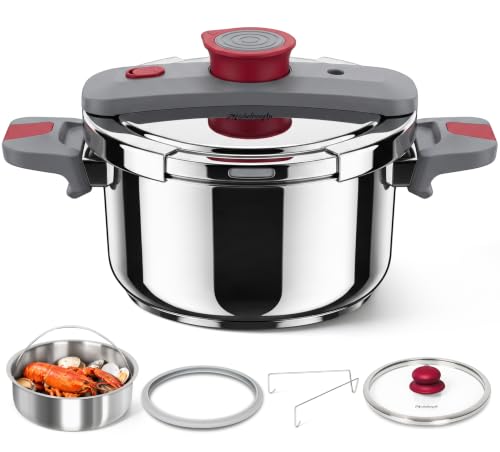
MICHELANGELO Stovetop Pressure Cooker Stainless Steel, 4.2 qt
Badge: Best Precision Compact
Strengths
- 304 stainless steel construction — the grade specified in serious cookware — in a compact, beautifully manageable size.
- Two pressure settings and a 6-fold safety system give a small pot a professional feature depth its class rarely offers.
- One-hand easy-open lid, steamer basket, and glass lid included; induction compatible out of the box.
Trade-offs
- Capacity is the hard limit: 4.2 quarts serves small households and side dishes, not batch work.
- Compact stovetop cooking still demands full manual attention.
- Per-quart, premium small pots are not the economy route; you are paying for grade and finish.
Mini spec box
- Capacity: 4.2 qt
- Material: 304 stainless steel (per listing)
- Safety: 6-fold safety system (per listing)
- Lid: one-hand easy-open (per listing)
- Settings: 2 pressure settings (per listing)
- Included: steamer basket and glass lid (per listing)
- Compatibility: induction (per listing)
Professional does not always mean large; it often means precise. The MICHELANGELO is the pool’s precision instrument: a compact pot built from 304-grade stainless, with two pressure settings that let a cook treat delicate and hearty loads differently — a refinement many full-size pots omit — and a six-fold safety system that is generous at any size. The one-hand lid is a working cook’s feature, designed for the moment your other hand holds a spoon or a tray. For small households, solo cooks who take technique seriously, and anyone equipping a compact professional-style station for sauces, grains, and sides, this is the most considered small pot in the guide.
Its honesty requirement is the mirror of the RVGMBO’s: do not ask it to be big. It will not batch cook, it will not host, and it will not can. Within its brief — small loads, exact pressure, premium materials — it is arguably the most professional object here, in the sense that every detail serves the cooking. Buy it for the work it is sized for and it will reward you for years.
Best for: precision-minded small households and cooks wanting a premium compact stovetop pot / Not suited for: families, batch cooking, or any workload beyond small-batch scale

Peterboo 3Qt Stainless Steel Pressure Cooker
Badge: Best Small-Batch
Strengths
- Eight-plus listed safety features in a 3-quart pot — the most safety-dense small cooker in the pool.
- Stainless, induction compatible, and sized for one or two people, with fast pressurising on small loads.
- An 8-in-1 multi-cooker positioning that stretches a small pot across more jobs than its size suggests.
Trade-offs
- The smallest capacity here; even modest family cooking exceeds it.
- Newer-brand parts considerations apply, as with its 6-quart sibling.
- Manual stovetop discipline is still required despite the safety count.
Mini spec box
- Capacity: 3 Qt
- Material: stainless steel
- Type: 8-in-1 multi-cooker, stovetop and electric-compatible positioning (per listing)
- Compatibility: induction (per listing)
- Safety: 8+ safety features (per listing)
- Sized for: 1–2 people (per listing)
The second Peterboo closes the pool at the small-batch end, and its headline is safety density. Small stovetop pots are often bought by first-time pressure cooks — exactly the users who benefit most from layered protection — and this one lists eight-plus safety features, the richest count in the guide relative to size. Combined with stainless construction and induction compatibility, it makes a credible claim to be the thinking beginner’s professional-style starter pot, or the experienced cook’s dedicated small-batch tool for grains, sauces, and sides alongside a larger main cooker.
Judge it as a specialist. It will not grow with a household, and it is not the pot for Sunday batches. But a kitchen that runs a big main cooker and a precise small one is a genuinely professional arrangement, and this is the pool’s natural candidate for the small role. Paired with the T-Fal or the RVGMBO above, it completes a two-pot system that covers the entire workload range this guide describes.
Best for: singles, couples, beginners wanting maximum safety features, and as a small-batch companion to a large cooker / Not suited for: family cooking or any batch workload
Comparison Table
| Pick | Capacity | Material/build | Safety story | Hobs | Link |
|---|---|---|---|---|---|
| RVGMBO | 12 Qt | 18/8 stainless, canner | One-hand locking lid | Induction, gas | Check on Amazon |
| T-Fal Secure Trendy | 8.5 Qt | Stainless | 5-point safety system | Induction | Check on Amazon |
| Presto 01362 | 6 Qt | Stainless | Classic regulator design | Stovetop | Check on Amazon |
| Peterboo 6 Quart | 6 Qt | Stainless, 3-ply base | Indicator + multi safeguards | Induction, gas, ceramic | Check on Amazon |
| MICHELANGELO | 4.2 Qt | 304 stainless | 6-fold safety system | Induction | Check on Amazon |
| Peterboo 3Qt | 3 Qt | Stainless | 8+ safety features | Induction | Check on Amazon |
Read the safety and hob columns together. They are where the modern professional-style cookers separate themselves from basic pots, and where an older kitchen’s equipment constraints get answered.
How to Choose a Professional-Style Pressure Cooker
Define your workload before your budget. Professional buying is workload buying. Canning and crowd work point to the RVGMBO. Big family batches point to the T-Fal. The family mainstream splits between the Presto’s heritage value and the Peterboo’s modern compatibility. Precision and small batches point to the MICHELANGELO or the small Peterboo. A pot matched to its workload is professional; a pot bought on a label is not, whatever it cost.
Interrogate the safety system. Ask what the layers are: locking that prevents opening under pressure, indication that shows the pressure state, controlled release paths, and overpressure protection. The listings in this pool answer with counts and named systems — five-point, six-fold, eight-plus, multi-safeguard. A cooker that cannot describe its safety architecture in specifics has not earned a professional claim, and you should price it accordingly.
Check the base against your hob. Induction demands a magnetic, flat, well-bonded base; the 3-ply composite and induction-rated picks here answer directly. On gas, base diameter relative to your burner matters for efficiency and handle heating. On ceramic, weight and base smoothness matter. The professional question is never just “compatible?” but “compatible, efficient, and stable on my exact stove?”
Price the gasket, not just the pot. The sealing gasket is the one part every stovetop cooker consumes. Before buying, confirm the replacement exists, fits your exact model, and is orderable today. That two-minute check, plus the pot’s steel and safety architecture, predicts your decade of ownership better than any other diligence. It is also the check that separates professional-style purchases from decorative ones, as the programmable mainstream discussed in Best Progammable Pressur Cookers shows from the electric side.
Stovetop Pressure Technique: The Professional Method
- Inspect before every cook. Gasket seated and supple, valve clean and moving freely, rim free of dents and dried food. Professionals inspect because pressure forgives nothing.
- Load with discipline. Thin liquid sufficient for steam; solids below the two-thirds line, or half for grains, beans, and foaming foods.
- Brown in the open pot. The stovetop format’s great advantage: real searing on real heat before the lid goes on, building the flavours pressure cannot.
- Bring to pressure briskly, then govern. High heat to reach pressure, then reduce to the lowest heat that holds it steadily. The holding heat, once learned for your stove, is written in your notebook forever.
- Time from full pressure. Not from sealing, not from the first hiss — from the moment the cooker reaches its working pressure and settles.
- Release deliberately. Natural release for meats, grains, and full or foamy pots; controlled quick release for vegetables and delicate work. Never force a lid; pressure decides when opening is allowed.
- Maintain the system. Wash the gasket, dry it, store the lid inverted or ajar, and replace the gasket at the first sign of cracking, hardening, or a persistent rim leak.
Troubleshooting
Problem: steam leaks steadily from the rim → cool the pot, then inspect the gasket for debris, mis-seating, or perishing; a leaking gasket on a professional-style pot is a maintenance item, not a catastrophe — replace it and return to service.
Problem: pressure will not build → check for sufficient thin liquid, a correctly seated lid and gasket, and a burner large enough for the base; on induction, confirm the pot is centred and the hob recognises it.
Problem: the bottom scorches during the pressure phase → the holding heat is too high or the liquid too thick at the base; deglaze after browning, layer thick sauces above other ingredients, and lower the holding heat a notch in your notebook for next time.
What “Professional Grade” Should Never Mean
A short section of consumer defence, because this search term attracts the category’s worst habits. “Professional grade” should never mean a thicker font on the box. It should never mean a home cooker photographed in a commercial kitchen, nor a capacity figure quoted without the fill rules that govern it, nor a safety claim without a named system behind it. It should never be used to sell an electric appliance on durability language borrowed from steel cookware, nor to imply certifications the product does not hold. This guide has defined the term by attributes and applied it only where listings document those attributes: steel grades, base construction, safety architecture, hob compatibility, and replaceable sealing systems. Hold every other guide — and every listing you open from here — to the same evidentiary standard. The cookers in this pool can meet it. Products that cannot meet it are not professional grade at any price, and the disciplined buyer treats the phrase itself as a claim to be verified, never as a fact to be assumed. That discipline, more than any single purchase, is what actually makes a kitchen professional.
Steel Grades and Bases: The Material Facts
Since professional claims in this category rest on materials, the materials deserve a section of their own. The listings in this pool name two stainless families. The RVGMBO specifies 18/8 stainless, the long-standing food-grade composition valued for corrosion resistance against acidic foods — tomatoes, wine-based braises, pickling liquids — which are exactly the loads pressure cookers handle weekly. The MICHELANGELO specifies 304 stainless, which is the same family by its technical designation and the grade most serious cookware advertises. The practical meaning for a buyer is not bragging rights but behaviour: these steels resist staining and pitting, tolerate hard scrubbing and metal utensils, do not react with food, and — unlike any coated surface — present the same cooking face in year ten as in week one. When a listing declines to name its steel at all, that silence is information too, and this guide’s spec boxes reflect only what each listing actually states.
Bases matter as much as walls. A pressure pot lives on a burner, and the base decides how evenly it heats, how it behaves on induction, and how it resists warping across years of thermal cycles. The Peterboo 6-quart’s 3-ply composite base is the pool’s clearest example of modern base engineering: bonded layers that spread heat laterally, so the centre hotspot that scorches stews in thin pots is tamed, and the magnetic outer face that induction requires is built in. The larger pots rely on sheer mass and diameter, which is its own strategy — an 8.5- or 12-quart base over a matched burner heats evenly by scale. The buying lesson generalises: in professional-style cookware, you are purchasing a heat-management system as much as a vessel, and the base specification deserves the same scrutiny as capacity. A warped or hotspot-prone base will undermine every other virtue a pot has, slowly and then completely.
Safety Systems, Layer by Layer
Modern pressure safety is not a single device but a stack, and understanding the stack turns marketing counts into meaningful comparisons. The foundation layer is the locking system: the lid physically cannot be opened while pressure remains, and cannot build pressure unless correctly closed — the RVGMBO’s one-hand locking design is this layer, engineered for use mid-task. Above that sits indication: a visible signal of the pressure state, explicit on the Peterboo models, so the cook never guesses whether the pot is live. Then comes regulation: the valve or weight that holds working pressure and vents excess continuously. Above regulation sits controlled release, the path by which pressure is deliberately and safely shed. And at the top of the stack, overpressure protection: the last-resort routes — a gasket that yields outward, a secondary valve — that ensure a neglected pot fails safe rather than fails dangerously.
Now the counts in this pool become legible. The T-Fal’s 5-point system, the MICHELANGELO’s 6-fold system, and the small Peterboo’s 8+ features are different manufacturers’ enumerations of this same stack, with variations in how finely they divide the layers. More named layers generally means more deliberate engineering attention, but the stack’s completeness matters more than the arithmetic: a cooker is well protected when every layer is present and maintained, whatever number the box prints. Maintenance is the operative word. Every layer except the last-resort ones depends on clean valves and sound gaskets, which is why this guide repeats the gasket discipline until it bores you. Professional safety is a system plus a habit, and the habit is yours. The electric mainstream builds the same stack in different materials, as the survey in Best Programmable Cookers shows — the layers are universal, only the implementation changes.
Building a Two-Pot Professional-Style Setup
Serious kitchens rarely run one pressure cooker; they run a system, and this pool assembles into systems unusually well. The classic configuration pairs a large main pot with a compact satellite. The main pot — the T-Fal for most households, the RVGMBO for canning and crowd scale — handles batches, stocks, braises, and preserving. The satellite — the MICHELANGELO for precision, the small Peterboo for safety-rich simplicity — handles grains, sauces, vegetables, and sides, often cooking in parallel with the main on a second burner. That parallelism is the professional secret the single-pot household never discovers: pressure cooking’s speed multiplies when two pots run at once, and a full meal — braise in the large pot, grains in the small — lands together, both cooked under pressure, both timed to the same minute.
The alternative configuration pairs by material role rather than size: a heritage workhorse like the Presto as the daily driver, with a modern induction-ready Peterboo covering the hob the Presto’s generation did not anticipate. Mixed-generation fleets like this are common in real professional environments, where equipment is bought for roles across years rather than as matching sets in a single afternoon. Whichever configuration tempts you, the buying order matters: main pot first, satellite only once your cooking proves the parallel need. A two-pot system bought on speculation is just two pots; bought on evidence, it is the single most professional upgrade this guide can recommend, and it costs less than most people expect because the satellite role is served by the pool’s most affordable sizes.
For Serious Preservers and Small-Scale Producers
A distinct audience searches this term with genuinely professional intent: home preservers putting up a garden’s surplus, smallholders processing in quantity, and micro-producers working within the rules that govern their local markets. For this audience, the pool’s centre of gravity is the RVGMBO, and the guidance around it needs to be exact. A pressure canner is not simply a big pressure cooker; safe canning of low-acid foods depends on achieving and holding specified pressures for specified times at your altitude, following tested recipes from authoritative sources, with jars, lids, and headspace handled exactly as those sources direct. The pot provides the environment; the procedure provides the safety. This guide recommends the RVGMBO for its capacity, steel, and locking design, and in the same breath insists that any reader new to canning learn the procedure from current official guidance before the first jar is sealed, and verify that their intended use complies with whatever regulations apply to food they plan to sell or serve beyond their household.
For production-adjacent batch cooking that stops short of canning — stocks, sauces, and braises in volume — the calculus is friendlier, and the T-Fal and RVGMBO divide the work by scale. What this audience should weigh beyond capacity is throughput discipline: how fast the pot returns to pressure between loads, how manageable it is to wash between batches, and whether a second mid-size pot would raise daily output more than one giant. Often it would, which is why the two-pot thinking in the previous section applies with double force at production scale. Buy for the workflow you actually run, document your times and heats like the professional you are becoming, and let the equipment be the simplest part of a well-run system.
Common Buying Mistakes
- Buying the label instead of the attributes. If a listing cannot name its steel, its safety system, and its base construction, it has not made a professional case.
- Assuming professional means commercial. These are professional-style home cookers. Certified commercial equipment is a separate market with separate rules.
- Oversizing for status. A 12-quart canner in a two-person kitchen is not professional; it is unused. Match capacity to workload.
- Skipping the gasket check. No available replacement gasket, no professional purchase — the seal is the system.
- Ignoring hob compatibility. A superb pot that your induction hob cannot see is a superb ornament. Verify before buying.
- Neglecting technique. Stovetop pressure rewards method. Budget a weekend of practice cooks into the purchase, or choose an electric instead.
Final Recommendation
For most serious cooks, the T-Fal Secure Trendy is the headline buy: big, stainless, induction-ready, and protected by the pool’s most complete safety system. For canning-scale and crowd workloads, the RVGMBO 12 Quart stands alone. At the family size, take the Peterboo 6 Quart for modern hobs and indication, or the Presto for heritage value — and add the MICHELANGELO or the small Peterboo if your cooking includes a precision small-batch role. Buy the attributes, verify the gasket, learn the technique, and the phrase professional grade will describe your kitchen rather than your shopping.
Frequently Asked Questions
Are these cookers really professional grade?
They are professional-style: stainless stovetop construction, layered safety systems, replaceable gaskets, and induction-ready bases, in the pattern professional kitchens favour. They are not certified commercial appliances, and this guide does not claim otherwise. For serious home and small-scale use, their attributes are the ones that matter in professional practice.
Why are there no electric models in this guide?
Because the verified pool for this search is entirely stovetop, and because the professional pattern in pressure cooking — durability, repairability, instant heat response — is embodied by stovetop steel. Electrics excel at automation, a different virtue, covered in this series’ programmable and mainstream guides.
Which size is right for a serious home cook?
Six quarts is the versatile centre for family cooking, in either the Presto or the Peterboo. Step to 8.5 or 12 quarts only if your batches, preserving, or gatherings genuinely reach that scale, and consider a compact second pot if small-batch precision work is part of your cooking.
How long do stovetop pressure cookers last?
Decades is a realistic expectation for the stainless pots in this guide, with gaskets replaced as wear items along the way. Their longevity is precisely why the format dominates the professional-style end of the market: the pot is a platform, and only the seal is consumed.
Is stovetop pressure cooking safe for beginners?
Modern stovetop cookers carry layered safety systems — up to eight-plus listed features on the small Peterboo in this pool — and are safe when used with basic discipline: correct fill, clean valves, maintained gaskets, and no forcing of lids. Beginners who want maximum feedback should choose a model with a clear pressure indicator, and start with water-only practice runs.
How do I know if a gasket needs replacing?
Three signs tell you. The pot begins taking noticeably longer to reach pressure, because steam is escaping past a seal that no longer sits tight. You see or hear a persistent wisp or hiss at the rim during cooking, after confirming the gasket is clean and correctly seated. Or the gasket itself shows the physical evidence: cracks, hardening, stretching that makes it sit loosely, or a permanent set that no longer springs back. Any one of these means replacement, and on the professional-style pots in this guide that is a deliberate design feature — the seal is a consumable, the pot is not. Replace with the exact gasket for your model, keep the old one only as an emergency spare if it still seals at all, and note the date: a household that pressure cooks weekly should expect this moment every few years, and it should never be a surprise.
What is the first accessory to buy?
A spare gasket for your exact model. It is inexpensive, it is the one part certain to be needed eventually, and having it in the drawer converts the most common pressure cooker failure from a ruined dinner into a two-minute fix. After that, a steamer basket — though several picks here already include one.


